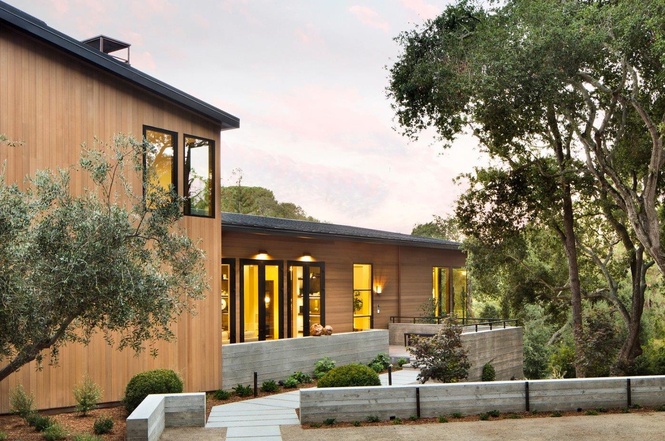
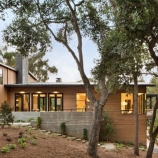
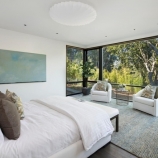
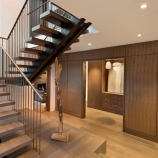
New construction isn’t exactly common anywhere in the Bay Area; in Atherton, it’s rare indeed, and if it exists, we better expect something spectacular: This five bed, six bath, 12,000 square foot luxury listing — brand newly built at 20 Belbrook Way — is just that.
The contemporary creation glimpsed in the gallery above is that of renowned San Francisco architects Butler Armsden. Inside, along with the plethora of beds and baths already mentioned, find an office, two family rooms plus a recreation room with bar and wine cellar, “curbless showers,” a steam room and sauna and a gym.
Outside the main house, on the very private feeling 1.43 acres, features include a one-bedroom guest house with full kitchen, a 50-foot pool and spa, lawns, and landscaping for days. That luxury trend we’ve mentioned before, the walls that actually function as doors, appears here too, described in the listing as “Floor-to-ceiling disappearing glass panels on both sides of the great room and in the guest house for a truly seamless connection across the courtyard lawn.”
A home for fame and fortune
That private feeling we wrote about above isn’t just a feeling. Again, according to the listing itself, owners of this home will enjoy “onsite or remote programmable systems, video surveillance, and gated privacy set far back from the street.” In other words, this is a property fit for celebrit y– which you would sort of have to be… 30 Belbrook Way lists for $21,980.
Anna Marie Erwert writes from both the renter and new buyer perspective, having (finally) achieved both statuses. She focuses on national real estate trends, specializing in the San Francisco Bay Area and Pacific Northwest. FollowAnna on Twitter: @AnnaMarieErwert
The race is on between San Francisco and L.A. to land George Lucas’ Museum of Narrative Art, with some big names working in the shadows to try to bring it to Treasure Island.
All you need to know about San Francisco in 2016 was on display one recent Sunday at 83 McAllister Street, an office building turned into condominiums at the edge of the Tenderloin.
Prospective home buyers tromped through an open house in a fifth-floor unit: two bedrooms, 430 sq ft, $599,000. Just outside the building’s front door, a couple dozen of the homeless and hard up gathered for Open Cathedral, a regularly scheduled Sunday service followed by a free lunch.
There it was, all in one place: outrageous prices for a tiny slice of a scarce commodity. Haves. Have nots. And the yawning gulf between the two.
San Francisco has the priciest real estate in the country by many metrics. It has been ranked among the 10 least affordable cities in the world. It suffers under the worst income inequality in California. The top 1% of households in the metropolitan area earned $3.6m on average in 2013, according to one recent report, or 44 times the average income of the bottom 99%.
This is the place where a 25-year-old made national news in March for paying $400 a month to live in a wooden box in a friend’s living room. Where a 99-year-old widow went to court in April to fight eviction from the flat she’d lived in since the 1940s. Where the cheapest home for sale in late July was fire-gutted, uninhabitable and still cost $228,000.
Battles rage about what the problem is – an affordability crisis? a housing shortage? lack of political will? – how to fix it, how the city got into such a mess in the first place and who to blame. The current favorite whipping boy is the tech sector, but the pain began long before the first laptop was a gleam in British designer Bill Moggridge’s eye.
“The tech boom is a clear factor,” said Peter Cohen, co-director of the Council of Community Housing Organizations. “When you’re dealing with this total concentration of wealth and this absurd slosh of real estate money, you’re not dealing with housing that’s serving a growing population. You’re dealing with housing as a real estate commodity for speculation.”
This uninhabitable, fire-gutted single family home in the Bayview neighborhood was on the market recently for $228,000. Photograph: Maria La Ganga for the Guardian
But Cohen is quick to note that there are other culprits behind what some realtors peg as San Francisco’s $1.2m pricetag for a starter home and its tops-in-the-nation $3,510 median rent for a one-bedroom apartment: population growth, income inequality, history, geography.
A history of cramped quarters
The first housing crisis on this 47 square mile peninsula exploded before San Francisco was even a city. Between January 1848 and December 1849, Gold Rush fortune-seekers swelled the frontier town’s population from 1,000 to 25,000.
Then, like now, the question of where to put the vast new influx was answered badly.
In his 1851 memoir Golden Dreams and Waking Realities, English seaman William Shaw described “Francisco” as a rude collection of tents, wood-framed houses and “stupendous taverns, gambling-houses and other extensive edifices … From sixty to eighty thousand dollars was the rent of some taverns–houses of timber, iron, zinc or canvass”.
By the time the second world war came and went, the small city had been built out. Growth since has come via successive waves of redevelopment, because San Francisco is surrounded on three sides by water and the fourth by San Mateo County. Unlike Houston, Las Vegas or Atlanta, it cannot grow out.
“You don’t have land and space to work with,” Cohen said. “You have to redevelop and recycle space that’s already been used … As a starting point, it immediately raises various kinds of tensions.”
Since Kenneth Rosen moved to the San Francisco Bay Area 42 years ago, he has counted six boom and bust housing cycles.
The primary cause for the current boom, says Rosen, chairman of UC Berkeley’s center for real estate and urban economics, is something most cities technically envy: “Extraordinary job creation,” 30,000 to 40,000 jobs per year for the last five years in San Francisco alone.
Rosen figures that 70% of the new leasing and job growth springs from the tech sector. For housing costs to drop and affordability to rise substantially, he said, “we’d have to see a correction in that sector”.
‘That’s unheard of in Ohio’
Kevin Bankovich, 29, is moving from Akron, Ohio, to San Francisco.
Bankovich, who works in financial services, just sold his Akron home – three bedrooms, 1.5 bathrooms, a small yard – for $145,000.
One recent Sunday, while trawling open houses, he peered into the closets of a one-bedroom, 1.25 bath condominium in the South of Market neighborhood, asking price, $595,000 for 814 sq ft.
A block or so away, a top-floor studio apartment was on the market for $495,000. It is 370 sq ft, about the size of a large hotel room.
On the plus side, a Murphy bed folded out from the wall, space-saving at its most efficient. On the minus, the 11-unit building sported delicate graffiti, and the smell of urine wafted down the street on the summer breeze.
Kevin Bankovich just sold his three-bedroom house in Akron, Ohio, for $145,000 and is house hunting in San Francisco. Photograph: Maria La Ganga for the Guardian
Not that there was much for him to choose from at the affordable end of the San Francisco housing market. Between the last week of January and the last week of July, only seven housing units priced at $500,000 or less sold in the entire city, according to the Multiple Listing Service (MLS).
The week he searched, the MLS listed 31 homes in that price range. Zillow listed 32.
Of those, seven were restricted to low-income, first-time buyers. One was available to those 55 and older. One unit could only be bid on by other owners in the upscale condominium building; it was a maid’s unit on the market for $179,000. Two had been gutted by fire and could not be lived in.
After one weekend, Bankovich gave up looking for an actual house and started shopping for condos. In short order, he decided he didn’t need a garage. Or even a parking space for his motorcycle. Or a washer-dryer in the unit.
He’s sold his car. The one thing he doesn’t want to give up – at least for now – is an actual bedroom.
“I don’t want a studio”, he said. “I need to have that one bedroom at least. That would be my preference.
“There are people who live here, and it’s in their dreams to own a place,” he continued, wistful. “But they say they’ll never own here … Or they have roommates.”
“That’s unheard of in Ohio.”
Too little house building
Compounding the problem of population growth in San Francisco is the fact that the city has built far too little housing for far too many decades. Since 2010 alone, its population has grown by more than 60,000, but only 12,000 new units of housing were constructed.
On the plus side, though, San Francisco is in the middle of one of the biggest building booms in its history.
Most of the new units, however, are in flossy skyscrapers filled with high-end condos. Because, as Paragon Real Estate Group described San Francisco in a spring 2016 update: “Development is not for the faint of heart or shallow of pocket.
“One cannot contemplate building virtually anything in the city without vehement opposition and sometimes a well-funded coalition in opposition,” according to the report. “For developers, the equation to be calculated out includes very high land and construction costs, increasing affordable-housing contributions required by the city, enormous hassle-factor and extended project timelines.”
But at least one faction in this famously fractious city applauds the plethora of pricey new homes, or any homes, for that matter: the San Francisco YIMBYS.
The Yes In My Back Yard faction was out in force at a recent hearing on whether San Francisco property owners should be able to build so-called accessory dwelling units – also known as granny flats or in-law units – an issue that has roiled neighborhoods like upscale, baby-filled Noe Valley.
Noe Valley is home to multi-million-dollar Victorians, and, as Sfgate.com puts it: “Merchants who cater to those looking for handmade Guatemalan textile products, upscale beauty products, or Eileen Fisher ensembles.”
Its residents have had much to grumble about in recent years: an influx of “monster houses” built by the well-heeled who buy, tear down and rebuild on lavish scale; a gaggle of Google buses and other shuttles that take techies to and from jobs in Silicon Valley.
The possibility of granny flats, which the city says could add up to 33,000 units to already existing housing, saw YIMBYs front and center at a July hearing that brought out the worst in everyone.
Sonja Trauss is founder of the San Francisco Bay Area Renters Federation, which the activist describes as “the increase capacity arm of the anti-displacement movement”.
“I want to remind everybody that not building displaces people,” she said at the hearing.
“I don’t really see any downside at all,” she said, “besides the fact that some neighbors might have to let their eyes pass over a new thing that looks different and unfriendly to them. We’re talking about places that people live, and I don’t think it’s worth it to save the way a house looks to deny someplace for someone to live.”
To which Monica McFadden, a self-described fourth generation San Franciscan whose children are “fourth generation Noe Valleyans”, replied: “We can’t allow one-person’s greedy wants to overshadow literally the quality of life of many.”
“I mean, what do we want this city to become?” McFadden fumed. “Do we want to see the end of backyard barbecues, water balloon fights, mud-pie making, home gardens and the ray of light for the elderly and housebound?
September has rolled around and rents have come due, so what does everybody’s bonkers San Francisco rents look like these days?
Once again, median rents across the city crept downward for August. And, depending on which survey you perused, various East Coast cities are bumping Bay Area burghs out of position in the top ten rankings. It seems all of that August fog cooled things down a bit after all. (Thanks, Karl.)
For the third month in a row, rental site ApartmentList continues to insist that New York has well and truly unseated San Francisco as America’s most expensive market, now by an even more prominent degree.
A one bedroom in San Francisco averages $3,420 on AL, and a two bedroom is $4,720, down 2.7 percent year over year and 0.8 percent since last month. Similar units cost $3,550 and $5,200 in the Empire City.
ApartmentList is still the lone voice crying in the wilderness on this point (after three months we’ve decided that it’s part of the site’s charm and we just need to accept it), but their figures aren’t at all dissimilar from competitor Zumper, which pegs San Francisco at $3,440/month for one bed, down 0.6 percent for the month.
New York: Surely it wants to be number one again? We’re willing to let it win this, really.
Wikimedia Commons
Since New York declined on Zumper too we’re still number one in their books, but a cadre of East Coast cities in the form of New York, Boston, and Washington DC bumped San Jose down to the nation’s fifth priciest ($2,140 for one bed) and pushed Oakland to number six with $2,120. That’s a 3.6 and 4.1 percent drop, respectively.
It’s always nice when the competitors more or less agree, and doubly so when their agreement includes phrases like “down 2.7 percent year over year.”
Reinforcing the mostly happy news, the Chronicle reports on two summertime rent surveys that showed rents flattening out, down 0.7 percent year over year in one and up two percent year over year in another but down slightly since the beginning of the year.
As usual, these creeping, cringing, one or two percent declines are hard to get excited about in a “Break out the champagne and make it rain” kind of way. But with some people telling us that rents will never really decline again, we’re happy for any slim opportunity to prove them wrong.
Washington DC: Bumping the East Bay out of the top five in demand despite proximity to Congress.
Wikimedia Commons
Real estate site Trulia reports San Francisco rents down significantly, dropping to $2,737/month for a one bedroom, 5.6 percent off from last month and an incredible 18 percent off from last year. Trulia’s rent figures are always lower than everyone else’s and generally very volatile, so don’t put too much stock in them.
And just to keep us in check, RentJungle, the curmudgeonly site that refuses to tell us anything we want to hear month after month, still says that rents are completely flat for the entire summer and up slightly since the same time last year (although they have not yet updated to reflect August prices).
What makes a good housing market a good housing market? It depends on who’s asking.
Take a national survey by the credit site WalletHub, which first ranked 300 US cities by the robustness of their housing markets, comparing things like the proportion of homes with positive equity, the average degree of annual appreciation, the vacancy rate, and the foreclosure rate.
Out of those 300 cities, San Francisco ranked a respectable and downright competitive 64th. San Jose came in an amazing 18th place. Sunnyvale is number 35, and Berkeley just barely slid into the top third at 98. (Oakland scored lower than most Bay Area cities at 138.)
None of these figures should be a big surprise to anyone, except perhaps those market watchers who feel the Bay Area’s overall position might merit being a little bit higher.
So is that a good market? It certainly is if you’re in a position to take advantage of it. Or if six years ago you were spending a lot of sleepless nights staring at the ceiling and worrying that housing would just never bounce back from the flaming disaster of a few years prior.
And now, someone to drop the other shoe…
Creative Commons
On the other hand, the same WalletHub study also ranked those 300 cities for affordability, based on home prices relative to median household income, cost of maintenance, unemployment rate, and job growth rate.
You can see where this is going: While San Francisco blew away a lot of other cities on the jobs-related fronts, we got hammered on home prices, ranking only a devastating number 259 on the list.
San Jose managed to come in number 171. Berkeley was a depressing 272. Oakland got the worst of both worlds both times, rating only 278th place on the affordability scale. So is that a healthy housing market? Maybe. But it’s not always terribly healthy for the people in it. (In fact, it’s literally killing some people in Oakland.)
How did it get this way, some people ask? Well, to a degree, it’s always been like this. In a separate but timely report titled “Rich City, Poor City,” the real estate site Trulia notes that the median home value in San Francisco has rocketed 557 percent since 1986.
Back then, the median San Francisco home cost a little under $161,000, the equivalent of $353,500 today. San Jose’s median price was just under $155,000. Oakland’s, $130,700.
Pictured: The beginning of San Francisco’s housing crisis.
But here‘s the kicker: Even in ‘86, these three Bay Area cities were already the first, third, and seventh most expensive places in America, respectively.
The Bay Area’s crushing lack of affordability and accessibility is hardly anything new, as longtime residents will testify. The change over time is a question of degree; just like the gap between rich and poor continues to get wider, the gap between middle class earners and the lowest rungs of the home ownership ladder spreads out too.
Home Insurance company Nationwide recently reported that only a handful of home markets in the US are “vulnerable to a downturn.” Technically, that’s good news. Secretly, many people have probably been hoping for a bust, either in housing or tech, despite the damage it would do. But you can’t win (or lose?) them all.