The Most Splendid Housing Bubbles in America, Feb. Update: Raging Mania in Phoenix to Cooling Condos in San Francisco

But the deals were made when mortgage rates were still 3%, not 4% as today.

By Wolf Richter for WOLF STREET.

In some cities, house prices continued their crazy spikes, such as in Phoenix, where prices have exploded by over 30% year-over-year for the sixth month in a row. In other cities, prices only surged, so to speak. And in a few cities, that surge slowed. Condo prices in the San Francisco Bay Area started to dip last summer and haven’t gone anywhere since 2018. That’s the range for the most splendid housing bubbles in America, as depicted by the SP CoreLogic Case-Shiller Home Price Index today.

The overall National Index ticked up 0.9% in December from November, same as in the prior month. Compared to a year ago, the index jumped by 18.8%, same as in the prior month.  “Buyers may have been rushing in anticipation of higher rates,” SP CoreLogic said.

But the home prices here don’t yet reflect the higher mortgage rates. Today’s “December” data are a three-month moving average of closed sales that were entered into public records in October, November, and December, reflecting deals made roughly in September, October, and November, when the average 30-year fixed mortgage rate hovered at around 3%. On Friday, the average 30-year fixed rate was 4.08%, according to Mortgage News Daily.

All Case-Shiller Home Price Indices were set at 100 for January 2000. The National Case-Shiller Home Price Index, with a value of 279 for “December,” indicates that national home price inflation is now 179% since 2000. Over the period, consumer price inflation, as tracked by the CPI, has risen 67%. In Los Angeles, house price inflation since 2000 has now hit 279%, over four times the rate of consumer price inflation.

Los Angeles metro: Prices of single-family houses rose 1.0% in December from November. Though steep, it was the slowest month-to-month increase since August. Year-over-year, the index jumped 19.3%. This 279% home price inflation since January 2000 makes Los Angeles the Number 1 most splendid housing bubble on this list.

3f3db US Housing Case Shiller 2022 02 22 Los Angeles The Most Splendid Housing Bubbles in America, Feb. Update: Raging Mania in Phoenix to Cooling Condos in San Francisco

San Diego metro: The Case-Shiller Index spiked 1.8% for the month, and 29% year-over-year. Since 2000, house price inflation has ballooned by 276%:
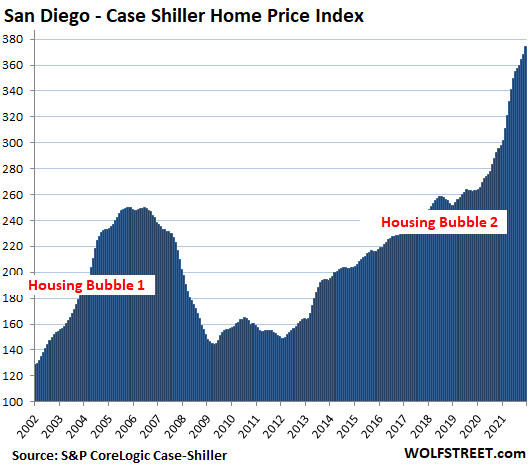
3f3db US Housing Case Shiller 2022 02 22 San Diego The Most Splendid Housing Bubbles in America, Feb. Update: Raging Mania in Phoenix to Cooling Condos in San Francisco

House price inflation as measured by the Case-Shiller Index. The index’s “sales pairs method,” compares the sales price of a house when it sells in the current period to the price of the same house when it sold previously, often years earlier. The data includes adjustments for home improvements and the passage of time between sales. By measuring the price movements of the same house, the index tracks how many dollars it takes to buy the same house over time and thereby measures house price inflation.

Seattle metro: House prices spiked 1.5% for the month, and 23.9% year-over-year. Since January 2000, house price inflation in the Seattle metro has ballooned to 258%:

3f3db US Housing Case Shiller 2022 02 22 Seattle The Most Splendid Housing Bubbles in America, Feb. Update: Raging Mania in Phoenix to Cooling Condos in San Francisco

San Francisco Bay Area: House prices rose 0.8% for the month, after having nearly stalled in the fall. Year-over-year, prices jumped 18.8%:
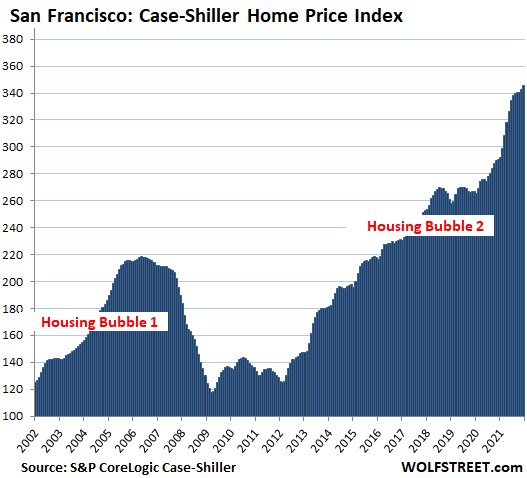
f9bb9 US Housing Case Shiller 2022 02 22 San Francisco Bay Area The Most Splendid Housing Bubbles in America, Feb. Update: Raging Mania in Phoenix to Cooling Condos in San Francisco

San Francisco Bay Area: Condo prices for the month were unchanged, after having dropped three months in a row. For the past seven months, prices have gone essentially nowhere. This whittled down the year-over-year gain to 7.5%. Since June 2018, condo prices have risen just 3.9%:

f9bb9 US Housing Case Shiller 2022 02 22 San Francisco Bay Area condo The Most Splendid Housing Bubbles in America, Feb. Update: Raging Mania in Phoenix to Cooling Condos in San Francisco

Portland metro: House prices rose by 0.8% for the month, and by 17.9% year-over-year:

f9bb9 US Housing Case Shiller 2022 02 22 Portland The Most Splendid Housing Bubbles in America, Feb. Update: Raging Mania in Phoenix to Cooling Condos in San Francisco

Miami metro: House prices jumped by 1.8% for the month, and by 27.3% year-over-year, the fastest since February 2006, when Miami was approaching its epic Housing Bust:

f9bb9 US Housing Case Shiller 2022 22 02 Miami The Most Splendid Housing Bubbles in America, Feb. Update: Raging Mania in Phoenix to Cooling Condos in San Francisco

Washington D.C. metro: House prices ticked up 0.4% for the month, which whittled down the year-over-year gain to 10.5%, the slowest since January 2021:

95d01 US Housing Case Shiller 2022 02 22 Washington DC The Most Splendid Housing Bubbles in America, Feb. Update: Raging Mania in Phoenix to Cooling Condos in San Francisco

Boston metro: House prices rose 0.7% for the month, after having been flat for two months, which whittled down the year-over-year gain to 13.4%:

95d01 US Housing Case Shiller 2022 02 22 Boston The Most Splendid Housing Bubbles in America, Feb. Update: Raging Mania in Phoenix to Cooling Condos in San Francisco

Tampa metro: +1.6% for the month, and halleluiah, +29.4% year-over-year, a new record spike for this metro, out-doing even the nutty spikes during Housing Bubble 1 before it all came apart:

95d01 US Housing Case Shiller 2022 02 22 Tampa The Most Splendid Housing Bubbles in America, Feb. Update: Raging Mania in Phoenix to Cooling Condos in San Francisco

Denver metro: +1.1% for the month, and 20.3% year-over-year:
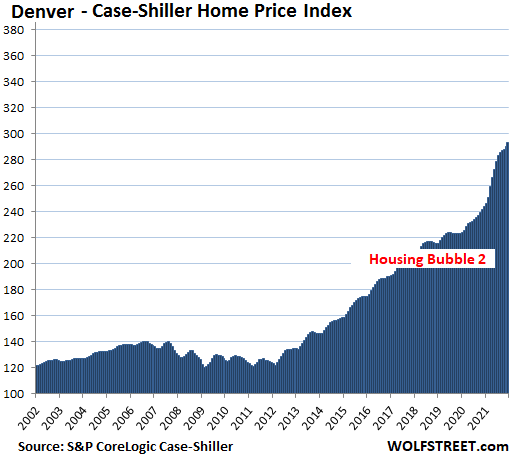
f7beb US Housing Case Shiller 2022 02 22 Denver The Most Splendid Housing Bubbles in America, Feb. Update: Raging Mania in Phoenix to Cooling Condos in San Francisco

Phoenix metro: +1.3% for the month, bringing the year-over-year gain to 32.5%, a new record, out-spiking even the peak of crazy Housing Bubble 1. For months now, Phoenix has been the metro with the red-hottest year-over-year price spikes among our most splendid housing bubbles:

f7beb US Housing Case Shiller 2022 02 22 Phoenix The Most Splendid Housing Bubbles in America, Feb. Update: Raging Mania in Phoenix to Cooling Condos in San Francisco

Las Vegas metro: +1.0% for the month, and +25.5% year-over-year:
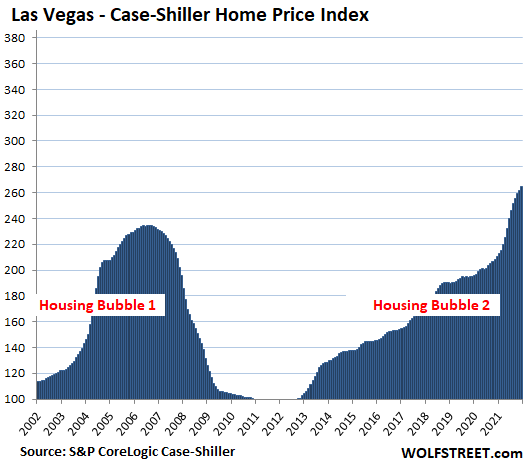
f7beb US Housing Case Shiller 2022 02 22 Las Vegas The Most Splendid Housing Bubbles in America, Feb. Update: Raging Mania in Phoenix to Cooling Condos in San Francisco

Dallas metro: +1.2% for the month, and a record +26.0% year-over-year:

f7beb US Housing Case Shiller 2022 02 22 Dallas The Most Splendid Housing Bubbles in America, Feb. Update: Raging Mania in Phoenix to Cooling Condos in San Francisco

New York metro: House prices +1.1% for the month, and +13.6% year-over-year. At an index value of 255, the metro has experienced 155% house price inflation since 2000.
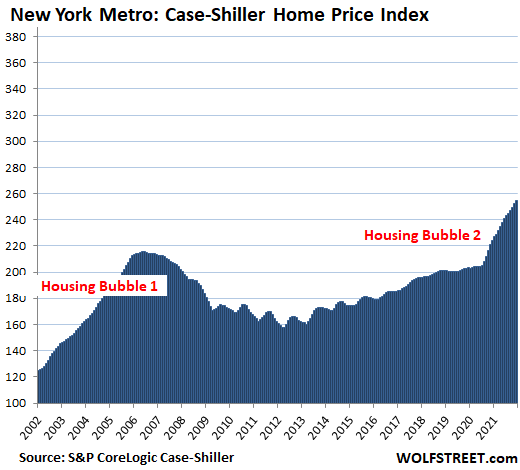
6e19c US Housing Case Shiller 2022 02 22 New York metro houses The Most Splendid Housing Bubbles in America, Feb. Update: Raging Mania in Phoenix to Cooling Condos in San Francisco

The remaining metros in the 20-metro Case-Shiller Index – Atlanta, Charlotte, Chicago, Cleveland, Detroit, and Minneapolis – have house price inflation since 2000 of less than 150% and thereby don’t qualify for this list of the most splendid housing bubbles.

Enjoy reading WOLF STREET and want to support it? Using ad blockers – I totally get why – but want to support the site? You can donate. I appreciate it immensely. Click on the beer and iced-tea mug to find out how:

6e19c BeerMug2 The Most Splendid Housing Bubbles in America, Feb. Update: Raging Mania in Phoenix to Cooling Condos in San Francisco

Would you like to be notified via email when WOLF STREET publishes a new article? Sign up here.

6e19c placeholder2 The Most Splendid Housing Bubbles in America, Feb. Update: Raging Mania in Phoenix to Cooling Condos in San Francisco


Article source: https://wolfstreet.com/2022/02/22/the-most-splendid-housing-bubbles-in-america-february-update-from-raging-mania-in-phoenix-to-cooling-condos-in-san-francisco/

Posted in SF Bay Area News | Tagged | Leave a comment

How a San Francisco remodel turned into an epic nightmare involving city red tape, squatters and cops shrugging off crime

It involves insanely high real estate prices. Byzantine planning codes that even the city’s planners find confusing. Neighbors who demand a say in any change near them. Squatters, drugs and vandalism. Police officers who blame the district attorney as they let criminals go. A pricey private security guard. And heaps of frustration.

Sounds like San Francisco, alright.

“This is a whole other level of crazy,” Calhoun said.

It all began in October 2020 when Jennifer Sun and her husband, Ben, purchased a house in Bernal Heights for $1.75 million. In most parts of the country, that would buy a stunning mansion. In San Francisco, it buys a rather dated fixer-upper.

The couple are wealthy, and nobody but them will shed any tears over their home remodel gone awry. Still, what happened next points to what’s broken in San Francisco — and so much is broken.

 How a San Francisco remodel turned into an epic nightmare involving city red tape, squatters and cops shrugging off crime

A sticker, writing on the refrigerator and a sign are some of the damage left over from squatters who trespassed and lived in the home of a Bernal Heights couple.

Lea Suzuki/The Chronicle

The couple hired Calhoun to design a remodel, submitted their plans in March 2021 and hoped to secure permits within six months. They kept paying rent on their South of Market apartment so they could live there during the remodel, while also paying their new mortgage.

But six months turned into 12 months — and still, no permits.

The first hiccup was that the Planning Department said the home had been illegally converted into three units by a previous owner, and the couple wanted to restore it to its original single-family home set-up.

After some back-and-forth, the Planning Department said the plan was allowable because there was no record of any tenants ever living there.

Dan Sider, chief of staff for the Planning Department, said planners were ready to approve the plans including major interior work in July 2021, but then the couple submitted a proposal with a new wrinkle: extending the back of their home by just under 3 feet. That would make the back of the house even since the third story juts out beyond the lower two.

But this being San Francisco, and especially Bernal Heights, that seemingly small change is a very big deal. That’s because of a “special use district” approved by the Board of Supervisors in 1991 that governs every little change to homes in the neighborhood. The idea was to preserve the area’s character, but the details will make your eyes glaze over and, according to Calhoun, have prompted many architects in the city to refuse to work there.

In sections and subsections to subsections, it governs changes to homes in minute detail — down to the allowable width of curb cuts and garage doors.

“I can assure you that it is not a page-turner,” Sider said good-naturedly.

 How a San Francisco remodel turned into an epic nightmare involving city red tape, squatters and cops shrugging off crime

Jennifer Sun stands below two holes in the ceiling of her home, part of the damage from squatters. She and her husband have had to hire private security while they wait for permits to remodel their new home.

Lea Suzuki / The Chronicle

A group of neighbors called the Bernal Heights East Slope Design Review Board — with no apparent website or easy way to find them — gets to weigh in on projects in the area. An email sent to an address associated with the group was not returned.

The rules include the length a home can extend into the backyard from the front of its property line. But because the couple’s house sits on a curved lot, Calhoun’s been trying to get an answer on where on the front lot to start measuring from. She said she waited until November just to get a planner assigned and has spoken to four different planners about the 3-foot extension, and that none knows the answer.

“They shared that the code is confusing even for them,” she said.

Then, the planner told Calhoun the home was historic and the facade — though nondescript — could not be altered. Sorting that out would have extended the project by another six to nine months, Calhoun said, so the couple dropped proposed changes to the front.

Then things got really weird.

In February, Calhoun received an email from a member of the Bernal Heights East Slope Design Review Board who reported a neighbor across the street from the couple’s home had grown “increasingly agitated” by the couple’s lifestyle and the cars coming and going from the home at all hours.

Sun said she was shocked. They weren’t living there. What cars? What lifestyle?

So they visited the property, which had weird spray paint across the garage door and signs of people inside. They called police, who accompanied them inside the house where they found squatters had taken it over.

Photos the couple took show piles of furniture, clothes and a fridge full of food. Graffiti covers the refrigerator and walls. One message can’t be relayed in full because of antigay language, but it reads in part, “No soliciting. No shopping. No snitches.” They bashed holes in the walls and ceilings, wrecked a sink and other fixtures, left dog poop on the carpets and discarded needles and syringe caps around the house. Flies were everywhere. The house still smells bad.

According to the couple, police officers gave the squatters — all of whom appeared high — 10 minutes to collect their belongings and leave. They arrested only one. No one else faced any consequences. The couple said police explained there was nothing they could do because District Attorney Chesa Boudin “has different priorities right now” and wouldn’t prosecute.

Salar Naderi, a spokesperson with the Police Department, confirmed police found seven people occupying the house and arrested Richard Ostergard, 47, who had warrants for stealing a vehicle, possession of stolen property and theft. Naderi said the homeowners “did not want to have any of the (other) subjects cited or arrested,” disputing the couple’s version.

In any case, Sun, 36, said that just a few hours later, neighbors texted and called to tell her the squatters were back. And it doesn’t sound like they’re merely people down on their luck. Photos show nice belongings, and neighbors reported them driving a Mercedes, BMW and Dodge Durango.

Neighbors continued to report to the couple that people were entering the home over the next couple of days, and that someone tried to access the property with a crowbar.

The couple quickly hired a private security guard whom they’re paying $8,000 a month to watch over the house every night.

“If we had known the city would take so long, we would have moved in and this wouldn’t be an issue,” Sun said.

Even though they’re doing well professionally, the couple said the costs have created “an immense financial impact” — and work hasn’t even started yet. Mortgage payments and property taxes on the house have topped $180,000 so far. They paid $3,000 to haul away the squatters’ belongings and don’t know yet how much it will cost to repair their damage.

Meanwhile, construction costs keep growing because of inflation and supply chain shortages, and there’s no telling how much the remodel will end up costing or when they can finally start.

“How does anyone afford this?” Sun asked.

Sun said she’s no longer excited about moving in after the remodel — which she thinks won’t be done for another year at best.

“It totally creeps me out,” she said. “Just unlocking the door, I get goosebumps. It’s uncomfortable being in here. It’s so unnerving. This is supposed to be home.”

This being San Francisco, there is one bit of good news for the couple. Redfin says their dream home turned nightmare is now worth more than $2 million.

San Francisco Chronicle columnist Heather Knight appears Sundays and Wednesdays. Email: hknight@sfchronicle.com Twitter: @hknightsf

Article source: https://www.sfchronicle.com/sf/bayarea/heatherknight/article/How-a-San-Francisco-remodel-turned-into-an-epic-17012999.php

Posted in SF Bay Area News | Tagged | Leave a comment

Ramshackle ‘historic’ Bay Area home on the market for $300,000

With a crumbling brick facade, tattered walls and ceilings, and remnants of a past life on display — see the posters and a calendar hung up on one bedroom wall — the four-bedroom, two-bathroom home is in total disrepair. The boarded-up windows and the crumbling brick facade, held up by tilting columns, will require a considerable amount of labor to fix its curb appeal.

But the upside for a renovator, the listing promises, is large — a 2,000-square-foot property with a brick chimney and major historic significance for a third of the price as comparable homes in the area.

 Ramshackle ‘historic’ Bay Area home on the market for $300,000

The house is in downtown Benicia, Calif.

Courtesy of Keller-Williams Bay Area

The vernacular-style home was built sometime in the 1870s, according to a survey conducted by the state of California in 2004, and “dates to the early development of the town.” 

“It is associated with the beginning of residential development just off the main commercial streets,” the survey says. “It is a good example of its style and retains a number of original elements including the windows, doors and porch configuration.”

This may all still sound a bit pricey, despite its provenance. But anything goes in the Bay Area housing market, where a decrepit home in San Francisco — branded as the “worst house on the best block” — was bought for $2 million.


Article source: https://www.sfgate.com/realestate/article/Ramshackle-Benicia-home-for-sale-17009494.php

Posted in SF Bay Area News | Tagged | Leave a comment

10 real estate markets on the cusp of a San Francisco-style affordability crisis

According to a Chronicle data analysis, there are at least 10 metro areas that could soon become “the next San Francisco” in terms of housing affordability and availability, including San Diego, Raleigh, N.C., and two areas in Montana.

“Two years into the pandemic, the U.S. housing market is virtually unrecognizable from before, with nearly half the number of homes for sale, prices a third higher and rising,” said Zillow spokesperson Tyrone Law in an email. “Basic supply and demand principles are the primary driver of current housing market conditions.”

What’s driving the national trends?

Home prices in unexpected areas have shot up in the past two years, leading to housing scarcity as people left big cities in search of more space and cheaper prices in suburban and rural areas.

Nationally, home values accelerated in January by a record 20% in annual gain, and inventory dropped to a record low of 42% over the same period, according to Zillow. When looking at the two year period between Feb. 2020 to Feb. 2022, the values are even more shocking: inventory is down 48% and home values are up 32%, said Zillow’s Law.

He said a main factor driving up home prices is the inventory shortage from more than a decade of underbuilding after the Great Recession, as well as competition for homes among millennials and baby boomers. Low mortgage rates and more people able to work remotely during the pandemic has “supercharged demand.”

 10 real estate markets on the cusp of a San Francisco style affordability crisis

A real estate agent stands in front of a home in suburban Salt Lake City.

Rick Bowmer/Associated Press 2019

In San Francisco, underbuilding started long before the Great Recession. The dearth of new home building – particularly affordable and multi-family housing — has been a problem for decades, in part due to the city’s strict zoning regulations and difficult approval process.

The typical home value in the San Francisco metro area in Jan. 2022 was just under $1.4 million, second in the nation to San Jose, and the inventory rate is 0.11% (inventory refers to the number of homes for sale), making it 32nd in the nation out of 917 regions, according to Zillow housing data. From Jan. 2010 to Jan. 2020, San Francisco’s home values nearly doubled at 90%, and from Jan. 2015 to Jan. 2020, they jumped 39%.

We wanted to see specifically which U.S. metro areas have experienced significant increases in home values and decreasing housing inventory over the pandemic, using Zillow’s data for metropolitan areas.

In our data analysis, we narrowed down the list to areas where home values rose 40% or more from Jan. 2020 to Jan. 2022, inventory from the same time period fell by 40% or more, and inventory is now at two homes or fewer per 1,000 people. Inventory data was not available for every metro area, so about a dozen or so were left out of the data analysis.

What we found was a mix of both large and smaller metro areas whose housing markets have become less affordable and scarcer over the past two years.

The next San Franciscos?

Two California metros appear on the list: Merced and San Diego. Housing inventory declined nearly 50% during the pandemic in Merced, with an average of about 1.5 homes per 1,000 people. Typical home values increased about 42% there from Jan. 2020 to Jan. 2022.

Matt Kreamer, a data spokesperson for Zillow, said the attraction to Merced and other parts of the San Joaquin and Central valleys is in large part due to people exiting the Bay Area in search of more affordability and space.

“I think that’s why Merced makes this list, and I’d be surprised if other Central Valley cities from Sacramento to Fresno aren’t close behind,” he wrote in an email. “For years now as the Bay Area has become more unaffordable, we’ve seen shoppers from there looking at homes in the Sacramento area especially.”

Kreamer called San Diego the “hottest major market in California,” and one of the top in the country.

“Home values there have risen 44% in the past two years, compared to 25.8% in the Bay Area,” he said. “Prices are still lower than in Los Angeles, but have quickly caught up as people have turned to it as the less expensive Southern California option for sun and year-round outdoor living.”

Also on the list are several cities in Washington state that are outside of the pricey Seattle metro area with “more affordable home prices and natural beauty.” Salt Lake City also appears on the list, along with Provo that sits south of the big city and is home to Brigham Young University.

 10 real estate markets on the cusp of a San Francisco style affordability crisis

Missoula, MT has seen its housing market skyrocket during the pandemic, with home values increasing and inventory declining, according to an analysis of Zillow data.

Courtesy Shannon Hilliard

Where the trends are most extreme

The metro area with the most extreme values in each category was another college town, Missoula in Montana, the second largest metro area population in the state of just under 118,000.

“People have more freedom than ever to live their preferences, and it’s safe to say that a fair share of people who worked in downtown big-city offices preferred a more rural or smaller-town life that they couldn’t have before, and can now,” Kreamer said. “ And it doesn’t take a ton of movement to move the needle on data in some of these smaller cities.”

From Jan. 2020 to Jan. 2022, housing inventory in the metro declined 58% with about 1.4 homes per 1,000 people on average. Home values shot up 57% during the pandemic.

Shannon Hilliard, a broker and partner for Ink Realty Group who has been in the Missoula real estate market for 17 years, said according to data collected by the Missoula Organization of Realtors, the median single family home price increased about 45% from the end of 2019 to the end of 2021.

 10 real estate markets on the cusp of a San Francisco style affordability crisis

A home in Missoula, MT

Courtesy Shannon Hilliard

The data shows the median home sale price was over $480,000 with an average of 75 days on market in 2021, compared to a median price of $332,000 and an average of 93 days on market in 2020.

“I have a listing that last week got 17 offers, and 17 isn’t healthy,” she said. “A healthy market is six months of inventory, and right now we’re under a month of inventory based on demand.”

In fact, the state data shows there was around 2.5 months of supply at the end of 2019, with a gradual increase throughout the pandemic. The latest estimate was nearly three weeks of supply in the fourth quarter of 2021.

Hilliard isn’t surprised by the growing interest in living in Missoula, a place that she called “awesome.” Home to the University of Montana, the city flanked by beautiful mountain ranges and scenic national parks. And, like many places across the country during the pandemic, more people who aren’t tethered to office jobs have been drawn to Missoula.

“When people have the ability to bring their incomes to a place they’ve always wanted to live, where price was a prohibiting factor before,” she said, adding that it opens up the possibilities, including beautiful places like Missoula that offer plenty of outdoor activities, a “vibrant downtown” and a mix of “gritty” and “luxury.”

She’s had clients all across the board, from families looking for bigger homes, retirees wanting to downsize, or first-time home buyers. While she doesn’t have concrete data, Hilliard said anecdotally she’s seen people move from Washington, Texas, California and Colorado. And many people buying homes are in-state who are looking to make a life change, or people who grew up or went to school in Missoula and have finally found a way to return.

But the housing demand and rising costs has priced out the previously affordable city for many people. Hilliard said she is not optimistic for clients looking to spend $300,000 on a home, and even the rental market is tough. Plus, because Missoula is the intersection of five valleys, there is not much room for sprawl, which limits the housing supply further. Hilliard doesn’t think this is changing any time soon.

“I think with the world changing and many people able to work for higher paying corporations, they can live where they want to be,” she said. “I think it will keep going for a little bit.”

Kellie Hwang is a San Francisco Chronicle staff writer. Email: kellie.hwang@sfchronicle.com

Article source: https://www.sfchronicle.com/realestate/article/real-estate-san-francisco-san-diego-montana-17007749.php

Posted in SF Bay Area News | Tagged | Leave a comment

These U.S. real estate markets may be on the cusp of a San Francisco-style affordability crisis

According to a Chronicle data analysis, there are at least 10 metro areas that could soon become “the next San Francisco” in terms of housing affordability and availability, including San Diego, Raleigh, N.C., and two areas in Montana.

“Two years into the pandemic, the U.S. housing market is virtually unrecognizable from before, with nearly half the number of homes for sale, prices a third higher and rising,” said Zillow spokesperson Tyrone Law in an email. “Basic supply and demand principles are the primary driver of current housing market conditions.”

What’s driving the national trends?

Home prices in unexpected areas have shot up in the past two years, leading to housing scarcity as people left big cities in search of more space and cheaper prices in suburban and rural areas.

Nationally, home values accelerated in January by a record 20% in annual gain, and inventory dropped to a record low of 42% over the same period, according to Zillow. When looking at the two year period between Feb. 2020 to Feb. 2022, the values are even more shocking: inventory is down 48% and home values are up 32%, said Zillow’s Law.

He said a main factor driving up home prices is the inventory shortage from more than a decade of underbuilding after the Great Recession, as well as competition for homes among millennials and baby boomers. Low mortgage rates and more people able to work remotely during the pandemic has “supercharged demand.”

 These U.S. real estate markets may be on the cusp of a San Francisco style affordability crisis

A real estate agent stands in front of a home in suburban Salt Lake City.

Rick Bowmer/Associated Press 2019

In San Francisco, underbuilding started long before the Great Recession. The dearth of new home building – particularly affordable and multi-family housing — has been a problem for decades, in part due to the city’s strict zoning regulations and difficult approval process.

The typical home value in the San Francisco metro area in Jan. 2022 was just under $1.4 million, second in the nation to San Jose, and the inventory rate is 0.11% (inventory refers to the number of homes for sale), making it 32nd in the nation out of 917 regions, according to Zillow housing data. From Jan. 2010 to Jan. 2020, San Francisco’s home values nearly doubled at 90%, and from Jan. 2015 to Jan. 2020, they jumped 39%.

We wanted to see specifically which U.S. metro areas have experienced significant increases in home values and decreasing housing inventory over the pandemic, using Zillow’s data for metropolitan areas.

In our data analysis, we narrowed down the list to areas where home values rose 40% or more from Jan. 2020 to Jan. 2022, inventory from the same time period fell by 40% or more, and inventory is now at two homes or fewer per 1,000 people. Inventory data was not available for every metro area, so about a dozen or so were left out of the data analysis.

What we found was a mix of both large and smaller metro areas whose housing markets have become less affordable and scarcer over the past two years.

The next San Franciscos?

Two California metros appear on the list: Merced and San Diego. Housing inventory declined nearly 50% during the pandemic in Merced, with an average of about 1.5 homes per 1,000 people. Typical home values increased about 42% there from Jan. 2020 to Jan. 2022.

Matt Kreamer, a data spokesperson for Zillow, said the attraction to Merced and other parts of the San Joaquin and Central valleys is in large part due to people exiting the Bay Area in search of more affordability and space.

“I think that’s why Merced makes this list, and I’d be surprised if other Central Valley cities from Sacramento to Fresno aren’t close behind,” he wrote in an email. “For years now as the Bay Area has become more unaffordable, we’ve seen shoppers from there looking at homes in the Sacramento area especially.”

Kreamer called San Diego the “hottest major market in California,” and one of the top in the country.

“Home values there have risen 44% in the past two years, compared to 25.8% in the Bay Area,” he said. “Prices are still lower than in Los Angeles, but have quickly caught up as people have turned to it as the less expensive Southern California option for sun and year-round outdoor living.”

Also on the list are several cities in Washington state that are outside of the pricey Seattle metro area with “more affordable home prices and natural beauty.” Salt Lake City also appears on the list, along with Provo that sits south of the big city and is home to Brigham Young University.

 These U.S. real estate markets may be on the cusp of a San Francisco style affordability crisis

Missoula, MT has seen its housing market skyrocket during the pandemic, with home values increasing and inventory declining, according to an analysis of Zillow data.

Courtesy Shannon Hilliard

Where the trends are most extreme

The metro area with the most extreme values in each category was another college town, Missoula in Montana, the second largest metro area population in the state of just under 118,000.

“People have more freedom than ever to live their preferences, and it’s safe to say that a fair share of people who worked in downtown big-city offices preferred a more rural or smaller-town life that they couldn’t have before, and can now,” Kreamer said. “ And it doesn’t take a ton of movement to move the needle on data in some of these smaller cities.”

From Jan. 2020 to Jan. 2022, housing inventory in the metro declined 58% with about 1.4 homes per 1,000 people on average. Home values shot up 57% during the pandemic.

Shannon Hilliard, a broker and partner for Ink Realty Group who has been in the Missoula real estate market for 17 years, said according to data collected by the Missoula Organization of Realtors, the median single family home price increased about 45% from the end of 2019 to the end of 2021.

 These U.S. real estate markets may be on the cusp of a San Francisco style affordability crisis

A home in Missoula, MT

Courtesy Shannon Hilliard

The data shows the median home sale price was over $480,000 with an average of 75 days on market in 2021, compared to a median price of $332,000 and an average of 93 days on market in 2020.

“I have a listing that last week got 17 offers, and 17 isn’t healthy,” she said. “A healthy market is six months of inventory, and right now we’re under a month of inventory based on demand.”

In fact, the state data shows there was around 2.5 months of supply at the end of 2019, with a gradual increase throughout the pandemic. The latest estimate was nearly three weeks of supply in the fourth quarter of 2021.

Hilliard isn’t surprised by the growing interest in living in Missoula, a place that she called “awesome.” Home to the University of Montana, the city flanked by beautiful mountain ranges and scenic national parks. And, like many places across the country during the pandemic, more people who aren’t tethered to office jobs have been drawn to Missoula.

“When people have the ability to bring their incomes to a place they’ve always wanted to live, where price was a prohibiting factor before,” she said, adding that it opens up the possibilities, including beautiful places like Missoula that offer plenty of outdoor activities, a “vibrant downtown” and a mix of “gritty” and “luxury.”

She’s had clients all across the board, from families looking for bigger homes, retirees wanting to downsize, or first-time home buyers. While she doesn’t have concrete data, Hilliard said anecdotally she’s seen people move from Washington, Texas, California and Colorado. And many people buying homes are in-state who are looking to make a life change, or people who grew up or went to school in Missoula and have finally found a way to return.

But the housing demand and rising costs has priced out the previously affordable city for many people. Hilliard said she is not optimistic for clients looking to spend $300,000 on a home, and even the rental market is tough. Plus, because Missoula is the intersection of five valleys, there is not much room for sprawl, which limits the housing supply further. Hilliard doesn’t think this is changing any time soon.

“I think with the world changing and many people able to work for higher paying corporations, they can live where they want to be,” she said. “I think it will keep going for a little bit.”

Kellie Hwang is a San Francisco Chronicle staff writer. Email: kellie.hwang@sfchronicle.com

Article source: https://www.sfchronicle.com/realestate/article/real-estate-san-francisco-san-diego-montana-17007749.php

Posted in SF Bay Area News | Tagged | Leave a comment