The 10 US Cities With the Fastest-Growing Suburbs

Ever since the modern American suburb sprouted like kudzu in the post-WWII era, we’ve found ourselves in a love-hate relationship of epic proportions.

Love: Owning your own slice of the dream—a home with a front and back yard, far from urban crime, crowds, squalor, and substandard schools. Hate: Leaving behind the thrill and culture of the city and settling into a tragically unhip, homogenized milieu, skewered in all its soul-crushing glory by everyone from Updike to “Stepford Wives” to “Mad Men.”

But here’s the thing: We can’t quit them.

Even the most die-hard urbanites often wake up to realize they crave more space and better public schools at a lower price—while hopefully remaining within commuting distance of the jobs, restaurants, and indie music joints of the Big City.  In some of the nation’s top metro areas, the suburbs are growing faster than the city proper.

And now with an aging millennial generation, and growing interest from minorities, suburban communities are getting a fresh influx of transplants seeking affordable, family-friendly living. From 2010 to 2017, households in the suburbs grew 7.9% nationally, compared with 6.6% growth in urban areas, according to a realtor.com® analysis of Nielsen population data.

“Most high-growth urban areas just don’t have enough land, so prices are higher and homeownership is typically lower,” says Jonathan Smoke, our chief economist. “It’s tempting to live in a walkable urban neighborhood … but the costs make it hard to afford, especially  for large or growing families.”

To pinpoint which suburbs are growing the fastest, our data team looked at where the number of households, home listings, list prices, and demand for homes are growing the fastest for every ZIP code in the 50 largest metro areas—our research portal has a more in-depth analysis of each metro. What did the data reveal?

It turns out America’s most sought-after suburban neighborhoods are often the exurbs of its fastest-expanding metros—places where those white picket-fenced homes often offer a way more affordable option.
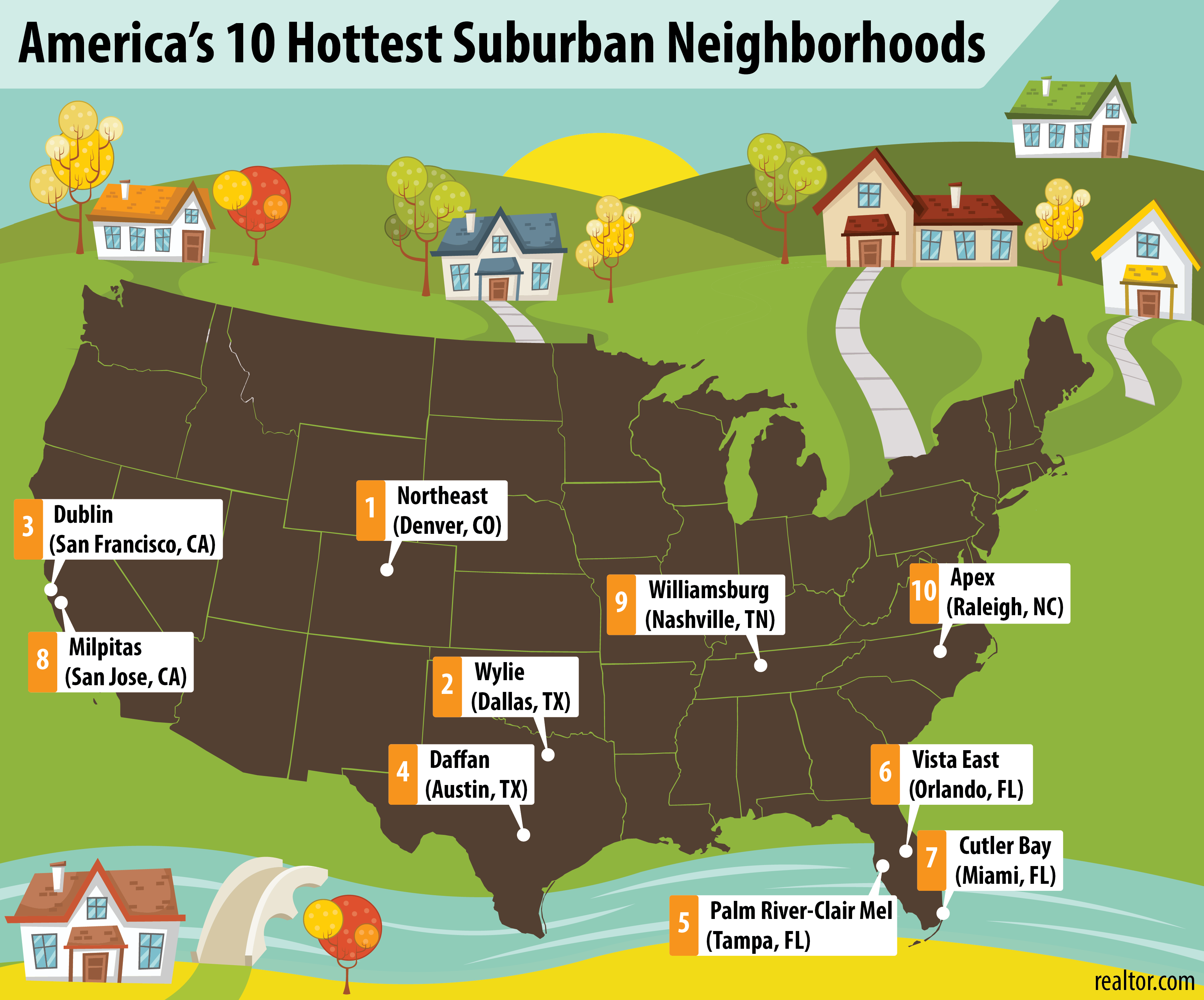
27c5e suburb 01 2 The 10 US Cities With the Fastest Growing Suburbs

1. Denver, CO

Median urban home price: $544,000
Hottest suburban neighborhood: Northeast Denver (ZIP code: 80239)
Median price in Northeast Denver: $270,000
Suburban savings (moving from the city to the suburbs): 50%

The suburb known as Northeast Denver burst onto our radar with the opening of the surprisingly cool Stanley Marketplace—a chic, food-centric neighborhood center with restaurants, beer halls, and a yoga studio. It’s helping turn the former industrial neighborhood into the next hot spot.

The proof is in the prices. The median home price in the neighborhood jumped 27% last year—making Northeast Denver the fastest-growing suburban neighborhood in our analysis. (That sure makes sense, given that the city of Denver is also growing at a breakneck pace.)

“The Marketplace is one of the things really joining the top 1 percenters and the bottom 10 percenters here,” says Jessica Jiang, a real estate agent with Re/Max Momentum.

Lifelong Northeast Denver resident Jascon Willis, 37, an  oil industry consultant, is witnessing the changes with some apprehension.

“It’s growing,” says Willis, who hopes longtime residents won’t be displaced. “It’s an area in transition.”

Fun fact: Bordering Northeast Denver is the Rocky Mountain Arsenal National Wildlife Refuge, inhabited by 330 species, including coyotes, black-footed ferrets, and bison.

2. Dallas, TX

Median urban home price: $501,500
Hottest suburban neighborhood: Wylie (ZIP code: 75098)
Median price in Wylie: $369,000
Suburban savings: 26%

1cd0e ISS033 E 021663 The 10 US Cities With the Fastest Growing Suburbs
God’s-eye view of Dallas and its suburbs

Visible Earth/NASA

For folks who work in central Dallas but want to retreat to suburban security each night, Wylie is turning out to be just the place.

Named one of the safest cities in the U.S. by the website Neighborhood Scout, it’s home to a mix of young families as well as established professionals, with many first-time homeowners. The median home list price in Wylie currently sits at $352,000, around $100,000 above the national median—but hey, safety’s worth it, right?

With buyers eager for homes, new residential construction is booming. In fact, overall economic growth in the area has exerted pressure on the local labor market for more college-educated workers.To that end, the city worked with Collin College to sponsor a large new campus in Wylie, scheduled to open in 2020,

Fun fact: Sorry, the place was NOT named after Wile E. Coyote—the guy who supplied its moniker was railroad engineer Col. William D. Wylie, who helped pave the way for the trains that brought prosperity to Wylie in the 1880s.

3. San Francisco, CA

Median urban home price: $1,144,000
Hottest suburban neighborhood: Dublin (ZIP code: 94568)
Median price in Dublin: $890,000
Suburban savings: 22%

Just over the hill from Oakland, and nestled in a region referred to as the Tri-Valley Area, Dublin represents a rare pocket of (relative) affordability in the exorbitant San Francisco Bay Area.

Not only do the homes have friendlier prices, but the city’s schools are at the top of the class, too. In fact, seven of them are rated 10 out of 10 on Greatschools.org.

We’re not saying it’s cheap—buyers will still need to pull down a Bay Area salary to buy a home here—but the number of households in this family-friendly ZIP grew 25.6% from 2010 to 2017.

1cd0e dublin water park The 10 US Cities With the Fastest Growing Suburbs
Emerald Glen Recreation Aquatic Complex, under construction in Dublin, CA

www.dublin.ca.gov

According to Nielsen data, half the housing stock in Dublin has been built since 2000. Much of the city’s growth can be traced to the addition of a Bay Area Rapid Transit station, which opened in the late ‘90s, directly connecting commuters to the metro Bay Area.

To keep pace with rapid growth, the city broke ground last year on a 189-acre community that could build up to 1,995 residential units over the next seven years.

Fun fact: In 2011, the Discovery Channel show “MythBusters” misfired a homemade cannonball and hit a Dublin home during filming. We’re not quite sure what myth it was trying to bust, but Dec. 6 was thereafter named “Victory in the Battle for Dublin.”

4. Austin, TX

Median urban home price: $494,500
Hottest suburban neighborhood: Daffan (ZIP code: 78724)
Median price in Daffan: $348,000
Suburban savings: 30%

The suburban neighborhood of Daffan may not seem to have much in common with its hip, young city neighbor to the west. In fact, if the hood is known at all, it’s probably as the home to the Decker Creek Power Station. But that’s already starting to change.

1cd0e austin suburb The 10 US Cities With the Fastest Growing Suburbs
Austin: The coolest city in America?

RoschetzkyIstockPhoto/ iStock

Daffan is seeing an influx of new residents who are being priced out of the city as home and rent prices continue to rise sharply. New developments of single-family homes are going up, and suburbanites are moving right in.

And why not? What Austinites may not know is that the neighborhood is also home to the family-friendly Austin Rodeo, Fair and Stock Show as well as the Travis County Exposition Center. The latter hosts everything from rodeos to Kenny Rogers concerts.

Fun fact: The nearly 1,300-acre Walter E. Long Lake, which runs through Daffan, is the ideal place to spend an afternoon catching hybrid striped bass and catfish. Kenny Rogers tunes are optional.

5. Tampa, FL

Median urban home price: $350,000
Hottest suburban neighborhood: Palm River–Clair Mel (ZIP code: 33619)
Median price in Palm River–Clair Mel: $134,000
Suburban savings: 62%

1cd0e tampa suburban The 10 US Cities With the Fastest Growing Suburbs
Tampa and nearby suburbs

ferrantraite/iStock

Last year, we named Tampa the No.1 city where Americans are moving, due to its winning combo of cheap housing and a strong job market. But plenty of area residents don’t want to actually live within the sleepy city’s limits. So instead, they’re heading for the ‘burbs.

Palm River–Clair Mel is becoming ever more popular with cash-strapped families looking for a safe and affordable home. It’s not a cultural mecca, however.

“Most of it is strip malls and residential real estate,” says Kenneth Stillwell, a real estate agent at Spin Real Estate, who specializes in buying homes in foreclosures, fixing them up, and then selling them as rental properties to investors. But “you have a lot of three-bedroom, two-bath homes and four-bedroom, two-bath homes” for a good price, he says.

Fun fact: Palm River–Clair Mel and nearby Progressive Village area were this metro’s first planned low-income housing suburbs.

6. Orlando, FL

Median urban home price: $278,500
Hottest suburban neighborhood: Vista East (ZIP code: 32829)
Median price in Vista East: $231,500
Suburban savings: 17%

There are plenty of reasons to love Orlando. But one thing residents aren’t so fond of are the quickly rising home prices.

And that’s why they’re moving out to newer neighborhoods on the outskirts of the city, like Vista East, which are still comparatively affordable, and just a half-hour from the soon-to-be-Shamu-free SeaWorld.

“It’s very family-oriented. It has a community pool, a community playground, and it’s very well taken care of,” says Orlando-area Realtor® Jodi Nielsen of Re/Max Select. And it’s growing. “Everywhere you can see construction companies clearing the area and breaking ground.”

Fun fact: Orlando has 100 lakes, many of which are the result of sinkholes.

7. Miami, FL

Median urban home price: $470,500
Hottest suburban neighborhood: Cutler Bay (ZIP code: 33189)
Median price in Cutler Bay: $290,000
Suburban savings: 38%

1cd0e deering park cutler bay The 10 US Cities With the Fastest Growing Suburbs
Deering Estate Park in Cutler Bay, FL

facebook.com/ CutlerBayFlorida

Floridians who love living on the water—and want to do it relatively affordably—seem to increasingly be discovering Cutler Bay. The small town, right on Biscayne Bay, is between Miami and North Key Largo, just 45 minutes from either destination.

“It’s far enough away to have that small-town feel,” says Realtor Marcos Fullana of Choice One Real Estate in Cutler Bay. “But it’s close to the beaches and downtown [Miami].”

The best part? “It’s affordable,” he says. “You’re going to get more square feet for your money than if you get closer to downtown Miami.”

Fun fact: Incorporated only in 2006, Cutler Bay is the youngest city in Florida.

8. San Jose, CA

Median urban home price: $1,149,500
Hottest suburban neighborhood: Milpitas (ZIP code: 95035)
Median price in Milpitas: $850,000
Suburban savings: 26%

b958e milpitas The 10 US Cities With the Fastest Growing Suburbs
Milpitas and the suburban sprawl of San Jose

Greg Chow

For years, the city of Milpitas has been notorious for a noxious and pernicious odor that residents claim originates in the landfills of San Jose, just to the south. The smell even inspired a couple of Twitter accounts (@MilpitasStinks and @MilpitasOdor). But perhaps the acrid air is a small sacrifice to pay for affordable housing in the San Francisco Bay Area?

After all, with top-ranked schools and easy access to most of Silicon Valley, Milpitas is an attractive location for tech professionals with families. Perhaps that’s why the number of households in the city grew 15.5% from 2010 to 2017.

As with Dublin, mass transit will likely play a vital role in Milpitas’ growth. A new BART station set to open in 2017 will link the city with the rest of the Bay Area.

With BART in mind, city officials recently approved a new mixed-use development of condos and retail spaces that they expect will eventually catalyze into something resembling a downtown.

Fun fact: From 1953 to 1983, Milpitas was home to Ford Motors’ primary manufacturing site in Northern California. Today, that site is the Great Mall of the Bay Area, a sprawling indoor mall whose 1.4 million square foot of retail space is anchored by a ginormous Burlington Coat Factory.

9. Nashville, TN

Median urban home price: $422,000
Hottest suburban neighborhood: Williamsburg in Murfreesboro (ZIP code: 37129)
Median price in Northwest Murfreesboro: $295,000
Suburban savings: 30%

We already know Nashville is cool. But now that’s spilling over into Murfreesboro, 33 miles southwest of Nashville. It’s the 13th fastest-growing city in the U.S., according to U.S. Census data.

In northwest Murfreesboro, neighborhoods like Williamsburg and White Haven have seen a huge influx of eager home buyers. Younger buyers can still get a home for under $250,000 if they’re lucky, says Realtor Brian Copeland with Village Real Estate Services.

Another plus is the presence of two major hospitals—St. Thomas Rutherford Hospital and TriStar StoneCrest Medical Center—right in the heart of Williamsburg/White Haven, providing hundreds of jobs.

Fun fact: Murfreesboro celebrates Uncle Dave Macon Day every July, when people honor the first superstar of the Grand Ole Opry with competitions for old-time music and dancing.

10. Raleigh, NC

Median urban home price: $418,000
Hottest suburban neighborhood: Apex (ZIP code: 27502)
Median price in Apex: $429,000
Suburban savings: Sorry, you have to pay a 3% premium. Apex is just that awesome.

b958e apex nc The 10 US Cities With the Fastest Growing Suburbs
Apex, NC: Is it really “The peak of good living”?

facebook.com/ TownofApex

In case you somehow missed it, Raleigh has become a magnet for millennials on the East Coast, benefiting from a booming job market.

That’s because the metro is home to Research Triangle Park, an area that’s home to more than 200 technology companies, including IBM and Cisco, and top-notch schools like Duke University.

And the hottest neighborhood is Apex. It’s so sought-after that it was rated the best place to live by Money Magazine in 2015.

Along with some of the state’s best schools, the community also boasts some serious small-town charm. Maybe there’s really something to that “peak of good living” town slogan after all.

Fun fact: Apex was a tobacco farming town in the early 1900s, when farmers discovered that its land produced excellent tobacco crops.

Article source: http://www.realtor.com/news/trends/cities-with-the-hottest-suburban-neighborhood/

Posted in SF Bay Area News | Tagged | Leave a comment

Bay Area tech job growth has rapidly decelerated – The Mercury News

SAN JOSE — Job growth in the tech industry used to zoom like a race car, but these days, hiring by this principal driver of the Bay Area’s economy chugs along more like a family SUV.

The technology industry’s job growth in the nine-county region has dramatically decelerated, according to this newspaper’s analysis of figures released by state labor officials and Beacon Economics. Tech’s annual job growth throttled back to 3.5 percent, or 26,700 new jobs, in 2016. That’s much slower than the 6 percent annual gain of 42,300 jobs in 2015, or the 6.4 percent gain in 2014.

1ab81 sjm techcuts 0212 901 Bay Area tech job growth has rapidly decelerated   The Mercury NewsAnd while the industry’s 3.5 percent growth last year is still a sturdy annual pace, Bay Area technology companies have already disclosed plans to slash about 2,000 jobs in the first three months of 2017.

“You have growth and you have layoffs at the same time in tech,” said Stephen Levy, director of the Palo Alto-based Center for Continuing Study of the California Economy. “You have layoffs because there are several companies trying to make the same products or services. Not all will succeed; some will fail.”

Even so, job growth in technology companies last year far outpaced total job growth of 2.6 percent across all industries in the Bay Area. That indicates the tech sector remains a major engine of the region’s economy.

“Tech will continue to outperform the overall job market over time, even as it goes through structural changes,” said Scott Anderson, chief economist with San Francisco-based Bank of the West.

Tech layoffs

Layoffs scheduled for the first quarter are occurring at some of the Bay Area’s largest tech companies, along with numerous smaller firms and green energy companies, according to a review of layoff announcements filed with state officials, also known as Worker Adjustment and Retraining Notification, or WARN, notices.


Reading this on your phone? Stay up to date with our new, free mobile app. Get it from the Apple app store or the .


“The technology industry is very dynamic, and there is a lot of change, and it has been growing very rapidly,” said Jeffrey Michael, director of the Stockton-based Center for Business and Policy Research at University of the Pacific. “So you would expect some increase in these layoff notices over time as these companies get bigger.”

Oracle is eliminating the largest chunk of jobs in the first quarter: 441 in Santa Clara. The nine other firms with the largest first-quarter layoffs are: Visa, 213 jobs in Foster City; NetApp, 160 jobs in Sunnyvale; Theranos, 150 jobs in Palo Alto and Newark; Marvell Semiconductor, 139 jobs in Santa Clara; SunPower, 116 jobs in San Jose and Richmond; Violin Memory, 106 jobs in Santa Clara;  Google, 94 jobs in Mountain View; Pandora Media, 91 jobs in Oakland; and AOL, 80 jobs in San Jose.

“Some of this is companies whose business models aren’t working out very well, or consolidation in semiconductors, or other factors,” said Rob Enderle, an Oregon-based analyst who tracks the technology sector. “You also have big companies that are hiring as well as getting rid of of people. Some companies have to change their skills mix. Intel is an example of that. Intel didn’t do that well with a push into mobile products, so now they are going into autonomous vehicles and artificial intelligence.”

Other experts say tech companies will continue to churn their workforce as they discard less promising business lines and try new ventures.

“Tech is always looking to get into new industries,” Anderson said. “Taxi cab services, driver-less vehicles, financial services, retail — tech is getting into all of these and looking for other new frontiers.”

Job growth by area

The region’s tech companies last year continued creating more jobs than they shed, but at a slower pace.

Santa Clara County continued to be the industry’s nerve center, creating more new tech jobs — 12,900 — than any other county last year. The county accounted for 47 percent of Bay Area tech jobs in 2016.

It was the East Bay that gained tech jobs at the fastest pace last year, growing by 4.3 percent. Santa Clara County tech grew by 3.6 percent and the San Francisco-San Mateo metro area grew by 3.1 percent.

Tech companies employed 779,300 people Bay Area-wide at the end of 2016, or 20 percent of all payroll jobs in the nine-county region.

Government labor agencies and analysts such as Beacon Economics roughly define tech employment as a combination of three industries: professional scientific and technical services, information services and products, and computer and electronics manufacturing.

By its nature, tech will remain a quickly transforming industry, experts said.

“I would be more worried if we weren’t seeing layoffs at the same time as hiring,” Enderle said. “Technology companies are competing not only heavily in the United States, but also overseas. Tech has to move fast.”

Article source: http://www.mercurynews.com/2017/02/10/tech-job-growth-slows-in-bay-area/

Posted in SF Bay Area News | Tagged | Leave a comment

Bay Area: Tech job growth has rapidly decelerated

SAN JOSE — Job growth in the tech industry used to zoom like a race car, but these days, hiring by this principal driver of the Bay Area’s economy chugs along more like a family SUV.

The technology industry’s job growth in the nine-county region has dramatically decelerated, according to this newspaper’s analysis of figures released by state labor officials and Beacon Economics. Tech’s annual job growth throttled back to 3.5 percent, or 26,700 new jobs, in 2016. That’s much slower than the 6 percent annual gain of 42,300 jobs in 2015, or the 6.4 percent gain in 2014.

ebdb4 sjm techcuts 0212 901 Bay Area: Tech job growth has rapidly deceleratedAnd while the industry’s 3.5 percent growth last year is still a sturdy annual pace, Bay Area technology companies have already disclosed plans to slash about 2,000 jobs in the first three months of 2017.

“You have growth and you have layoffs at the same time in tech,” said Stephen Levy, director of the Palo Alto-based Center for Continuing Study of the California Economy. “You have layoffs because there are several companies trying to make the same products or services. Not all will succeed; some will fail.”

Even so, job growth in technology companies last year far outpaced total job growth of 2.6 percent across all industries in the Bay Area. That indicates the tech sector remains a major engine of the region’s economy.

“Tech will continue to outperform the overall job market over time, even as it goes through structural changes,” said Scott Anderson, chief economist with San Francisco-based Bank of the West.

Tech layoffs

Layoffs scheduled for the first quarter are occurring at some of the Bay Area’s largest tech companies, along with numerous smaller firms and green energy companies, according to a review of layoff announcements filed with state officials, also known as Worker Adjustment and Retraining Notification, or WARN, notices.


Reading this on your phone? Stay up to date with our new, free mobile app. Get it from the Apple app store or the .


“The technology industry is very dynamic, and there is a lot of change, and it has been growing very rapidly,” said Jeffrey Michael, director of the Stockton-based Center for Business and Policy Research at University of the Pacific. “So you would expect some increase in these layoff notices over time as these companies get bigger.”

Oracle is eliminating the largest chunk of jobs in the first quarter: 441 in Santa Clara. The nine other firms with the largest first-quarter layoffs are: Visa, 213 jobs in Foster City; NetApp, 160 jobs in Sunnyvale; Theranos, 150 jobs in Palo Alto and Newark; Marvell Semiconductor, 139 jobs in Santa Clara; SunPower, 116 jobs in San Jose and Richmond; Violin Memory, 106 jobs in Santa Clara;  Google, 94 jobs in Mountain View; Pandora Media, 91 jobs in Oakland; and AOL, 80 jobs in San Jose.

“Some of this is companies whose business models aren’t working out very well, or consolidation in semiconductors, or other factors,” said Rob Enderle, an Oregon-based analyst who tracks the technology sector. “You also have big companies that are hiring as well as getting rid of of people. Some companies have to change their skills mix. Intel is an example of that. Intel didn’t do that well with a push into mobile products, so now they are going into autonomous vehicles and artificial intelligence.”

Other experts say tech companies will continue to churn their workforce as they discard less promising business lines and try new ventures.

“Tech is always looking to get into new industries,” Anderson said. “Taxi cab services, driver-less vehicles, financial services, retail — tech is getting into all of these and looking for other new frontiers.”

Job growth by area

The region’s tech companies last year continued creating more jobs than they shed, but at a slower pace.

Santa Clara County continued to be the industry’s nerve center, creating more new tech jobs — 12,900 — than any other county last year. The county accounted for 47 percent of Bay Area tech jobs in 2016.

It was the East Bay that gained tech jobs at the fastest pace last year, growing by 4.3 percent. Santa Clara County tech grew by 3.6 percent and the San Francisco-San Mateo metro area grew by 3.1 percent.

Tech companies employed 779,300 people Bay Area-wide at the end of 2016, or 20 percent of all payroll jobs in the nine-county region.

Government labor agencies and analysts such as Beacon Economics roughly define tech employment as a combination of three industries: professional scientific and technical services, information services and products, and computer and electronics manufacturing.

By its nature, tech will remain a quickly transforming industry, experts said.

“I would be more worried if we weren’t seeing layoffs at the same time as hiring,” Enderle said. “Technology companies are competing not only heavily in the United States, but also overseas. Tech has to move fast.”

Article source: http://www.mercurynews.com/2017/02/10/tech-job-growth-slows-in-bay-area/

Posted in SF Bay Area News | Tagged | Leave a comment

San Francisco Announces Deal for Tuition-Free Community College

San Francisco is expected to be the first city in the United States to offer free community college to its residents regardless of income under a deal announced Monday by Mayor Ed Lee and San Francisco Supervisor Jane Kim.

Under the deal, the city will guarantee nearly $5.4 million annually to the City College of San Francisco, a public, two-year community college, to pay for the $46-per-credit tuition fees of students. The funding will apply to California residents who have lived in San Francisco for at least one year and a day and is expected to start next fall. More than 28,000 students stand to benefit from this proposal, according to Kim.

“As a child of working-class immigrants, I know first-hand the importance of a college education and the struggles to pay for it,” Lee said in a statement. “Working together, we found an economic plan that would make City College accessible to our city residents and give additional support to those students struggling the most. This commitment will provide our residents the opportunity to attend college, continue to learn and create better lives for themselves. This is an investment in our youth, in our city and in our future.”

The plan is funded through a real estate transfer tax increase approved by San Francisco voters last November. Proposition W, which passed with 61.93 percent of the vote, raised the tax by .25 percent for commercial and real estate properties sold at $5 million or more. The increase is expected to raise an average of $44 million annually in new revenue, according to Kim, who proposed the measure and its funding proposal.

The program will also provide a grant to low-income students to cover extra costs. Full-time low-income students, who already receive a state-funded fee waiver, will receive a $500 annual grant, according to NBC Bay Area. Part-time students will receive $200. According to City College’s 2016-2017 Student Expense Budget, books, supplies, and transportation can cost up to $1,450 per semester.

“I am ecstatic that those who couldn’t previously afford it, or those who had to struggle with one of the many choices of, for example, school versus good nutrition or housing, now have the option to attend classes for free,” Alexandria Covert-Miranda, a student at City College, told NBC News. “This measure is going to open so many doors for the members of the San Francisco community, and I hope other colleges and cities soon follow in our footsteps.”

City College has seen a decline in enrollment over the years due to an accreditation crisis but had its accreditation renewed last month, according to NBC Bay Area. City College officials hope this new plan will reverse this trend and ultimately increase enrollment.

Proponents of tuition-free colleges argue that these proposals will expand access to education — especially for low-income students — as well as reducing the burden many students have of paying off student loans after graduation. According to Kim, the plan expands access to the tools necessary to qualify for better-paying jobs.

“Making City College free is going to provide greater opportunities for more San Franciscans to enter into the middle class and more San Franciscans to stay in the middle class if they currently are,” she said during press conference.

The plan comes amid a growing movement to address the problems of high college tuition and rising student debt. Last month, New York Governor Andrew Cuomo announced a similar proposal to make college tuition-free across the state to New Yorkers making up to $125,000 per year. In 2015, then President Barack Obama also called for making at least two years of college education free.

The City College of San Francisco’s board of trustees is expected to vote on the plan on Thursday.

Follow NBC Asian America on Facebook, Twitter, Instagram and Tumblr.

Article source: http://www.nbcnews.com/news/asian-america/san-francisco-announces-deal-tuition-free-community-college-n718341

Posted in SF Bay Area News | Tagged | Leave a comment

Silicon Valley’s immigrant tech workers are scared of buying homes after Trump’s travel ban


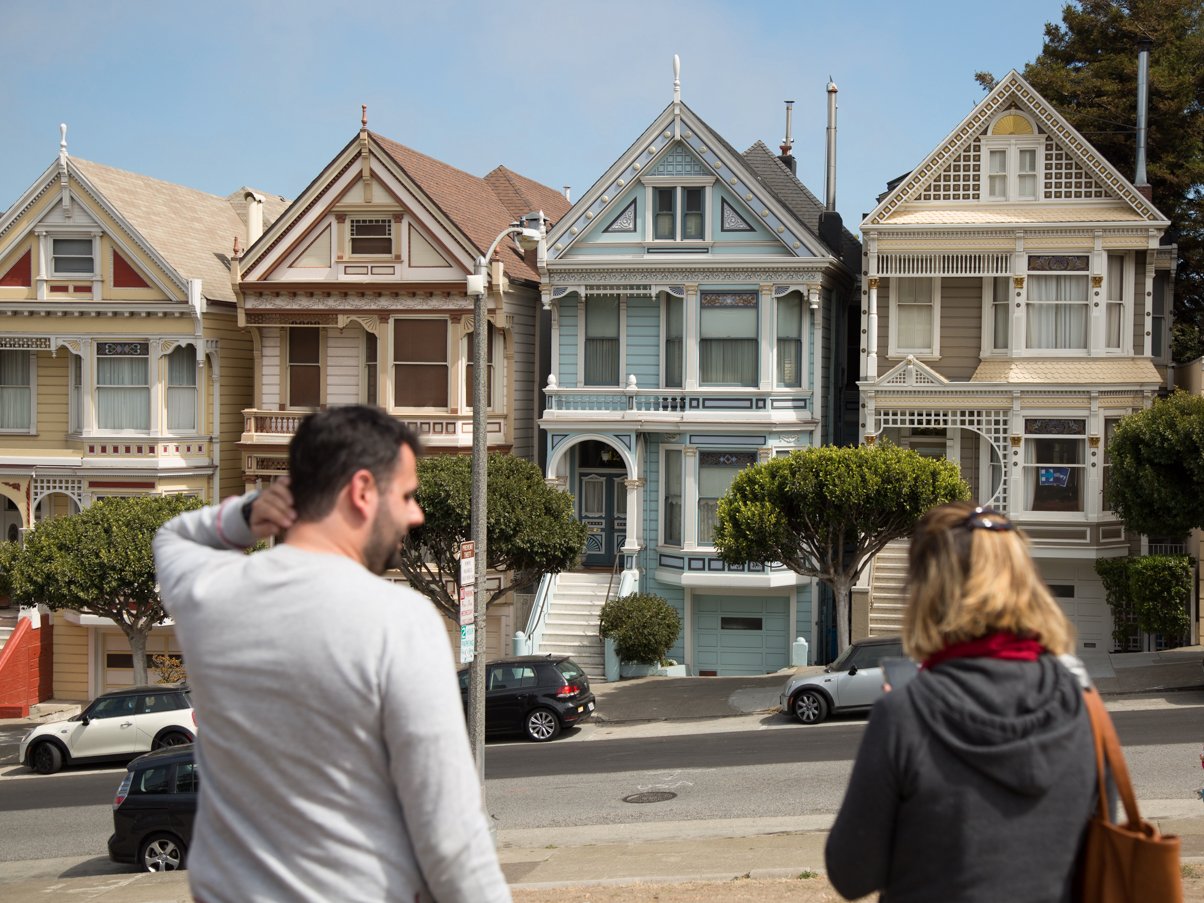
3c19f painted ladies home tour4 Silicon Valleys immigrant tech workers are scared of buying homes after Trumps travel banMelia Robinson/Business
Insider

A pair of married software engineers hooked up with real estate
agent Tim Gullicksen about six months ago in pursuit of their
dream home.

After taking time to peruse the market, the couple found a
multimillion-dollar single-family home in San Francisco that they
loved. In January, they wrote an offer letter to the seller,
complete with an attached photo of the young family, and squared
away their finances.

In early February, the couple told Gullicksen they would no
longer place a bid. They planned to take a three-week vacation in
their native country of India, and decided they couldn’t risk
buying a house if President Donald Trump’s administration
wouldn’t let them back into the US. (While no such restriction
exists, they worry the new administration might change its mind.)
They declined to speak with Business Insider directly for fear of
retribution from the government.

San Francisco is one of the most competitive housing
markets in the US, with a median listing price that tops $1.1
million. But
foreign-born tech workers, who often commute
to Silicon Valley, are starting to back out of buying property
because they worry about an escalating crackdown on immigration
under Trump, according to some real estate agents.


 Silicon Valleys immigrant tech workers are scared of buying homes after Trumps travel ban
Demonstrators
hold signs during a rally against the travel ban at San Francisco
International Airport.

Stephen
Lam/Getty


More than 100,000 visas
have been revoked since an executive
order issued on January 27 temporarily banned citizens of seven
majority-Muslim countries from entering the US. Real estate
agents in the Bay Area tell Business Insider they started to hear
rumblings among prospective buyers in late January, after Trump
signed off on the immigration ban. The topic came up in company
meetings, private emails, and closed groups for realtors on
Facebook.

Nina Hatvany, a luxury realtor with Pacific Union
International,
sold more houses
in terms of sales volume — $216 million —
than any other agent in San Francisco last year. Hatvany tells
Business Insider she frequently takes on clients who originated
outside the US.

“I often have conversations, ‘Is this a good place to put
my money?’ Absent earthquakes, it is,” Hatvany says. “[The San
Francisco Bay Area] has certainly shown tremendous appreciation,
and it’s a wonderful place to live. …

If people
start to worry about whether they’re going to be able to get into
the country when they come home from vacation, that could
change.”

Dylan Hunter, a real estate agent with Pacific Union
International, said he hasn’t had a client “pull the red cord”
yet, but he knows immigration reform is a concern for some. He’s
working with a couple based in San Francisco — one is an
investment banker, the other works at Google — who are in the
market for a $2 million single-family home. Their relatives in
India are worried the couple will never be able to visit, and
vice versa.

Google’s CEO Sundar Pichai
issued a company-wide memo last month
urging staff traveling
overseas to return immediately. He said 100 employees are
affected by the executive order.

One ripple effect of the Trump administration’s policies might be
a downturn in the Bay Area’s housing market. Karen Yang, a real
estate agent with Fling Yang Associates, says that if H-1B
visa holders (a type of visa that allows US companies to bring in
foreign professionals with specialized skills) disappear from the
marketplace, a sudden lack of competition could drive down the
price of a single-family home in the city.

Most real estate agents we spoke with, however, said their
clients should not be directly impacted by the travel ban (at
least for now).

Jackie Cuneo, a senior loan officer at mortgage lender
Summit Funding, tells Business Insider that so long as H-1B visa
holders have a Social Security number, a US address, more than
one year left on their visa, and a financial footprint
established in the US, they’re treated like citizens.

It’s unclear how
Trump’s travel ban
could affect these standards, and if the
rules vary for H-1B carriers who originated from one of the seven
countries named in the executive order. 

It also
appears Trump will go after the H-1B visa directly in an attempt
to open up more jobs for American workers, according to
leaked
draft of a new executive order
.

In the hypothetical situation that an immigrant worker gets their
H-1B visa revoked shortly after buying a house, they would have
to pay between 6% and 7% of the home value in closing costs and
transfer tax, a one-time fee imposed on the owner when a property
changes hands.


 Silicon Valleys immigrant tech workers are scared of buying homes after Trumps travel ban
A
real estate agent talks with potential home buyers as they look
at a newly constructed condominium in San Francisco,
California.

Justin
Sullivan/Getty


Trump’s immigration ban sent shockwaves throughout the Bay Area,
where technology companies rely on an international talent pool.
At Facebook,
more than 15%
of US employees in 2016 worked for the social
giant under a temporary work visa.

Gullicksen, the real estate agent whose clients backpedaled
because they have a vacation coming up, said the “What if?”
question is ultimately what cost him the sale.

“We were just about to submit an offer that was due … today,
actually,” Gullicksen said. “A couple days ago, they said,
‘We loved that house but we’re really nervous about spending that
much money and maybe not staying here.”‘

On February 5th, 97 tech firms, including Google, Apple, and
Facebook,
filed a legal brief opposing the travel ban
, in
Silicon Valley’s first united front attack on the new
administration. The brief argues that the policy “inflicts
significant harm on American business.”

Real estate agents will be keeping a close eye on what
happens next.

Article source: http://www.businessinsider.com/immigration-ban-san-francisco-real-estate-2017-2

Posted in SF Bay Area News | Tagged | Leave a comment