If you are on a personal connection, like at home, you can run an anti-virus scan on your device to make sure it is not infected with malware.
If you are at an office or shared network, you can ask the network administrator to run a scan across the network looking for misconfigured or infected devices.
The study used Zillow home value data and census income data to determine what share of homes men and women working in the private sector with the region’s median income could afford. Zillow defined affordability as being able to spend 30% or less of one’s monthly income on a home’s mortgage payment, though its calculation also accounted for a 20% down payment and insurance costs.
In the private sector in San Francisco, women earn about 78 cents for every dollar a man makes, according to Zillow’s calculations. Women make about $60,700 on average according to the Zillow analysis, while men earn $78,100.
While the difference is stark, it’s less than the overall U.S. pay disparity: Women earn 73 cents to a man’s dollar nationwide according to the Zillow data, or $38,600 compared with $53,000.
In San Jose, though, the gender gap is even wider than in the U.S. overall — women earn only about 68 cents for every dollar a man makes, with a median income of about $61,800 compared with $91,500 for men. And the yawning gap between men’s and women’s income in San Jose contributes to an even wider disparity in home-buying capability.
Zillow estimates that women in San Jose earning their gender’s median income can afford only two-tenths of a percent of the metro area’s homes; men earning their median income can afford about 16 times as many homes, or 3.3% of the housing stock.
Nationwide, men can afford 18% more of the housing market on average than women, or 57.1% of homes compared with women’s 39.1%.
While the gender pay gap is shrinking — a recent Pew study found that women age 30 and under are slightly outearning young men in some major metro areas, like New York and D.C. — the Zillow study shows that the continued pay gap is affecting women’s wealth-building abilities, making it harder for them to purchase homes and other large investments at earlier ages.
The gap is wider for women of color, too: While white women earned 79 cents for every dollar earned by white men in 2020 according to census data, Black women earned 64 cents, and Hispanic women earned just 57 cents.
Susan Neilson (she/her) is a San Francisco Chronicle staff writer. Email: susan.neilson@sfchronicle.com
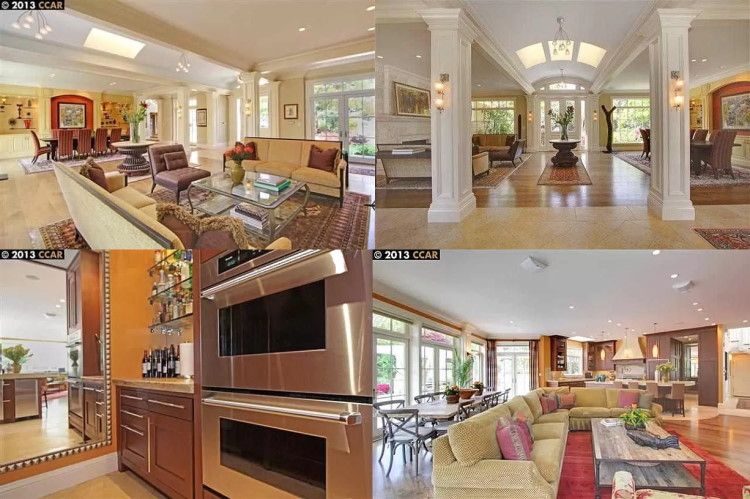
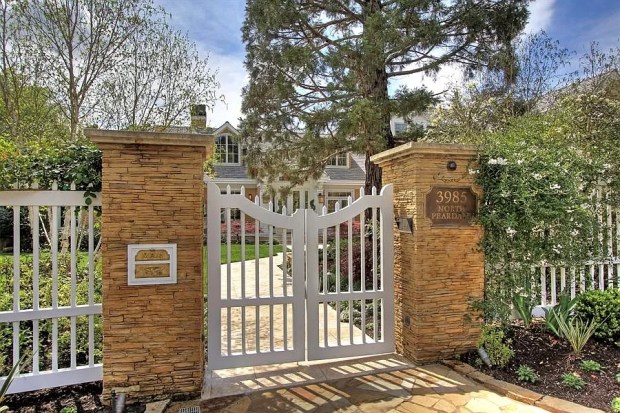
The home includes six bedrooms, six bathrooms, an office, a rec room, hardwood floors, high ceilings, wood shingling, an open floor plan, stainless steel appliances, and large closets, all behind a gated entrance, according to the Dudum Real Estate Group, which took care of the sale.
It isn’t just the inside that wooed the new buyers.
Photos via Zillow
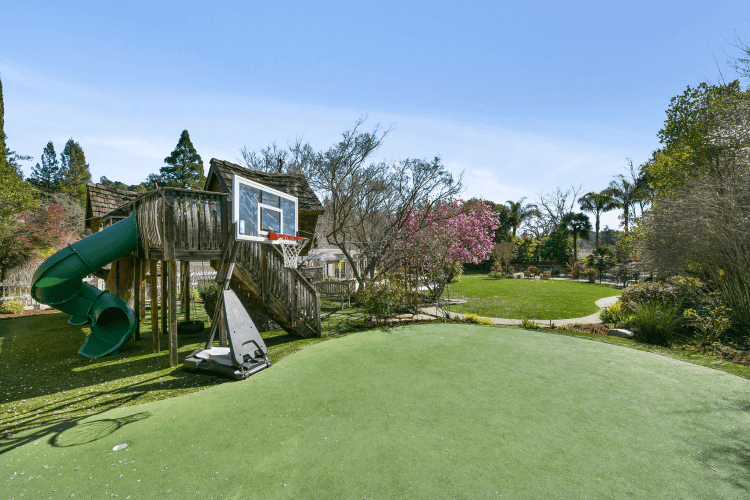
“Gorgeous, park-like backyard boasting sparkling pool spa, built-in kitchen with BBQ spit fire grill. Unbelievable custom tree house, mature landscaping for privacy, putting green, oversized of grassy area and covered patio complete this entertaining dream backyard,” the listing bragged of the outdoor space at the mansion.
The home is also within BART-able distance of downtown San Francisco, and is also close to schools, nature trails, restaurants and shops, and anything else a baseball legend or the mansion’s new buyer may want to access.
Photo courtesy of Dudum Real Estate Group
Posey’s real name is Gerald Dempsey Posey III, and he went by the alternate nickname “Hum Buss.” Other than his three World Series titles, he was also listed as an All-Star seven times, he’s been named Rookie of the Year and a League MVP, he’s a Gold Glove Award recipient, and the Johnny Bench Award was renamed the Buster Posey Award in his honor. He’s also ranked as the 156th best batter of all time. The Giants named May 7 “Buster Posey Day.”
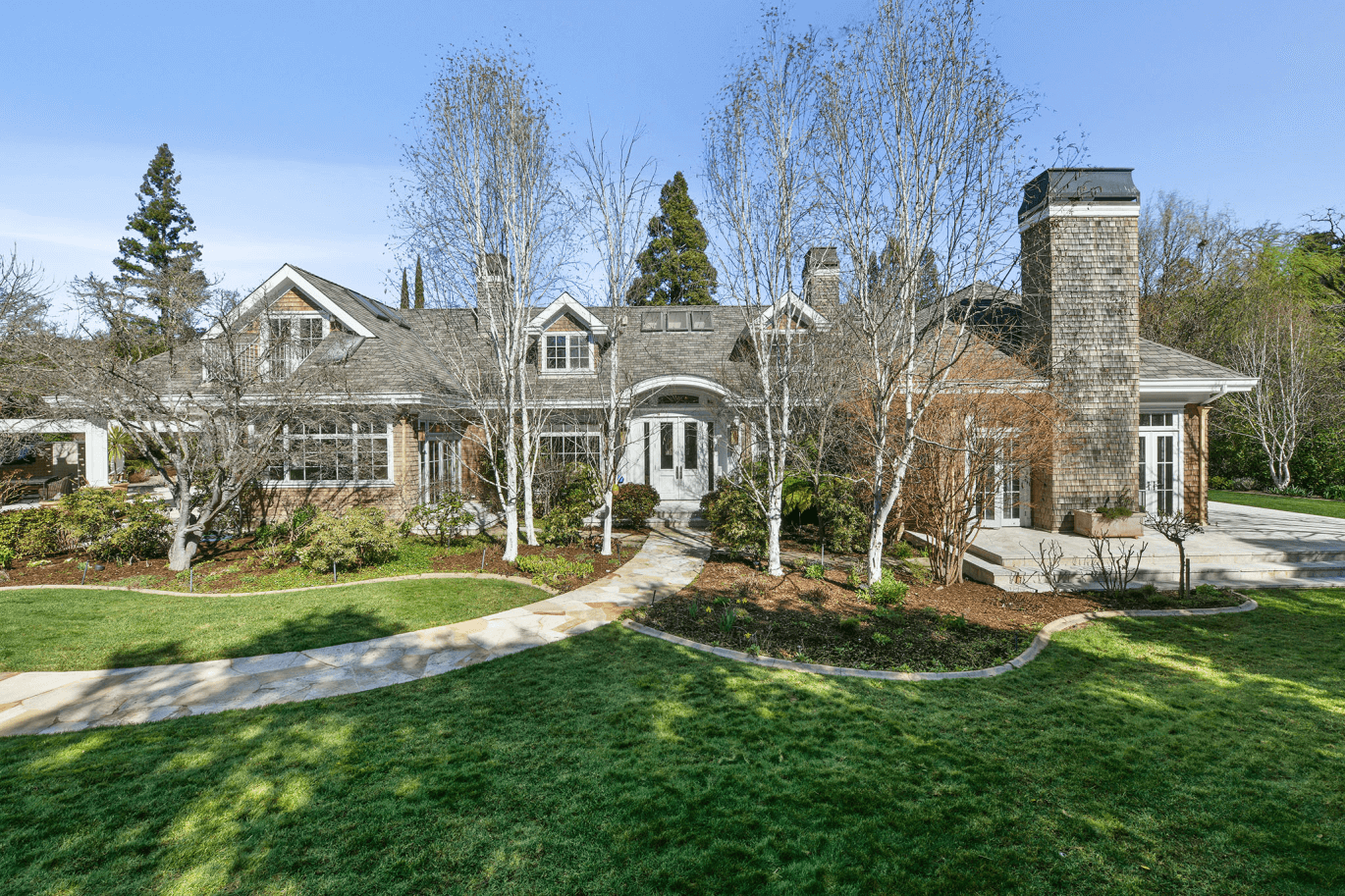
Former San Francisco Giants star catcher Buster Posey has quietly sold his Lafayette mansion for $9.28 million, cutting ties to a region he’s called home since he became a fixture with the team more than a decade ago.
The seven-time All-Star and three-time World Series champion spent his entire 12-year career with the Giants; he shocked the club and fans when he announced his retirement last year.
Posey, 34, sold the 6,038-square-foot six-bedroom, five-bathroom home off-market. It sits on almost an acre of landscaped grounds, which includes a pool, outdoor kitchen and putting green. He purchased it in 2013, after winning his second World Series title with the Giants, for $4.585 million.
Former San Francisco Giants star catcher Buster Posey has quietly sold his Lafayette mansion for $9.28 million. (Zillow)
The future Hall of Famer is moving back to his native Georgia. While the Giants will try their best to replace Posey’s phenomenal skills and leadership on the team, fans undoubtedly will miss his presence at the ballpark.
Thankfully, he’ll be back at Oracle Park on May 7 for Buster Posey Day.
Some sellers offer plots where people can live after buying their tiny home. Others require them to be shipped or trucked to land that the buyers own.
But with that demand also comes supply issues. Companies like Pacifica Tiny Homes, which builds and sells a variety of model tiny homes that ship to customers nationwide, say there’s a six month wait time for one of their custom-built homes.
This is in part what’s spurring a lot of buyers to look into direct buyers through websites like Tiny House Listings, where a 324-square foot redwood cottage can sell for upwards of $300,000.
So what’s available in the Bay Area when it comes to tiny home living? Here are a few properties that illustrate the sheer scale of how the market is growing.
A 192-square-foot tiny home in Windsor, Calif. The property is listed for $95,000.
Provided by Marisa Rosas, W Real Estate
129 Katherine Pl, Unit 59, Windsor
• 1 bedroom, 1 bath
• 192 square feet
• Listed at: $95,000
• Price per square foot: $495
In the eight days this tiny home — which is actually a manufactured home on wheels — has been on the market, listing agent Marisa Rosas says she’s already received more than 30 phone calls about it and has given 15 showings.
Most of the people interested are older than 65, and are looking to downsize or move the property to land they either own or can otherwise live on. But if a buyer doesn’t have that option, they can stay on this lot, which is zoned specifically for a tiny home and rents for $631 a month at Royal Mobile Manor, the all age RV park in Windsor.
The solid 2×4 wood throughout, in-unit laundry, butcher block countertops and yard space are just some of the elements drawing so many customers to her listing, Rosas said. But at nearly $100,000, Rosas knows that their asking price is high — though, she says, it’s never been a better time to roll the dice.
“I told my client, this market is a really interesting one right now, and that if (they) wanted to try a number, they could try it now.”
A 30-foot “Tiny Victorian” model built by Pacifica Tiny Homes.
Provided by Pacifica Tiny Homes
Pacifica Tiny Homes
• 1 bedroom – 2 bedroom, one bath
• 211-363 square feet
• $39,900 – $80,900
Having just started in 2018, Pacifica Tiny Homes is one example of the types of companies emerging to the meet the growing demand for simpler and more affordable living. While based out of Pacifica, their factory operations are in Corcoran (Kings County), and the custom-built trailer tiny homes have been shipped all over the Bay Area, said co-owner Crystal Serrano, who started the company with her husband. They’re also the first tiny home company to have their plans approved by the state of California for their homes to be used as accessory dwelling units, Serrano said.
They offer more than 30 different design and 120 color and material options, and the tiny homes can range in length from 18’ to 30’.
Each of their three models come furnished with a smart TV, a AC/Heating unit, and an Ikea queen sized sofa bed. Some can accommodate up to three sleeping spaces.
A 192 square foot tiny home at 129 Katherine Pl Unit 59 in Windsor, Calif. The property is listed for $95,000.
Provided by Marisa Rosas / W Real Estate
On the highest end, their 2.0 Tiny Victorian model — which is named because of its gabled-style roof — comes with two loft sleeping or storage spaces, and a propane tankless water heater.
Serrano says Bay Area customers make up at least 50% of their overall sales, and though many of their buyers are older and looking to downsize, many of them are also younger and building families.
“When COVID hit, we saw a bit of a lull and we didn’t know what was going to happen,” said Serrano. “It’s just skyrocketed since then, because there is obviously a high need for housing in the state and this has become an affordable way for a lot of people, young and old.”
Unlike the Windsor property, people are on their own when it comes to finding a place to live in the tiny home, but Serrano says many of their customers have found luck finding rental spots on Craigslist, finding RV parks that are accepting tiny homes, or joining tiny home communities like one in Delta Bay in Isleton.
And because the company handles all of the design and construction, customers are also able to customize the models even further, said Serrano, adding that one buyer, a nurse who worked long hours, requested her tiny home be built with a bathtub.
Some of the models of Harmony Communities’ tiny homes.
Provided by Harmony Communities
Harmony Communities
• Studio – 2 bedroom
• 220-400 square feet
• $67,500-$99,950
Like Pacifica Tiny Homes, Harmony Communities — one of the largest tiny home purchasers in the state — offers a few different models for their customers to choose from, though they’re not as customize-able.
The company, which is based out of Stockton, works with two factories in Lindsey (Tulare County) and Corona (Riverside County).
“They cannot get us homes fast enough,” said President Matthew Davies. “We are six to nine months out on our orders.”
The reason, he says, echoes a narrative that has come to explain the tiny home craze: affordability, at least by Bay Area standards.
“It’s impossible (here),” said Davies, referring to the Bay Area’s housing crisis. “These are your bread-and-butter, blue collar workers who are buying these … these are the workers who don’t have telecommuting jobs.”
For many white-collar workers, and especially those able to tele-commuting, the defining trend over the pandemic was to find more space, not less. But for working class Bay Area residents finding themselves increasingly priced out of cities they are tied to, tiny home living has become one of their only options for home ownership, said Davies.
The company sells about four properties a month to Bay Area buyers in three different park communities: Gilroy Garlic Farm, Bayshore Commons in San Leandro, and Creekside Village MHC in San Pablo. The properties are fairly austere, but sometimes include some added flourishes, like a wrap-around porch and additional loft units that can accomodate families of up to 4, sometimes 5 people.
“The model works best for the Bay Area,” he said. “Because land is scarce and prices are already high.”
Annie Vainshtein (she/her) is a San Francisco Chronicle staff writer. Email: avainshtein@sfchronicle.com