Hmart opens its first Korean market in NorCal, plans South Bay expansion

SAN JOSE — Hmart opened its first upscale Korean market in Northern California on Wednesday with colorful fanfare, and the upscale grocery chain is already planning to expand in the South Bay.

The new Hmart store in west San Jose offers a variety of international foods. It has a food court with a Korean tofu house, Chinese dishes and Japanese fusion cuisine, an Hmart spokeswoman said, along with ready-to-cook dishes to save time at home. There are counters of fresh fish, meat, poultry and produce.

“San Jose is a very affluent area,” said William Choi, Hmart’s president and chief operating officer, describing why the company picked the store at 1179 S. De Anza Blvd. for its first Bay Area market.

Shoppers packed the 28,000-square-foot market for the grand opening, drawn by offers of steep discounts.

“It’s very well organized — the quality is good,” said Julie Chao, a Cupertino resident who bought some items. “The selection is as much as Whole Foods.”

The throngs that wandered along into the store aisles found well-stocked shelves filled with colorfully packaged items. In the rear of the store, customers crowded around fish, meat and poultry sections.

“I’ll come back on a regular basis,” said Jan Smudski, a Cupertino resident.

Hmart also is busy building out the interior of a former supermarket in north San Jose for its next store in the area. The store will be located at the corner of Brokaw and Oakland roads and will be about 43,000 square feet, Choi said.

“In about five months, we will have a grand opening” for the second store, Choi said.

About 50 people work in the new store, which had a “We’re Hiring” sign posted on the front windows.

“I’ve been waiting for more than a year for this,” said Joomi Nam, who lives in Saratoga. “They have a great selection. I didn’t expect the crowds to be so big.”

San Jose officials also embraced the new store, saying it will bolster an already busy retail district.

“It’s great to see Hmart here,” San Jose City Councilman Chappie Jones said. “It’s another option for residents here. This will be great for residents of San Jose and this council district.”

A primary rival for Hmart is 99 Ranch, which has 42 stores, including 36 in California, 16 in the Bay Area and 18 in Southern California.

99 Ranch also has stores in Nevada, Texas and Washington, and it’s planning to expand into New Jersey and Oregon.

New Jersey-based Hmart operates 57 stores in 11 states. It operates in California, Maryland, New York, Michigan, Georgia, Pennsylvania, North Carolina, Texas, Illinois, Virginia and Massachusetts.

The San Jose store’s grand opening drew more than 1,000 customers to Hmart during the first hour alone.

“Hmart is a perfect fit for the demographics of the area,” said Mark Biagini, a commercial real estate broker who specializes in retail and a vice president with Biagini Properties, a commercial realty firm. Biagini helped arrange the Hmart lease at the new west San Jose site. “You can tell how well they will do by all the people who attended the grand opening.”

Hmart executives said they are eyeing expansions beyond San Jose, possibly on the eastern side of the bay and potentially San Francisco at some point. “Maybe in a year or two,” Choi said.

“We tend to be regional draws,” he said, “even from 20 to 30 miles away.”

Article source: http://www.mercurynews.com/2017/04/05/new-asian-market-opens-plans-san-jose-expansion/
Posted in SF Bay Area News | Tagged | Leave a comment

Double exposure? 4 San Francisco Bay Area MLSs strike data share deal

In a market where million-dollar real estate listings often sell in days, a fragmented MLS market and the inefficiency it brings can be frustrating and potentially costly for a real estate agent.Aiming to alleviate some of that pain, four San Francisco Bay Area multiple listing services are joining forces so that subscribers can stop hopping between various systems to access the data they need.Starting April 3, the more than 30,000 real estate brokers and agents that belong these MLSs will have “unconstrained access” to one another’s listings through a new agreement, the MLSs announced today:Silicon Valley-based MLSListings,
the Contra Costa Association of Realtors (CCAR) MLS,
the Bay East Association of Realtors MLS, and
East Bay Regional MLS (owned by the Oakland/Berkeley Association of Realtors), aka East Bay Regional Data (EBRDI)With a single entry on subscribers’ home platform, listings will automatically be shared with the other MLSs and placed in th…

Article source: https://www.inman.com/2017/03/30/double-exposure-4-san-francisco-bay-area-mlss-strike-data-share-deal/

Posted in SF Bay Area News | Tagged | Leave a comment

Survey: Nearly half of millennials consider leaving Bay Area over housing costs

For decades the San Francisco Bay Area has drawn young people from around the world to its mix of industry, culture and environment. Now almost half of the region’s millennials, the generation aged 18-39, are considering leaving because of the high cost of living and traffic, according to a new poll.

Forty percent of all Bay Area adults — and 46 percent of millennials ­— are considering relocating to more affordable regions in the next few years, according to a survey by the Bay Area Council, a business-sponsored advocacy organization.

Uncertainty about the future has eroded economic confidence. The Bay Area Council study found that only 42 percent of people think the economy is “headed in the right direction” today, as opposed to 57 percent in 2014.

This sentiment rings true for 27-year-old Dan Norton, who earns around $50,000 a year ferrying passengers from Sebastopol and Santa Rosa for Sonoma County Transit’s route 22 bus line. Norton, a Rohnert Park resident, likes his job but finds housing costs in the county prohibitively expensive for his family.

He’s considering taking his two young children, fiancee and mother with him to Oregon, where he believes rents and property values are more in line with what people earn.

“Things are just a little wacky here right now,” said Norton, who pays $1,725 a month for a “not so nice” two-bedroom apartment.

While some are contemplating leaving an area that saw average rent prices increase by 7.6 percent from 2015 to 2016, according to Novato-based analytics firm Real Answers, others have already left.

In the summer of 2016, Kristy Lindley and her husband moved to southern Oregon after spending the better part of a decade in Sonoma County. They left because neither could see themselves being able to purchase a house in the area.

“I miss Sonoma County, and would move back in a heartbeat if the real estate market was such that we had increased access, or even just more affordable rent,” Lindley wrote in an email.

For Ben Stone, executive director of the Sonoma County Economic Development Board, the sentiment expressed by people in surveys and their later actions don’t always match.

Stone points out that people are still coming to Sonoma County. In 2015, there was a net migration of 1,121 people into the county, but that is down significantly from 3,594 in 2014, according to an economic report issued by the board this winter.

“We’re still gaining people because we are so affordable relative to the rest of the Bay Area in our housing,” Stone said. “But some of what millennials are saying is true. Many are moving to places like Salt Lake City.”

High housing costs and the desire of many millennials to move to cheaper regions has others concerned.

“I do take the survey seriously and there is some evidence that this is a trend,” said Cynthia Murray, president and CEO of the North Bay Leadership Council.

“There has been a push to go where pastures are greener.”

Millennials and older generations are at odds over what to do about steadily increasing rents — up 50 percent in Sonoma County since 2011 — and property values. The Bay Area Council survey of 1,000 registered voters from nine Bay Area counties found 70 percent of the younger generation support housing projects in their neighborhoods, while roughly 57 percent of those 40 and older support housing projects near their residences.

Article source: http://www.pressdemocrat.com/news/6841645-181/survey-nearly-half-of-millennials

Posted in SF Bay Area News | Tagged | Leave a comment

In Bay Area, bald eagles breed and soar once more

From a giant nest perched above the clamor of a Milpitas school playground, there’s a chilling high-pitched peal. It’s the call of the unwild.

Spring has sprung a beautiful surprise in the urban Bay Area: a bumper crop of breeding bald eagles. Long endangered, this powerful symbol of American strength and solitude is making a remarkable comeback in our crowded metropolis, with 19 reported nests in eight counties.

Creatures once seen mostly on the Discovery Channel are being sighted in a place better known for semiconductors, shopping centers and subdivisions. They’re soaring over Stanford’s Inner Quad, San Jose’s Westfield Oakridge mall, the levees of Alviso. One eagle recently perched on a pine tree near Raging Waters aquatic park in San Jose. Another was mobbed by crows on the runway at Palo Alto Airport.

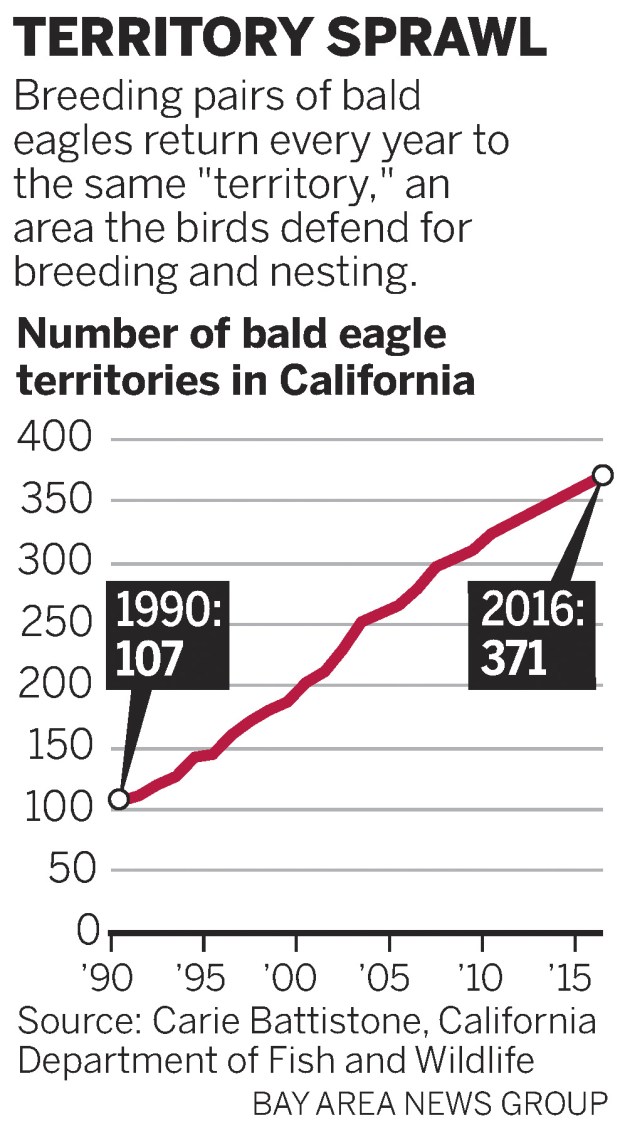
3927c eagles 040217 chartweb In Bay Area, bald eagles breed and soar once moreThe eagle boom here and across country is the pay-off for decades of environmental investment. Fifty years ago, the bird seemed destined to become a memory — seen only on coins and flagpoles — until official protection and pesticide restrictions changed its fate.

Like paparazzi, Milpitas parents and children gathered last week to gaze up at a redwood tree on the front lawn of Curtner Elementary School, swapping predictions about when eggs might hatch. They cheered when a bald eagle soared off the branch, its wings spread 6 feet wide, flashing its white tail like a winning hand of cards.

“They’re real majestic. Talons big as my hands,” said Ruben Delgadillo, who watches every afternoon when picking up his grandson.

Marveled another parent: “You could go your whole life without seeing this, or only see them in a zoo.”

In choosing a home, eagles look for the same things as people: plentiful food, a nice home and a little space, said Ralph Schardt, executive director of Santa Clara Valley Audubon Society. But just like millennials who get priced out of prime real estate markets, new pairs may be moving to more unconventional neighborhoods throughout the Bay Area.

“They fly right over our playground. Everybody’s like, ‘bald eagle, bald eagle! They yell it out,” said 11-year-old Ruben Delgadillo III, joining his grandfather after Curtner’s classes were dismissed. “It’s cool.”

The largest bird of prey in the United States, the bald eagle is one of the great success stories in wildlife conservation — proof that Mother Nature can bounce back, if only given a chance. Pumas, wolves and panthers are back on the prowl. So is the Yellowstone grizzly bear. Condors are recovering, as are gray whales. Sea otters, whose numbers dropped below 15 at their low point two decades ago, have rebounded to about 3,000.

This spring, Bay Area raptors are particularly abundant. A new web camera in a Richmond shipyard is recording an osprey nest — one of 42 pairs producing 51 fledglings along the San Francisco Bay, numbers that have surged over the past five years, according to the Audubon Society.

Golden eagles are nesting in Cupertino’s Stevens Creek watershed. A long-gone Swainson’s Hawk returned to the Bay Area several years ago, nesting near the Coyote Creek Parkway. The white-tailed kite, almost extinct in California in the 1930s and 1940s due to shooting and egg-collecting, is common again.

There’s a peregrine falcon nest inside a hangar at San Francisco International Airport, said Glenn Stewart, director of the UC Santa Cruz Predatory Bird Research Group. Another pair is nesting on the counterweight of a Bay Area drawbridge, bobbing up and down every day.

Records are sparse about bald eagles’ early populations in the Bay Area. A nest in 1915 near the San Mateo County town of La Honda was the last evidence of local nesting until the current recovery, according to William Bousman’s “Breeding Bird Atlas.”

By the mid-1960s, fewer than 30 nesting pairs of bald eagles remained in the entire state of California — and they were all in the northern third of the state. Marshes were filled, and the pesticide DDT disrupted the eagles’ reproduction, thinning and crushing eggshells. Conservationist Rachel Carson warned in her book “Silent Spring” that the bird would soon be extinct.

The Endangered Species Preservation Act of 1966 helped reverse its fate. Penalties were imposed for shooting the birds. In 1972, DDT was banned.

The fish-loving birds were aided by the creation of many new man-made reservoirs, which were stocked with bass, catfish and trout.

To re-establish breeding populations in Central California, conservationists with the Ventana Wildlife Society in 1987 began importing chicks from Canada and Alaska, then released them into the Big Sur wilderness.

“That was our seed stock,” said UCSC’s Stewart. “We harvested 6- to 7-week-old eaglets and released them, 10 to 12 per year.”  Survivors of these 70 transplants began spreading, first to Lake Nacimiento in San Luis Obispo County..

Meanwhile, individuals began coming down from the north; the first modern nest record for the Bay Area was from Lake Berryessa in Napa County in 1989. In 1996, a pair of breeding eagles were found at Alameda County’s Del Valle Reservoir; the female was one of Stewart’s transplants from Alaska. The first nest in Santa Clara County was in 2006. Six years later, there was a nest in San Mateo County’s Crystal Springs Reservoir. One year after that, youngsters were born at Lake Chabot Regional Park in the Berkeley hills.

Now, with 40 known nests in Central California, Stewart said, “we have succeeded beyond our wildest dreams.”

There are now 371 recorded eagle breeding nests or “territories” in California, although they may not be used every year, according to Carie Battistone, statewide raptor coordinator at the California Department of Fish and Wildlife.

The federal protection effort has been so effective that the bird has been removed from the endangered species list. Last spring, two bald eagles — dubbed Mr. President and The First Lady — nested in a tulip poplar tree in Washington, D.C.

Our new generations of Bay Area eagles aren’t banded, which makes tracking and counting them a challenge. Juveniles are easily mistaken for other raptors because they don’t develop their distinctive white heads and tails for five years.

As their population expands, they’re moving out into new habitats, and perhaps habituating to human mayhem.

“Just look up,” joked Audubon’s Schardt, remembering a recent drive in rush hour along Interstate 280. “There they were, above all that traffic jammed along the Peninsula. I almost crashed my car.”


Eagle nest sites reported in the San Francisco Bay Area, by county:

Alameda County, 3

Contra Costa, 1

Marin, 2

Napa, 5

San Mateo, 2

Santa Clara, 4

Solano, 0

Sonoma, 2

Article source: http://www.mercurynews.com/2017/04/03/in-bay-area-bald-eagles-breed-and-soar-once-more/

Posted in SF Bay Area News | Tagged | Leave a comment

Here’s what people are saying about leaving the overcrowded Bay Area

The poll released this week by the Bay Area Council showing the number of Bay Area residents who say they want to move away has taken a big jump will surely spawn acres of cocktail-party chatter for weeks to come. People, it seems, love to talk about how miserable they are and about how the grass is reportedly greener in places like Austin, Portland and Seattle, the top three destinations for unhappy and restless Bay Area residents, according to recent LinkedIn survey.

Our story also led to a long online thread of conversation and we’ve selected and edited some of the more thought-provoking – and less toxic – comments for you here:

  • “Be sure to tell your new neighbors in Seattle and Portland that you just moved up from California, and that you’re amazed at how cheap real estate is compared to California–then duck!”
  • “People have been fleeing the bay area high cost of living since the late 80’s; nothing new. First it was Boulder, then Seattle, then San Diego…and for the last decade, Portland. Nearly moved to “Little Beirut” ten years ago, but another startup torpedoed that idea. Nice place to live, but be sure to bring your job with you.”
  • “I actually had moved to Austin in 2001. I lived there for 12 years. Worked in the tech industry. Even met my wife there. We moved back to the bay area. Wanted to be closer to parents. Great place to live, but the weather gets to you after a while. Also…after some time Austin feels a bit like an island. Austin is fun, a bit of a party town…..lots of live music.”
  • “I can see Seattle and Portland as cities with the least “Culture shock” and Austin as the city with the most “Culture shock”
  • “I considered Austin as a possibility as well but anyone else find it funny how Green Californians are finding refuge in Big Oil Texas? Have you ever been to Texas? Its just nothing for miles in every direction. No trees just very very flat dirt as far as your eyes can see and everyone is confined indoors during the summer. Mind boggling.”
  • “I was in the Austin area once…..saw a tree-like object that topped out in a cloud….but it was gray, not green….the wind really picked up and everyone was running.  What’s a “tornado” tree?”
  • “Don’t go to SEATTLE … housing is even more than the BAY AREA. EASTERN WA state now you can live here affordable and there are J O B S !!”
  • “People leave this state because of two reasons: 1) Tax burden/cost of living, and 2) Regulation of everything. Moving to a small town in CA only reduces the cost of housing – the rest of it remains. We’re gone in less than three years, and that is to a rational state with low taxes, reasonable regulation, and a cheaper cost of living.”
  • “Seattle is actually turning into another expensive liberal dump. Really sad to see. Couple that with the same choking traffic and same high housing costs we have here and an avg. 50 days of sunshine/year, most will not find the utopia they desire in Seattle.”
  • “I must have been a modern day pioneer. I fled the bay area 7 years ago. It has become an overpriced cesspool compared to what it was just 20 or 30 years ago.”
  • “It doesn’t have to be a big city unless I suppose you’re tech and need to follow a specific job path. There are many wonderful smaller communities right here in CA and outside of the Bay area where nice homes and good schools (with under 20 kids in a class) can be found for well under $500K. Places looking for engineers, nurses, teachers, skilled labor and more. Places where you have a ten minute commute and know all the soccer parents on the field Saturday morning.  Places with real lakes and ski mountains a half hour drive away that you can experience in a half day and be home for supper. We relocated a dozen years ago and never looked back. People need to let the labels of living in “name” towns go and realize you’ve got one life and it shouldn’t be filled with stress on a daily basis.”
  • “I hear you but it’s difficult to give up the weather. Plus I never wanted to be so far from grandchildren – now a reality – that it involved airports and vacations as opposed to weekend possibilities. I’ll still argue for a third point: Quality of life. Perhaps in time we’ll head ever further but having seen my aging parents increasingly saddened by being so far apart from family in their later years, not sure that is a decision I would make. icon wink Heres what people are saying about leaving the overcrowded Bay Area
  • “Grass Valley, Nevada City, Murphys… but mum’s the word. icon wink Heres what people are saying about leaving the overcrowded Bay Area
  • “Probably foothill communites. Rocklin, Auburn, Nevada City, Green Valley, etc”
  • “(Not any more….) :} Just don’t tell them about SUSANVILLE!”
  • “I spent my first 45 years in east bay. Been gone 10 years. Live now in rural iowa. My town has about 5 stoplights. I know all my neighbors, the mayor and the sheriff by name. My blood pressure is down 20 points. There’s nothing I miss about the bay area.”
  • “I moved here from Texas. Good luck finding affordable housing and less congested highways in Austin. Sure, housing prices are cheaper on paper, but so are salaries. Friends there have the same complaints as friends here.”


Article source: http://www.mercurynews.com/2017/03/31/readers-weigh-in-on-exodus-of-bay-areas-disgruntled-masses/

Posted in SF Bay Area News | Tagged | Leave a comment