Bay Area housing crisis splits young and old

Generation X and baby boomer homeowners in the Bay Area are considerably more opposed to construction of new housing in their neighborhoods than millennials and those who have moved to the region in the last few years.

Moreover, a greater number of newer residents are worried about whether they can find affordable homes in the region than those who have lived here for many years.

That’s the bottom line, according to a new poll released Sunday by the Bay Area Council showing generational divides in residents’ attitudes toward the region’s housing crisis. Among millennials — ages 18-39 — 70 percent say “yes” to new housing in their neighborhoods. But only 57 percent of residents age 40 and older support such housing.

A majority of residents — 62 percent overall — supports putting new housing in their neighborhoods, up from 56 percent in 2014.

Attitudes are “trending in the right direction, and I think it’s a reflection of the severity of the housing crisis,” said Matt Regan, the council’s senior vice president of public policy and government relations. Still, he said, too many older homeowners continue to “kick as hard as they can at anybody else trying to get on their ladder.”

A separate poll released Thursday by the council showed that 40 percent of Bay Area residents — and 46 percent of the region’s millennials — are considering leaving the region because of congested roadways and exorbitant housing costs. Those costs have marched higher in recent years as the local economy has generated more jobs while the supply of available housing has shrunk.

Sunday’s poll reveals that 80 percent of millennials say they are concerned about finding an affordable place to live, as opposed to 52 percent of those in the 40-64 age bracket and only 36 percent of those 65 and older.

Many older homeowners, Regan said, have “for all intents and purposes built regulatory walls around their communities that prevent even their own children from moving back to the area after college, given the housing costs.”

By supporting local zoning barriers to development, he contended, entrenched homeowners have helped create “a ticking time bomb. If we don’t have a course correction, we’re going to end up with a very old region without enough new taxpayers to pay for our transportation infrastructure, our schools, our hospitals, all the services we need.”

The council drew its conclusions from the polling of 1,000 registered voters in the region’s nine counties: Santa Clara, San Mateo, Alameda, Contra Costa, San Francisco, Marin, Sonoma, Napa and Solano.

The poll shows more new Bay Area residents worry about finding an affordable home than those who have lived here the longest: 81 percent of those living here for five years or less share that concern, compared with 69 percent of residents here 6-10 years, 64 percent of those in the region 11-20 years and 48 percent of those with 20 or more years in the region.

There are county-by-county differences, as well. When it comes to supporting new housing in one’s own neighborhood, 64 percent of those in San Mateo County say “yes,” while 60 percent agree in Santa Clara County. In the East Bay, 61 percent support new neighborhood housing in Alameda County, but only 49 percent support it in Contra Costa County, which is more uniformly suburban.

Developer Kevin Casey, whose Emeryville-based company, New Avenue, specializes in building accessory dwelling units — so-called “granny units” — said attitudes have “turned a corner” as awareness of the crisis has grown.

“We haven’t had a neighbor fight an accessory dwelling project in two or three years now,” Casey said. “In fact, we see politicians who get up and say, `We’re going to build thousands of backyard cottages,’ and they get cheered.”

Lenny Siegel, a Mountain View City Council member and housing advocate, said, “People who have children who can’t buy homes are beginning to realize that though they’ve made it, they want their children to be able to live nearby. And the corollary is, how far do you have to travel to see your grandkids?”

That said, he expressed some empathy for homeowners concerned about neighborhood development: “Some of the reasons people are concerned about it are valid: traffic, parking … and will you put up El Capitan or the Tower of Pisa in somebody’s backyard?”

Article source: http://www.mercurynews.com/2017/04/06/bay-area-housing-crisis-splits-old-young/

Posted in SF Bay Area News | Tagged | Leave a comment

Bay Area Housing Market Named Most Competitive: Report

The following may not come as a surprise to Bay Area residents. The region is home to the most competitive housing market in the nation, according to real estate company Redfin.

Of all the homes sold in San Jose during March, 69.6 percent of them sold above the asking price, according to Redfin. That mark established the South Bay city as the most competitive market in the United States.

Not to be left in the dust, San Francisco followed right behind with 66.7 percent of its housing sales finalizing above the listing price, according to the report. Oakland rounded out the top three with 65.9 percent of its home sales settling in higher than the asking price.

San Francisco still topped the charts as the location with the highest median sale price ($1,185,000) for a home, according to the report. San Jose’s median sale price was $957,000 followed by Oakland’s mark of $650,000.

Get the latest from NBC Bay Area anywhere, anytime

  • 6f61d bay area icon Bay Area Housing Market Named Most Competitive: Report

    Download the App

    Available for IOS and Android

Posted in SF Bay Area News | Tagged | Leave a comment

Poll Shows Attitudes Toward Bay Area Housing Strongly Influenced By Age

SAN FRANCISCO (CBS SF) — Older voters who have lived in the Bay Area the longest and own their own home are less likely to want new housing built in their neighborhood than younger voters who rent and have lived in the area for a shorter time, according to poll results released Sunday.

The poll conducted for the Bay Area Council, an organization sponsored by businesses, showed that 70 percent of voters 18 to 39 years old support the construction of new housing in their neighborhood.

That’s less than the 57 percent of voters 40 to 64 years old and a similar number of voters 65 years old and older who support new housing construction in their neighborhood.

Seventy-six percent of voters who have lived in the area five years or less and 75 percent who have lived in the area between six and ten years support new housing construction in their neighborhood.

That’s more than the 55 percent who have lived in the Bay Area 20 years or more and support construction of new housing in their neighborhood.

“We’re shutting the door on future generations — sons, daughters, grandchildren,” Jim Wunderman, president and CEO of the council, said in a statement.

He said the housing supply needs to grow “dramatically.”

While the poll showed generational differences in support for new housing, it also showed growing support among all voters.

This year, 62 percent said they support building new housing in their neighborhood, up from 56 percent in 2014.

© Copyright 2017 by CBS San Francisco and Bay City News Service. All rights reserved. This material may not be published, broadcast, rewritten or redistributed

Article source: http://sanfrancisco.cbslocal.com/2017/04/02/bay-area-housing-poll-age-attitudes/

Posted in SF Bay Area News | Tagged | Leave a comment

Doctors can’t afford 58 percent of homes in San Francisco, says …

Real estate site Trulia released a study today on the home-buying prospects for different careers in the Bay Area. The outlook across the spectrum isn’t good. And unless you’re a doctor eyeing just 41 percent of available housing stock, the prognosis appears grim.

Trulia economist Cheryl Young looked at median wages in four fields—doctors, first responders, teachers, and restaurant workers—and assessed what percentage of homes on the market they can afford.

Note that afford in this case means spending 31 percent of monthly income on housing.

(Back in 2014, Trulia competitor Redfin released an even more pessimistic statistic for home buying odds, but used a formula that assumed less income toward housing.)

San Francisco doctors making $208,000/year fare the best: 41.6 percent of houses on the market are attainable at that salary. Alas, that’s as good as it gets.

Note that this statistic is suspect, since $208,000/year is actually the cap on wages that doctors have to report. The real average is presumably higher.

5cdd6 Marco Rubino4 Doctors cant afford 58 percent of homes in San Francisco, says ...

Marco Rubino

Still, it’s potentially useful for comparison: In Oakland, it’s 76 percent for $196,000/year, and in San Jose, 56.94 percent with $193,000/year. San Francisco’s rate is the lowest in the country.

Things get uglier from there: First responders (i.e., cops, sheriffs deputies, and firefighters) are almost entirely priced out despite a six-figure median wage ($100,625/year). Only around 2.6 of homes are cheap enough to buy without undue burden, as Young calculates.

For teachers (elementary, middle, and secondary school) averaging a bit over $72,000/year, the rate is a pitiful 0.4 percent.

And of course restaurant workers (who earn an average annual salary of $28,600) are off the board entirely.

Salary data comes from Bureau of Labor Statistics’ reports from May of 2016, the most recent available.

5cdd6 Eric Broder Van Dyke11 Doctors cant afford 58 percent of homes in San Francisco, says ...

Eric Broder Van Dyke

How much money the average worker makes does vary with how you parse it.

For example, one BLS report surveys, SF, Oakland and Hayward, and says that a rank-and-file firefighter makes $90,760/year.

But a separate report, which Trulia used, instead pools SF, Redwood City, and South SF, and gives firefighters it’s $89,000/year.

And some local workers may be better off than BLS estimates. Most firefighters and police officers, for example, end up accruing tens or even hundreds of thousands of dollars in overtime pay, some nearly doubling their salaries this way.

On the other hand, San Francisco Unified School District estimates that district teachers make a bit less than the average from BLS: The top salary schedule maxes out at $68,767/year and that’s for 15-year veterans.

Teachers may earn bonuses on top of base pay; however, given home prices these days an extra couple of grand isn’t going to make a big difference in this context.

Article source: http://sf.curbed.com/2017/4/12/15277880/sf-doctors-teachers-first-responders-afford-home

Posted in SF Bay Area News | Tagged | Leave a comment

Tight home supply keeps driving up real estate prices in Bay Area …

c4b0f a2.CA 1319 Montrose Place Pleasanton CA Tight home supply keeps driving up real estate prices in Bay Area ...

We’ve been hearing the same story, month after month: The tight housing supply is driving competition among buyers, which keeps pushing home prices up.

It’s a national story. The number of U.S. homes for sale sank 13 percent in March compared to one year earlier, marking the 18th straight month of annual inventory declines, according to a report from Redfin. At the same time, said the report, 2017 “remains on track to be the fastest housing market on record.” Nearly a fifth (19.1 percent) of U.S. homes sold in March went under contract within two weeks, and 21.7 percent of homes sold for more than their asking price.

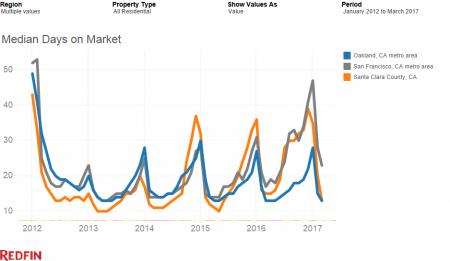
And it’s a Bay Area story. After Denver and Seattle (where newly listed homes spent just eight days on market), Oakland and San Jose were the fastest-moving markets in the nation with 13 and 14 median days on market, respectively. What’s more, Redfin ranked the nation’s most competitive markets like this: No. 1, San Jose, where 69.6 percent of homes sold for more than their listing price; No. 2, San Francisco (66.7 percent); No. 3, Oakland (65.9 percent). No. 4 was Seattle (56.6 percent) and Tacoma, WA (44.4 percent).

In parallel with the 13 percent dip in national inventory, U.S. home prices rose 7.5 percent year-over-year to a median sale price of $273,000.

This was the picture in the Bay Area: In San Jose, where the number of homes for sale fell a whopping 25.9 percent year-over-year, the median sale price rose 11.3 percent to $957,000. In San Francisco, where inventory fell 14.2 percent, the median price increased 8.2 percent to $1,185,000. And in Oakland, where supply fell 12.7 percent, the median price rose 11.6 percent to $650,000.

You can read the Redfin report (which covers single family homes, condos, townhomes and 2-to-4 unit buildings) right here.

This chart shows you how fast-moving the markets are in the Oakland, San Francisco and San Jose (here described as “Santa Clara County”) metros:

c4b0f Days on Market 7 450x261 Tight home supply keeps driving up real estate prices in Bay Area ...

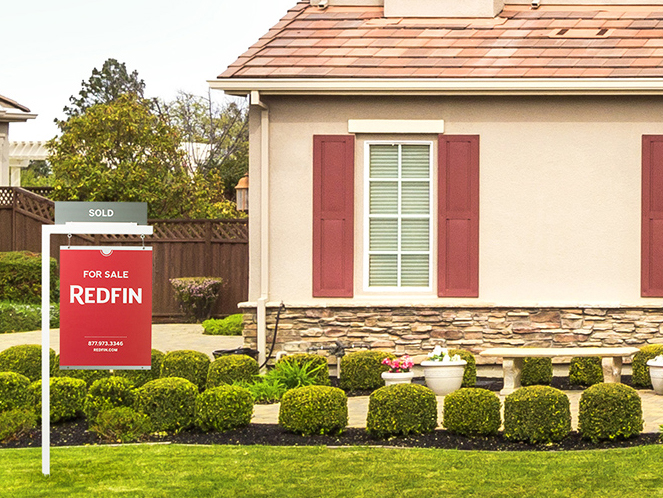
Top: Photo of home for sale in Pleasanton, CA. (Courtesy of Redfin)


Tags: , , , , , , , ,

Article source: http://www.siliconbeat.com/2017/04/13/tight-home-supply-keeps-driving-real-estate-prices-bay-area-nation/

Posted in SF Bay Area News | Tagged | Leave a comment