See the Most Expensive House on the Market in San Francisco

While San Francisco’s most expensive penthouse is under construction, you could move into the city’s priciest standalone home immediately. The seven-bedroom, 11,400-square-foot house (which was built this year at 2712 Broadway Street) listed for $40 million in April. The Pacific Heights location, known as Billionaire’s Row, was chosen by area elite after the 1906 earthquake. Wealthy families left their demolished Nob Hill mansions and rebuilt in Pacific Heights for the superior views. Larry Ellison owns a house there, as does thirtysomething billionaire Kyle Vogt—who made the city’s most expensive real estate purchase last year in Pacific Heights for $21.8 million.

Like Vogt’s 1901 beaux-arts home, 2712 Broadway Street has seven bedrooms, an in-home spa, and panoramic views of the San Francisco Bay and Golden Gate Bridge. However, the contemporary listing is newly constructed and 2,300-square-feet larger than Vogt’s. Developer Bill Campbell of Marble Management guessed his clients to be wine aficionados, thus equipping the LEED-certified home with temperature-controlled wine storage on nearly every floor.

Take the elevator to the bottom level to find the holy grail of wine storage, a well-lit vault with racks for thousands of bottles. Host intimate parties in the adjacent tasting room or hire a therapist for a massage in the spa treatment room, which is close to a dry sauna, gym, and home theater. Press “2” in the elevator to reach the garage, complete with an automotive turntable and a one-bedroom apartment. The bronze-colored elevator doors open on level three to the home’s main living spaces: a formal entryway, a dining room, a kitchen, and, yes, a second walk-in, glass-encased wine vault. Four en suite bedrooms are located on the fourth floor. The home also showcases a floor-to-ceiling wine fridge and picturesque San Francisco views that, like fine wine, only get better with time. (sothebyshomes.com)

Article source: https://robbreport.com/real-estate/see-most-expensive-house-market-san-francisco

Posted in SF Bay Area News | Tagged | Leave a comment

Bay Area’s housing recovery isn’t as universal as you think

With double-digit price appreciation returning to some Bay Area markets, we’re used to hearing that the region’s homeowners are a lucky bunch, richer by the minute.

It’s often true, but not always.

A new report by Trulia, the real estate website, finds that only 60.4 percent of single-family homes in the Oakland metropolitan area have recovered their pre-recession peak values, compared with 84.3 percent in metropolitan San Jose and 98 percent in the San Francisco metro area. Out of 100 U.S. metros whose housing recovery was measured by Trulia, Oakland ranks 34th, while San Jose ranks 19th and San Francisco is No. 2 in the nation.

“It’s important to realize that even though home prices have boomed in the Bay Area and a lot of people have gained a lot of equity in their homes, it’s not necessarily a ubiquitous phenomenon,” said Ralph McLaughlin, Trulia’s chief economist and author of the report. “In some areas, the recovery is still yet to be complete for all homes.”

Even so, Bay Area homeowners are in much better shape than their counterparts nationally. The report, titled “The Housing Recovery that Wasn’t,” finds that just over a third — 34 percent — of the nation’s homes have seen their values surpass their pre-recession peaks. The peak value for each home, as defined by the study, could have been reached at any time between Jan. 1, 1996 and Dec. 1, 2007.

The report notes that markets with strong post-recession income growth tend to have large percentages of homes passing their pre-recession peaks. In Denver — the No. 1 market for “recovery,” according to Trulia — more than 98 percent of homes passed their pre-recession peaks, while income growth stands at 20 percent. In San Francisco, job growth has been even higher — 25.5 percent — though the recovery rate of 98 percent is a tad lower. San Jose’s income growth is 21 percent, while Oakland’s is 17 percent.

The Oakland metropolitan area includes Contra Costa County, where many homes in outlying areas have yet to surpass their post-recession values. McLaughlin said that likely explains why Oakland — which has a reputation as a real estate hot spot — landed 34th on the list nationally. Only 37 percent of Contra Costa County’s single-family homes have regained their pre-recession peaks, according to Trulia, as compared with nearly 81 percent in Alameda County, 87 percent in Santa Clara County and 98 percent in San Mateo County (which is part of the San Francisco metro area, as defined by the study).

Likewise, the No. 19 ranking for the San Jose metro — synonymous with Silicon Valley and its hot real estate — owes something to its geographic breadth. The metro area includes San Benito County, as well as large swaths of residential Santa Clara County that “are far away from the epicenter of the tech boom,” McLaughlin said.

“Places like Gilroy and Morgan Hill and South San Jose are pretty far removed from where the economic engine is running on all eight cylinders,” he said. “Housing prices in those areas are not being buoyed up as much as in other areas.”

Prices on homes in Sunnyvale and Mountain View are “being blown out of the water by young high-tech buyers,” said Intero agent Craig Gorman, past president of the Santa Clara County Association of Realtors. “From the time you bought the home to the time it closes, you’ve already made money by the time it closes. Some areas of Morgan Hill and some areas of the Eastside San Jose haven’t done as well.”

In April, the CoreLogic real estate information service issued a report showing that home prices have surged in much of the Bay Area as buyers fight for the small number of houses on the market. The median price of a single-family home rose 11.5 percent year over year to $1,050,000 in Santa Clara County, for instance, and by 13.5 percent to $772,000 in Alameda County — record highs for both counties.

By focusing on the values of individual houses, the Trulia report offers a different perspective of the market.

It “paints a very different picture” from what typically emerges from “aggregate measures of house prices — medians and averages,” McLaughlin said. Those broad-based measurements tend to “mask the variation of home value recovery of individual homes.”

Certainly “those that bought near the bottom of the market in 2011 and 2012 are probably doing pretty darn good,” he conceded. “But for those who bought 10, 11 or 12 years ago, their homes may still be worth less than they were back then. The recovery is not complete.”

Article source: http://www.mercurynews.com/2017/05/04/sjm-homevalue-0505/

Posted in SF Bay Area News | Tagged | Leave a comment

In costly Bay Area, even six-figure salaries are considered ‘low income’

In the high-priced Bay Area, even some households that bring in six figures a year can now be considered “low income.”

That’s according to the U.S. Department of Housing and Urban Development, which recently released its 2017 income limits — a threshold that determines who can qualify for affordable and subsidized housing programs such as Section 8 vouchers.

San Francisco and San Mateo counties have the highest limits in the Bay Area — and among the highest such numbers in the country. A family of four with an income of $105,350 per year is considered “low income.”  A $65,800 annual income is considered “very low” for a family the same size, and $39,500 is “extremely low.” The median income for those areas is $115,300.

Other Bay Area counties are not far behind. In Alameda and Contra Costa counties, $80,400 for a family of four is considered low income, while in Santa Clara County, $84,750 is the low-income threshold for a family of four.
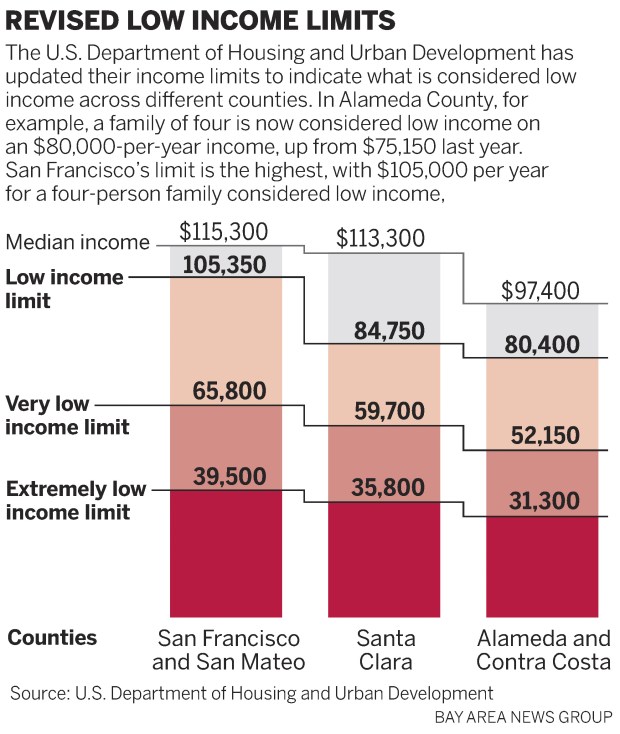
8977f cct income 0421 web In costly Bay Area, even six figure salaries are considered low incomeThe eye-popping numbers are harsh reality for Demetrio Gonzalez, a Richmond resident with multiple higher education degrees, including a master’s in education, who supports the work of approximately 1,700 educators in West Contra Costa Unified School District in his position as president of the United Teachers of Richmond. With an income of $48,000, it’s a challenge for him to live in the Bay Area. By the time he pays rent for a home he shares with four roommates, including teachers, along with student loans, food, travel, phone and car payments, he has about $300 left each month.

“With this income, I don’t think it is possible to create a future in the place I love and the place I work,” he said. “When I decide to buy a home — if possible — I’ll have to look elsewhere.”

The new federal income limits are higher than last year and previous years, a reflection of the rising incomes and cost of living in the Bay Area. The increases will allow people at the upper tiers of the “low-income” limits access to some affordable housing programs from which they were previously disqualified.

“We’ve significantly increased income limits at every income level — that means more housing opportunity (because it) broadens the pool of individuals and families (who are considered low income),” said Ed Cabrera, a regional public affairs officer for HUD. “I think it’s fair to say that these income limits are one way to gauge livability and affordability.”

Jeff Levin, policy director for East Bay Housing Organizations, said the market has shifted “dramatically” over the past two decades, forcing renters to spend significantly more on average than they have in previous years.

In Oakland, the median income for renter households is around $40,000, which means that more than half of all renter families qualify as very low income, Levin said. Most of those families are paying more than half their income for housing costs.

Moriah Larkins is one of them. Larkins makes $15.50 an hour working at Home Depot and spends at least 40 percent of that on her HUD-subsidized apartment in West Oakland, she said. Sometimes, it’s even more than that.

“It’s not even enough living in subsidized rent,” Larkins said of living in the costly Bay Area.

Michael Santero, director of asset management for San Jose-based First Community Housing, said it’s easy to see the increased need for affordable housing right now, as more people flock to affordable housing programs offered by First Community Housing and others in the face of rapidly rising housing costs. While the new HUD income limits broaden the group of people eligible for such programs, it doesn’t help alleviate the demand for such housing. It’s up to developers and cities to provide more supply.

“There is a huge demand for anything that’s remotely affordable. … People aren’t moving out at all,” Santero said. “Even in an affordable unit, I’d have people moving out often in summer in a normal market, but now we get hardly any notices.”

Roxanne Calimeris, 27, a social worker who lives in Oakland, said she was shocked at the level of competition for getting an apartment in that city. An employee of Alameda County, Calimeris makes about $82,000 per year, putting her well above the “low income” limit of $56,300 for a single person in the East Bay, but even on that salary, living in the region isn’t easy. Rent costs her about $1,200 per month, for an apartment she shares with her sister (“I knew I couldn’t get my own place,” Calimeris said), and an extra $600 in student loans and $250 for a car payment eat into the rest of her paycheck.

Some Bay Area cities have seen average rents soften a bit, but they’re still higher than much of the country. According to ApartmentList.com, the median monthly cost of a two-bedroom apartment was $2,550 in San Jose by the end of last year. In Oakland, it was around $2,500, and in San Francisco, it was a cool $4,550. Even places in the East Bay suburbs, where many have flocked to find rent relief, were expensive. Pleasanton’s median for a two-bedroom was $2,770, and in Concord, it was $1,900 per month.

Not surprisingly, the Bay Area HUD income limits are higher than other metropolitan areas in the country. In the Seattle area, $72,000 per year is considered “low income” for a family of four, while in Boston, the limit is $78,150. In Los Angeles County, $72,100 is “low.”

Jennifer Lin, deputy director of the East Bay Alliance for a Sustainable Economy, said that while more people are falling into the “low-income” bracket, it’s important to remember how many people are still struggling to make it work at the lowest income levels.

“For every household who makes $80,000, there are many who make much less,” Lin said, pointing to minimum-wage earners in Oakland, for example, whose $12.86-per-hour wage adds up to under $27,000 a year. Even when the minimum wage across the state hits $15 per hour by 2022, workers will make just $31,200 annually (working 40 hours per week every week of the year).

A member of the Alliance of Californians for Community Empowerment, Larkins, the Home Depot employee, has been active in campaigns to improve wages for herself and others in low-wage industries like retail. While such efforts have been successful in lifting minimum wages across the state, it can still be a struggle for those workers to survive in the Bay Area.

“Minimum wage is going up, but it would be different if the cost of living was the same as when I was a teenager,” Larkins said. “Minimum wage goes up, and the cost of living goes up.”

Article source: http://www.mercurynews.com/2017/04/22/in-costly-bay-area-even-six-figure-salaries-are-considered-low-income/

Posted in SF Bay Area News | Tagged | Leave a comment

Trulia’s ‘Heat Map’ Is A Fascinating Look Into Urban America’s Real Estate Market

(A home in East Hampton, N.Y. / AP Photo/Mark Lennihan)

There’s a very precise formula for how major U.S. metro areas can make their housing markets “hot”; simply commit to jobs and population growth, then artificially restrain the housing supply. This has been the price inflation calculus in New York and San Francisco. But even within these and other desirable metros, the price variation across the geographic landscape is so disperse as to seem random–and counters the stereotypes about where consumers actually want to locate.

This is evident when looking at the “Heat Maps” on Trulia.com. These maps allow prospective homebuyers to see color-coded overviews of the price ranges across their desired metros. Areas shaded in red are ones where average listing prices exceed $1 million; orange areas are between $500-999k; yellow areas are between $350-499k; and green areas are $349k or less. Along with average listing prices, Trulia’s Heat Maps can be altered to show average sale prices, sale prices/sqft, valuations and rental prices.

What’s surprising about the maps is just how spiky and variegated they are, by neighborhood and by municipality. This would refute certain commentary that has been made about cities in recent decades. Thanks to the continued growth of major metros, center city areas are anecdotally thought to be places of high demand and pricing. Suburban sprawl, meanwhile, is viewed as the less desirable second option; something people choose only because it is cheaper and less burdened by regulation.

But neither of these sentiments are exactly true. While there are a lot of cheap suburbs, there are also many suburbs that are pricier on average than central cities, making them destinations unto themselves; and while much of central-city America is famously expensive, certain neighborhoods within even these hot markets remain surprisingly cheap.

The New York-Newark-Jersey City metro area, which likely remains America’s most analyzed housing market, is one case study. On its heat map, most of the blocks south of 110th street in Manhattan have average listing prices above $1 million (no surprise there). But then, the Long Island townships of Kings Point, Old Westbury and the Hamptons also have at or above this average price range, as do parts of southern Connecticut.

Meanwhile Brooklyn, for all the talk of whitewashing and gentrification, is really not much different than the rest of the metro. Some parts of the borough, especially close to Manhattan, average above $1 million. Other parts, especially those further from Manhattan, average around the metro area median of $411,000. But a majority of the borough contains the orange designation of between $500-999k. This isn’t cheap, but it doesn’t cause Brooklyn to stick out from other parts of the region; much of suburban Long Island, Connecticut and New Jersey is also like this. Meanwhile, various portions of New York City proper–namely The Bronx–have average listing prices below the metro area median.

A similar calculus applies to the Bay Area. A majority of San Francisco is of course shaded red. But so too is pretty much all of Silicon Valley (besides San Jose); the entire northern peninsula leading to San Rafael; and even some of the uber-suburban territory far east of Oakland. Meanwhile, various neighborhoods in San Francisco city proper have cheaper listing prices on average than the metro area median of $843,000, and this goes for almost all of the East Bay, including Oakland and Berkeley.

In other notably pricey metros, the most expensive areas sit outside the city proper altogether. This is the case in San Diego (La Jolla and Coronado); Washington, DC (Bethesda and Potomac); Los Angeles (Malibu, Santa Monica and the Hollywood Hills); Seattle (Bellevue and Mercer Island); Denver (Boulder); and Boston (western suburbs). It is also the case in metros with cooler housing markets, such as Phoenix, Oklahoma City and Chicago.

Article source: https://www.forbes.com/sites/scottbeyer/2017/05/03/trulias-heat-map-is-a-fascinating-look-into-urban-americas-real-estate-market/

Posted in SF Bay Area News | Tagged | Leave a comment

Vallejo rents Bay Area’s lowest, but rising fast

Vallejo may be the last chance for relatively affordable housing in the Bay Area, and this could easily impact the local real estate market, experts say.

Besides home prices here being the lowest in the Bay Area, rents in Vallejo are also the regions’s lowest. They are also the area’s third fastest growing, a new real estate industry report shows.

“We at Zumper have just published our latest monthly Metro Report for the SF Bay Area,” Zumper’s Crystal Chen said. “The report covers 30 cities in the metro area to highlight the most/least expensive cities and cities with the fastest growing rents.”

After analyzing more than 15,000 active listings last month, Zumper officials found Vallejo the least expensive city in which to rent, with a median price for a one-bedroom unit at $1,300, she said.

“When sorted by two-bedroom prices, Vallejo is still the least expensive city to rent in the SF Bay Area metro,” Chen said. “And the data in this post is from Vallejo city, not the Vallejo-Fairfield metro.”

Chen attributes this to a number of factors, but the news may already be outdated, she said.

“With higher crime rates and less modern amenities than other Bay Area cities, Vallejo in the past few years has not had a huge migration of new residents into the city,” she said. “More recently, however, that seems to be changing.”

Local Realtor Curtis Lafferty, who’s also in the home rental business, said he’s seeing this reflected on the ground.

“Rents are rising so fast here, I’m having a hard time keeping up with it,” he said. “Inventory is very low, and that drives up desire and price.”

Lafferty said he has noticed a migration into town from more expensive surrounding cities.

“Most of our people that are paying high rents are coming from outside the area,” he said. “Most of the people who live and work in Vallejo can’t afford to rent here; they’re being priced out of the market. Landlords are increasing their rents and there are people lined up to pay it. Those priced out are moving to less expensive areas, outside the Bay Area.”

Solano Association of Realtors President Linda Daraskavich reports seeing the same phenomenon.

“More people are moving into Vallejo from places like San Mateo and Alameda, and forcing residents farther east,” she said.

Although Vallejo rent prices are down slightly on a month-over-month basis, the yearly growth numbers are another story, with one-bedroom costs up more than 10 percent and two-bedroom prices up more than 13 percent, the report shows.

“Similar to what happened in Oakland, there has been increased interest in living in Vallejo since so many people are being priced out of the other, more expensive Bay Area cities,” Chen said.

While Vallejo’s rents may be the cheapest in the Bay Area, they’re still high compared to the rest of the country, the report shows.

Vallejo’s median $1,300 one-bedroom rent, compares to a $1,164 national median, according to the report. The national median for two-bedroom units is $1,377, where in Vallejo they’re $1,460.

“So, while rental rates in the other Bay Area cities will most likely continue to stay expensive, more and more people will be looking at Vallejo for rentals, which will probably continue to drive up prices big picture wise, with the increased demand,” Chen said.

Zumper found the Bay Area’s most expensive rents are in San Francisco, where a one-bedroom will set you back about $3,320 per month.

Vallejo’s one-bedroom median is $340 below the state median, and Napa’s $1,460 median rent makes it the second cheapest city to rent in the Bay Area, the report found.

Rents are rising fastest in Concord, with a yearly growth rate of slightly more than 15.2 percent since last year, followed by South San Francisco’s 15.1 percent and with Vallejo’s 15 percent right behind, the report shows.

A full discussion can be found on https://www.zumper.com/blog/2017/04/sf-bay-area-metro-report-april-2017/.

Contact Rachel Raskin-Zrihen at (707) 553-6824.

Article source: http://www.eastbaytimes.com/2017/04/28/vallejo-rents-bay-areas-lowest-but-rising-fast/

Posted in SF Bay Area News | Tagged | Leave a comment