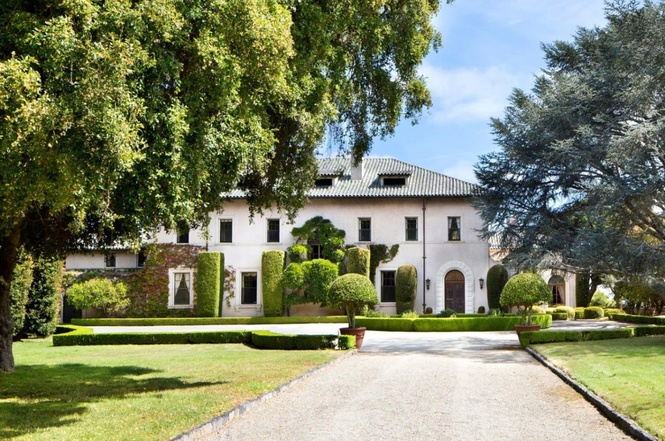
We’ve visited and revisited the De Guigne estate over the years, watching its drama unfold.
Now, finally, the 16,000-square-foot mansion in Hillsborough has sold for $29.85 million, and at such a dramatic discount from its original list price of $100 million that this story’s end makes for good real-estate gossip.
Weird history
Aside from newsworthy features this estate offers, which we’ll detail shortly, its listing history too made the news: In February of 2013, the de Guigne estate hit the Hillsborough market at $100 million, debuting then as one of the five most expensive properties for sale in the entire country.
But there was a quirk in the listing that made it even more newsworthy: A life estate its then owner, 75 years old Christian de Guigne IV who hoped by these terms to remain in the home rent free until his death. New owners would wait in the wings until then, not able to live in the home; but expected to maintain maintenance on a property with “household expenses average[ing] $450,000 a year” according to the San Jose Mercury News.
No buyers emerged to snap up this dubious deal.
In May of 2015, the listing was withdrawn. In June of 2016, it came back — priced $60 million less than its original list — at $34.9 million. The life estate for Christian de Guigne had disappeared from the equation.
Still, no buyers.
Final sale
After all that drama, 891 Crystal Springs Road has finally sold for $29.85 million, a fraction of its original list.
What does that money buy?
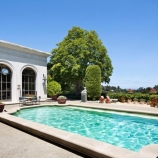
The de Guigne family began building the 16,000-square-foot mansion in 1914, and held title on the 47.4-acre estate for over 150 years. That land, with its lush lawns, gardens and private hiking trails, was designed by Thomas Church.
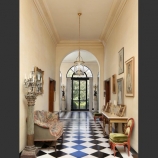
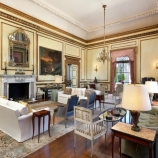
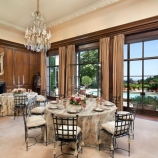
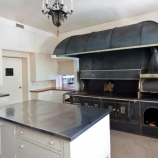
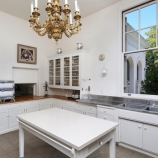
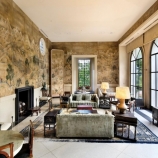
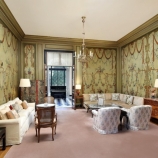
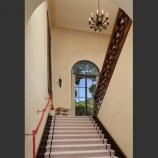
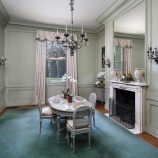
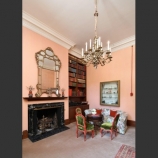
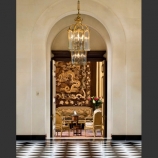
In the mansion, which was designed by Bliss Faville, are 10 bedrooms and nine a half bathrooms, a ballroom, a grand formal banquet room, a flower-arranging room, a library, and a plethora of additional rooms for all the activities the very rich need separate rooms to accomplish. Many of the interiors remain intact and original from the 1960s, when the owners at that time — Christian de Guigne III and his wife, Eleanor — hired decorator Anthony Hail.
History
Christian de Guigne I was a prominent Bay Area businessman who “at one point in the 19th century owned a chunk of downtown San Mateo,” writes the Mercury. This home that he commissioned was the scene of many lavish parties and opulent occasions.
But decades later, all this luxury wasn’t enough for Christian IV and his wife, Vaughn Hills, of the Hills Bros. coffee family. Theirs was a reportedly bitter divorce made more acrimonious by a failed attempt to sell or subdivide the estate.
De Guigne’s proposal “to subdivide the property into 25 single-family homes” collapsed under pressure of the poor 2009 economy and vociferous opposition from neighbors and environmental groups. So, though the MLS write up for this now sold property boasts “potential to subdivide,” it’s hard to know if new owners can actually do so.
But then again, maybe new owners plan to keep all 47-plus acres and 16,000-square-feet of luxe to themselves.
AnnaMarie Erwert writes from both the renter and new buyer perspective, having (finally) achieved both statuses. She focuses on national real estate trends, specializing in the San Francisco Bay Area and Pacific Northwest.Follow Anna on Twitter: @AnnaMarieErwert
Facing competition from cities where it’s cheaper to live, the Bay Area isn’t the talent magnet it used to be, a report released by LinkedIn on Friday shows.
The net number of workers moving to the region dropped 17 percent from February to May. But other cities such as Seattle saw that figure jump 2 percent during that same period.
“(The Bay Area) isn’t quite the El Dorado it might have been three to four years ago when the rest of the country was still struggling to recover from the Great Recession,” said Guy Berger, LinkedIn’s economist.
In the last 12 months, the San Francisco Bay Area lost the most workers to Seattle, Portland, Oregon, and Austin, Texas — cities with lower living costs.
In April, the median price for a previously owned single-family home in the nine-county Bay Area region climbed to an all-time high of $800,000, according to real estate information service CoreLogic.
“A lot people are probably hearing that even if you’re getting paid really well in San Francisco a huge chunk of that is going to be for rent or your mortgage,” Berger said.
The Bay Area, though, is still an attractive place to live.
Looking at the number of people who changed their location on their LinkedIn profile in the last 12 months, the tech firm ranked the Bay Area No. 12 on its list of cities that are gaining the most workers. Seattle topped the list, followed by Denver, Austin and Portland.
The Bay Area gained the most workers from New York City, Boston and Chicago, data showed.
In February, the Bay Area was ranked higher at No. 10 on LinkedIn’s list of cities that are gaining the most workers. The region gained 32.1 workers per 10,000 LinkedIn members from December 2016 through January 2017.
“(The Bay Area’s economy) slowed down from red hot to really good,” Berger said.
Bay Area hiring in May was also down 4 percent compared to the same period last year. LinkedIn looked at the percentage of members who changed their employers on their profiles to calculate the hiring rate.
More than 138 million workers in the United States are on LinkedIn. The Bay Area included San Francisco, Alameda, Contra Costa, Marin, San Mateo, Santa Clara, and Solano counties.
Preston Cook has valiantly tried to step quietly into his new life among the 2,500 souls of Wabasha, Minn.
He’s been only partially successful.
“If anyone recently made a big splash around here, it’s him,” said Wabasha Mayor Rollin Hall, who described Cook as “very personable, modest, not arrogant, a good listener. He fits into Wabasha very well.
“But he has been active — and this is about eagles.”
Wabasha — a renowned bald eagle flyway on the Mississippi River and home to the educational nonprofit the National Eagle Center — thought it knew something about obsessions with bald eagles.
Then it met Cook, a confidently understated 70-year-old San Francisco real estate developer.
He came to Wabasha in search of a permanent home for his singular and dumbfounding treasure — the Andy Warhols, the James Audubons, the Roger Tory Petersons and a semitrailer truck trailer full of 20,000 eagle-themed books, photos, statuary, documents, posters, medals, music, advertising, jewelry and everyday ephemera that celebrate the nation’s great bird.
Cook brought his collection, which is worth millions, to Wabasha as a gift for the Eagle Center, which enthusiastically accepted it. Then, he and his wife, Donna, followed the collection from California to the little town on the Mississippi River to oversee its arrival and ultimate display.
“I’m kind of a hoarder,” Cook said with a shrug. “I’m trying to become a donor.”
The Eagle Center, Cook and the town of Wabasha seem to have found one another at an opportune moment.
The center moved from a storefront into its stunning 15,000-square-foot riverside building in 2007. But its 83,000 annual visitors threaten to overcrowd the space. The Eagle Center’s executive director, Rolf Thompson, and the board have been trying to finance expansion for years.
Cook’s collection, accompanied by more than $100,000 to help fund its display, means the expansion now includes two downtown buildings next to the center.
That has brought a lot of construction to Wabasha, Minnesota’s oldest municipality but not its busiest as of late.
“When I got here, there were about 13 properties for sale downtown,” Cook said. “Now it’s just a couple.”
Mayor Hall credits Cook, in part, for the rivertown’s new bustle.
“There does seem to be a lot going on these days,” he said. “Some of that has to be due to what’s going on at the Eagle Center. Lots of people coming through town.”
Hunting for a home
Twelve years ago, one of those people was Preston Cook.
Then 58, he had a successful Bay Area real estate business (he was also commissioner of the Port of San Francisco). He came to town during what would be his 10-year search for a permanent home for his bald eagle collection, a home he hoped would appreciate, preserve and display what had been a principal focus of his life for 30 years.
His search would take him from Alaska (too distant) to Philadelphia (no live eagles) to Tennessee (Dollywood was very briefly in the running), before he settled on Wabasha, which by then boasted a new building for the Eagle Center and a board with a vision to embrace the unexpected gift.
How did this happen, this colossal collection?
Cook will admit to being “a collector” by nature (“I still have an old dresser I bought for $100 when I was 18,” he said). And he is, obviously, consumed by the mystique of the American bald eagle.
If you visit
Although visitors to the National Eagle Center in Wabasha, Minn., can’t see Preston Cook’s extensive collection just yet, there are plenty of things to do.
Located on the banks of the Mississippi, the center’s live eagles are the stars of the show. Naturalists lead daily interactive programs featuring an eagle “ambassador,” and the exhibits and eagle viewing areas can keep the attention of visitors of all ages.
Where: 50 Pembroke Av., Wabasha.
Hours: 10 a.m. to 5 p.m. daily.
Cost: $10; veterans $9, ages 4-17 $7. Free for members and ages 3 and under.
Info: 1-651-565-4989, nationaleaglecenter.org.
“Think about it — everyone has an eagle story,” he said. “Even if that story is, ‘I would love to see an eagle someday.’ … It is the living representation of our country.”
Besides, he added, “no one else was doing this.”
Three events turned Cook’s unfocused inclinations into a lifelong pursuit. First, in 1966, he said, he saw the Herb Gardner movie “A Thousand Clowns,” in which Jason Robards’ character proclaims, “You can’t have too many eagles!”
It was Cook’s Rosebud moment.
An internal switch flipped, Cook said, and he began scouring flea markets and antique stores for anything bearing an eagle — stamps, magazines, carvings, buttons, postcards, jewelry, plaques, coins, currency, flags, sheet music and beer steins.
Second, his real estate business took off, giving him the budget to extend his eagle searches into art galleries and auction houses.
Third? “EBay,” Cook said. “That was a new world for me. It was just endless. Search ‘eagle’ and you get 750,000 hits.”
Word eventually got out that there was a guy in San Francisco amassing an eagle-themed collection. The galleries and auction houses started calling him, and other collectors from all corners of the internet began sending Cook shipping crates of eagle items to examine, on spec.
“I was just inundated,” Cook said. “I had to put a stop to it. It just got out of hand, even for me.”
From cookie jars to Warhol
Cook’s collection is, for now, housed in a warehouse in downtown Wabasha (Cook bought the old American Legion Hall, which is now secure and climate-controlled).
To walk through it with Cook is to see the work of an affably intense one-man team of collectors, curators and archivists. File cabinets, display cases, shelves and work tables burst with thousands upon thousands of items that “tell the story of the American eagle through American history,” he said.
There’s a proclamation signed by Abraham Lincoln, with an eagle on the stationery. There’s a Model T radiator cap with an eagle on the top. There’s an original Bowie knife, eagle on the blade. There’s a pair of red-white-and-blue cowboy boots, eagles on the sides. There’s an original Norman Rockwell print, eagle-themed. There’s a cookie jar. Guess what? It’s an eagle.
But it’s walking among the fine art that Cook tells some of his best stories.
The Warhol, a rare print from the artist’s Endangered Species Series, he found in a gallery in Portland, Ore. He worked several years to negotiate its price. (“I have my limits.”) A 5-by-4-foot painting of an eagle in distress is from English painter Robert Havell Jr. — who, Cook pointed out, is also the man who hand-painted the copper-plate engravings brought to him by a young American named James Audubon. Then Cook walks you over to an Audubon eagle print; then an Edward Savage print from 1796 that was one of Thomas Jefferson’s favorites.
Few people make it into the old Legion Hall for one of Cook’s tours. That will change if the Eagle Center can find $15 million to pay for its plans — a 125-seat event and education space; expanded care for and display of the center’s flock of live bald eagles (all of which have recovered from injuries but cannot survive in the wild); and larger gallery and education spaces, including a gallery next door for the Cook collection.
Thompson said the center has commitments for $2 million, has requested $5 million from the state’s bonding program, and is searching for the rest. They hope for a 2019 grand opening.
In the meantime, Cook is culling, editing and analyzing his great trove. And he and Wabasha continue to get comfortable with each other.
For his part, Cook had grown weary of the hubbub of the booming Bay Area. When his stepchildren moved to Indiana, he and his wife decided to move east permanently. Already, he’s been touched by the warmth of his new neighbors.
“Wabasha is a very social town — it’s great,” Cook said. “Moving to a small town has not been a cultural shock for us.” He added, “Everyone’s so generous. But Midwestern food is different from California food. I put on about 10 pounds since I got here.”
Inevitably, there is the faintest bit of grumbling around town.
Despite Cook’s best efforts to be low-key, he has bought up downtown buildings, the Eagle Center has been public about its gratitude for all his contributions and he is, in fact, a wealthy guy from California who drives around Wabasha in what is apparently the town’s only Tesla.
The mayor has heard some of the talk.
“There are people who don’t have his money who might want to spend his money another way, if you know what I mean,” said Hall. “It’s mostly some old-timers not comfortable with change. But what we have going on here is all good.”
Cook said that most of the townsfolk treat him like a regular guy, even if he occasionally gets stopped and asked about his eagle collection. And he said he has no regrets about exchanging San Francisco for Wabasha — except maybe one.
“If I had known I was going to move to Wabasha,” Cook said, “I would not have bought the Tesla.”
Tony Brown is a Minneapolis-based freelance writer.
VALLEJO (CBS SF) — If you’re looking for a bargain in the Bay Area’s pricey housing market, look no further than Vallejo.
It was just named as the hottest market in America, edging out San Francisco at number 2 according to Realtor.com.
“2007, 2008 when the market crashed this city was one of the hardest hit, the city even filed for bankruptcy and a lot of people think of Vallejo as a crime-ridden spot, a lot of foreclosures but because of the prices and where it’s situated, it’s really in an incredible transition,” said luxury real estate broker Justin Fichelson.
Take the nearly 2,000-square-foot, 4-bedroom home at 117 Chatham Place. It features a remodeled kitchen, easily up-gradable fixtures, and a huge backyard – priced at $450,000.
And that’s above the city’s median home value – $349,300, according to Zillow.
If you’re willing to shell out a bit more – you can snap up a rare find – a historic 6 bedroom, multi-family Victorian built in 1917 at 518 Florida Street. The asking price is $598,000.
For buyers looking for something more modern and brand new — a 3-bed, 3-bath Colina at Waterstone home is listed for just under $750,000.
“Vallejo is 30 miles from San Francisco, it’s 15 miles from Napa Valley, you have a direct ferry that goes straight into the city and it’s great weather,” added Fichelson.
Fichelson says demand has gone up particularly because people have been priced out of San Francisco. Buying in Vallejo is a steal – even compared to Oakland – where the median home value is $678,800, according to Zillow.
“Look on this block alone you have cute coffee shops and restaurants opening up, there’s a burgeoning art scene in downtown Vallejo so it’s really changing,” said Fichelson.
Like other Bay Area cities though — homes in Vallejo are in short supply. Half sell in under 30 days.
The Bay Area’s super-costly housing market has made it hard — sometimes impossible — for schoolteachers to put down roots and buy homes near their jobs.
Now, the Chan Zuckerberg Initiative is giving $5 million to a fund that will help educators in three San Mateo County school districts make down payments on houses.
The philanthropic initiative founded by Dr. Priscilla Chan and her husband Mark Zuckerberg, chief executive of Facebook, is partnering with San Francisco startup Landed.
The startup pays up to half of a 20 percent down payment — 10 percent of the cost of a home — for educators, with zero interest or monthly payments. The assistance maxes out at $120,000 per participant. It is meant to create a stepping stone toward home ownership in the nine-county Bay Area, where the median price of a single-family house hit $800,000 in April, an all-time high.
“This gives people a pathway,” said Alex Lofton, who co-founded Landed in 2015. “We totally acknowledge that the other 10 percent they have to bring (to the deal) is still difficult. But it makes it more achievable. It creates hope.”
The program is expected to assist around 60 educators in the Redwood City, Ravenswood City and Sequoia Union High School districts — all in San Mateo County, where the median cost of a single-family home reached a new peak of $1.4 million in April. With many teachers and staff commuting long distances from more affordable markets in the East Bay and even the Central Valley, the program offers a “leg up” for those desperate to crack the market closer to their classrooms, said John Baker, Redwood City School District superintendent.
“It’s getting your foot in the door,” he said. “And that’s really important to people who are committed to being educators and committed to their students, and who want to be truly engaged with their students. It’s a real plus — what a wonderful way to have a career and to have a home near the town where you work.”
Educators in the three school districts already are inquiring about the assistance, said Lofton.
Often, he explained, assembling the funds for a 20 percent down payment is the most difficult challenge for first-time homebuyers. Recognizing that hurdle, Landed — with funding from different investors — began in recent months to assist educators in the East Bay and in the Los Altos and Mountain View-Los Altos school districts.
As an example of how the program works, he cited someone who wants to buy an $800,000 home. Landed would supply up to $80,000, or half of the $160,000 down payment. If the home were to be sold a few years down the road, the homeowner would keep 75 percent of the value of its appreciation, with the other 25 percent being reinvested in the assistance fund. (Likewise, if the home loses value, the homeowner would shoulder 75 percent of the depreciation, while the fund would absorb 25 percent of the loss.)
“I’d been a really conscientious saver ever since I graduated college and started working,” said Joel Key, principal of the middle school at Impact Academy of Arts and Technology, a public charter school in Hayward. Yet over the past 12 years, he was unable to put together an adequate down payment to buy a home. All the while, he rented apartments; his most recent one-bedroom flat cost him $2,100 monthly in Oakland near Lake Merritt.
The rental on that same apartment was about to rise to $3,100 monthly late last year when he heard about Landed and applied for assistance. He received $58,000 toward a $116,000 down payment on a one-bedroom condominium selling for $580,000 in Oakland’s Fruitvale neighborhood. He closed the deal and moved in the day after Christmas.
“I’d been feeling that there wasn’t going to be a way into the market at all,” said Key, who grew up in Los Gatos, his father a longtime teacher and counselor at Independence High School in San Jose. The assistance program “made it possible to buy a place near my job where I could feel like a proud owner. Instead of moving to Arizona or Idaho, I’m right here where I want to be. And I don’t have any intention of moving.”



 In the last 12 months, the San Francisco Bay Area lost the most workers to Seattle, Portland, Oregon, and Austin, Texas — cities with lower living costs.