Oh, the pain, the pain — and the cost, the cost — of renting a Bay Area apartment.
A luxury condo sold last month in San Francisco’s Russian Hill neighborhood for $4.35 million. It’s a two-bedroom, two-and-a-half-bath, 1,960-square-foot unit lined with walls of windows, mimicking the style of a mid-century Eichler home. Set on the 31st floor at 999 Green Street, with expansive views of the city, the apartment’s cost per square foot is $2,219.
“That means that just one foot of the place is more than you pay in rent for your tiny San Francisco apartment,” wrote Alexa Collins of the Homelight real estate website. “You could probably fit a toaster in that space. Or a corner of your bed.”
The cost per square foot is close to a match for what many people pay for two-bedroom apartments in San Jose, Oakland and other Bay Area cities. According to a June report from ApartmentList.com, which tracks the national apartment market, the median monthly rent for a two-bedroom unit in San Jose was $2,570 last month. In Oakland, it was $2,500.
However, San Francisco is a slightly different story. One might say that the value of two square feet at 999 Green — $4,438 — is more in line with what San Francisco tenants pay for their two-bedroom apartments. According to ApartmentList.com, the median monthly rent for a two-bedroom flat in San Francisco was $4,550 last month.
The Summit on San Francisco’s Russian Hill is influenced by the design of midcentury Eichler homes, which have walls of windows and light-filled interiors. A condominium on the 31st floor of The Summit sold last month for $4.35 million. (Courtesy Alexa Collins, Homelight.com)
(The Green Street condo was sold through Sotheby’s International Realty and its agent Betty Brachman.)
And in case you were wondering about those walls of windows: 999 Green Street is known as The Summit. It is a modern Eichler-style apartment house, described by Collins as “a rectangular skyscraper with a beige central concrete column that divides the building in half. You’ll find resemblance between the facade of Eichler houses and this building in the two walls of windows that make up the four corners of each unit. San Francisco’s elite (who) own property in the mid-century modern … units have sprawling views of the city.”
Developer Joseph L. Eichler built distinctive, mid-century tract homes that create the sense of bringing the outdoors into their flowing, light-filled interiors, lined with windows. In 1949-1974, Eichler — while based in Palo Alto and, later, San Francisco — built 10,500 houses across the region, even entire Eichler neighborhoods, from Walnut Creek to San Jose’s Willow Glen.
This is the floor plan for a luxury condo that sold last month on San Francisco’s Russian Hill for $4.35 million. Each square foot of the unit has a value of $2,219. (Courtesy Alexa Collins/Homelight.com)
Few people would characterize basketball commentator and former player Charles Barkley as a restrained public speaker. So when he told a local Sacramento news reporter in 2008 that the state’s capital was still a “cow town,” it seemed sure to be brushed off as another example of blunt talk.
But that comment stung many Sacramentans (some of whom, in interviews for this story last week, brought it up unsolicited). California’s capital has always been looked down upon by the coastal urban elite, viewed as a country cousin with little to offer except office space for the state government.
But a decade after Sir Charles’s pronouncement, the city is experiencing a real estate boom and urban renaissance that’s hard to miss. In fact, if Barkley came back to town for an NBA game—now held at the cutting-edge new Golden 1 Center, home of the Sacramento Kings and arguably the country’s most high-tech venue—he’d be at the center of a renewed downtown gleaming after more than a billion dollars of reinvestment over the last decade.
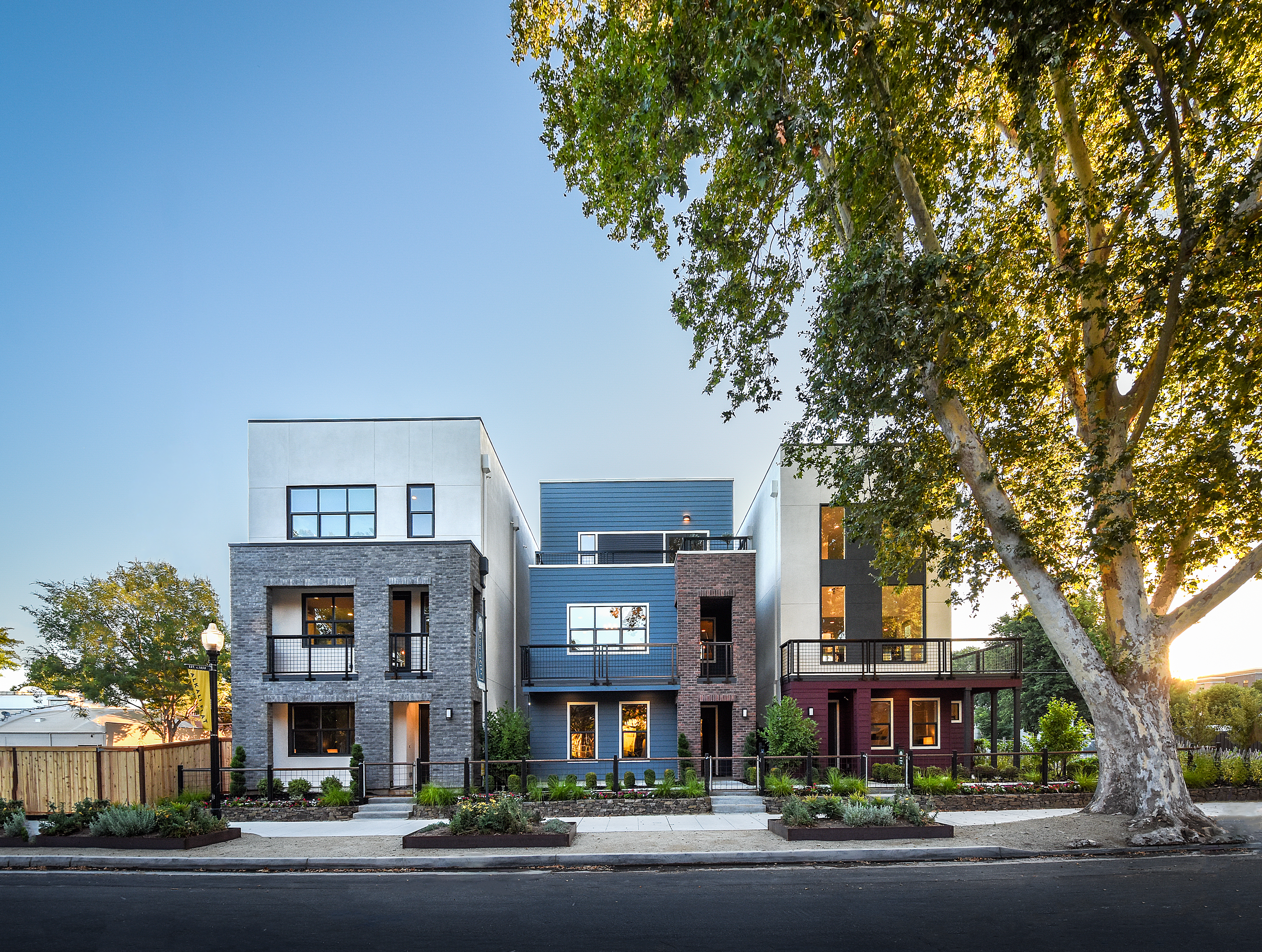
Homes in The Creamery, an upscale development walking distance from downtown Sacramento.
BlackPine Communities
At the center of the thriving business district, which now has its own trendy moniker (DoCo, or Downtown Commons), the arena opens onto a plaza boasting an $8 million stainless steel statue of a piglet by Jeff Koons. Sacramento Kings owner and local tech entrepreneur Vivek Ranadivé calls the space the neighborhood’s “communal fireplace.”
Across town, the Creamery, 122 modern single-family homes, seeks to lure a “heady brew of professionals, ‘creatives,’ young families and energetic mid-agers” (who can afford housing in the high $400K range).
Many out-of-towners are discovering the burgeoning city, which is equidistant from San Francisco and Lake Tahoe and offers the best aspects of the Northern California lifestyle for a fraction of the price. This “cow town,” in fact, was recently anointed one of the nation’s busiest real estate markets for 2017 by Realtor.com.
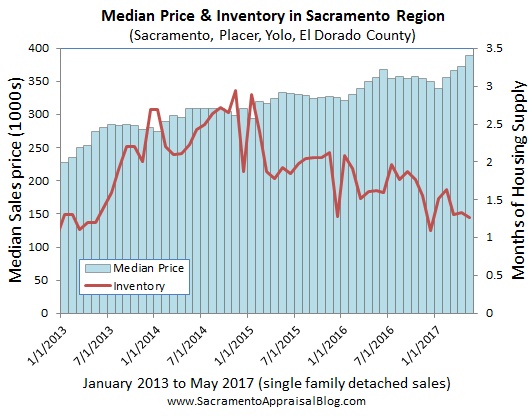
According to the Sacramento Association of Realtors, new construction hasn’t kept up with demand, while buyers from the Bay Area are beginning to flood in, leading to incredible competition for new developments and the city’s stock of Victorian homes as well as a steady uptick in the average home price. It hit $317,000 in April, up from $311,000 in March and $295,000 in April 2016. Median rent is up 18 percent since 2000, according to the California Housing Partnership Coalition. The average home is on the market for just eight days, and homes near the $300,000 mark were spending just 14 days on the market, a record low.
“The run-up in cost for the Bay Area is helping our market, and people are finding Sacramento is a great place to live,” says Mike Paris, founder of BlackPine Communities, the local developer behind the Creamery. “It’s the first time I’ve seen the lines blur between the Bay Area and Sacramento.”
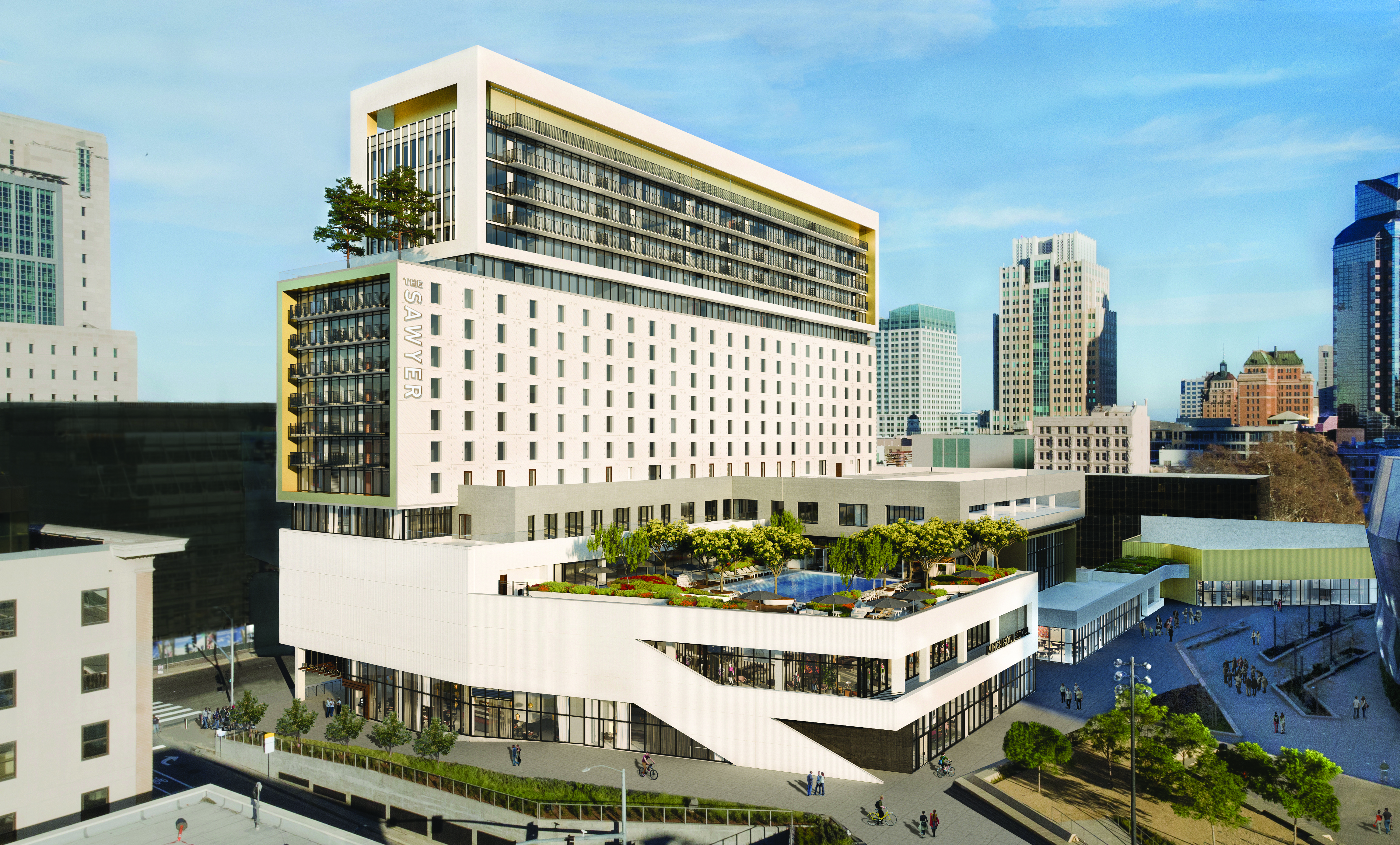
Rendering of the Residences at Sawyer, the high-end condos overlooking the Golden 1 Center.
Is the Bay Area changing Sacramento, or as one local realtor, Pat Shea of Lion Real Estate, put it, has what happened to San Francisco—the insane homes prices and ever-tightening inventory—already arrived in the nearby city? It’s true that Bay Area prices—$531 a square foot on average compared to $228 per square foot in Sacramento—have meant more people are relocating to Sacramento (20,000 a year, according to census data). With telecommuting increasingly acceptable, more are willing to make the commute or split their time between both cities. According to 2013 census data, of the 2.4 million people living in the six-county Sacramento region, about 119,000 work in the Bay.
But Sacramento isn’t growing faster than any large California city, at 1.4 percent more residents a year, simply because it’s a cheaper satellite city for Bay Area techies. It’s coming into its own, and just happens to be near a metro area filled with residents looking for a cheaper option for urban living.
“The quality of life in Sacramento is what will attract talent,” says Randy Koss, the senior vice president of real estate development for the Sacramento Kings. “There’s a lot more things for people to do here, and that just attracts more talent.”
Koss should know, since his work on the Golden 1 Center and surrounding properties has been one of the key changes anchoring downtown growth. It’s a big turnaround from decades of shrinking density. Between 1950 and 1970, the city’s downtown shrunk by half, going from 58,000 to 27,000, all while outlying areas and the suburbs boomed. It’s only been during the last five years that downtown Sacramento has truly bounced back. Paris compares the shift, in part, to the trend of urbanizing suburbia, trying to provide an identity to places that grew up without a “there” there.
The Golden 1 Center has been highlighted in stories of the city’s resurgence, and for good reason. The development, on the site of a former mall, will include a 250-room luxury Kimpton hotel topped with 45 luxury condos, the Residences at Sawyer (the building’s $4.1 million penthouse, like the other units, is being sold by a firm based in Beverly Hills); ground-floor retail; a massive Macy’s; as well as a state-of-the-art, year-round entertainment and sports facility. It planted a flag for development, and others followed.
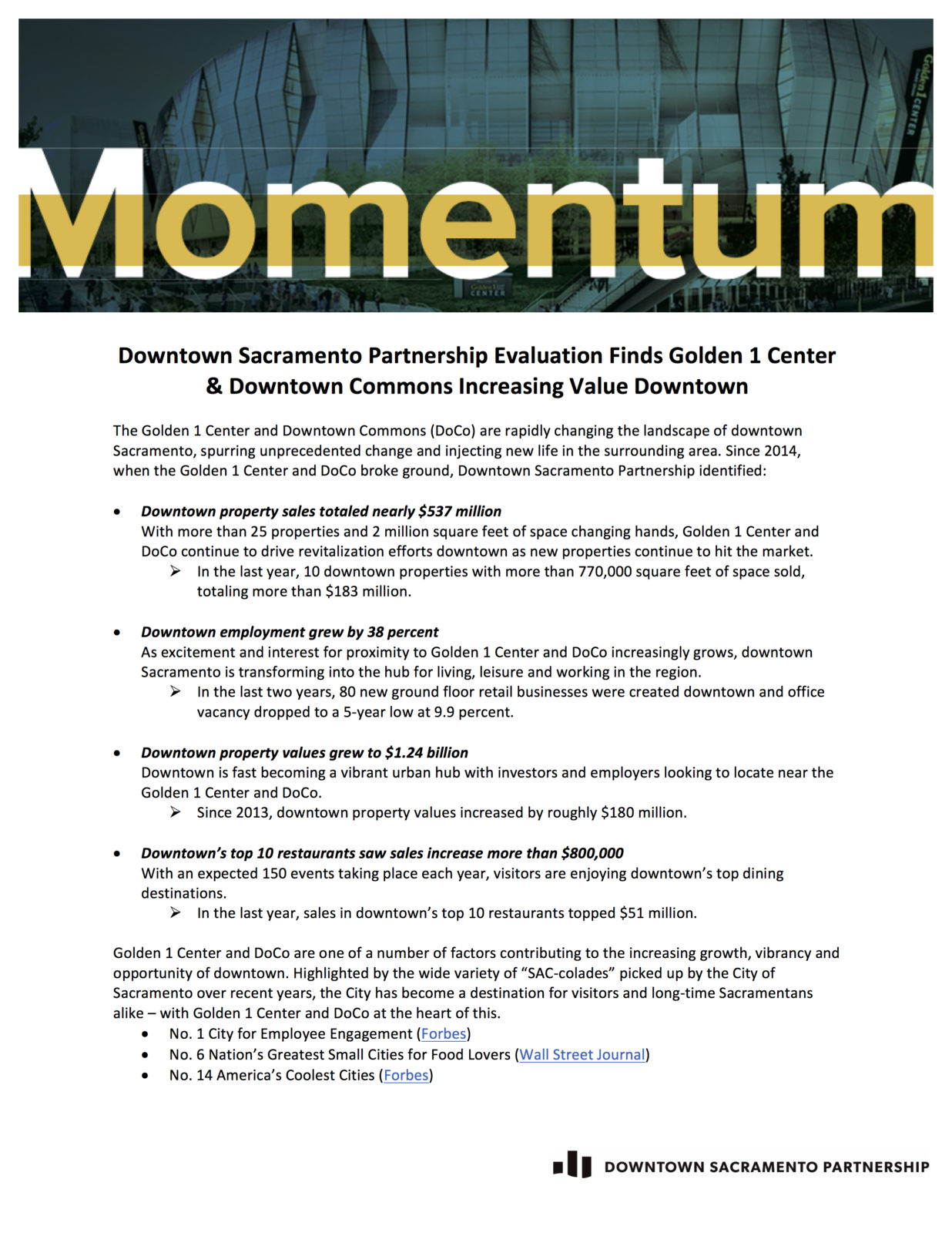
According to the Downtown Sacramento Partnership, in the 26 months the complex was under development, $530 million in real estate transactions took place in a 10-block radius around the arena, more than 80 new businesses moved downtown, and neighborhood employment jumped 40 percent. Breweries and tech companies have also set up shop, making Sacramento an even bigger draw for those seeking out a more urban lifestyle.
But the massive capital investment in the new stadium was capitalizing on earlier bets on Sacramento’s economic future. Investment in the city’s medical industry from players such as Kaiser Permanente brought in the jobs that have become early catalysts in driving more downtown investment.
Local appraiser Ryan Lundquist, who runs the Sacramento Appraisal Blog, agrees the new crop of Bay Area arrivals has changed the market. But he cautions others not to overstate their impact or lose sight of what’s happening organically in Sacramento. For instance, cash sales for homes have hovered at 13 to 15 percent of the home market over the last few months—not exactly a sign of rich startup founders swooping in en masse with stacks of VC money. He says the city’s inventory shortage can in part be traced back to the lingering impact of the recession, which hit here earlier (2005) and lasted longer (2012) than elsewhere in the country.
“Our location hasn’t suddenly changed,” he says. “We’ve been the same distance from the Bay Area forever. People are just starting to recognize Sacramento more, especially since our Midtown has been gentrifying for the last 15 years or so, easily. The more it grows, and the better it gets, the more people are recognizing what Sacramento has to offer. Lots of Bay Area investors have actually come to town without realizing how competitive it is here.”
There will soon be much more real estate to bid over. A number of high-profile projects under construction or in the planning stages, especially along K and R streets. New developments are rising in downtown and Midtown; housing is going up in Curtis Park, already filled with covetable historic housing; and new homes are being built in the Bridge District, a neighborhood in nearby West Sacramento, a town just across the river, set to house 9,000 when it is finished.
Perhaps most promising is the Railyards, a 224-acre infill project among the largest of such developments in the country. The former western terminal of the nation’s first transcontinental railroad will be transformed into a huge mixed-use hub for commercial, residential, and even museums. For scale, the titanic Hudson Yards development in Manhattan is just 28 acres. Kaiser Permanente alone purchased an 18-acre site within the plot and plans a massive facilities expansion and half-billion-dollar new hospital.
The Railyards might also be the home of a new Major League Soccer team, if Sacramento wins its bid for an expansion team. Koss says it would form a triangle of activity downtown; connect the MLS team to the Golden 1 Center to the ballpark for the San Francisco Giants’ minor league team, the River Cats, and you have a core of development crisscrossing the Sacramento River. Sure, the offerings aren’t as varied as they are in the Bay Area. But increasingly, that seems to be a major selling point.
Oh, the pain, the pain — and the cost, the cost — of renting a Bay Area apartment.
A luxury condo sold last month in San Francisco’s Russian Hill neighborhood for $4.35 million. It’s a two-bedroom, two-and-a-half-bath, 1,960-square-foot unit lined with walls of windows, mimicking the style of a mid-century Eichler home. Set on the 31st floor at 999 Green Street, with expansive views of the city, the apartment’s cost per square foot is $2,219.
“That means that just one foot of the place is more than you pay in rent for your tiny San Francisco apartment,” wrote Alexa Collins of the Homelight real estate website. “You could probably fit a toaster in that space. Or a corner of your bed.”
The cost per square foot is close to a match for what many people pay for two-bedroom apartments in San Jose, Oakland and other Bay Area cities. According to a June report from ApartmentList.com, which tracks the national apartment market, the median monthly rent for a two-bedroom unit in San Jose was $2,570 last month. In Oakland, it was $2,500.
However, San Francisco is a slightly different story. One might say that the value of two square feet at 999 Green — $4,438 — is more in line with what San Francisco tenants pay for their two-bedroom apartments. According to ApartmentList.com, the median monthly rent for a two-bedroom flat in San Francisco was $4,550 last month.
The Summit on San Francisco’s Russian Hill is influenced by the design of midcentury Eichler homes, which have walls of windows and light-filled interiors. A condominium on the 31st floor of The Summit sold last month for $4.35 million. (Courtesy Alexa Collins, Homelight.com)
(The Green Street condo was sold through Sotheby’s International Realty and its agent Betty Brachman.)
And in case you were wondering about those walls of windows: 999 Green Street is known as The Summit. It is a modern Eichler-style apartment house, described by Collins as “a rectangular skyscraper with a beige central concrete column that divides the building in half. You’ll find resemblance between the facade of Eichler houses and this building in the two walls of windows that make up the four corners of each unit. San Francisco’s elite (who) own property in the mid-century modern … units have sprawling views of the city.”
Developer Joseph L. Eichler built distinctive, mid-century tract homes that create the sense of bringing the outdoors into their flowing, light-filled interiors, lined with windows. In 1949-1974, Eichler — while based in Palo Alto and, later, San Francisco — built 10,500 houses across the region, even entire Eichler neighborhoods, from Walnut Creek to San Jose’s Willow Glen.
This is the floor plan for a luxury condo that sold last month on San Francisco’s Russian Hill for $4.35 million. Each square foot of the unit has a value of $2,219. (Courtesy Alexa Collins/Homelight.com)
SAN FRANCISCO and OAKLAND, Calif., July 10, 2017 (GLOBE NEWSWIRE) — Housing developers and multifamily property management firm Thompson International Professionals is expanding into mixed use commercial real estate development with a series of acquisitions and development projects slated to come online in late 2017 and 2018.
This reorganization and expansion repositions Thompson International Professionals as a parent holding company that will allow the company to focus on a wider range of opportunities covering all of the various company holdings in commercial, retail, hospitality, and multi-family developments coming online.
The first new project slated in 2017 is a condominium development project in the San Francisco/Oakland Bay Area featuring 32 Units that is expected to break ground later this year. Other projects will come online over the next year in other locations around the country. ”The executive team is excited about the new reorganization and hopes to make an impact in providing quality housing in underserved inner city markets,” Stated CEO James Thompson.
TIP Real Estate Development will develop new communities and seek acquisitions to add to the firm’s growing portfolio. TIP Real Estate Investment will continue to invest and acquire well-positioned properties leveraging our ROI projections and goals. TIP has wide-ranging experience and partnerships in areas including operations, marketing, sales, branding, training, asset management, business development and communications for a broad range of commercial, retail, and residential classes.
ABOUT THOMPSON INTERNATIONAL PROFESSIONALS COMPANIES
TIP Real Estate Companies provides an end-to-end suite of services including developing exceptional mixed use commercial and community based projects, retail franchises and operations, affordable housing, hospitality, entertainment venue management and productions, and high end condominiums and residential apartment development and management operations for its partners, investors, and its wholly owned subsidiaries. TIP sources high value acquisition opportunities for investors, growing Net Operating Income (NOI), and Return On-Investment (ROI) through exceptional management, and assisting in dispositions. The privately-owned firm is based in New York City with satellite partnership offices in Los Angeles, SF/Oakland, Atlanta, Chicago, and Johannesburg, SA.
Facebook is to build its own “village” of 1,500 homes for workers struggling to pay soaring rents as the housing crisis in Silicon Valley deepens.
The social networking company has submitted plans to the local council to create a new neighbourhood of homes, shops and a public plaza across the street from its global headquarters.
Mark Zuckerberg’s company said it was being forced to build the “mixed-use village” called Willow Campus in Menlo Park, about 30 miles south of San Francisco, because the regional government’s “failure” to invest in infrastructure has led to sky-high rents and hours-long commutes to work.
“Our goal for the Willow Campus is to create an integrated, mixed-use village that will provide much-needed services, housing and transit solutions as well as office space,” John Tenanes, Facebook’s vice-president for global facilities, said after the company submitted plans to Menlo Park officials. “Part of our vision is to create a neighbourhood centre that provides long-needed community services. The region’s failure to continue to invest in our transportation infrastructure alongside growth has led to congestion and delay.”
Kirsten Keith, the mayor of Menlo Park, welcomed Facebook’s plan to help address the rent-price-rise crisis caused by the rapid growth of west-coast technology companies. More than 640,000 new jobs have been created in the San Francisco Bay area since 2010 but house-building has failed to keep even close to that pace of growth.
“Peninsula cities have a housing crisis,” Keith tweeted. “I hope more tech companies come forward with affordable housing proposals as Facebook has done.”
However, just 15% of the Facebook homes will be offered below market rates. The apartment block homes, which the company hopes will be built by 2021, will be available to Facebook employees and those working elsewhere.
The average monthly rent in Menlo Park has more than tripled to $3,349 (£2,600) since 2011 when Facebook announced it would move to the city, according to property data site Rent Jungle. Menlo Park’s rents, which rise to an average of $3,934 for a two-bed apartment, are some of the highest in the country and considerably higher than in New York City.
The median house price across Silicon Valley has jumped from $535,000 in 2012 to $888,000 last year, according to real estate agency Trulia.
Zuckerberg, 33, who is the world’s fifth-richest person with a $64.7bn fortune, owns several homes worth tens of millions of dollars. He spent $30m buying up four houses surrounding his Palo Alto home in an effort to protect his privacy. He’s also spent $100m on a 700-acre plot on the Hawaiian island of Kauai and $10m on a home in San Francisco’s Dolores Heights.
More than 9,000 people work at Facebook’s offices in Menlo Park, according to the city. The number of staff has increased by 54% over the past year and is expected to continue to rise quickly as a larger office campus opens.
The huge influx of staff at Facebook and other large tech companies has forced thousands of key workers out of the area and many teachers, cleaners and support staff battle through miles of congested highways to work each morning. Tech workers are often bussed to offices in company-branded vehicles, angering local people who are concerned about growing inequality in the area.
Facebook, which made profits of $12.4bn last year, has previously been criticised for exacerbating the housing crisis in Menlo Park by offering its staff a $10,000 bonus to move closer to its head office.
John Liotti, chief executive of Able Works, a charity representing key workers, said at the time of previous iniative in 2015: “A lot of local families are going to get hurt.” Facebook said that scheme was “to support our employees and the people who matter most to them at all stages of life”.
Facebook’s proposals for the Willow Park development, which will include a grocery store and pharmacy, have been welcomed by Diane Bailey, executive director of community group Menlo Spark. “We feel that Facebook genuinely wants to be a good neighbour,” she said. “They appear to have heard the requests of the community and they want to meet those requests. The area has not had a grocery store or pharmacy for a long time.” It can take more than half an hour to drive to the nearest supermarket four miles away due to traffic jams.
The social network has also committed to spending $1m exploring the idea of reopening an old railway line that runs through the company’s campus and is “investing tens of millions” to improve a highway – US 101 – that runs from the office to San Francisco. There are no plans to build a new school.
Facebook is not the only company seeking to tackle the housing crisis. Last month a spokesperson for Google said it would spend $30m on 300 prefabricated apartments for workers at its campus headquarters in nearby Mountain View.
Carol Galante, faculty director of the Terner Center for Housing Innovation and a former federal housing commissioner, said: “We’ve reached a tipping point where costs are just so high that people are desperate to figure out a solution.”
Tenanes said Facebook’s planning application was “only the beginning … Going forward we plan to continue to work closely with local leaders and community members to ensure Facebook’s presence is a benefit to the community,” he said. “It’s one we’re lucky to call home.”