On Tuesday, the United States Senate and House of Representatives passed a bill that would restructure America’s tax code. But in the process of negotiating the details, the two houses ended up with a tax break for homebuyers that prices out most Bay Area properties.
Earlier this week, California Sen. Dianne Feinstein noted the most recent version of the tax bill (which will likely pass its final House vote today) includes a mortgage interest deduction for homes that cost $750,000 or less.
That’s a huge amount of money most places in America, but not in some of California’s largest metro areas.
“In California, seven counties have average home prices that are more than $750,000: Alameda, Marin, Orange, San Francisco, San Mateo, Santa Clara and Santa Cruz counties,” Feinstein said via Twitter.
Feinstein is right about the numbers. The final version of the mortgage interest deduction is a compromise figure: The House bill put in a cap of $500,000 and the Senate bill had $1 million (which is the present cap), so the two bodies ended up with $750K in the end.
And Feinstein is also right about the price of real estate in those seven California counties, according to the California Association of Realtors (CAR). In fact, CAR estimates the median price of a home in the Bay Area was over $900,000 in November.
Of 424 San Francisco properties presently listed on real estate site Redfin, only 61 are priced at $750K or less and six of those are just vacant land. Under the present, $1 million cap, the number of potentially eligible properties rises to 164.
[Update: Reader Aaron Master notes that Feinstein’s tweet appears to misinterpret how the deduction cap operates: “The way caps work is that you only get the first $750k of interest on your mortgage. For example, if you are so fortunate as to buy a $1M house you usually put 20 percent down leaving you with a $800000 mortgage. Under the new plan, interest on $750000 of the $800000 is deductible.
[...] “Therefore to figure out the max purchase price if you want to deduct all $750k worth of interest you take 750000/0.8 to get $937,500, which is higher than the 750k number.” Although notably still less than most houses in San Francisco.]
Some of the responses to Feinstein’s tweet noted that those buying $750,000 homes—more than twice the median home price in the US, according to the U.S. Census—in San Francisco or Marin may not really need the tax break.
By
As Beacon Economics co-founder Christopher Thornberg told the LA Times, “If you are borrowing a million bucks to get a home, the write-off is not your primary concern.”
But it is one more case where the spiraling price of buying in the Bay Area turns values and expectations upside down.
Docking the mortgage cap is supposed to be a hit at luxury real estate. However, as Jordan Weissman wrote for Slate, buyers “stuck house-hunting in San Francisco or New York” end up swept up by default. Because any new rule aimed at high-end luxury homes is going to hit most of San Francisco—even the teardowns.
The new tax plan has been framed as a deathblow to the American dream by some real estate professionals and groups, who warn of falling home prices, a new generation trapped in renting, and an exodus of residents from the highest-cost cities and states.
But are these fears surrounding the new, lower cap on mortgage interest deduction—and the incentive for taxpayers not to use it—overblown? Or are there indeed big repercussions to come? That all depends on whom you ask—and where they live.
The Republican tax plan allows taxpayers to deduct mortgage interest on loans up to only $750,0000 combined for both primary and secondary (vacation) homes. The previous limit was $1 million.
The U.S. House of Representatives passed the plan on Tuesday, but will need to hold a revote, likely on Wednesday. Several provisions appear to be in violation of U.S. Senate rules. The Senate was slated to vote on the proposal on Tuesday as well, and President Donald Trump is expected to sign it into law before the end of the year.
The vast majority of new homeowners won’t be affected, as the median home price is nowhere near $750,0000. The median list price is $270,000 nationally, according to realtor.com® data.
Existing homeowners will be grandfathered into the previous deduction limit. So the new cut is expected to affect only about 1.3% of new mortgages, according to realtor.com data. These are likely to be awarded to the wealthiest homeowners, who can at least theoretically afford the cuts, and those living in the most expensive parts of the country.
What’s more worrisome is that fewer homeowners are likely to take the mortgage deduction. That’s because the new tax code will double the standard deduction, to $12,000 for individual filers and $24,000 for married couples filing jointly, and eliminate many of the other available deductions for taxpayers. So there’s less of an incentive to itemize.
“On a scale of 1 to 10 on if interest deductibility is going to have a big impact on housing, it’s a 2,” says Ken Johnson, a real estate economist at Florida Atlantic University in Boca Raton. “It’s not clear that it will hurt housing. But it is clear that it’s not going to help.”
That’s because most taxpayers don’t itemize their tax bills anyway, so they aren’t taking advantage of the available deductions. Only about a third itemize, and 21.5% claim the mortgage interest deduction. The mortgage deduction netted them an average $8,612 write-off in 2015, according to the Pew Charitable Trusts.
“When you take the standard deduction, you’ve lost that subsidized benefit of homeownership,” Johnson says.
Fewer homeowners taking the deduction may be a good thing after all
Losing the mortgage write-off isn’t necessarily a bad thing. Some housing experts have described it as wasteful and blamed it for inflating housing prices and encouraging buyers to borrow more money for bigger houses, according to the New York Times.
“My basic view is if you subsidize something you’ll get more of it,” Edward Pinto, co-director of the conservative American Enterprise Institute’s Center for Housing Markets and Finance, told the Times. “And as a country we’ve been subsidizing debt.”
The mortgage interest deduction was created in 1913. It was a byproduct of Congress making interest deductible when it passed the first income tax.
“It feels problematic to be using the tax code to support people buying houses that are this expensive or, even worse, to be encouraging housing prices to rise further,” Harvard economist Edward Glaeser told the Times.
So who will mourn the changes to the deduction?
Residents of cities and states where housing costs and taxes are sky-high are likely to be hardest hit by the changes to the tax code. Those hailing from Washington, DC; California; Hawaii; Massachusetts; and New York will be the most affected, according to realtor.com data. These states have the highest percentages of mortgages worth $750,000 and up.
“At a national level, it’s not likely to affect very many people,” says Joseph Kirchner, senior economist at realtor.com.
However, he adds, ”in certain high-housing-cost markets, it is still a concern because there will be significant numbers of people who’ll be impacted.”
Those folks could lose out on several thousand dollars a year in tax refunds, says Patrick Carlisle, chief market analyst at the Paragon Real Estate Group, based in San Francisco.
“In an area like ours, where our median house price is $1.5 million, it’s not a huge [decider] in someone making a decision to buy a home. Even the previous limit was well below what many buyers in San Francisco” were spending, he says. “It’s property taxes and state income taxes that are going to have a grievous effect on residents in states like California, New Jersey, and New York.”
That’s because residents will be able to write off only up to $10,000 in property and either income or sales taxes. So the property tax bill on that $1.5 million abode is likely to be more than $15,000. When folks can no longer deduct their income tax as well, it means that owners’ bank accounts are likely to take a big hit.
“Everything combined is where the whammy” comes in, says Carlisle. He fears more people will leave and fewer will come into the San Francisco Bay Area, where residents may make more but also spend more due to expensive housing and overall cost of living. “It certainly doesn’t incentivize someone to live in the Bay Area or a buy a home in the Bay Area.”
Will these changes dissuade buyers from becoming homeowners?
Whether or not they can deduct the mortgage interest is not likely to dissuade too many people from buying. Homeownership is the American dream, after all. Conventional wisdom says it’s an opportunity for the middle class to build equity and wealth over time. Plus, many folks don’t like the idea of forking over their hard-earned cash on rent or not being able to modify their abodes as they wish.
But the changes could dissuade some buyers on the margins to continue renting. That’s because when these more cash-strapped folks do the math, they won’t be saving nearly as much by owning the roof over their heads.
This could lead to housing prices to fall. Or, if more prospective buyers suddenly see more money in their paychecks thanks to the tax cuts, they could enter the market. And that could push prices up.
“I just don’t see [the mortgage interest deduction] as as big of a deal as everybody is concerned about,” Johnson says. “Most people have already stopped using the deduction.”
Bay Area home prices raced upward again in November, climbing 12.5 percent beyond their levels of a year earlier.
It was the steepest regional increase in the state, bringing the median price of a single-family home across the nine-county region to a lofty $910,350, according to the latest analysis by the California Association of Realtors (C.A.R.).
The Bay Area “continues to reflect dire market conditions of tight supply and low affordability,” the report said.
Prices rose 27 percent year-over-year to $1,282,500 in Santa Clara County and 22.1 percent to $1,486,000 in San Mateo County. The year-over-year price jumped 10.3 percent to $1,500,000 in San Francisco; 10 percent to $880,000 in Alameda County; and 8.1 percent to $615,000 in Contra Costa County. Among the nine counties, only in Solano County, where the median rose 7.9 percent to $410,000, did the November median fall below the statewide figure of $546,820.
As in past months, the lack of inventory is the key to the region’s affordability crisis.
Active listings dropped 17 percent year-over-year across the nine counties — and by 36 percent in Santa Clara County alone. With so few homes available to potential buyers in a market where the job force has continued to grow, prices inevitably are pressured upward.
Also, because of the exceptionally tight supply, homes get snapped up fast.
Statewide, single-family homes typically spent 22 days on the market, down from 30 days in November 2016. In the Bay Area, homes spent just 15 days on the market last month, down from 22 days a year earlier. In Santa Clara County, homes spent a mere nine days on the market, sharply down from 17 the year before. In Contra Costa County, the median days on market fell from 17 to 14.
C.A.R. also measured the amount of unsold inventory on the market.
Statewide in November, the unsold inventory stood at 2.9 months. That’s how long it would take to sell the supply of homes on the market at the current sales rate. In the Bay Area, the unsold inventory was about half that: 1.5 months. In Santa Clara, San Mateo and Alameda counties, it was even less: the unsold inventory stood at just 1.2 months.
Remarkably, given the slim pickings, sales inched upward across the region, by 0.7 percent from November 2016.
Across the state, the year-over-year sales increase was 8.8 percent, the largest gain since January 2016. But that bit of good news comes with a caveat, according to 2018 C.A.R. president Steve White.
“While high-priced markets have performed well in recent months, sales remain lackluster in the lower-priced segments as the supply of affordable homes continues to shrink,” he said. “This tale of two markets is not a story that we enjoy telling as the dichotomy in the market is posing some affordability challenges to many potential homebuyers who want to enter the market.”
Reporting about the rising real estate and housing costs in San Francisco and the Bay Area isn’t exactly breaking news. But a new study published this week demonstrates just how much pressure high-income new arrivals have placed on the region’s real estate market, and how wealthier and wealthier individuals are getting pushed out by the seemingly inexorable rise in housing costs.
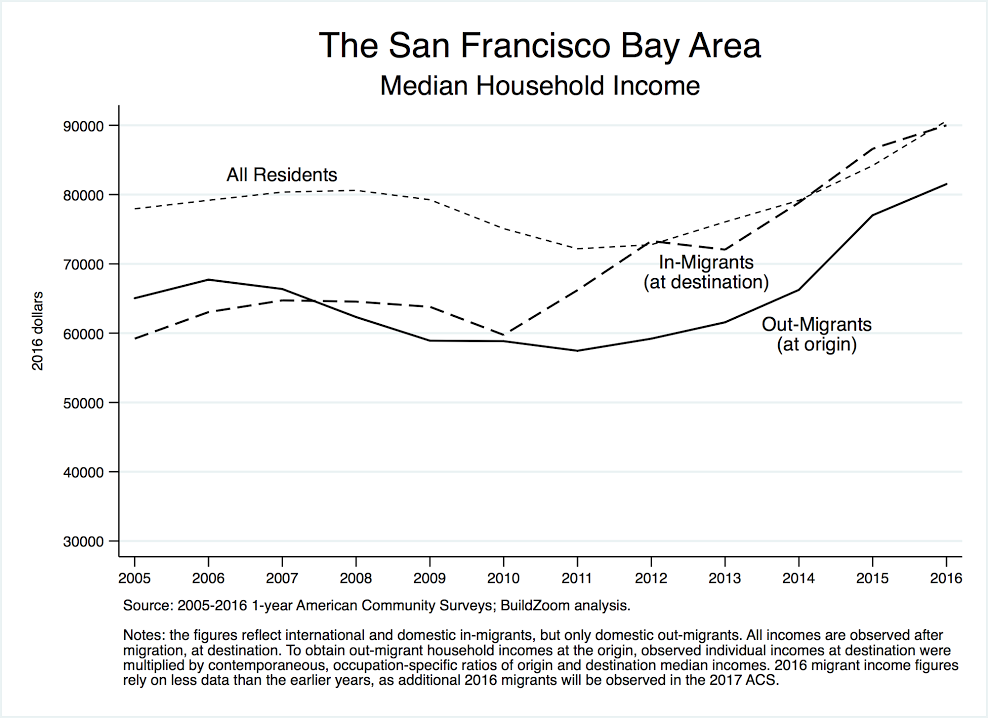
Last year, the income of those leaving the Bay Area reached $81,500, while the average household income of new arrivals hit $90,000. These stats make the region a significant outlier on a national level, and offers more proof of the region’s accelerating real estate values, its affordability crisis, and the claim that wealthy former San Franciscans are puttingpressure on a number of nearby cities.
The research and report, conducted by Issi Romem, chief economist at BuildZoom, and published by SPUR, a Bay Area urban planning and research non-profit, shows how rising prices are impacting migration. It suggests that those feeling deterred from moving to the region due to high prices, as well as those who leave the area because of the same high housing costs, are at a higher income level that some may have expected.
“By dampening the flow of newcomers and tipping the scales so that more residents leave, the rising cost of housing prevents the population from exceeding what the current housing stock can accommodate,” Romem writes. “This price driven mechanism has implications with respect to the identity of who moves to the Bay Area, who stays and who leaves, however.”
Issi Romen
Romem examined 12 years of data from the American Community Survey and found that the incomes of those moving in and moving out rose faster than the area average. That suggests a few things. In-migration is becoming more financially selective, and attracting those employed in high-wage sectors of the economy, likely the tech sector (61 percent of new arrivals have a college degree, versus 47.7 percent of current residents). Increasingly higher incomes are needed to make a move here financially viable.
In addition, higher and higher costs have changed the calculus for even wealthier segments of the current Bay Area population, making it more attractive to sell homes in this hot market and use the proceeds to move to a less expensive city. Those on higher rungs of the socio-economic ladder are also feeling shunned, and see greener pastures elsewhere. Romem found that while those leaving the Bay Area saw their salaries drop from $81,500 to $68,200 once they left, on average, even that new, lower paycheck was better than the median salaries in most major U.S. cities, including Chicago, Los Angeles, Dallas, and Atlanta.
The Bay Area is still a relatively dynamic regions. Roughly 1.7 million people left and nearly 2 million moved in between 2010 and 2016, Romem found, indicating one-fifth of the population changed. New residents aren’t all high flyers, either: more than half a million migrants with income below $50,000 arrived during that period, 337,000 of whom came from elsewhere in the U.S.
But as these migration figures make clear, the population is increasingly skewed towards high earners, making the Bay Area less hospitable to those with lower salaries. “The human cost is real,” he concludes, noting that “Those leaving the area or deterred from moving to it pay a price in terms of lost opportunity. It is ironic that for many Bay Area homeowners, realizing the gains from escalating property values requires leaving the Bay Area.”
Imagine a Bay Area with highways that flow instead of grind to a halt. With trains that ring the bay, some running 24 hours a day. With ferries that stop at more than a handful of terminals and autonomous buses cruising in their own lanes, blasting past cars on the freeway.
If that sounds like a fantasy, just wait. The dream may be closer to reality than you think.
A coalition of Bay Area business leaders represented by the Silicon Valley Leadership Group and the Bay Area Council, along with the urban planning think tank SPUR, say that dream is the answer to traffic congestion on Bay Area roads, which grew 84 percent between 2010 and 2016. The average commuter now spends more than 29 hours a year slogging through highways at speeds of 35 mph or slower.
“People are wasting hours of their life in traffic,” said Gabriel Metcalf, the president and CEO of SPUR. “Conversations started all over the Bay Area asking the question, can we do something at a bigger scale than we have done before? Big enough to actually solve the problem? Big enough to actually get us a different regional transportation system than we have today?”
Securing passage of Regional Measure 3, the proposed $3 toll increase on most bay bridges, is the first step, Metcalf said. But it’s a small one paving the way for a much bigger ask: A “mega measure” to fix traffic in the Bay Area for good — or at least for the foreseeable future.
For Oakland resident Lynn Hall, relief can’t come soon enough. She commutes to Redwood City and said it’s becoming impossible to get around.
“It’s crazy,” Hall said. “It feels like there are just too many people here. Our roads just can’t handle the capacity of the traffic we have.”
It’s too early to specify what transformative projects Bay Area residents can expect as part of this mega measure, said Carl Guardino, president and CEO of the Silicon Valley Leadership Group. However, early conversations have shed some light on the direction it might take.
The plan would almost certainly include a major expansion of train service for BART and Caltrain, said Jim Wunderman, president and CEO of the Bay Area Council. First on the list is a second tube, or bridge, for BART, which would allow 24-hour service, minimize the impact from a massive earthquake wiping out the existing Transbay Tube, and provide relief for trains bottle-necking in West Oakland. That tube could include Caltrain, or there could also be a new bay crossing, likely a bridge, to carry Caltrain, high-speed rail, or both, along with cars, Metcalf said.
There could be a vast network of toll lanes ringing the bay and radiating to the north, east and south, he said. They would run parallel to or even share lanes with buses. In turn, those buses, which will one day likely be autonomous, would cruise along at much faster speeds because they would be separated from single-occupancy cars, Metcalf said.
There could be dramatically expanded ferry service, and better access to the North Bay, he said.
“It’s really important to connect to the North Bay,” Metcalf said, “whether that means expanded ferry service or connecting to the SMART train. It seems like a good opportunity.”
It won’t be cheap.
There’s no price tag, at least not yet, but early estimates indicate it could be in the ballpark of $100 billion. To put that in perspective, the state’s gas tax is estimated to generate $130 billion over 25 years. And the proposed $3 toll hike is expected to generate between $4 billion and $5 billion over the same time period.
It won’t be easy, either.
Architect Jeffrey Heller is photographed in his office on Monday, May 22, 2017, in San Francisco, Calif. Heller has been working for a year with local and state agencies on a conceptual Bay Region transportation plan. (Aric Crabb/Bay Area News Group)
Bay Area residents have been asked repeatedly in recent years to fund maintenance and expansion projects. Alameda, Contra Costa, San Francisco, San Mateo and Santa Clara counties all have existing half-cent sales taxes for transportation improvements. Beginning Nov. 1, drivers started paying 12 cents more at the pump and will soon be paying more to register their cars. And then there are the special assessments for BART and AC Transit in the East Bay, along with a new proposed 1/8th-cent sales tax for Caltrain in San Francisco and the South Bay.
There’s a threshold for how much people are willing to pay, said Congressman Mark DeSaulnier, D-Concord. He’s a proponent of expanding the Bay Area’s transportation network and recently joined Sen. Dianne Feinstein in calling for a new bridge across the bay for cars and BART, but he said safeguards should be put in place to ensure any new tunnel, bridge or toll lane project is rooted in data documenting what will move the most people.
“Historically in this country, too many projects have been based on political relationships,” DeSaulnier said. “That part of the system is failing us.”
The Bay Area Council, Silicon Valley Leadership Group and SPUR have already hired SCN Strategies, Gov. Jerry Brown’s campaign firm, for what they expect will be a lengthy public outreach period. They promise no decisions will be made until there’s strong analysis backing any proposed project.
“It takes a lot of public will and the resources to do this,” Guardino said. “This is nine counties, 101 cities, 33 or 34 different transit districts.”
It’s also 7 million people, including suburban and semi-rural residents who take only occasional trips to San Francisco and aren’t particularly interested in 24-hour BART service or ferries far from their inland homes.
But it’s not completely without precedent. Bay Area voters came together in 2016 to approve passage of a $12 parcel tax to fund wetlands restoration in the bay. It was the first regional tax of its kind in the Bay Area. But, Guardino said the measure sought a relatively small amount of money, an estimated $500 million over 20 years.
What SPUR and the two business organizations are contemplating is much larger, he said.
For that, Wunderman cited two recent successes in major West Coast cities as inspiration for the Bay Area’s own mega measure: Los Angeles voters approved a half-cent sales tax to drum up an estimated $120 billion over four decades for a dramatic expansion of the county’s light rail system, bus and rail operations, ongoing maintenance and fare subsidies. And Seattle voters agreed to a mix of sales, property and motor vehicle excise taxes to generate approximately $27 billion over more than 20 years to help pay for a nearly $54 billion expansion of the region’s light rail, bus rapid transit and train network, including a new transit tunnel below downtown Seattle and ongoing maintenance.
Central to both measures was a unified vision and a relatively small number of very large projects. They also both included future maintenance needs as part of the cost of building new infrastructure.
The last time the Bay Area did anything that big was the creation of BART, said Randy Rentschler, a spokesman for the Metropolitan Transportation Commission, the region’s transportation planning agency. Then, like now, it was the business community leading the charge, he said.
Jeff Heller, a prominent local architect who sits on the Bay Area Council’s transportation committee, acknowledged convincing the paying public will be the largest hurdle.
“The voting public has got to connect the dots that if they want the transportation issues solved, if they want access to housing solved, they’ve got to do this,” he said. “And they should want to do it, and they should even be excited about it.”