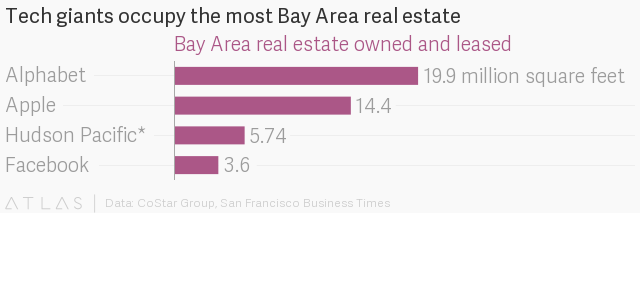
Alphabet, Apple, and Facebook have tens of thousands of employees in the Bay Area, all of whom need space to do their jobs. As a result, the tech giants command millions of square feet in the region.
Alphabet alone owns or leases 19.9 million square feet in the Bay Area, nearly four times as much as the area’s largest commercial real estate firm, Hudson Pacific Properties, according to the San Francisco Chronicle and San Francisco Business Times.
Next up? San Jose, which tech firms are eyeing to escape San Francisco’s skyrocketing real estate prices.
You know the generational drill—or at least you think you do.
Millennials, the conventional wisdom goes, are tech-obsessed, self-obsessed, debt-laden, and weirdly fascinated by beards and avocados. Generation X: cynical, self-reliant, often forgotten. Baby boomers: rebellious, materialistic, obstinate, unhealthily obsessed with late-night cable news.
But through all of their stark differences, card-carrying members of each group share one unifying goal: to live in a place that neatly checks off the boxes on their master list of needs, hopes, and dreams. As the millennials say, YOLO. Yet when it comes time to pack up the U-Haul and move to a new home, millennials, Gen Xers, and boomers all define this in different ways—and in different places.
The data team at realtor.com® set out to discover which are the hottest markets for each generation. And we confirmed that one size most definitely does not fit all when it comes to where these generation groups are moving and buying homes.
“The different generations are, for the most part, in different stages of life,” says Chris Porter, the chief demographer at John Burns Real Estate Consulting in Irvine, CA. So they “are seeking out locales that meet their specific needs.”
Despite the high cost, millennials are still headed to tech centers and cultural hot spots, where they can make good money and still have a good time. Meanwhile, Gen Xers, badly scorched by the Great Recession, are all about going to places where they can score a big home without going broke. And baby boomers/empty nesters are still heading to Sun Belt metros, where costs are lower, cold weather is in short supply, and they’ll have plenty of like-minded company.
As generations age, they’re likely to want some of the things generations before them did. But preferences change too.
Each generation “moves in the same direction [as the previous one], but not quite as far,” says Dowell Myers, an urban planning and demography professor at the University of Southern California, in Los Angeles. “They’ll always be uniquely different [from one another].”
To figure out the most in-demand metros for each generation, we looked at the following criteria:
The metros where each generation is moving, according to U.S. Census Bureau migration data* from 2011 to 2015
The metros where each generation is searching for homes on realtor.com by page views
Percentage change in homeownership from 2016 to 2018, according to Nielsen Holdings
(The Pew Research Center defines the millennial generation as being born from 1981 to 1998, Generation X from 1965 to 1980, and baby boomers from 1946 to 1964. Definitions of generations vary, but we tried to stick as close as the data would allow to the Pew definitions.)
It’s also worth noting that although Chicago and New York City have thousands of new residents moving in every year, they lose thousands, too. So we looked at metros that gained more folks than they lost. And because it’s not fair to compare a huge metro with a smaller one, we also looked at the percentage change of new residents from each generation moving in and out. That helps to control for population size.
Got it? OK, now let’s take a closer look at where millennials, Gen Xers, and boomers are most likely to head next. Some of this just might surprise you.
Millennials are flocking to big cities, despite the cost
Hottest markets for millennials
Claire Widman
You thought millennials were throwing in the towel on exorbitant urban meccas? Think again. Undeterred by the mind-boggling high prices for homes and just about everything else, young adults are continuing to flock to many of the country’s biggest and buzziest cities, particularly the tech hubs. These places simply offer the largest paychecks, as well as the lifestyle these folks are seeking.
So what’s a little more debt when you’re having fun?
You can’t get much more expensive than the San Francisco Bay Area. Yet the San Francisco metro grabbed the top spot on our ranking for millennials. The median home list price in the metro was $846,400, according to realtor.com.
But that didn’t stop Kaila DeRienzo. The 27-year-old was at the top of her pay scale at her public relations job in Norfolk, VA. So she packed up and shipped her belongings to bet on a future 3,000 miles to the west.
San Francisco, where the home prices are as steep as the hills
Nicolas McComber/iStock
“Jobs in the San Francisco area kept popping up in my news feed … jobs that I didn’t even know existed,” says DeRienzo. And, surprise: She turned out to love the place. “The city is so friendly.”
Hot job markets are extremely important for millennials, as is a lively nightlife scene with plenty of Instagrammable bars and eateries. And when millennials post selfies of all the fun stuff in their new hometown, it makes that place all the more enticing to pals back home.
“The biggest thing for me was that more and more people I went to college with were moving here,” DeRienzo says. “You see all things they post online and want to be part of it.”
Millennials may make up only about a third of buyers overall, but their portion is likely to keep growing. (They are the country’s largest generation, after all.) And that makes attracting these soon-to-be home buyers a priority for local governments.
“Millennials are saying, ‘We are willing to move for lifestyle and job,’ as opposed to, ‘I need to stay close to home because it’s safer and lower cost,’” as previous generations may have, says Jason Dorsey, chief strategy officer for the Center for Generational Kinetics, a marketing firm in Austin. “If communities position themselves correctly, and have the type of lifestyle [millennials] want, they absolutely can be a top choice for the future.”
There were some surprises on the list, smaller metros far from Silicon Valley and Silicon Mountain (Denver). But what the college towns of Ann Arbor and State College lack in size and prestige, they make up for in affordability.
Every year, thousands of recent high school graduates flock to Pennsylvania State University, in State College, and the University of Michigan, in Ann Arbor. Many of them stick around after graduation. And why not? The median home list price is just $235,550 in State College, whereas the national median is $269,500, according to realtor.com data. While Ann Arbor’s median price of $343,625 is a bit higher, the metro has a strong job market and is within commuting distance from Detroit.
“Within 15 minutes you can be hiking in the mountains or trout fishing,” says Tom Fountaine, the borough manager who oversees the administrative management for State College’s city government. “Thousands of acres in just minutes.“
Gen Xers want big paychecks and big homes
Hottest markets for Generation X
Claire Widman
With older, college-bound kids putting more of a dent in their wallets, many Gen Xers are moving away from costly coastal metros in pursuit of more space and good schools at a better price. And as everyone knows, everything is bigger in Texas. So it makes sense that five of the top 10 metros for Gen X are in the Lone Star State, with its cheaper cost of living, lower taxes, and more affordable homes.
“Generation X is looking for housing affordability, where they can meet the needs of growing families,” says John Burns’ Porter, adding they often prefer warmer weather and more business-friendly states as well. That may help to explain why “Texas has been one of the fastest-growing regions in the country for a while.”
Gen Xers are big fans of 2,400-square-foot, four-bedroom suburban homes in the $260,000 price range in Houston, says Greg Nino. And he would know: The Houston real estate agent at Re/Max Compass has a lot of these clients.
But that ardor was put on pause last year when Hurricane Harvey roiled the Houston housing market in August, destroying more than 15,000 homes, and causing more than $125 billion in damages, according to the U.S. Department of Commerce. Homes in flood plain areas are seeing price decreases. And some homeowners without flood insurance are now facing foreclosure.
Yet things aren’t as bad as some had feared; much of the area was spared the devastation. And there is no shortage of eager buyers moving in as the affected areas rebuild.
“We’re such a big city with so many jobs being added, that [Harvey] isn’t crippling us. It was a punch in the face, but we didn’t fall down,” Nino says. Gen Xers in particular, he adds, are “still taking advantage of the low prices and the low cost of living.”
The median list price in Houston is $318,000, compared with $846,400 in San Francisco. For a generational group badly hit by the recent financial downturns, that’s a life-changer.
The Dallas region, where the median home price is $342,500, has also seen a spike in buyers, as many companies have recently transferred to, expanded in, or opened up shop in the region. That includes Toyota, which relocated nearly 4,000 employees from other parts of the country.
Buyers there are seeking single-family homes in good school districts with reasonable commutes to their jobs, says local real estate broker Debbie Murray,of Allie Beth Allman Associates. In recent years the housing market has gotten hot, she says, and everything under $1 million goes fast.
“Gen Xers many times are looking for master-planned communities, with lots of amenities for their families,” Murray says.
Baby boomers are still moving to Florida—but it’s not No. 1
Hottest markets for baby boomers
Claire Widman
Some things never change. Wisconsin is crazy about the Packers. The car registration line at the local DMV doesn’t seem to ever move. And retiring Americans flock to the Sunshine State.
Florida claimed six of the top 10 metros for baby boomers, but—stop the internet—not the top spot. That honor went to Phoenix, where the median home price is $329,000. That’s not exactly cheap, but it’s still much lower than many other Western metros.
“A lot of [baby boomers] are looking to downsize,” says Lori Corwin, a local real estate agent at Realty Executives. Many of these buyers want to be near golf courses in Phoenix or in homes that require little maintenance, such as in 55-plus communities.
One of the pioneers of such communities is located in the Phoenix metro area. Sun City opened in 1960 specifically for retirees and snowbirds. During the peak winter months, its population soars to around 40,000.
Many of these locales also offer reasonable median home prices—which are quite a bit less than what these folks may have been paying in the pricier Northeastern states. For example, the median home list price in North Port was $350,000. Compare that with $493,000 in Boston and $415,000 in Washington, DC.
Did we mention the lower taxes? In Florida, retirees don’t pay income tax on withdrawals from their retirement accounts.
North Port–area real estate agent Mireille Devos has slowly watched baby boomers move in during her 15 years in the region. Initially, they bought second homes in the state while still working up north. She says many lost those homes when the housing bubble popped.
In recent years, things have picked back up because the economy’s improved. And North Port has been among the top beneficiaries. Devos, a real estate agent at U.S. Invest International, says the hurricane-free region has an edge over other Gulf locations.
The metro has also added the things baby boomers want: great restaurants, museums, cultural organizations, and beach activities.
“Fifteen years ago you had to look around for good cuisine,” Devos says. “Over the last three years it’s improved an awful lot.”
* The U.S. Census Bureau doesn’t group people by generation, so the realtor.com data team, like other publications, defined millennials as those aged 20 to 34, Gen X as those aged 35 to 49, and baby boomers as those aged 50 to 69. Individuals were grouped based on their age when they responded to the Census during the five-year period of 2011 through 2015.
SAN JOSE (KPIX 5) – A Bay Area landlord is fed up with the high cost of living, so he’s moving out. And he’s taking his tenants with him.
San Jose landlord Tony Hicks is fed up with the Bay Area. He’s moving to Colorado taking a houseful of his tenants with him.
It started when Hicks, who owns three houses in San Jose, started worrying about earthquakes.
“All that caused me to think about moving,” Hicks said. “Then the sanctuary state came on. That was kind of like a clue. And then I said okay, I think I need to go.”
But he didn’t want to leave his longtime tenants, whom he calls his friends, out in the cold. So, he asked them if they wanted to go with him. Seven of them said yes.
Tenant Edwin Blomgren said, “I’m in favor of moving out of California. Of course, I never expected to move in to coal country again.”
They’ll be moving into a four-bedroom home in Colorado Springs that Hicks bought with cash from the sale of his San Jose homes.
Tenant Retta McDaniels Setser said, “It’s like a caravan. It’s like an exodus, right?”
They’re all in their 60s and 70s, on fixed incomes, and would never find rents in the $400 to $500 a month range that they pay now.
Hicks hasn’t raised rents in over a decade.
So for some, the reasons for leaving the Golden State are more economic.
Tenant Dan Harvey said, “I don’t mind being here, but everything’s just too expensive.”
But others mentioned changes in the Bay Area they don’t like.
“I’m getting fed up with the bull crap going on in the state, with the governor and all. I’m getting fed up with that. Politics. Crime,” said another tenant.
“To me, San Jose has lost all of its charm. It looks like one ugly strip mall to me now,” McDaniels Setser said.
Hicks sold his primary home which he bought 30 years ago for $1.2 million. It was $200,000 over the asking price.
So while people are leaving California, others are eager to come into the state.
Real Estate Agent Sandy Jamison said, “It’s not hurting the Bay Area, in fact it’s freeing up housing that we desperately need.”
The group plans to set out for their new lives in Colorado next month.
With 19.9 million square feet, Alphabet has a Bay Area footprint that’s 38 percent larger than Apple’s. Facebook is a distant third with 3.6 million square feet — though it’s set to expand that by 50 percent with a new Menlo Park campus, and has projects in San Francisco and Fremont as well.
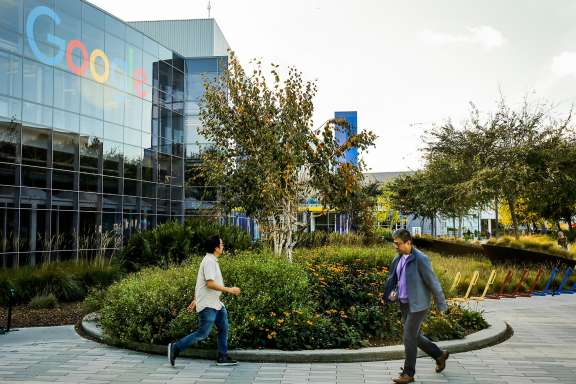
Alphabet’s holdings, calculated by commercial real estate research firm CoStar Group, reflect its vast and expanding operations in the Bay Area. Google, Alphabet’s largest division, employs more than 34,000 people in the region. But its growth has brought inevitable side effects like higher office rents and pressure on housing and traffic.
The presence of huge companies can make it difficult for startups to find space, as landlords may be more willing to work with established, deep-pocketed firms that can sign longer leases and might even buy the property in the future.
In 2014, Box, then a privately held cloud services startup, was rapidly outgrowing its Los Altos office and seeking a new home. Peter McGoff, the company’s general counsel, spent hours working on leases, only to get calls informing him, “Sorry, Google just grabbed the deal.”
More on Google
Google’s digital assistant branches out to Nest camera
With Waymo settlement, Uber CEO clears the way for company’s
Google again spending freely on wooing search users, cutting into
“You’re competing with a company that has unlimited resources,” McGoff said. “When we’re struggling to add another 10 cents a square foot on rent, they can easily do that and throw in an option to buy — for a landlord, that’s a big thing.”
At one of the sites Box lost out on, Google went in with the option to purchase the entire campus, and “we can’t compete on that scale,” McGoff said. He added that Box ended up moving its offices to Redwood City, farther from Palo Alto than CEO Aaron Levie originally wanted.
Since then, Alphabet has continued to accumulate office space at a rapid clip. Besides Google, Alphabet’s divisions include life sciences company Verily and self-driving car division Waymo.
In 2017, the company purchased its largest amount of commercial real estate in a single year — 3.6 million square feet, or 2½ Salesforce towers — in Mountain View, Sunnyvale and San Jose, according to CoStar Group. Google, Alphabet’s most profitable division, declined to comment on CoStar’s data.
“Google has been far and away the most aggressive” in accumulating office space compared to other tech companies, said Jesse Gundersheim, CoStar’s San Francisco market economist.
Google already dominates its hometown of Mountain View, where 20,000 employees work, according to CoStar Group. In Sunnyvale, Alphabet owns or leases 4 percent of the office space. Google plans to open a campus there by 2021 that could fit up to 4,500 workers.
It has more than 1,000 workers in Palo Alto and Alphabet’s real estate reach stretches as far as Alameda. Google’s YouTube division is the largest employer in San Bruno.
Other deals are in the works. Google is negotiating with the city of San Jose to buy acres of land, potentially adding up to 8 million square feet of office, research and development space. The project could bring 15,000 to 20,000 jobs, mostly from Google, to the city. If it moves forward, Google could become one of San Jose’s largest employers.
Maria Noel Fernandez, a campaign director with community group Silicon Valley Rising, is concerned that Google’s huge project in San Jose could contribute to the housing crisis that has forced lower-income workers to leave the Bay Area.
Her group, made up of community activists, residents and labor supporters, has pushed for Google to commit to investing in affordable housing.
“As we think about these companies continuing to expand, continuing to grow, the question we must ask ourselves is what real plans the cities and the tech industries will create to address the problems that are really being led by this growth?” Fernandez said.
Google declined to comment for this story. In January, a Google manager said the company looked forward to working with city officials and the community “to create a shared vision for downtown San Jose that will benefit the city and its residents.”
Google is also increasing its investment in offices outside of California (as are competitors like Apple). CEO Sundar Pichai said in a recent Alphabet earnings call that the company “grew faster outside the Bay Area than in the Bay Area” in 2017. Google plans to make “significant investments” in offices in nine states, including Colorado, California and Michigan, and build five data centers in the U.S., Pichai said.
In the Bay Area, housing for employees has become a foremost concern for companies like Google. Mountain View recently made changes to its city rules to add housing in what had been a primarily commercial neighborhood.
In San Bruno, YouTube plans to rapidly expand its 1,700-employee workforce, hiring an additional 350 people a year.
San Bruno City Councilman Marty Medina says he has seen YouTube buy up numerous properties, not unlike someone playing the game Monopoly.
“It’s a confirmation of why I live in San Bruno,” Medina said. “It’s a great place, and YouTube has spotted the potential. … But we have to be careful when we load on too much on one employer. It’s a delicate balance.”
The Bay Area has 101 municipalities, according to the census. That means a big company like Google can aggressively negotiate, said Dowell Myers, a professor of policy planning and demography at the University of Southern California.
“They can try to play off one city against the other,” Myers said.
For the startups that Silicon Valley is known for, this can mean fierce competition. Ten years ago, Centrify, a startup that prevents data breaches, had an office for close to 100 employees in downtown Mountain View. As Google rapidly expanded there, rents rose, pushing Centrify to move to Sunnyvale, according to CEO Tom Kemp.
Centrify had to move again. Its landlord declined to let it expand because Apple was increasing its presence in Sunnyvale. So the company moved farther south and today is in Santa Clara.
“You get squeezed,” Kemp said. “You get pushed out.”
By the numbers:
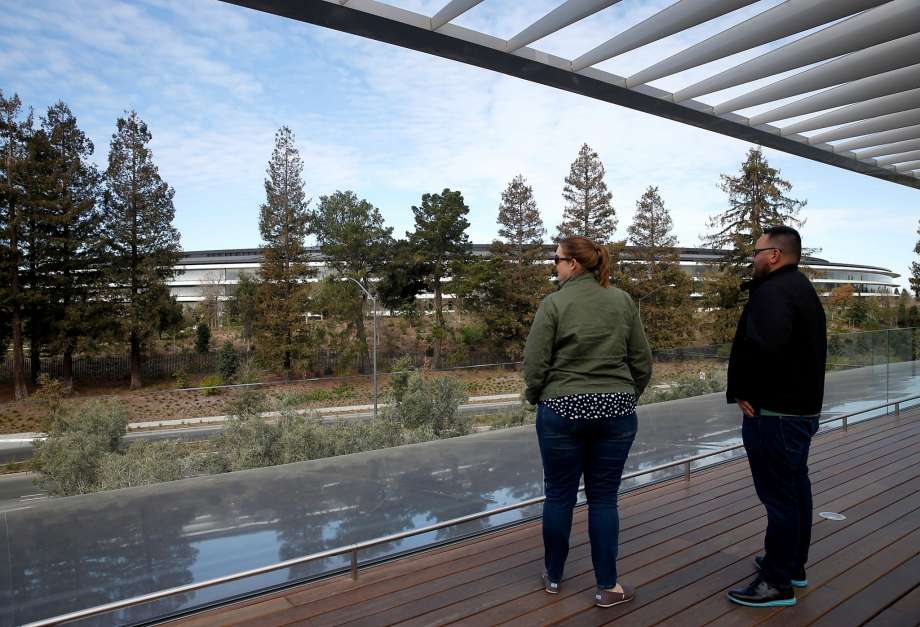
Apple: More than 25,000 employees in the Bay Area, owns or leases 14.4 million square feet
Google: More than 34,000 employees in the Bay Area (including 20,000 in Mountain View); Google’s parent company, Alphabet, owns or leases 19.9 million square feet
Facebook: Half of its 25,105 global employees work at its Menlo Park headquarters; owns or leases 3.6 million square feet
A new report from Paragon Real Estate reveals that the household income now required to buy a median-priced home in San Francisco reached an all-time-high of $303,000 in December.
That means a person who wants to buy property in the city needs a mid-six-figure salary in order to afford the 20% down payment on a $1.5 million home — the median sale price of a single-family home in San Francisco last quarter.
According to Paragon Real Estate, only 12% of households in San Francisco can afford it.
Patrick Carlisle, the chief market analyst at Paragon who worked on the report, has said low housing affordability is the greatest economic and social issue issue facing the Bay Area.
San Francisco, one of the epicenters of the tech industry, does not have enough dwellings to house all of its workers. Tech companies frequently locate their campuses in areas without much nearby housing, and tech workers often use their high salaries and stock options to bid up home prices.
Even tech workers can’t afford to live in the Bay Area
The report was unsurprising but still unsettling for Bay Area residents.
Katherine Maher, executive director of the Wikimedia Foundation, wrote on Twitter, “As a non-profit employer, I cannot see how we reconcile this with a future for our organization in San Francisco.”
The non-profit was founded in St. Petersburg, Florida, and moved to San Francisco in 2008. Maher said that fewer than two-thirds of Wikimedia Foundation’s staff work out of the city office. The organization has embraced remote work and seen “tremendous benefits.”
Maher said the findings of the Paragon Real Estate report are “nonsensical” to the group’s staff and donors, and the high cost of living hurts their ability to recruit and retain employees.
“Our local employees, particularly the younger ones, struggle to make ends meet. They leave when they start families. How can we be an equitable employer when only those who can afford to work for us, do?” Maher said on Twitter.
Mike Rosenberg, a reporter with the Seattle Times who previously worked at the San Jose Mercury News, responded to the report with some free advice for millennial homebuyers.
“You’d need to avoid eating 33,600 avocado toasts a year to generate $303,000,” he said.