Leslie Smith says industrial owners in Texas are seeking cash for capital improvements.
HOUSTON—Projected rents are more than adequate in many markets to justify additional development of warehouses and distribution centers, according to a new report from CBRE. The firm analyzed the gap between pro forma rents in various markets–the rental rates that developers can reasonably expect to obtain on newly built warehouses–and break-even rents, i.e., those needed to cover overall development costs. In the 10 major markets that CBRE examined, the former exceeded the latter by 20 to 40%.
Sarah Low always figured she’d have her first baby, and own her own home, by the time she turned 30.
Instead, she’s 32 and living in a rented house in Hayward with her husband and two roommates. There’s no room — or money — for kids.
“At this point, if we had a child there’d be nowhere to put it,” Low said. “No bedrooms left.”
A new study by real estate website Zillow suggests many Bay Area women may be putting motherhood on hold at least partly because of the region’s housing market. The fertility rate is dropping across the country for women between the ages of 25 and 29, but the dip is most pronounced in counties where home prices are rising rapidly — including Santa Clara, Alameda and San Francisco.
“Raising a child is a really expensive proposition,” said Zillow economist Sarah Mikhitarian, “and in these markets where home prices have grown really, really quickly … it’s making it really difficult to afford housing, and that could be delaying having children.”
Nationally, on average, every 10 percentage point increase in home values was associated with a 1.5 percentage point drop in birth rates for women ages 25 to 29, according to the study, which chose that group as the age when women are most likely to be considering having children but do not yet own their own home.
But the drop in births was even more pronounced in the Bay Area. In Santa Clara County, home values rose 58 percent between 2010 and 2016, while the fertility rate of women ages 25 to 29 dropped 20 percent. In Alameda County, home values rose 60 percent while the fertility rate dropped 24 percent. And in San Francisco, home values rose 61 percent while the fertility rate dropped 22 percent.
Nationally, the birth rate for women ages 25 to 29 was 97.9 births per 1,000 women last year — down 4 percent from 2016 and a record low for the age group, according to the Centers for Disease Control and Prevention’s Division of Vital Statistics.
While Zillow researchers are quick to clarify that their analysis does not suggest rising home prices alone are causing falling birth rates, they say the housing market likely is a contributing factor.
It certainly was for Low and her husband, who want to buy a home and become more financially stable before having children. The couple moved back to Hayward, where Low was born and raised, after graduate school about two years ago and tried to buy a house but quickly realized the available homes were out of their price range. The two have steady incomes — Low is a behavior analyst who works with autistic children, and her husband is a physical therapist — but they also are paying off about $200,000 in student debt.
So Low and her husband figured they would rent for a year and then buy a home, but prices have climbed so steadily since then that the couple still hasn’t been able to save enough for a down payment. They could move away in search of cheaper housing, but Low’s friends and family are in Hayward, and she doesn’t want to leave. So the couple pays $1,800 for one bedroom in a three-bedroom house that they share with Low’s brother and former co-worker. Instead of a baby they have a dog — a border collie-Chihuahua mix.
As time ticks on and Low gets older, she worries they might never be in a situation where they can have children. And she says that prospect seems sad.
“Kids are great,” Low said. “They’re life-long companions, essentially. Once you get to the point in your life when you’re retired and don’t have kids, I just imagine that being kind of a lonely existence.”
SAN FRANCISCO (KPIX 5) – With the ever-escalating Bay Area real estate regularly hitting new levels of insanity, the asking price in a recent San Francisco home purchase is downright outrageous.
Prices are crazy in the Bay Area with residential homes selling for seven-times higher than the national average with the average price of about $1.6 million.
The house, located in the Pacific Heights neighborhood, just sold for $9.6 million.
That’s $1.6 million over the asking price.
The property tax alone is nearly double the median household income and far more than what most U.S. families make in a year.
Some say the reason for the trend may come down to bragging rights.
It’s a San Francisco dream house with five beds, six baths, amazing closets and a wine cellar. While it was originally listed for under $8 million, it had six offers and went for 20 percent over asking at $9.6 million just nine days after hitting the market.
Patrick Carlisle, the chief market analyst with Paragon Real Estate said the number was not surprising.
“No. No, actually in SF, the average house sells for 13 percent over asking,” said Carlisle.
He went on to say that over 80 percent of San Francisco homes sold for over asking this year.
And while $1.6 million over asking is a staggering dollar amount, percentage-wise, 20 percent is not that impressive.
The highest overbid so far this year was 76 percent over asking for a “fixer-upper” in the Ingleside.
In just the last 6 months more than 100 homes have gone for at least 40 percent over asking.
Carlisle thinks he knows the reason why.
“I honestly believe it egregious underpricing,” said the realtor.
Carlisle explained that obviously a hot housing market, low inventory and a realtor’s ability to market and stage are factors, but the trend of over overbidding has a lot to do with realtors purposely underpricing.
“They do that because they want to create that bidding frenzy. And bragging rights,” said Carlisle.
The listing agent for this home tells KPIX 5 she purposely didn’t underprice the Pacific Heights home and doesn’t recommend it to her clients as a strategy.
Still, there is no question that the overbidding trend is leading to some staggering numbers.
Some might be wondering if the sky-high prices for Bay Area real estate will ever come down.
Carlisle believes it will.
Carlisle notes housing market upcycles typically last five to seven years. The Bay Area is now in the seventh year of the current upcycle.
And while Carlisle admitted it is impossible to predict when the cycle will turn, he said there’s one thing that all downturns have in common.
“It’s called irrational exuberance. People get to this belief that it’s never going to end,” explained Carlisle.
He says downturns are generally caused by national events: an oil price embargo in the 1970s and the savings and loan crisis in the 1980s.
And a shift doesn’t necessarily mean a crash. It could be stability or a small decline.
The affliction starts when you get a job that you love in a place that you adore — say, San Francisco, or Berkeley, or Marin County or Silicon Valley. You fall in love with that Golden Gate, the way Mt. Diablo rises out of the mist, the city’s sparkling skyline — then realize there is no way in hell you’ll ever be able to afford to live there without making compromises that would be laughable in most other parts of the country.
Drive 90 minutes each way to work?
Rent the dining room of a flat as your bedroom when you are on the cusp of middle age?
Step over human waste and discarded needles as you walk to your $120,000-a-year job at a promising start-up?
All of these are all well-known causes of the Bay Area blues.
And they aren’t getting better any time soon.
For the first time in the four years a business group began taking the emotional temperature of residents here, more than half of registered voters surveyed said that things in the Bay Area are “pretty seriously off on the wrong track,” a huge increase in dissatisfaction since 2014, when only 27% felt that way.
More surprising, almost half said they are “likely” to move away within the next few years.
“The Bay Area is in a funky mood,” said Jim Wunderman, president and CEO of the Bay Area Council, a business-sponsored public policy group that conducts the annual survey. People are seriously put off by traffic, poverty and homelessness.
But the biggest obstacle to sticking around, they say, is the high cost of housing.
Since 2011, said Rufus Jeffris, spokesman for the Bay Area Council, the nine counties of the Bay Area have added 630,000 jobs, but issued building permits for only 146,000 homes. That’s 4.3 jobs per unit of house, far more than what experts say is a healthy balance of 1.5 jobs per house.
“And people aren’t just thinking about moving,” said Wunderman, whose council advocates for more housing construction and improvements in public transit. “They are actually doing it.”
Recently, when he and his wife returned to San Francisco from a car trip to Oregon, he was astonished by the number of U-Hauls that passed them on the road, heading north.
His own daughter, a travel writer and photographer, moved to Montana because she could no longer afford to live in San Francisco.
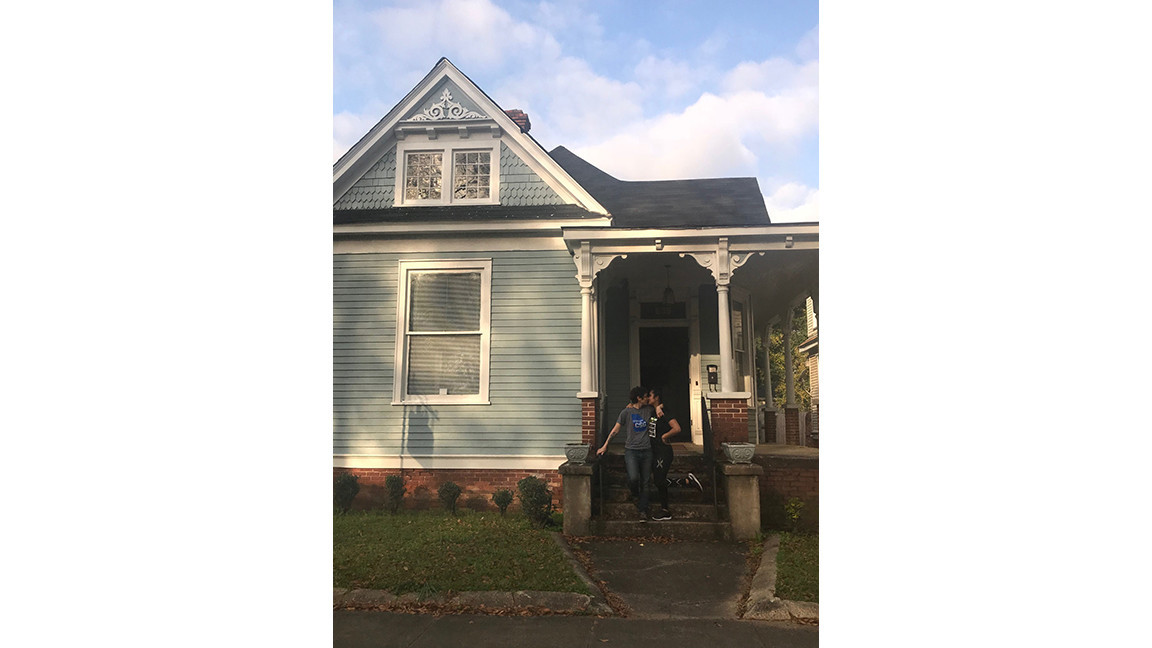
Ana Luisa Ahern, left, with her partner, Demetri Lopez, on the day they closed on their $200,000, 2,500-square-foot home in Columbus, Ga., a historic city with a thriving little downtown. Courtesy of Ana Luisa Ahern
Ana Luisa Ahern gave up on the Bay Area last August.
After she earned a master’s degree at UC San Diego, Ahern landed her dream job: marine conservation scientist for an Oakland-based nonprofit that focuses on projects in El Salvador.
She assumed that on a salary of $62,000 she’d have no trouble finding a place with a yard that would also accommodate her rescued mutt, Chimi Chewy. Maybe a house to share. She thought she could handle a rent of $1,500.
For a year, she lived with her cousins in South Berkeley, renting a nook in their attic.
“I just thought, ‘I’ll be there til I find my own place,’” she said. “Never happened.”
Reluctantly, she left California.
Her partner, Demitri Lopez, was living in the South, where she had grown up. Despite a little trepidation about being a lesbian couple in a conservative state, Ahern decided to join her.
In February, the couple closed on a 2,500-square-foot house with a yard in the historic downtown of Columbus, a small city 100 miles southwest of Atlanta.
“Never in a million years did I think at this point in my life I would own a home,” she told me. “Now I have a home in the best neighborhood in the best part of town. Big backyard. It’s gorgeous.”
The best part? Her home cost $200,000. “I’m paying $850 a month, the same as I was paying for an attic in Berkeley.”
She has a big, diverse circle of friends that has dubbed itself “the United Nations.”
As for her fears about a hostile political climate, she said, “I have more gay friends here than I did in California. There, you are just another lesbian on the street. Here, it’s like ‘Hey, we gotta hang out!’”
::
Stuart Schuffman is a writer and political activist known around town by his nom de plume, Broke-Ass Stuart. Like many San Franciscans, he is living in a converted dining room — at the advancing age of 37.
In his 16 years in San Francisco, he said, almost all his friends have lost their housing. Many were evicted by landlords eager to raise rents. Some have fled to Oakland, which used to be cheap but isn’t anymore. Others have gone to Portland, Ore., San Diego, Los Angeles, even New Orleans.
On Tuesday, San Francisco voters, by a large margin, approved a measure to provide free legal representation for every tenant who is facing eviction.
“If this had passed five or 10 years ago,” Schuffman said, “so many of my friends and loved ones would still be here.”
Buying a home anywhere in the Bay Area, he said, “is not even a thought.”
::
Sitting in their downtown 10th-floor offices with postcard views of the Transamerica Pyramid on one side and the Bay Bridge and Ferry Building on the other, both Wunderman and Jeffris said it was painful to discover how many people in this part of the state feel they are being forced out.
“Do we really want to put those numbers out there?” Jeffris wondered. “You really worry that you become branded as a place that no one wants to be.”
This fear is nothing short of radical. After all, the population is highly educated, the economy is booming and few urban areas can boast of the extraordinary natural beauty found here.
Yet something has gone terribly wrong. “This is a failure of our own making,” Wunderman said.
Given the glacial pace of home construction, no one knows how long it will take to turn things around.
But there has to be a cure for the Bay Area blues that does not involve moving to Georgia.
From there the unit would move steadily down the line, and, over 21 additional stations, would acquire toilets, indoor walls, outdoor walls, a roof, electric outlets, windows, sinks, countertops and tiling. It takes about a week to finish a unit, Mr. Pace said. The goal is to churn out about 2,000 apartments a year, which would be turned into four- and five-story buildings with 80 to 150 units each.
For workers, factory building seems to mean lower wages but steadier work. Factory OS pays about $30 an hour with medical insurance and two weeks of vacation. That’s about half what workers can make on a construction site, but the work is more regular and, for many, requires less commuting.
Tony Vandewark, a 51-year-old foreman at Factory OS, is OK with the trade-off. Mr. Vandewark lives a few minutes from the factory in Vallejo, where homes cost less than half what they do closer to San Francisco. Contrast that with a job he once had in the Silicon Valley city of Sunnyvale. Mr. Vandewark drove two hours to work and three hours home before deciding to rent a room so he could stay closer to work on weekdays.
“On a job site, you can go do piece work and make really big money, but then the job is gone,” he said.
In addition to not being rained on, one of the key differences between a construction site and Factory OS is that any worker can be trained to do any job. And for old-school trade unions, that is a declaration of war. “The business model is ‘Hooray for me,’” without regard for anyone else, said Larry Mazzola Jr., business manager of UA Local 38, a San Francisco plumbers’ union with about 2,500 members across Northern California.
Factory OS is not anti-union: It has a contract with the Northern California Carpenters Regional Council, which has organized other modular factories and is banking on the technology’s continued growth. The issue is that builders are laid out like a Detroit auto factory, where one union represents all of the workers, and workers can be trained to do any job within the company walls.
That is a huge departure from construction sites, where unions representing plumbers, electricians, carpenters and various other trades each control their piece of the building process. Last year Mr. Mazzola wrote a letter to San Francisco’s mayor, Ed Lee, a month before he died, urging him to deny any city business — such as contracts for subsidized housing — to Factory OS.

 Leslie Smith says industrial owners in Texas are seeking cash for capital improvements.