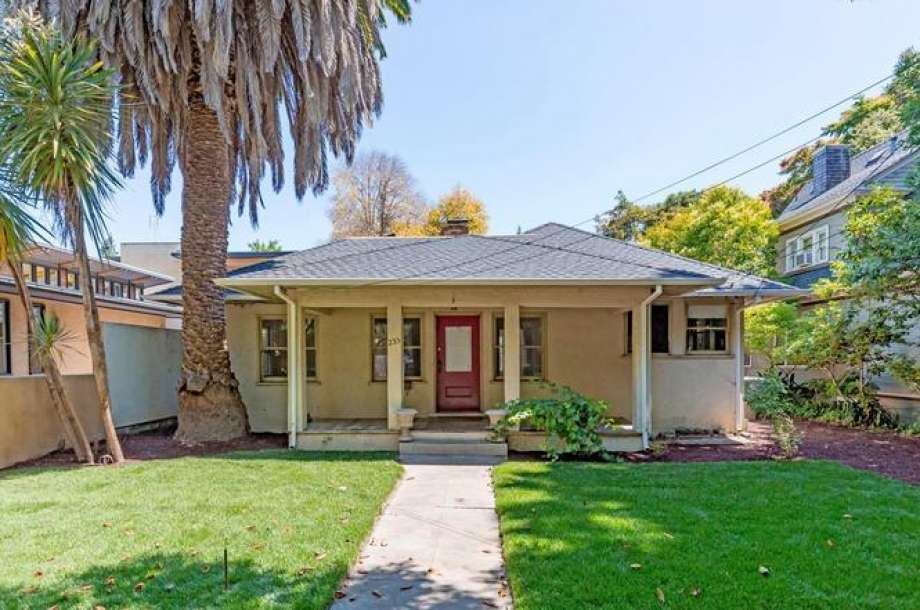
Tiny Palo Alto pad was just $40K in the 70s. Now, it’s $2.5M


  • ac544 920x920 Tiny Palo Alto pad was just $40K in the 70s. Now, its $2.5M

Caption

Close

Oh, for a time machine. In the 70s, this home cost $40K. Today: $2.5M

Oh, for a time machine. In the 70s, this home cost $40K. Today: $2.5M

Photo: The Troyer Group • Intero Real Estate Services


Oh, for a time machine. In the 70s, this home cost $40K. Today: $2.5M

Oh, for a time machine. In the 70s, this home cost $40K. Today: $2.5M

Photo: The Troyer Group • Intero Real Estate Services


Oh, for a time machine. In the 70s, this home cost $40K. Today: $2.5M

Oh, for a time machine. In the 70s, this home cost $40K. Today: $2.5M

Photo: The Troyer Group • Intero Real Estate Services


Oh, for a time machine. In the 70s, this home cost $40K. Today: $2.5M

Oh, for a time machine. In the 70s, this home cost $40K. Today: $2.5M

Photo: The Troyer Group • Intero Real Estate Services


Oh, for a time machine. In the 70s, this home cost $40K. Today: $2.5M

Oh, for a time machine. In the 70s, this home cost $40K. Today: $2.5M

Photo: The Troyer Group • Intero Real Estate Services


Oh, for a time machine. In the 70s, this home cost $40K. Today: $2.5M

Oh, for a time machine. In the 70s, this home cost $40K. Today: $2.5M

Photo: The Troyer Group • Intero Real Estate Services


Oh, for a time machine. In the 70s, this home cost $40K. Today: $2.5M

Oh, for a time machine. In the 70s, this home cost $40K. Today: $2.5M

Photo: The Troyer Group • Intero Real Estate Services


Oh, for a time machine. In the 70s, this home cost $40K. Today: $2.5M

Oh, for a time machine. In the 70s, this home cost $40K. Today: $2.5M

Photo: The Troyer Group • Intero Real Estate Services


Oh, for a time machine. In the 70s, this home cost $40K. Today: $2.5M

Oh, for a time machine. In the 70s, this home cost $40K. Today: $2.5M

Photo: The Troyer Group • Intero Real Estate Services


Oh, for a time machine. In the 70s, this home cost $40K. Today: $2.5M

Oh, for a time machine. In the 70s, this home cost $40K. Today: $2.5M

Photo: The Troyer Group • Intero Real Estate Services


Oh, for a time machine. In the 70s, this home cost $40K. Today: $2.5M

Oh, for a time machine. In the 70s, this home cost $40K. Today: $2.5M

Photo: The Troyer Group • Intero Real Estate Services


This home, a modest two-bedroom, one-bathroom in downtown Palo Alto, asks $2.5 million. It’s a rather perfect example of the Peninsula and Silicon Valley real estate phenomenon.

The house

Built in 1904, the home appears to be in nearly original condition.

None of the 960 square feet show evidence of remodeling or updating, but nor are they terribly deteriorated.

There’s a fireplace in the living room, hardwood floors, and a kitchen with decorative cabinet work.

There’s nothing actually wrong with this house. We’ve seen far more dramatic examples of old, occasionally dilapidated homes in Palo Alto asking over $2 million.

In 2016, for example, an outright teardown listed for $5.5 million.

Still, a new buyer for this property is clearly encouraged to “rebuild or renew,” via the listing language.


The value is in the land

This abode’s real value lies in the 5,625-square-foot lot. This lot is in downtown Palo Alto.

The area, based on market acitivty over the last 30 days, enjoys a median listing price of $4.5 million, a sale-to-list ration of 112 percent, and a value of $1,572 per square foot.

ALSO, A stately home on a huge San Francisco lot asking $1.9 million

That last figure makes the listing price for 235 Webster about a million dollars too high, but only if we forget to value the large lot and all its potential.

Give us the time machine!

The last time records show this home selling was 1970; then, it was $40,000. Today, it’s more than 60 times that much, and being sold with the expectation that someone will drop at least a few multiples of $40,000 in remodeling.


But then, this is Palo Alto, with its confluence of factors: proximity to the Silicon Valley, Stanford, and San Francisco; heavy foreign investment; and limited supply for high demand.

And 235 Webster Street will indeed be in high demand.

See the full listing here. 

Anna Marie Erwert writes from both the renter and new buyer perspective, having (finally) achieved both statuses. She focuses on national real estate trends, specializing in the San Francisco Bay Area and Pacific Northwest. Follow Anna on Twitter: @AnnaMarieErwert

Article source: https://www.sfgate.com/realestate/article/235-webster-st-palo-alto-2-5M-13040216.php
Posted in SF Bay Area News | Tagged | Leave a comment

Twelve Pacific Union Real Estate Professionals and Teams Named to REAL Trends Top 250 in the US for 2017 Sales …

SAN FRANCISCO, July 2, 2018 /PRNewswire/ — Twelve real estate professionals and teams at Pacific Union International have been ranked among the most productive in the United States, a testament to the firm’s commitment to recruiting and retaining California’s top performers.

2f551 Pacific Union International CEO Twelve Pacific Union Real Estate Professionals and Teams Named to REAL Trends Top 250 in the US for 2017 Sales ...

The REAL Trends Annual The Thousand list ranks the top 250 real estate professionals and teams in the nation by 2017 sales volume. This year’s honorees, along with the rest of Pacific Union’s real estate professionals, strengthened the California top independent brokerage’s position as the fifth-largest residential real estate brokerage in the U.S. earlier this year, with 2017 sales volume of $14.1 billion.

“We are humbled by the extraordinary results of our top professionals,” Pacific Union CEO Mark A. McLaughlin says. “We honor their accomplishments and appreciate their continued commitment to our core values of teamwork, trust, and innovation. While we honor these amazing teams and individuals today, I believe our entire organization and our united culture throughout the San Francisco Bay Area and Los Angeles are our most significant assets.”

This year’s REAL Trends The Thousand honorees are:

Individuals by Sales Volume:

  • Aaron Kirman, Beverly Hills, ranks No. 5, with $426 million in sales
  • Dana Green, Lafayette, ranks No. 31, with $199 million in sales
  • Tracy McLaughlin, Ross, ranks No. 51, with $155 million in sales
  • Shana Rohde-Lynch, Belvedere-Tiburon, ranks No. 86, with $124 million in sales
  • Craig Strong, Toluca Lake, ranks No. 159, with $94 million in sales
  • Raziel Ungar, Burlingame, ranks No. 218, with $81 million in sales
  • Peter Bergman, Marina del Rey, ranks No. 246, with $76 million in sales

Teams by Sales Volume:

  • Nina Hatvany, San Francisco, ranks No. 56, with $226 million in sales
  • Pence Hathorn Silver, Santa Monica, ranks No. 97, with $186 million in sales
  • Smith Berg Partners, Beverly Hills, ranks No. 123, with $171 million in sales
  • LeMieux Associates, Menlo Park, ranks No. 185, with $142 million in sales
  • Watson-Marshall Group, Burlingame, ranks No. 245, with $124 million in sales

About Pacific Union International                                                                   

Founded in San Francisco in 1975, Pacific Union International, Inc. is the West Coast’s premier luxury real estate brand, with 2017 sales volume of $14.1 billion. In 2018, real estate industry leaders RISMedia and REAL Trends ranked Pacific Union as the fifth-largest brokerage in the U.S. The prestigious London-based International Property Awards awarded Pacific Union “Global Real Estate Brokerage of the Year 2017-2018.”

Through its 2015 acquisition of The Mark Company, the nation’s leading sales and marketing firm for new urban luxury developments, Pacific Union expanded its brand to development projects from San Diego to Seattle.

In 2016, Pacific Union merged with Los Angeles-based brokerage John Aaroe Group, followed in 2017 with mergers with Partners Trust and Gibson International also based in Los Angeles, and Empire Realty Associates, extending the Pacific Union brand to become the preeminent leader and ultimate California real estate company. The strategic alliance of these five powerhouses supports 1,700 elite real estate professionals in more than 50 offices throughout the West Coast. Northern California markets include San Francisco, Marin, Contra Costa, Alameda, Napa, and Sonoma counties; Silicon Valley; and the Lake Tahoe region. Greater Los Angeles markets include Beverly Hills, Malibu, Downtown, Northeast L.A., the Westside, as well as the San Fernando and San Gabriel Valleys.

To extend Pacific Union’s international reach, the brokerage established an award-winning, Beijing-based China Concierge program in 2013 that fully supports its Chinese investors on the mainland. Additionally, Pacific Union offers a full range of personal and commercial real estate services, including buying, selling and relocation, in addition to operating joint-venture businesses that provide rental and commercial property management and insurance services. Locally owned, Pacific Union executes with a vision for the future, an entrepreneurial mindset and an unwavering commitment to deliver exceptional service and expertise. For more information, visit: www.pacificunion.com.


858ff favicon Twelve Pacific Union Real Estate Professionals and Teams Named to REAL Trends Top 250 in the US for 2017 Sales ... View original content with multimedia:http://www.prnewswire.com/news-releases/twelve-pacific-union-real-estate-professionals-and-teams-named-to-real-trends-top-250-in-the-us-for-2017-sales-achievements-300674984.html

SOURCE Pacific Union International

Article source: http://markets.businessinsider.com/news/stocks/twelve-pacific-union-real-estate-professionals-and-teams-named-to-real-trends-top-250-in-the-u-s-for-2017-sales-achievements-1027334962

Posted in SF Bay Area News | Tagged | Leave a comment

How San Francisco minimum wage increase affects Sacramento …

It’s no secret that Bay Area residents have been flocking to Sacramento and other California cities, or even fleeing the state, to escape skyrocketing housing costs.

The minimum wage bump to $15 per hour took effect Sunday in San Francisco, becoming the first major U.S. city to reach that mark. But will that be enough to keep workers in the city by the Bay?

Data and simple math suggest that no, it probably won’t be enough.

Earlier this month, SFGate used National Low Income Housing Coalition data to deduce that at the previous minimum wage of $14 per hour, it would take 171.5 hours per week to afford a two-bedroom rental home in San Francisco. (No need to grab a calculator — there are only 168 hours in a week, so this is actually mathematically impossible.)

Help us deliver journalism that makes a difference in our community.

Our journalism takes a lot of time, effort, and hard work to produce. If you read and enjoy our journalism, please consider subscribing today.

The $1-an-hour boost knocks that number down to 160 hours, which works out to about 23 hours a day, seven days a week. SFGate notes that a household would need to earn $60.02 an hour to live comfortably; in other words, four full-time workers at the new minimum wage can just barely afford a decent, two-bedroom place among them. And they would probably need bunk beds.

An estimated 142,000 workers in San Francisco will benefit from the new minimum wage, the SF Examiner reports. The city has a population of about 870,000.

While it’s a win for many advocates and workers, the $15 minimum wage will likely make only a small dent in the so-called Bay Area exodus, especially as surrounding cities see the massive costs of living and housing continue to rise. In several other counties, including San Mateo and Marin, six-figure salaries are considered “low-income” for a family of four.

Additionally, as pointed out in a recent opinion piece published by the Orange County Register, the “dramatic” increase to $15 has forced some small businesses out of the Golden State. Small-business jobs are leaving, and the residents go with them.

Under state law, $15 minimum wage will be mandatory across California by 2022. The San Francisco increase to $15 an hour in 2018 is the result of a 2014 city initiative, Proposition J, which passed with a 77 percent “yes” vote. The city’s minimum wage is planned to rise in line with inflation going forward.

The East Bay city of Emeryville also reached $15-an-hour on Sunday. Berkeley will reach the mark in October.

Other Bay Area cities are on pace to hit the $15 mark later, closer to 2022. Oakland’s current minimum wage is $13.23 after a 37-cent increase Jan. 1 of this year.

A recent survey by advocacy group Bay Area Council involving 1,000 registered voters found that 461 hope to move out of the Bay Area soon. Of those 461 people, 5 percent said they’d likely move to Sacramento; 24 percent said they’d stay in California.

The median home price in the Bay Area has surpassed $900,000, according to the San Jose Mercury News. In Sacramento County, the median price hit $360,000 in May.

About 60 percent of those polled by the Bay Area Council said they think an economic downturn is coming to the region within the next five years.

The Associated Press contributed to this report.

Related stories from Sacramento Bee

 How San Francisco minimum wage increase affects Sacramento ...

Unemployment is below 4% in most California cities. See the rate in your town

 How San Francisco minimum wage increase affects Sacramento ...

Which city’s health workers boast highest disposable income? Hint: It’s a capital

 How San Francisco minimum wage increase affects Sacramento ...

Are Sacramento home prices reaching ‘bubble’ bursting levels?

Article source: https://www.sacbee.com/news/business/real-estate-news/article214132889.html

Posted in SF Bay Area News | Tagged | Leave a comment

San Francisco Is So Expensive, You Can Make Six Figures and Still Be ‘Low Income’

In neighboring San Mateo County, officials say the housing stock — primarily single-family homes, many on picturesque cul-de-sacs — lags far behind demand. Many residents who have been forced to move farther inland now face grueling commutes to their jobs.

“We’re the epicenter of the affordability crisis we’re seeing in the hotter markets throughout the U.S.,” said Ken Cole, the county’s director of housing.

“What it means on the ground is that teachers, first responders, people who grew up here of average income are being forced out by the high prices,” he said.

He called for building new, higher-density housing along rail lines. Others, including Mr. Walker, say the state should abolish a state law that limits rent control and consider other steps to cool the overheated market.

“The very success of the place undermines the viability of life for at least the lower half, if not the lower two-thirds,” Mr. Walker said. “And those are the people who get forgotten in the narrative of the glamour of tech changing the world.”

Kate Hartley, director of the San Francisco Mayor’s Office of Housing and Community Development, said high construction costs and low federal funding had added to the challenges of keeping low- and middle-income people in the city.

“What makes the Bay Area great is its diversity, its creative and innovative economy, and its free spirit,” she said.

“But the harder it is to house our artists, teachers, restaurant workers, health care providers,” she added, “the more we put that great spirit and strong economy at risk.”

Article source: https://www.nytimes.com/2018/06/30/us/bay-area-housing-market.html

Posted in SF Bay Area News | Tagged | Leave a comment

Homebuyers, Beware: Hackers Targeting Real Estate Transactions

A sophisticated scam targeting homebuyers robbed a San Jose couple of their life savings, and real estate experts say everyone shopping for a place to live is at risk.

NBC Bay Area spoke with multiple homebuyers who fell victim to the same scheme: hackers, intercepting emails and spoofing agents, conned them into seinding their down payments to the thieves’ bank accounts.  By the time the victim realizes what has happened, the money — and the crooks — are long gone.

Among the victims is Cindy Bernal.  The San Jose grandmother told us she has had enough of the cost of living in the San Francisco Bay Area. 

“Our rent is currently $1,500,” she said.  “They’re going to raise it up, double.”

Cindy’s daughter and grandchildren live in Ohio, where housing is substantially cheaper.  She found an ideal new home for herself and her husband: a three-bedroom, 980-square-foot house south of Cleveland.  The asking price: about $28,000.  Not enough for even a down payment in much of Northern California, but typical of the rural Midwest.

“I put in an offer the same day with the agent, and that was it,” Cindy said.

To Cindy’s delight, her offer of $25,400 was accepted.  She decided to pay cash — one payment, with no mortgage — and it came from her retirement savings.

“I was just happy when I got the house,” Cindy said.

On May 10, Cindy says she got an email telling her where to wire the down payment funds.  She followed the instructions, transferring the $25,400 payment to an account at a bank in Texas.

Four days later, Cindy’s life turned upside-down.

Her real estate agent called early the morning of May 14 with alarming news: she needed to head to her bank, immediately.

“I said, ‘What’s going on?’” Cindy told us.  “He goes, ‘It was a fraudulent account.  The other Realtor’s account was hacked.  You need to run to the bank now, and stop the transaction.’  I just ran out the door and ran to the bank and turned off the transaction, and I thought it was done from there.”

Her ordeal was far from over.  After days of back-and-forth with her bank in California and the bank in Texas, Cindy learned the funds were drained from the fraudsters’ account.  Less than $250 remained of her life savings.

“It’s gone,” Cindy said, between tears.  “I have $244.39 out of $25,340.  And that’s all I had.  That was my retirement fund.  I pulled out all my money.”

Cindy is not alone.  Dave Walsh, Treasurer for the California Association of Realtors, says the problem of real estate wire fraud is growing.

“It is a horrible situation that’s going on statewide,” Walsh said.  “It’s going on nationally.”

Walsh says hackers are now targeting virtually every homebuyer, seller, and agent — in an effort to capture the huge sums of money trading hands.

“When you realize that’s the depth of the thieves’ efforts to get into — to breach these data firewalls — it’s endless,” Walsh said. “There’s bots everywhere now, and they’re simply attacking any server, including the real estate professionals’ servers, for any kind of data they can get.”

Using information they get from those private servers, scammers then fabricate documents that trick mortgage brokers, title agents, real estate agents, and consumers into wiring money to the wrong place.

NBC Bay Area Responds: Real Estate Wire Fraud14c5a DIT BAY RESPONDS HOME LOAN PAYMENTS 1200x675 1267420739950 Homebuyers, Beware: Hackers Targeting Real Estate Transactions

Hackers targeted a San Jose couple and got away with their life savings when they tried to buy a home out of state. Now they face homelessness, and they say no one is taking responsibility for the theft.

(Published Friday, June 29, 2018)

The California Association of Realtors says home buyers need to protect themselves:

  • Always call and verify everything, before sending any money.
  • Call your agent, the seller’s agent, the escrow officer, and the title company — everyone!
  • Double-check account names and numbers.
  • Call everyone again immediately after the transfer.

As for Cindy, she hit a wall with banks, brokers, and even police.  That’s when she turned to NBC Bay Area.

We contacted both Cindy’s real estate agent and the house seller’s agent.  Both firms blamed each other.

The seller’s agent, Jeffrey First of First Realty, insisted he sent the proper financial instructions to Cindy’s agent before Cindy received the bogus instructions.

By email, First told NBC Bay Area:

The selling agent Brent Karlen received my email in the morning and did not forward that to his client. He opened this email on his cell phone, I beleive [sic] that is where the breach occurred. He did forward the fraudulent email he later received later in the afternoon.

Cindy’s agent, Brent Karlen of RE/MAX Edge Realty, told Cindy that First was to blame.  An attorney representing RE/MAX Edge Realty told NBC Bay Area by email:

Our preliminary investigation indicates that the fraudulent wire instructions were initiated by an unknown third party who was able to hack the email account of the listing agent, Jeff First of First Realty, and send a fraudulent email from this account to Brent Karlen.  As the email came from Mr. First’s correct email address, Mr. Karlen had no reason to suspect that the email was not legitimate.

NBC Bay Area asked both agencies what they will do to get Cindy her money back.  Jeffrey First did not offer an answer.  The attorney for RE/MAX Edge Realty provided this statement:

RE/MAX Edge has fully cooperated with Ms. Bernal and the authorities and will continue to provide any assistance it can as the investigation continues with the goal of helping Ms. Bernal be made whole by the party or parties responsible for the fraud. 


Cindy’s family opened a GoFundMe account to help the Bernals get back on their feet.  You can view the fundraiser by clicking here.


Posted in SF Bay Area News | Tagged | Leave a comment