Bay Area realtor, economist predict rents will rise 5% to 10% by end of the year – KGO

SAN FRANCISCO (KGO) — As consumers are hit with rising interest rates for the third time, a local economist predicts big impacts will soon hit the Bay Area rental market.

Whether it’s at the grocery store or the gas pump, the cost of nearly everything is going up. But, thankfully Bay Area rents haven’t quite fully returned to pre-pandemic rates.

RELATED: California lawmakers reach deal on pair of bills to build more housing amid shortage

Rents in San Francisco, Oakland, and Berkeley metro areas are still down around three percent compared to pre-pandemic rates. In San Jose, Sunnyvale, and Santa Clara metro areas rents are down just over one percent from pre-pandemic, according to data compiled from Apartment List.

But experts say that won’t last long.

“Rents will be back sooner than you think,” said Neil Canlas, co-owner of San Francisco real estate firm the Canlas Brothers.

“Define soon,” ABC7′s Stephanie Sierra asked.

“I think we could probably see a five to 10 percent increase at least by the end of the year and from there it would incrementally go up a couple percent every quarter,” Canlas said.

VIDEO: Are Bay Area housing prices about to drop? Here’s what experts say as interest rates hike

Canlas studies trends across the Bay Area real estate and rental markets. He’s seeing first-hand how the interest rate hikes are impacting the local housing market.

“Sellers can’t get the numbers they want to sell their home and buyers’ affordability has significantly changed with interest rates nearly doubling within the last year,” Canlas said. “These once buyers are now going to be renters.”

Purchasing power to buy a home has dramatically shifted in the Bay Area. A new report from Redfin shows luxury home sales have plummeted 28 percent across the country. But the decline is twice as severe in the Bay Area-where luxury homes are priced in the multi-million dollar range, estimated to be properties valued in the top five percent of the market.

RELATED: New California program for first-time homebuyers will let you borrow down payment at 0% interest

Oakland is reporting the largest decline in luxury home sales among the country’s 50 most populous metro-areas – a 63.9 percent drop. San Jose not far behind reporting a 55 percent drop.

“We know the whole housing market is cooling,” said Taylor Marr, the Deputy Chief Economist for Redfin.

Marr says it’s possible the cooldown may bring some relief to the rental market. But it won’t be anytime soon.

“Potentially the owners of these housing units don’t want to list it for sale in a really cool housing market. So they’re listing it up for rent…so that supply is also following that demand which mitigates some of that impact on the rising rents,” said Marr.

VIDEO: Here’s how you can get lower mortgage rate on bigger loan

But, Marr says that’s not expected to happen for at least six months – assuming rising interest rates continue to weaken our economy and push it further into a recession by next spring.

So when is the best time to rent?

Experts say the seasons do play a role in finding rental deals. For example, Marr recommends the best time to start a lease is anytime between November and March. Data shows tenants usually save $100 to $300 per month on the same unit during those months compared to the summer.

31a23 11518842 247 NOWSTREAMING 1280x720 Bay Area realtor, economist predict rents will rise 5% to 10% by end of the year   KGO

If you’re on the ABC7 News app, click here to watch live

Article source: https://abc7news.com/bay-area-housing-market-apartments-to-rent-interest-rates-hike-rental-prices/12257311/

Posted in SF Bay Area News | Tagged | Leave a comment

California Housing Market: Dismal Sales, Prices Sag in San Francisco (-20% fr. peak), Silicon Valley, San Diego, Orange County…

And this was during the summer rally as mortgage rates dropped to 5%, stocks bounced, the Fed “pivoted,” and the Good Times started all over again.

By Wolf Richter for WOLF STREET.

Home sales that closed in August were made somewhere from a few days to a couple of months before they closed – so roughly around and before the peak of the summer bear-market rally in mortgage rates and stocks that started in mid-June and ended in mid-August.

By mid-June, the average 30-year fixed rate mortgage was at or above 6%, having doubled in less than a year. And stocks had sunk. But then the tightening-deniers fanned out and trolled the media with nonsense about the Fed being “dovish,” that it would “pivot” in September or whatever, and they declared that inflation was “over,” etc. etc., and stocks bounced off their mid-June lows and mortgage rates fell from 6% to 5%, and for a moment just below 5%. And Realtors were already talking about how the housing market was picking up again.

Now we know that all this was a hoax. Mortgage rates are now solidly over 6%.  Fed chair Powell finally got through to everyone with his Jackson Hole speech that the Fed will tighten further. Inflation got worse and has shifted to services, from where it’s difficult to dislodge. And the stock market, now finally seeing inflation and higher rates, has given up most of the bear-market rally gains.

But back then, it seemed real enough to lots of people. In the San Francisco Bay Area and in Southern California – whose housing markets are heavily dependent on the stock market – there were hopes of an uptick amid re-surging stock prices, plunging mortgage rates, and gorgeously imagined Fed pivots. Those were the Good Times. So here is what we got instead from the California Association of Realtors for August:

Prices sank further. In four of the five big Bay Area counties, prices were down year-over-year. Sales volume was dismal, though slightly less dismal than the collapse in July. Time on the market about doubled year-over-year. And supply surged year-over-year.

San Francisco County leads:

Sales volume, single-family houses (SFH): -24% year-over-year, slightly less dismal than -26% in July.

Median time on the market: 20 days, up from 15 days in July, and up from 11 days a year ago.

Supply of unsold inventory: 2.2 months, same as in July, compared to 1.7 months a year ago.

Median Price, single-family houses: $1.635 million, lowest price for any August since 2019 ($1.60 million): -3.8% from July, fifth month in a row of declines, -20.6% from peak in March, -11.6% year-over-year.

In San Francisco, prices usually hit their seasonal lows in January or February; so this will be interesting. The green line connects the Augusts:

1315f US california housing CAR 2022 09 16 San Francisco California Housing Market: Dismal Sales, Prices Sag in San Francisco ( 20% fr. peak), Silicon Valley, San Diego, Orange County…

These are massive price declines in San Francisco. Yes, median prices are volatile, and we look at them with a good dose of circumspection, and trends need to be confirmed over time. But this trend here is being confirmed nicely so far.

One glance at the chart tells us that the median price will eventually bounce again, to zigzag lower rather than to go to heck in a straight line.

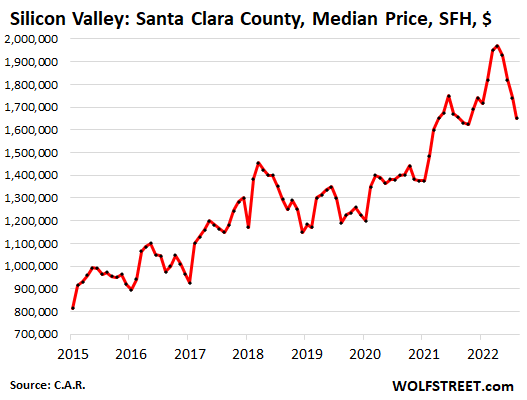
Santa Clara County, southern Silicon Valley.

Sales volume, single-family houses: -28% year-over-year, less dismal than -46% in July.

Median time on the market: 16 days, up from 14 days in July, and up from 8 days a year ago.

Supply of unsold inventory: 2.0 months, compared to 2.6 months in July, and 1.4 months a year ago.

Median Price, single-family houses, $1.65 million: -5.2% from July, fourth month in a row of declines, -15.4% from peak in April, -0.3% year-over-year:
1315f US california housing CAR 2022 09 16 Santa Clara California Housing Market: Dismal Sales, Prices Sag in San Francisco ( 20% fr. peak), Silicon Valley, San Diego, Orange County…

San Mateo County, northern Silicon Valley.

Sales volume, single-family houses: -30% year-over-year, slightly less dismal than -35% in July.

Median time on the market: 14 days, up from 12 days in July, and up from 9 days a year ago.

Supply of unsold inventory: 2.3 months, compared to 2.2 months in July, and 1.5 months a year ago.

Median Price, single-family houses, $1.95 million: -0.8% from July, fourth month in a row of declines, -14.5% from peak in April, +1.3% year-over-year:

646d6 US california housing CAR 2022 09 16 San Mateo California Housing Market: Dismal Sales, Prices Sag in San Francisco ( 20% fr. peak), Silicon Valley, San Diego, Orange County…

Alameda County, East Bay.

Sales volume, single-family houses: -30% year-over-year, less dismal than -35% in July.

Median time on the market: 16 days, up from 13 days in July, and up from 9 days a year ago.

Supply of unsold inventory: 2.1 months, compared to 2.4 months in July, and 1.3 months a year ago.

Median Price, single-family houses, $1.23 million: -8.2% from July, third month in a row of declines, -14% from peak in May, -5.4% year-over-year:

646d6 US california housing CAR 2022 09 16 Alameda California Housing Market: Dismal Sales, Prices Sag in San Francisco ( 20% fr. peak), Silicon Valley, San Diego, Orange County…

Contra Costa County, East Bay.

Sales volume, single-family houses: -27% year-over-year, less dismal than -36% in July.

Median time on the market: 18 days, up from 13 days in July, and more than double the 9 days a year ago.

Supply of unsold inventory: 2.3 months, compared to 2.5 months in July, and 1.4 months a year ago.

Median Price, single-family houses, $870,000: -3.6% from July, fourth month in a row of declines, -10% from peak in April, -2.2% year-over-year:

646d6 US california housing CAR 2022 09 16 Contra Costa California Housing Market: Dismal Sales, Prices Sag in San Francisco ( 20% fr. peak), Silicon Valley, San Diego, Orange County…

Southern California trying to catch up.

In Southern California overall, house prices fell for the third month in a row, -5.9% from the peak, which whittled the year-over-year gain down to 4.6%. So here are the three biggest counties. In San Diego, the median price dropped nearly 5% from July. In Orange, it dropped 2.5%, but it ticked up in Los Angeles. So here we go, starting with the most splendid housing bubble, San Diego.

San Diego County.

Sales volume of single-family houses: -28% year-over-year, less dismal than -41% in July.

Median time on the market: 15 days, up from 10 days in July, and nearly double the 8 days a year ago.

Supply of unsold inventory: 2.5 months, compared to 3.1 months in July, and 1.7 months a year ago.

Median Price, single-family houses, $885,000: -4.8% from July, fourth month in a row of declines, -9% from peak in April, which cut the year-over-year gain to +6.0%:

646d6 US california housing CAR 2022 09 16 San Diego California Housing Market: Dismal Sales, Prices Sag in San Francisco ( 20% fr. peak), Silicon Valley, San Diego, Orange County…

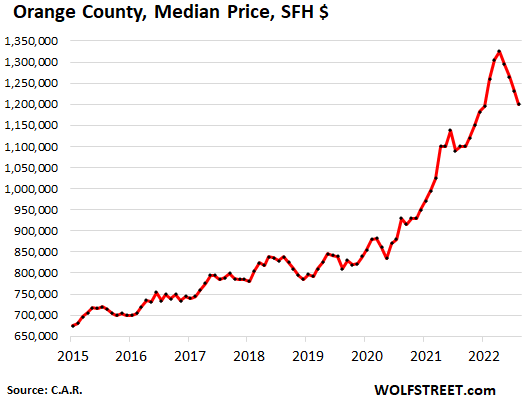
Orange County.

Sales volume of single-family houses: -30% year-over-year, less dismal than -39% in July.

Median time on the market: 17.5 days, up from 13 days in July, more than double the 8 days a year ago.

Supply of unsold inventory: 2.5 months, compared to 3.0 months in July, and 1.6 months a year ago.

Median Price, single-family houses, $1.2 million: -2.5% from July, fourth month in a row of declines, -9% from peak in April, which cut the year-over-year gain to +9.1%:
bd469 US california housing CAR 2022 09 16 orange California Housing Market: Dismal Sales, Prices Sag in San Francisco ( 20% fr. peak), Silicon Valley, San Diego, Orange County…

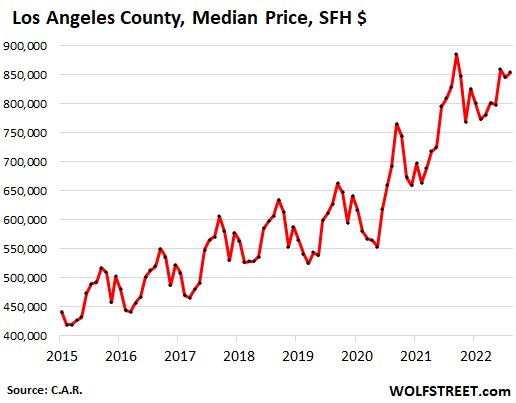
In Los Angeles County.

Sales volume of single-family houses: -29% year-over-year, slightly less dismal than -32% in July.

Median time on the market: 16 days, up from 13 days in July, nearly double the 9 days a year ago.

Supply of unsold inventory: 3.1 months, compared to 3.3 months in July, and 2.0 months a year ago.

Median Price, single-family houses, $855,000: +1.0% from July, -3.5% from peak last September, +3.0% year-over-year:
bd469 US california housing CAR 2022 09 16 Los Angeles California Housing Market: Dismal Sales, Prices Sag in San Francisco ( 20% fr. peak), Silicon Valley, San Diego, Orange County…


Enjoy reading WOLF STREET and want to support it? Using ad blockers – I totally get why – but want to support the site? You can donate. I appreciate it immensely. Click on the beer and iced-tea mug to find out how:

bd469 BeerMug2 California Housing Market: Dismal Sales, Prices Sag in San Francisco ( 20% fr. peak), Silicon Valley, San Diego, Orange County…

Would you like to be notified via email when WOLF STREET publishes a new article? Sign up here.

bd469 placeholder2 California Housing Market: Dismal Sales, Prices Sag in San Francisco ( 20% fr. peak), Silicon Valley, San Diego, Orange County…


Article source: https://wolfstreet.com/2022/09/16/california-housing-market-dismal-sales-prices-sag-in-san-francisco-20-fr-peak-silicon-valley-san-diego-orange-county/

Posted in SF Bay Area News | Tagged | Leave a comment

S.F.’s economic pain: 25% office vacancy, more tech layoffs and plunging venture capital funding

Leasing activity totaled around 800,000 square feet, the lowest level in two years. The vacancy rate is more than six times higher than it was at the start of the pandemic, when it was 4%, and is up from 20% a year ago, according to CBRE.

The market isn’t likely to rebound soon: Tech giants and smaller startups alike are trying to slash costs and shuttering mostly empty offices, with Facebook parent Meta and Google instituting hiring freezes.
Salesforce, Airbnb and Twilio all listed San Francisco space for lease in the third quarter, adding to the vacancy rate.

U.S. venture capital funding, the engine of startup growth, fell by nearly 40% from the second quarter to the third quarter, to $43.3 billion. That is its lowest level in more than two years.

San Francisco and San Mateo counties
lost around 2,500 jobs in August,
the first monthly drop in a year. Though San Francisco’s unemployment rate was a minuscule 2.1% in August, layoffs have ramped up in the past month, with cuts at
tech firm DocuSign,
clothing giant Gap
and
scooter company Spin,
among others.

Rising interest rates, high inflation and a slumping housing market are fueling
fears of a recession, and making office expansion even less likely.

“The economic issues over the past few months have caused this stall. There’s a lot of ‘wait and see’ out there,” said Robert Sammons, senior director of Bay Area research at real estate brokerage Cushman Wakefield. “I don’t see the market improving quickly.”

Cushman Wakefield, which uses slightly different methodology, said the San Francisco third-quarter vacancy rate was 23%.

Only a few leases exceeded 50,000 square feet — space for roughly 200 workers prior to the pandemic — including Asana subleasing 70,000 square feet from Macy’s at 680 Folsom St. Planet Labs also renewed and expanded its lease to 72,000 square feet at 645 Harrison St.

The deals were far smaller than
Google’s 300,000-square-foot lease
at the end of the second quarter.

Colin Yasukochi, executive director of CBRE’s Tech Insights Center, said even with low coronavirus cases, remote work is dampening any sustained return to offices and the desire for companies to expand. San Francisco’s office occupancy rate in buildings managed by security firm Kastle
was below 40%
last week, one of the lowest levels in the country.

“San Francisco is sort of ground zero for a lot of these trends,” Yasukochi said. “I don’t think we’re in recovery mode yet.”

A sustained recovery may not come until the second half of next year, he said.

There are some cities with even higher vacancy rates — including Dallas, Denver and Phoenix, Yasukochi said. But the disparity between San Francisco’s surging pre-pandemic office market and its current struggles is greater than in any other U.S. city, he said.

It could get worse. Ted Egan, the city’s chief economist, forecasts that office vacancy rate could exceed 41% in the North Financial District and 34% in South of Market.

Sammons, of Cushman Wakefield, said he doesn’t think it will get that bad. But leases accounting for around 16 million square feet of space, almost a fifth of the entire market, are set to expire in the next three years.

There are some signs of life: developer
Lendlease recently broke ground
on a $1 billion office and condo project at 30 Van Ness Ave., a prominent corner near City Hall and Twitter’s headquarters.

Muni ridership to downtown is noticeably higher during the morning commute, Sammons said. Large-scale events and conferences like Fleet Week and Dreamforce have returned,
boosting the tourism industry.
A
series of community events
meant to bolster civic pride and engagement are scheduled for this month.

Mayor London Breed, speaking Wednesday at a real estate event organized by the San Francisco Business Times, acknowledged downtown’s struggles.

“Uncertainty around work-from-home has shaken the confidence of what lies ahead for us — not just here in San Francisco, but in major cities across the country,” she said, according to prepared remarks. “Today, we need to adapt.”

Breed said efforts include potentially changing the city’s tax structure, incentivizing the conversion of office space into other uses,
speeding up housing permitting
and addressing the police staffing shortage to improve public safety.

“With challenge comes opportunity,” she said. “For reflection, for reinvention, for a resilient city to live up to its reputation.”

Roland Li is a San Francisco Chronicle staff writer. Email: roland.li@sfchronicle.com Twitter: @rolandlisf

Article source: https://www.sfchronicle.com/sf/article/san-francisco-economy-17490125.php

Posted in SF Bay Area News | Tagged | Leave a comment

Meta to downsize Bay Area offices to adjust to hybrid work

“We’re creating a smaller venue, and for the same amount of folks, but it’s a smaller venue and we’re hoping that really drives a life in the building: more energy, more activity,” Tenanes told the Wall Street Journal. 

That includes potentially letting some office space leases expire, consolidating offices across multiple buildings and evaluating offices that haven’t been moved into yet. 

It’s too early to tell how these changes will impact the company’s offices and employees in the Bay Area, Meta spokesperson Tessa Giammona told SFGATE. 

“Our aim is to build a best-in-class remote work experience to help everyone do the best work of their careers no matter where they are. We remain firmly committed to the San Francisco Bay Area as evidenced by the thousands of Meta employees who live and work here,” Giammona said. 

According to an analysis by the San Francisco Business Times, Meta currently owns or leases about 10 million square feet of office space in or near its Menlo Park headquarters. This includes the 1.6 million-square-foot Willow Village, a mixed-use project the company has planned to turn into something of a Facebook hamlet complete with apartments, cafes and markets, as well as a 193-room hotel and a “town square.” It’s unclear whether Meta’s plans for Willow Village will be impacted by this shift in the company’s real estate footprint. 

This is the latest segment in what seems to be a rough chapter for the company. Last week, Meta co-founder and CEO Mark Zuckerburg announced a hiring freeze, as well as plans to reduce budgets across most teams. 

Of Meta’s roughly 120,000 employees, 28,615 live in the Bay Area, according to LinkedIn.

Article source: https://www.sfgate.com/bayarea/article/facebook-meta-reduces-office-space-17489723.php

Posted in SF Bay Area News | Tagged | Leave a comment

SF’s Downtown Condos Are Piling Up And Pricing Down As Housing Market Cools

English

High-rise condos near San Francisco’s downtown—which account for the bulk of San Francisco’s newer housing stock—are piling up amid rising interest rates and a shift in the city’s housing market.

The luxury condos are another casualty of San Francisco’s slow return to offices, with a once-thriving social and retail scene in SoMa and Mission Bay now gasping for air. Home buyers are looking to other neighborhoods for less cookie-cutter units, more outdoor space and—frankly—more life. 

“The amenities you can take advantage of living downtown now versus before the pandemic are much smaller,” said Laila Salma, a broker with Salma Company. “Right now it’s just not a space that’s vibrant.” 

Take the $4 million July sale of a unit in 181 Fremont, one of the city’s premier condo towers, as a recent example. The unit sold for some 30% lower than the $5.77 million paid by the seller in 2018, according to real estate blog Socketsite. 

A letter about the sale from real estate brokerage The Krishnan Team said while the discount they were seeking initially “didn’t seem possible,” the offer was eventually accepted at $1.4 million below the list price. 

“The market is the softest it’s been since 2008. This is especially true for high-rise developments in San Francisco,” the brokerage wrote. 

The same trends hold true for condos in the lower-tier mid-Market area: A unit at 1075 Market that was purchased for $882,000 in 2018 is currently on the market for $670,000.  

“There are some people losing a lot of money on these properties,” said Ilana Minkoff, a broker with Vanguard Properties. “Down there we’re not at 2018 pricing, we’re maybe closer to 2016 or 2017.”

Condo prices fell 13% year-over-year in August, according to data from Vanguard Properties. But areas in and around SoMa were outliers. South Beach, Mission Bay and the Bayview were the only three neighborhoods where the average condo sold for lower than its list price in August, with lower prices per square foot compared to other neighborhoods. Conversely, condos in NoPa, Castro and Richmond were selling at more than 115% over list price on average. 

Dustin St Jonn, who moved back to the city in 2016 after a spell on the East Coast and recently bought his first home, said he didn’t look at downtown condos at all even though his workplace at the time was located in SoMa. He wound up purchasing a “fixer-upper” condo unit in Twin Peaks—close to the Castro, his main social hub—last April, and spent the last year improving the property. 

See Also

92f8b stanyanmain 180x180 SFs Downtown Condos Are Piling Up And Pricing Down As Housing Market Cools

“I think downtowns are going to kind of have to reshape themselves and rethink themselves to make themselves attractive,” St Jonn said. “We’re no longer that 9-to-5, Monday through Friday environment and I don’t see us going back to that, even though offices are reopening.”

Minkoff echoed that sentiment, describing depreciating value for downtown high-rise units, particularly those owned by investors and formerly filled with tenants paying top dollar to be close to their offices or transportation down the Peninsula. 

At 2238 Market St. for example, a 44-unit condo building that wrapped up construction in May with units starting at $800,000. Just a few months later, the base price has already dropped by $50,000. 

But price drops in the area that includes SoMa and South Beach have been especially stark in the ultra luxury segment, defined as condos over $3 million, which saw a nearly 23% year-over-year drop in average price per square foot for the second quarter, according to Compass

“If you’re an investor you’re not going to want to sit and keep a unit empty for three years. You’re going to want to sell,” Minkoff said, noting that the supply glut has made that more difficult. She’s currently working with a client to sell a condo in Mission Bay and recommended they drop the asking price by $100,000. 

English

Article source: https://sfstandard.com/housing-development/sfs-downtown-condos-are-piling-up-and-pricing-down-as-housing-market-cools/

Posted in SF Bay Area News | Tagged | Leave a comment