California Rent Control Ballot Measure Prompts Fierce Fight

Californians who rent apartments built after 1995, single-family homes or condominiums have limited protections from rising prices under a state law passed that year that significantly restricts rent control

That could change if voters pass Proposition 10 in November.

The ballot measure would let cities and counties across California expand or enact rent control by overturning the 1995 law, the Costa-Hawkins Rental Housing Act.

It’s one of the highest profile and most expensive issues this election season as California faces a massive housing shortage and steeply climbing rents. Proposition 10 supporters argue rent control is necessary to keep low-income and disenfranchised Californians in their homes. Opponents say it will lower real estate values, further decreasing the state’s already-limited housing supply and stifling building. Economists widely agree rent control ultimately limits supply.

Nearly a third of California renters spend more than half of their income on rent, according to the state. Projections estimate California needs to roughly double its rate of housing production to meet its growing population’s needs by 2025.

In Los Angeles, the median estimated rent for a 1 bedroom was over $2,300 per month in August, according to real estate website Zillow. In San Francisco, it’s more than $3,600 per month.

“No other part of the country has seen rents increase as quickly or as much as California,” said Zillow economist Aaron Terrazas. “Whenever rents are rising particularly quickly, there’s no question that people have trouble keeping up.”

More than a dozen California cities already have some rent control on older properties, including Los Angeles and San Francisco. Proposition 10 would give local governments more flexibility to implement or expand rent control rules while guaranteeing landlords the right to a fair rate of return on their investment. Rent control policies range from curbing how much landlords can raise rents each year to limiting what they can charge new renters.

Supporters including the AIDS Healthcare Foundation, a non-profit known for wading into hot-button political issues, have contributed more than $14 million to back Proposition 10. Rental companies and other opponents have poured more than $47 million into the “no” campaign.

A poll released in September by the nonpartisan Public Policy Institute of California found 36 percent of likely voters plan to vote for the measure, with 48 percent saying they’ll vote no and 16 percent undecided.

Berkeley, California, is one city that would see an immediate effect if Proposition 10 passes. Landlords in the East San Francisco Bay Area city used to be limited in what they could charge new renters to prevent price spikes when one tenant moved out and another came in.

But state lawmakers outlawed that practice, known as “vacancy control,” with the 1995 law. It would be reinstated in Berkeley if Proposition 10 passes.

Other cities are already discussing proposals to enact or expand rent control.

In Oakland, rent control only applies to buildings constructed before 1983. City Councilmember Dan Kalb said he thinks the city, which borders Berkeley, would move to expand rent control if Proposition 10 passes but continue to exempt brand new construction.

“We need to have tools in our toolbox to protect as many of our renters as possible so they can continue to live in the city,” he said.

Supporters of rent control say it’s one tool to help alleviate the state’s housing crisis. They’re taking the issue directly to voters after legislative efforts to allow more rent control failed.

“Building at the scale we need will take decades,” said Christina Livingston, one of the initiative’s backers. “But families are being kicked out of their homes right now.”

The nonpartisan Legislative Analyst’s Office says Proposition 10 will lower the value of rental properties. Economic research “overwhelmingly” shows that although rent control benefits some individual renters, overall it limits supply and raises rents because it decreases incentive to build, Terrazas said.

Proposition 10 opponents also argue it would drive small landlords out of business.

“This will make a bad problem worse,” said Steve Maviglio, the anti-Proposition 10 campaign spokesman.

Decreasing regulations on construction and providing more money for affordable housing are better steps the state could take to alleviate the housing crisis, opponents argue.

Two other measures on the ballot are aimed at providing more money for housing. Proposition 1 would authorize $4 billion in bond funding to house low-income people, veterans and farmworkers. Proposition 2 would authorize $2 billion in bond funding to house people who are homeless or at risk of becoming homeless. The Proposition 2 bond would be repaid using money from the California millionaire’s tax that provides revenue for mental health services.

Article source: https://www.nbcbayarea.com/news/local/California-Rent-Control-Ballot-Measure-Prompts-Fierce-Fight-495352321.html

Posted in SF Bay Area News | Tagged | Leave a comment

Better Homes and Gardens Real Estate JF Finnegan REALTORS®: Advancing a Legacy in San Francisco

(L to R) Co-Owners/Partners Rick Whipple, Debbie Wong and Steve Belluomini

ef62e Oct18 BHG JFF Cover 300x420 300dpi Better Homes and Gardens Real Estate JF Finnegan REALTORS®: Advancing a Legacy in San FranciscoDebbie Wong, Rick Whipple and Steve Belluomini all followed different paths in real estate, but landed at the same destination: Better Homes and Gardens Real Estate JF Finnegan REALTORS®. After developing rich careers at the brokerage as sales associates and then managers, the trio became owners when founder John Finnegan retired three years ago. In that short time, they’ve expanded the firm’s reach to cover the entire San Francisco Peninsula, all while staying loyal to its family-oriented culture of caring and support. In this interview, Wong, Whipple and Belluomini share their insights into what’s made the company such a longstanding success, and how they intend to keep the momentum going.

Maria Patterson: Tell us a bit about the firm’s history and where it stands today.
Debbie Wong:
John Finnegan founded the firm in 1973. He started in Daly City and built a thriving business in Northern San Mateo County that trickled down into Burlingame and San Mateo. He had three offices when he retired and offered Rick, Steve and I the opportunity to purchase the company. At the same time, there was another Better Homes and Gardens broker retiring in San Francisco and San Jose, so we also picked up those two regions. With seven offices total, we now cover the entire San Francisco Peninsula, from San Francisco south to San Jose and Campbell. We’re running at about 400-plus agents, and we’re the seventh-largest member of the Better Homes and Gardens Real Estate family.

MP: What is your personal history with the firm?
Rick Whipple:
Before real estate sales, I was in general contracting, and that’s how I met John Finnegan. In 1982, I developed 25 units in Daly City, and I hired John’s firm to market them. After working together, he talked me into joining his brokerage in 1985. My successful career in real estate was founded on the mentoring, coaching and friendship he provided. I’ve been learning from him ever since. By 1998, he had branched out to San Mateo, and he approached me to manage the Daly City office. Three years ago, he approached Steve, Debbie and me with an offer for us to purchase the company.

Steve Belluomini: I started back in 1998. I was an agent with John Finnegan, and four years later, he made me the manager of the San Mateo branch, and I grew it into one of the top offices in the market. I started with 25 agents and recruited it to 125 agents at the peak in 2015.

DW: I’ve been with the firm for 28 years. Rick actually sold me my first house and was instrumental in hiring me. It’s unusual for a real estate business to have the sincere family connection that we all feel.

ef62e BHG JFF group pic 100 Better Homes and Gardens Real Estate JF Finnegan REALTORS®: Advancing a Legacy in San Francisco

(L to R) John Finnegan, Better Homes and Gardens Real Estate JF Finnegan REALTORS® mentor and former owner; Whipple; Sherry Chris, Better Homes and Gardens Real Estate CEO/President; Wong; and Belluomini

MP: It’s particularly amazing in this business to stay with the same firm for your entire career…
DW:
What kept me with the firm is that John always instilled a family style of running the business. He truly was a master of building and retaining great rapport. We have several associates who have been with us for five, seven, 15 or 20 years. Sometimes they might leave for a shinier penny or think the grass is greener somewhere else, but we’ve seen them come back time and time again. In my mind, we have a unique environment. We provide a lot of caring support, and that keeps people with us.

RW: I agree. It’s our culture—the family atmosphere, the environment of learning. We’re always growing. There are agents still here in our organization that started not much later than I did, so we must be doing something good.

MP: How does that culture impact your leadership philosophy?
SB:
My philosophy is that leaders create leaders. We give the staff ownership of their job description; we don’t micromanage. With agents, it’s about creating an environment where they feel safe and not judged if they do three transactions instead of 20. We want everyone to do as much as they can—and that’s up to the agent. We help them develop a business plan and then they meet with us on a quarterly basis and we talk about how we can support them.


RW:
My leadership philosophy is not to give the impression that I know everything…because I don’t. I do have the resources and the systems in place so that I can find the answer. Our culture is such that we’re constantly learning. We definitely have the training, but at the same time, we have an environment of accountability. You have to be action-oriented and stay focused, then the results will come.

520bb BHG JFF awards pic 101 Better Homes and Gardens Real Estate JF Finnegan REALTORS®: Advancing a Legacy in San Francisco

Better Homes and Gardens Real Estate JF Finnegan REALTORS® has the highest number of award winners in the network.

DW: You’d be hard-pressed to find a leadership team that cares as much as we do. We’ve seen a lot of other business models out there; however, I don’t know of anyone who has the type of boots-on-the-ground experience that we have, and the amount of care and encouragement we provide our agents. There’s no other place like it.

MP: What has been your approach to growth over the years, and what are your current goals in terms of expansion?
DW:
In terms of growth, we have the dream territory. Now it’s just a matter of growing the agent population organically. We’re not opposed to doing roll-ins if the right opportunity arises, but it’s more about organic growth; we look for talent and show them how their work ethic aligns with ours. Other companies might pay agents an incentive to join them, but we don’t have to do that. We’re really thoughtful about the way we’re growing, and there’s something to be said for that.

MP: How would you describe the current state of your markets? What are the greatest challenges and opportunities?
DW:
Our average sales price is between $1.5 and $1.8 million. Every property is a million-dollar property. Inventory is so tight that everything sells. It’s one of the greatest markets ever, and we just happen to be in the thick of it.

SB: But with the inventory challenge and multiple offers, agents are getting frustrated. They’re writing 4-5 offers a week and not getting them ratified because there’s so much competition.

RW: Price point is definitely a challenge. We have a robust economy in the San Francisco Bay Area. You really have to educate the buyer because rents aren’t cheap either. Real estate is the ideal investment, but you have to show them in detail, because the average consumer is just looking at the monthly payment.

DW: That’s right—and to do that, we educate our agents on how to support buyers on attaining the dream of homeownership. They may not be able to afford X, so we have to help them think outside the box. Our agents have to explain the steps buyers can take to get to the end game or the dream. Sometimes you can’t jump immediately into the house.

MP: What differentiates your firm from the competition?
SB:
It comes down to always putting the agent first, making sure we have the technology and the training to help them meet their expectations and compete out there. All the agents in the company have access to myself, Rick and Debbie. We’re not hiding behind a corporate wall.

RW: We’re known in the market as a very good training organization. We train our agents to have the systems and resources in place to grow their business. We grow our agents so that they’re equipped to handle the real estate process in the best way possible. We want to make sure every buyer and seller that works with us has the opportunity to work with a highly trained, skilled and supported agent. We want to ensure our customers have a terrific home-buying or -selling experience. Essentially, we’re transforming the lives of our customers for generations, through the power of homeownership.

DW: We’re a unique lifestyle brand that’s relevant 365 days a year. We’re highly consumer-facing. All of our marketing efforts through social media and our branding is exactly what sets us apart. Very early on, Sherry Chris (president and CEO of Better Homes and Gardens Real Estate) brought to the forefront that millennials are the next wave of customers. We know this generation wants to be homeowners, and we understand them and the kind of experience they want to have.

We also believe strongly in giving back to our community. We don’t want to be defined strictly by how many homes we list or sell. Over the past 20-plus years, our agents have contributed thousands of dollars and volunteered hundreds of hours to a host of local charities like Adopt an Angel, Samaritan House and Habitat for Humanity, in addition to supporting global relief efforts through national trade organizations like AREAA, the Asian Real Estate Association of America. More recently, through New Story, our company has been involved in building homes for poverty-stricken families in El Salvador.

MP: What draws agents to your firm, and why do they stay?
DW:
We’re very much in tune with what people want to create for themselves. We offer very personalized services to help our agents achieve their goals. We help them create a business plan that will work for them and their lifestyle. I’ve had four Rookies of the Year out of my branch and a Young National Entrepreneur of the Year last year. We know how to get people up and running quickly in a way that’s meaningful for them. We’re attracting millennials because our culture is exactly what they’re seeking.

SB: We’ve had agents go to competitors out there that might be cheaper or offer better commission splits, but they come back to us. It really comes down to the relationship we can establish with agents to make them feel that we’re there to help them succeed.

MP: How do you stay ahead of the curve on technology and marketing?
RW:
We package all the agent services into one platform where they have everything they need right there. At many other brokerages, agents have to subcontract out for their resources. With us, it’s all in one platform, in part because of the extensive Better Homes and Gardens operating system provided to all of our agents.

DW: We’ve adopted a digital platform provided by our Zap Labs® technology group, which is very robust and features predictive analytics that savvy agents demand.

Also, people talk a lot about data these days, and, in most cases, its purchased data. However, our partner Meredith Corporation® just purchased Time Magazine (at press time), so we’re immediately at the forefront when it comes to data. We don’t pay to buy data; we own the data and have access to over 200 million consumers who are customers of the Meredith family and predisposed to work with our offices.

Better Homes and Gardens Real Estate has its finger on the pulse of social media. Our agents can refer to the Greenhouse, which has 1,000-plus items they can choose from to post. There’s also an image library that’s licensed by Meredith, with thousands of photos they can use to create standout digital and print marketing. That’s a big differential for our agents.

MP: Lastly, what are your plans for the company’s next chapter?
SB:
Short term, our plan is to continue to grow the offices organically. We’d like to focus on newer agents, bring them in, coach them and lead them in the right way to do business. Long term, we’re always looking for opportunities to continue to grow. Our five-year goal is to get to 1,000 agents. This market is challenging. If we take care of the day-to-day and make sure agents are cared for and supported, I believe we’ll come out on the other end in a very good position. There will be some opportunities to grow at a faster pace. We’re also fortunate that our franchisor is willing to partner with us to acquire other firms who are seeking an exit strategy.

For more information, please visit www.gobhg.com.

520bb Patterson Maria 60x60 Better Homes and Gardens Real Estate JF Finnegan REALTORS®: Advancing a Legacy in San FranciscoMaria Patterson is RISMedia’s executive editor. Email her your real estate news ideas at maria@rismedia.com. For the latest real estate news and trends, bookmark RISMedia.com.

Article source: https://rismedia.com/2018/10/06/better-homes-and-gardens-real-estate-jf-finnegan-realtors-advancing-a-legacy-in-san-francisco/

Posted in SF Bay Area News | Tagged | Leave a comment

Progress San Francisco collects and spends big in two supervisor races

San Francisco voters are beginning to get inundated with mail and TV ads seeking to sway their vote in November. For residents in Districts Four and Six, some of those campaign ads for the supervisor races have been funded by donors that include a Silicon Valley angel investor, the CEO of a San Francisco real estate company and a big contributor to the Republican Party.

The $580,000 recently raised by Progress San Francisco, an independent political action committee, is the first big chunk of money funneled into the November district supervisor races by major donors. The PAC, which typically supports moderate candidates in local races, doled out some of its money to committees supporting District Four candidate Jessica Ho and District Six candidates Sonja Trauss and Christine Johnson.

These next few weeks are critical for the campaigns because voters start paying closer attention to the races as mail ballots go out at the beginning of October. The City Hall voting center opens Oct. 9.

There is no limit on how much money such independent political action committees can raise from corporations, unions and individuals. But by law, the candidates cannot coordinate with the committees. Progress San Francisco received the $580,000 during the Ethics Commission’s latest filing period, which runs from July 1 to Sept. 22.

According to the latest disclosure forms, some of the donors include:

$100,000 from Chris Larsen, executive chairman and founder of Ripple, a cryptocurrency company.

$150,000 from Dede Wilsey, San Francisco socialite and president of the Fine Arts Museum Board of Trustees. Wilsey is also a major donor to the Republican Party.

$25,000 from SST Investments, a San Francisco real estate firm.

$5,000 from real estate investor Victor Makras.

Progress San Francisco donated $50,000 to another PAC supporting Ho called Safe Clean Sunset Coalition, Supporting Ho for D4 Supervisor 2018. Ho, a legislative aide to Supervisor Katy Tang, moved back to San Francisco in March from Los Angeles. She is viewed as the moderate contender in the race who would be more in line with Mayor London Breed’s agenda than her main competitor, Gordon Mar.

In District Six, Progress San Francisco donated $155,000 to a PAC supporting the joint campaign of housing activist Trauss and former Planning Commissioner Johnson called San Franciscans for Change, Supporting Johnson Trauss for Supervisor 2018. The mayor has endorsed Trauss and Johnson for the District Six seat.

Trisha Thadani is a San Francisco Chronicle staff writer. Email: tthadani@sfchronicle.com Twitter: @TrishaThadani

Article source: https://www.sfchronicle.com/bayarea/article/Progress-San-Francisco-collects-and-spends-big-in-13279890.php

Posted in SF Bay Area News | Tagged | Leave a comment

1 in 3 Bay Area renters have less than $1000 saved

Nearly a third of Bay Area renters are one financial emergency away from missing a rent payment — and potentially getting slapped with an eviction notice, according to a recent survey.

Twenty-nine percent of renters in the San Francisco metro area don’t have enough money saved to cover an unexpected expense of $1,000 or more, according to new data from real estate website Zillow.

The small-sample survey provides further evidence that as Bay Area rents swell, tenants are struggling to pay, leaving them with little or no savings. One mishap — such as a broken-down car or surprise medical bill — is enough to cause many tenants to miss their rent payments and risk losing their homes.

Zillow surveyed 216 renters in San Francisco, Alameda, Contra Costa, San Mateo and Marin counties as part of a nation-wide survey of 4,323 renters.

“Folks do not have savings. There’s no cushion,” said Amy Price, program manager of the Eviction Defense Collaborative’s Rental Assistance Disbursement Component, which provides loans and grants to low and middle-income tenants in San Francisco who fall behind on their rent.

Price blames the region’s high housing costs, which she says have overshot tenants’ salaries. The median price to rent a studio apartment in San Francisco is nearly $2,900, according to Zillow. In San Jose, it’s almost $2,500, and in Oakland it’s nearly $1,900.

One of Price’s clients recently had a stroke, leaving him unable to work and his family unable to make the $3,400 rent payment that’s due Oct. 15.

“A lot of our clients are walking a tightrope,” Price said.

Zane Burton, 64, of Oakland, is one of those Bay Area renters who feels as if one small misstep could send him plunging from that tightrope. Burton, a mental health worker for the city of San Francisco, just had his car serviced and is not sure he can afford both the mechanic’s bill and his $1,225 rent payment.

“Right now I’m trying to do some odd jobs or something of that nature to really make ends meet,” Burton said.

It’s even worse in the rest of the country. Nationwide, 48 percent of renters said they could not cover an unexpected expense of $1,000.

“A lot of people aren’t in a financial position to be able to afford unexpected expenses,” said Sarah Mikhitarian, a senior economist with Zillow.

And rising rents are pushing tenants from their homes. In the San Francisco metro area, 56 percent of renters who moved in the last year blamed a rent increase.

The Zillow figures aren’t the first to illustrate the massive rent burden crushing many tenants.

Workers in core Bay Area counties would need to earn four or more times the minimum wage to afford a Bay Area apartment, according to a 2018 report by the nonprofit California Housing Partnership. Meanwhile, the lowest-income renters in Alameda, Santa Clara and Contra Costa counties spend more than half their income on rent.


Article source: https://www.mercurynews.com/2018/10/04/1-in-3-bay-area-renters-have-less-than-1000-saved/

Posted in SF Bay Area News | Tagged | Leave a comment

$20 million Bay Area home: What you can have in the ultra luxury market

PALO ALTO — A few years ago, a little ranch home was perched on just over an acre of rolling grass and oak trees in Palo Alto.

A San Francisco investor saw something more than a rancher: the perfect dirt for a rare, nearly $20 million hillside estate.

“It’s a stunning piece of property,” said developer David Dossetter.

92593 SJM L BIGHOUSE 1002 90 011 $20 million Bay Area home: What you can have in the ultra luxury marketSince 2014, Dossetter and other investors have poured millions of dollars into a speculative house that just hit the market — a 13,500-square-foot mansion with 7 bedrooms, 8 full baths, 4 kitchens, a wine cellar, movie theater, double-infinity edge pool, cabana house, butler’s pantry and garage apartment, generously outfitted with numerous and sundry hand-crafted and high-tech accoutrements.

The home, three miles south of Stanford University, is empty, waiting for the right match with a tech entrepreneur, foreign executive or Powerball winner. And for just $19.95 million, it could be yours.

The mansion offers a glimpse into the very top of the country’s priciest real estate market.

More than 400,000 homes have sold in the Bay Area since 2012, the start of a record-breaking run of increasing home prices, but only 385 cost more than $15 million, according to data from Zillow and CoreLogic. The asking price for the new estate is about triple the average sale — $6.7 million — for a home in the nation’s wealthiest zip code in Atherton. It’s nearly five times as expensive as the average home in the country’s third most exclusive district — Old Palo Alto, Professorville, and Crescent Park in Palo Alto.

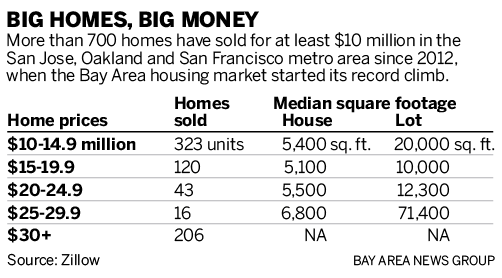
About 700 Bay Area homes have sold for more than $10 million since 2012, according to a Zillow analysis. Estates fetching between $15 and $19 million typically get a buyer a 5,100-square-foot mansion on a 10,000 square foot lot.

Wealthy buyers also have been active in the market for homes over $30 million — about 200 estates in San Francisco, Oakland, San Jose and their surroundings have topped that price, according to the real estate site.

By comparison, the median price for a new single family home in the super-heated Bay Area comes in at a mere $942,000. The median home value in Palo Alto — boasting strong schools, sunny weather, and quick commutes to Stanford University and tech and banking headquarters — is about $3.2 million.

Aaron Terrazas, senior economist at Zillow, said high end homes, typically more than $10 million, are difficult to price because they have so few comparable spaces. Luxury estates come with one-of-a-kind features, and buyers often have specific, non-negotiable demands.

“At those very high price points, it’s a different market,” he said. “Not only are the homes more unique, so are the buyers.”

The developers bought the property on the 4100 block of Old Adobe Road near   Arastradero Road and Foothill Expressway in February, 2014. The high value of the land, assessed at $3.9 million, made it unprofitable for developers to build a collection of more affordable homes —  even just a few multi-million dollar units.

“We could use smaller houses,” said Michael Dreyfus, agent with Golden Gate Sotheby’s International, “but it just doesn’t work out for builders.”

Dreyfus has spent nearly three decades representing buyers and sellers in the wealthiest enclaves of Silicon Valley. The typical Santa Clara County home now stays on the market less than a month before finding a buyer.

But buyers in the ultra-luxury market can wait and pick and haggle from a world of housing opportunities, agents say. They fret little about multiple bids, late night contract writing and contingency waivers.

“Your buying pool is way smaller,” Dreyfus said. The typical net worth of a buyer would be more than $30 million, he estimated, a tiny fraction of the population.

Dreyfus put the home up for sale in June. It’s set in the foothills, near horse farms, hiking trails, gated estates and a few tech headquarters, including electric vehicle maker Tesla. New, high-end construction has swept into the neighborhood, encouraged by the booming economy, large lots and more permissive land use codes.

The rugged terrain allowed architects to build into the side of the hill, offering big, lighted spaces technically considered basement space by city planners, Dossetter said. The designation allowed for a larger and more elaborate space.

The estate has all the features expected in a $20 million home and more, Dulcy Freeman, agent for Golden Gate Sotheby’s, said during a recent tour of the property.

Work from local artisans fills the spaces — a hand-worked copper fireplace accent and kitchen hood from a Redwood City furniture maker, custom chandeliers from a Healdsburg shop, gates and railings forged in Scotts Valley.

Oversized windows slide open to usher in northern California breezes, and provide a wide, walk-through transition from indoors to out. Built-in heaters lift the evening chill from the patio.

Downstairs holds a billiards room, limestone-lined wine cellar, workout studio and sauna and steam rooms. “I feel like I’m in a spa,” Freeman said.

The 1.25-acre property was unusually large for Palo Alto, she said. “This is a secret find,” she added, although the marketing campaign is more shout than whisper.

The firm is promoting the property with a 20-page catalog, packed with buttery images of the property at dusk, tight shots of handmade furnishings and aerial photos of surrounding trails and estates. A second brochure includes a video player, with short clips offering gauzy, hovering details of the craftsmanship.

Several groups and individuals have toured the property. But the right match is still waiting.

“No one needs a $20 million house,” Dreyfus said.

But he’s betting someone will want it.

Article source: https://www.mercurynews.com/2018/10/03/20-million-bay-area-home-what-you-can-have-in-the-ultra-luxury-market/

Posted in SF Bay Area News | Tagged | Leave a comment