Michael Covarrubias of TMG Partners talks up downtown San Jose, downtown Oakland

Michael Covarrubias is a key player on both the finance and building sides of the development coin. He spent 17 years with Union Bank, including a stint as a decision maker in the bank’s construction lending unit. Since 1988, Covarrubias has been with development stalwart TMG Partners and is TMG’s chairman and chief executive officer.

If there’s a big commercial real estate market in the Bay Area, San Francisco-based TMG is in it. This news organization recently talked with Covarrubias about  the nine-county region’s development scene, and in particular, the picture in downtown San Jose and downtown Oakland.

Q How hot is the current commercial real estate market in the Bay Area?

A No one likes to say it’s different this time. But the corollary is that it’s always different. This market is different from the dot-com era.

Q In what ways is it different? How does the upswing compare with the dot-com period? Is it the FAANGs, the Facebook, Amazon, Apple, Netflix, Google tech companies?

A The magnitude and breadth of the FAANGs and the almost-FAANGs has never been seen before in the Bay Area. They are highly capitalized. They are very aggressive in their growth efforts. Their appetite to increase their employees is something unlike we have ever seen.

Q How do you assess the downtown sectors of the Bay Area’s three largest cities?

A San Francisco has essentially been out of large blocks of space for about three years. Oakland is the beneficiary of that, as is downtown San Jose.

Q How long have you been active outside of the downtown San Francisco market?

A We went to San Jose and Oakland three years ago. We entered both those markets even though that was 2015, when there were worries about how long the economic recovery would last. We thought there were several more years of economic expansion.

Q What are your major efforts in downtown Oakland?

A We bought three major assets in Oakland and earlier this year we sold 1330 Broadway downtown. We will still be in Oakland after this deal. We are bringing two other assets to the market this year.

Q What are your plans in downtown San Jose?

A In San Jose, we have our Platform 16 office project, consisting of 1 million square feet of offices, a fully entitled project. We are now starting to think about how to activate that development. We are having conversations with tenants and capital partners.

Q What’s the development expense for Platform 16?

A It will cost $800 million to $900 million to build that campus. That is a big project.

Q What are the pluses and minuses of downtown Oakland?

A The bones of Oakland have always been great. Transportation, freeway and BART access, the waterfront, proximity to San Francisco, a workforce that draws from the east, the north and the south. What Oakland lacked was the momentum to create a 24-hour city. They tried office buildings, but those didn’t work. They tried retail and that didn’t work.

Q Have things begun to change for the better in downtown Oakland?

You have the Uptown district, the artists, the theaters, the non-profits, great restaurants and safety is increasing. Under Mayor (Libby) Schaaf, crime has gone down dramatically. And then you add the bonus round. San Francisco’s downtown is full.

Q What are the pluses and minuses of downtown San Jose?

A I’ve had a lot of experience with San Jose. San Jose was on its way to being a very complete place when the 2008 economic crash happened. Everything that was being planned went up in smoke. A lot of projects were foreclosed or abandoned.

Q How are things improved now in downtown San Jose?

A Now you have the transit hub at Diridon Station. That station is the most multi-modal transit hub in the entire Bay Area. It has Caltrain, Amtrak, light rail, the ACE Train, and BART is coming to that station. Companies want to be on the Caltrain line, next to BART, and in an urban environment. If we get high-speed rail from the Central Valley and Los Angeles, that will all add to Diridon Station.

Q How much of a difference is all this activity at the train station, Google’s interest in the area, going to make for downtown San Jose?

A San Jose is finally going to have its day. If it all comes to pass, Google will be the anchor of a complete revitalization of the downtown. Google creates the need for more housing, the need for more retail, more restaurants. All of it will be focused on transit. BART will open up so much for so many corridors.

Q Are big infill developments such as your proposed Platform 16 office campus in downtown San Jose the future in the Bay Area?

A Fixing transportation is a slow process. You can’t build a new bridge everywhere, or double-deck all the freeways. But you can put people’s jobs near where they live. That is done through BART or Caltrain. The traffic is beyond horrible, and the goal is less traffic on the freeway. That is why infill development is an answer. You are going to have growth, you have to find creative ways to accommodate the growth. You can’t put a lid on boiling water and expect it to stop. Make buildings bigger and more efficient, put them in places where people can take BART, Caltrain, or light rail.


MICHAEL COVARRUBIAS

Organization: TMG Partners

Job: chairman and chief executive officer

Age: 69

Birthplace: Oakland

Residence: San Francisco

Education: University of San Francisco

Family: Married to Kathleen McIntosh.  One Daughter, Alison, married with two children.


FIVE THINGS ABOUT MICHAEL COVARRUBIAS

  1. He appreciates balance in his life.
  2.  He is a sports car enthusiast.

3. He says action movies are a way to fully escape for a while.

4. He enjoys immersion in other cultures through travel, including museum visits, enjoying local dishes and good wine.

5. He spends time at his Napa home with his wife, daughter and her family.


Article source: https://www.mercurynews.com/2018/11/25/sv-chat-michael/
Posted in SF Bay Area News | Tagged | Leave a comment

Longtime urban planner leaving Bay Area for Sydney with frustrations, hopes

Gabriel Metcalf has spent a lifetime thinking about cities. He spent 21 years at SPUR, the Bay Area urban think tank in San Francisco, and led the organization for 13 years. Holding that job, he said, was “the honor of my life.”

He’ll be leaving town at the turn of the year, bound for Sydney, where he’ll be head of the Committee for Sydney, a planning organization similar to SPUR. In a way, he’s following a dream. Metcalf and his wife have always wanted to live and work abroad. So he was delighted when a job offer came from Australia, “right out of the blue,” he said.

He’d been in Sydney a few times.

“I fell in love with it,” he said, “It’s a great city.”

He said the same thing about San Francisco, when he moved here 22 years ago, “when it was still possible to come here without a job and figure it out,” he once said.

Metcalf thinks San Francisco is “the most progressive of American cities.” But problems are overwhelming the city and the Bay Area. “Something has gone terribly wrong,” he wrote in SPUR’s magazine.

The success of the region has also brought failure — and economics are the key, he thinks.

“The economy has changed fundamentally in the last 50 years,” Metcalf said. “We have made the transition to the knowledge economy,” with thousands of new people and new jobs. The Bay Area has become a player on the world stage, with an economy that is larger than Sweden’s. He calls it “the reluctant metropolis.”

The region has become so attractive and successful that no one can afford to live here. Economic studies show that the median price for a house in San Francisco is $1.6 million — twice what it was five years ago. And it’s not just San Francisco. Only 18 percent of Bay Area residents can afford a medium-price house.

Metcalf believes it’s our own fault. The current generation — the voters, the leaders, the ordinary citizens — are to blame.

“You know what they say, San Franciscans love innovation as long as it doesn’t mean changes,” he said. Every development decision in the city — and the region as well — involves endless meetings, public hearings and workshops. Not to mention a permit system of Byzantine complexity.

“We’ve really gotten good at preventing bad things from happening,” Metcalf said, “but we are not good at making good things happen.”

It’s no secret that the result is that the region’s supply of housing has been overwhelmed by demand. Restrictions on zoning, coupled with construction costs that are among the highest in the country, mean that only one housing unit has been built in the Bay Area for every six new jobs.

Metcalf thinks that more dense housing is an answer. But zoning regulations are in the way.

“In most of the Bay Area, it is illegal to build anything but single-family houses,” he said. “What we are doing now is not working.”

The housing crisis is behind the Bay Area’s terrible traffic, long commutes and inadequate transportation as people push farther out in search of places to live. Metcalf is worried about the lack of big transit projects. In recent years, the region’s only major projects to be approved have been the Sonoma-Marin SMART train, a couple of BART extensions, increased ferry service and plans to electrify the 155-year-old Peninsula commute trains.

BART is talking about a second Transbay Tube in the next decade, but so far it’s only talk.

And projects seemingly take forever these days.

“Look how many years it has taken to study faster buses on Geary Boulevard,” Metcalf said. In fact, the Geary bus project has been in the works for 10 years.

Metcalf thinks the region can learn from the past, “particularly the generation that built BART.”

It took leadership to build BART, he said, in the face of technical problems and political opposition, especially from so-called progressive groups that argued BART would benefit only big business and developers.

Like all urbanists, Metcalf looks to the future. The numbers are sobering: The most recent Metropolitan Transportation Commission study envisions 300,000 new jobs in San Francisco over the next 20 years, part of a growth pattern in a booming mega-region of 4 million new residents that stretches from Monterey to Sacramento.

“People are going to come here,” he said. “There will be new immigrants from other parts of the country and from foreign countries. Our job is to make the region better for the next generation.”

In the meantime, he’s off to Sydney, a city very similar to San Francisco, where a combination of natural beauty and growth has created its own problems. He sees it as a challenge and an adventure.

How will it work out?

“Ask me in a year,” he said.

Carl Nolte is a San Francisco Chronicle columnist. His column appears every Sunday. Email: cnolte@sfchronicle.com Twitter: @carlnoltesf

Article source: https://www.sfchronicle.com/bayarea/nativeson/article/Ex-think-tank-chief-follows-dream-from-SF-to-13417854.php

Posted in SF Bay Area News | Tagged | Leave a comment

When WWII brought blacks to the East Bay, whites fought for segregation

Just north of Berkeley off San Pablo Avenue in Albany stands a housing complex called University Village, reserved for married students at UC Berkeley. Few realize that in the years after World War II, this complex, then called Codornices Village, was the site of one of the most racially charged housing battles in Bay Area history.

At stake: whether to tear down a public housing project that had been hastily erected to give wartime shipyard workers a place to live.

World War II brought about the most dramatic migration to the Bay Area since the Gold Rush. Drawn by high-paying shipyard jobs, hundreds of thousands of people poured into the area. Richmond, home to the Kaiser shipyards, saw the most explosive growth: Its population nearly quadrupled in three years, to 93,738 in 1943. San Francisco, Oakland, Vallejo and other cities also experienced big increases.

Many of the newcomers were African Americans from the South, an influx that radically transformed the region’s racial makeup. In 1940, there were 270 blacks living in Richmond; in 1945, there were 5,673. Oakland’s black population soared from 8,462 to 21,770, and San Francisco’s from fewer than 5,000 to 32,000.

There were also large numbers of whites from Oklahoma and the South, following the path blazed by the Dust Bowl migrants of the 1930s.

The population boom created a Bay Area-wide housing crisis. As Marilynn S. Johnson notes in “The Second Gold Rush: Oakland and the East Bay in World War II,” Oakland’s vacancy rate fell to 0.06 percent in September 1942. Workers slept outdoors, in 24-hour movie theaters, in shifts in the same bed, in trailer parks, even in chicken coops.

For black workers, finding housing was much harder than for whites. Federal authorities, ideologically opposed to public housing, initially relied on private sector initiatives like the war guest program, which encouraged homeowners to take in war workers as tenants and boarders. Since few white homeowners would take them in or rent to them, African Americans were forced to squeeze into existing black neighborhoods like West Oakland, creating Eastern-style ghettos that had not existed on the West Coast.

When the private sector was unable to meet the need, the federal government decided it had no choice but to construct housing of its own. But under pressure from real estate interests that feared permanent housing would harm postwar construction, and clinging to the belief that most of the migrant workers would go home after the war, the government decided to build housing designed to be temporary.

“Guided by expediency … federal housing agencies created, in effect, distinct zones of migrant settlement along the bay flatlands between Richmond and Alameda,” Johnson writes.

In all, more than 30,000 public housing units, holding an estimated 90,000 war workers and their family members, were built in the East Bay. Among them was the 1,900-unit Codornices Village.

Trivia time

The previous trivia question: What loud nighttime noises assaulted dwellers on the eastern side of Telegraph Hill until 1993?

Answer: The coupling of trains belonging to the State Belt Line railroad.

This week’s trivia question: How many people died in San Francisco in the great earthquake and fire of 1906?

Every corner in San Francisco has an astonishing story to tell. Gary Kamiya’s Portals of the Past tells those lost stories, using a specific location to illuminate San Francisco’s extraordinary history — from the days when giant mammoths wandered through what is now North Beach to the Gold Rush delirium, the dot-com madness and beyond. His column appears every other Saturday, alternating with Peter Hartlaub’s OurSF.

Like what you’re reading? Subscribe to the Chronicle Vault newsletter and get classic archive stories in your in-box twice a week.

Read hundreds of historical stories, see thousands of archive photos and sort through 153 years of classic Chronicle front pages at SFChronicle.com/vault.

The projects, especially Codornices, ran into immediate opposition from whites. The Albany City Council warned of “an undesirable element” (i.e., blacks) that would bring integration to city schools and make Albany “like south Berkeley.” The city of Berkeley, not yet a liberal bastion, was also opposed, as was UC Berkeley, which owned 40 percent of the project’s land.

But the federal government overruled local objections and opened Codornices in 1943. Like nearly all wartime Bay Area public housing projects, it was racially segregated — white tenants ended up in the more desirable units on San Pablo Avenue, while blacks were shunted to the west side of the project, next to the Southern Pacific railroad tracks.

When the war ended, local governments had to decide what to do with their temporary housing and the people who lived there. The federal housing acts of 1949 and 1950 provided funding for 135,000 new public units nationwide to house displaced residents, and transferred title of all existing projects to local authorities. But the powerful National Association of Real Estate Boards, which had opposed public housing since the 1930s, mounted an all-out statewide campaign to block “socialistic” developments.

Red-baiting tactics led to one pro-housing city councilman in Oakland losing his seat; when he was subsequently fired from his job, he committed suicide.

Under relentless pressure, the liberal, pro-housing coalition collapsed. Between 1945 and 1965, Oakland built only 500 public housing units. In Richmond, many displaced black families, unable to move elsewhere because of racial covenants, crowded into south- and west-side neighborhoods bracketed on three sides by railroad tracks — creating the so-called Iron Triangle ghetto.

The black residents of Codornices Village eventually suffered a similar fate. Thanks to an antisegregation campaign led by future Assemblyman Byron Rumford and the progressive stance of the project’s federal managers, Corornices’ buildings had become largely integrated by 1946. But in a familiar pattern, white tenants who had housing options moved out, while blacks who lacked such options remained and other blacks moved in. By 1954, the project was almost 90 percent African American.

For local officials and citizens who feared they would be “overrun” by Southern blacks, integration had now gone too far, and they renewed their efforts to demolish Codornices. In 1954, with no local agency willing to take the project on, and the University of California washing its hands by saying it “would not get involved in the housing business,” the federal government announced its closure. By 1956, all the residents had been forced out.

But not all the buildings were razed. Despite its earlier claim, UC did in fact get involved in the housing business — taking over several hundred units and converting them to married student housing.

The last of the wartime buildings, within whose walls a brief attempt at racial integration failed more than half a century earlier, were demolished in 2007.

Gary Kamiya is the author of the best-selling book “Cool Gray City of Love: 49 Views of San Francisco,” awarded the Northern California Book Award in creative nonfiction. All the material in Portals of the Past is original for The San Francisco Chronicle. To read earlier Portals of the Past, go to sfchronicle.com/portals. For more features from 150 years of The Chronicle’s archives, go to sfchronicle.com/vault. Email: metro@sfchronicle.com

Article source: https://www.sfchronicle.com/chronicle_vault/article/When-WWII-brought-blacks-to-the-East-Bay-whites-13417228.php

Posted in SF Bay Area News | Tagged | Leave a comment

`Nothing safer than cash’: Tech rout puts Silicon Valley on edge

Steve Hoffman grabs the mic and, at once, beams Silicon Valley optimism. Decked out in his trademark purple-and-blue plaid shirt, his high-pitched voice echoing off the concrete walls, he touts his start-up incubator’s track record and rattles off the names he helped propel: Instagram, Etsy, Change.org, Foursquare.

Oohs and aahs ripple through the crowd of twenty-somethings. Smartphones are raised to film his every word. They’ve packed themselves tightly into this underground San Francisco conference room for a shot at meeting venture capitalists willing to take a chance on their dreams. When Hoffman delivers his punch line — “you may be the next unicorn” — the place erupts in cheers.

Moments earlier, though, Hoffman, or Captain Hoff as he likes to be called, sounded a decidedly more pessimistic tone as he chatted candidly while waiting for his guests to arrive. The truth was, he said, that when it came to his own money, he was plunking down very little. After a decade of soaring tech valuations, the recent 12 percent wipeout in the Nasdaq was to be expected. He fears the sell-off in public stock markets will only get worse — a lot worse — and, in turn, start driving down the stubbornly high valuations of privately owned start-ups.

“I’m actually quite worried,” said Hoffman, who created his incubator, Founders Space, in 2011. He said he’s pulled 80 percent of the money he had in public markets and 60 percent of what he had in private markets. It’s all parked in cash now. “There’s nothing safer than cash.”

Hoffman’s trepidation may be a bit extreme by Silicon Valley standards — some here don’t share the sentiment at all — and yet it underscores an unmistakable new reality: The hand-wringing over the tech stock rout is no longer the exclusive domain of Wall Street traders, that notoriously more jittery and anxious crowd on the other side of the continent. No, even here, in the heart of the industry where gung-ho optimism and bullishness are built into the DNA, doubts are starting to seep in.

It’s not that folks are bracing for another dot-com or 2008-type bust. Only a few, like Hoffman, are quite that gloomy. Typically, it’s more subtle than that. Maybe a VC firm spends a few extra days scrutinizing deal terms. Or a young programmer puts a million-dollar home purchase on hold.

Austin Degenhardt, the 29-year-old founder of Paul Hardt, an early-stage company that makes luxury shoes and markets them online, described the growing sense of angst this way: “It’s more just in the back of my mind. I just feel the rush.”

For Degenhardt, the rush is to lock in funding from venture capitalists while valuations remain near-record highs. He’s seeking $600,000. (He had a pretty good day at Founders Space last week, having scored about a half-dozen business cards from VC types; he flashed a coy smile as he showed them off.)

And for those entrepreneurs further along in the development stage, the rush is often to tap public markets with an IPO. So far, that market hasn’t shown any signs of cooling. There have been 46 tech IPOs this year. They raised $16 billion, topping 2017’s total of $13 billion. And some marquee names — Uber, Slack and Airbnb, among them — are lining up to come to market soon.

“We’re seeing no slowdown in IPO preparation, readiness, planning for 2019,” says Alex Wellins, co-founder of the Blueshirt Group, a technology investor relations firm and IPO adviser that’s helped take SurveyMonkey, among others, to market. He predicts another big year in 2019 though he acknowledges that if the market sell-off deepens, those projections could fall apart. “There’s definitely been a correction, there’s been a lot of volatility, but the markets are still relatively strong and it makes sense to be ready.”

Most tech stocks have been plunging for several months now. Some of the moves are eye-popping: As of midweek, Netflix is down 32 percent from a record high in July; Amazon.com is off 22 percent since early September; Tencent, the Chinese technology behemoth, is down 38 percent from a January record. Semiconductors have gotten hammered too, dropping 19 percent since early June. So too have tech hardware companies. They’ve fallen 14 percent from an October peak. Globally, tech companies have lost $1.1 trillion in value in the past two-and-a-half months.

The causes are many, from the nagging privacy issues at Facebook and Google to slumping demand for semiconductors and smartphones to the U.S.-China trade war. And all of them point to a seemingly inescapable truth — that the days of never-ending profit growth are coming to an end. So after an incredible decade-long run in which the Nasdaq soared more than 500 percent, many Wall Street investors have decided the sector is just too pricey.

“Investor optimism is more curbed,” says Alex Chompff, an angel investor and consultant who took a few of his investing pals to the Founders Space event. “It has an upper boundary that it may not have had a year ago.”

Curiously, that new-found cap on exuberance is hitting the Bay Area real estate market faster than it is private tech valuations. The go-go days, where every new listing sold as soon as it hit the market, are gone. Tracy McLaughlin, a real-estate agent in Marin County, says she’s seeing price cuts of up to 10 percent and is bracing for a 20 percent decline in her business next year. Ditto for Natalie Kitchen, a realtor in San Francisco, who, like McLaughlin, only sells million-dollar homes.

Both of them cite the rout in tech stocks as a key reason for the recent declines. “I think it’s more about that feeling of generally being poorer than you thought you were,” Kitchen says. When clients began asking for discounts on listings, she was taken by surprise. “Those are not conversations that we’re used to having.”

Back at Founders Space, Captain Hoff is ready for whatever may come.

At 53, he’s old enough to have witnessed firsthand both the dot-com bust and the 2008 collapse. Those experiences give him a perspective many of his younger colleagues lack. And they keep telling him that a major tumble — something much bigger than what’s been seen so far — is not far off.

When exactly? He’s not sure. Perhaps within a year. “I’m not an oracle.” He’d rather be safe than sorry, he says, and give up some potential gains for the sake of peace of mind. Here in Silicon Valley, he recognizes that is somewhat rare. “I tend to be one of the more conservative ones, having been burned twice,” he says. “I have no qualms about making those decisions and living with them.”

Article source: https://www.seattletimes.com/business/nothing-safer-than-cash-tech-rout-puts-silicon-valley-on-edge/

Posted in SF Bay Area News | Tagged | Leave a comment

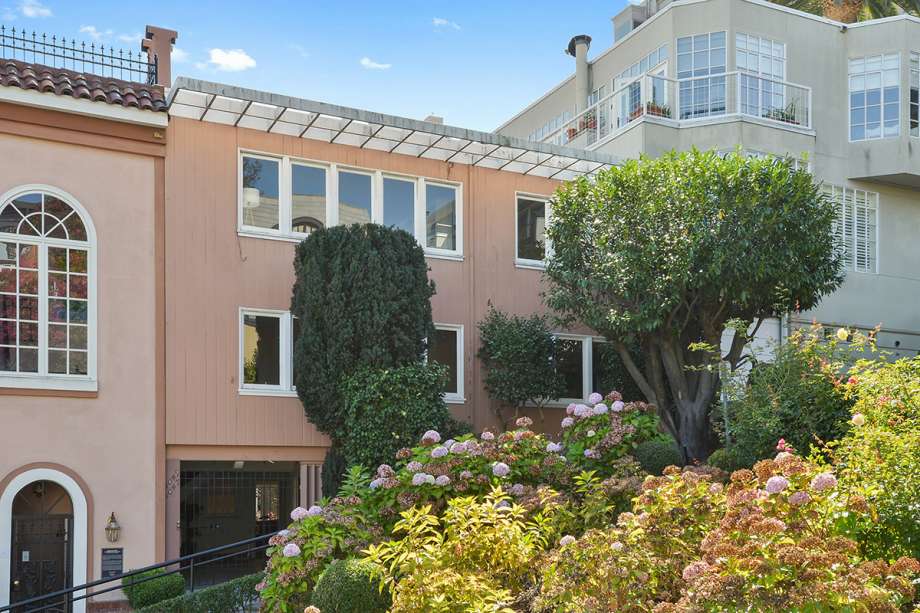
Iconic pink duplex on Lombard has history and seven parking spaces for $5.375M


  • d5762 920x920 Iconic pink duplex on Lombard has history and seven parking spaces for $5.375M

    An iconic home on a tourist favorite street. Yours now for $5.375M

    An iconic home on a tourist favorite street. Yours now for $5.375M


    Photo: Lino Photography Www.by-lino.co

  •  Iconic pink duplex on Lombard has history and seven parking spaces for $5.375M

Caption

Close

An iconic home on a tourist favorite street. Yours now for $5.375M

An iconic home on a tourist favorite street. Yours now for $5.375M


Photo: Lino Photography Www.by-lino.co


In 2015, one of San Francisco’s most recognizable homes– a pink duplex– on one of its most recognizable streets–the famously crooked Lombard– went up for sale for the first time in over 50 years. Now, three years later, it’s on the market again, priced at $5.375 million.

The history


The duplex at 1047-1049 Lombard is a familiar site for those who’ve traveled the many curves of that iconic San Francisco Street.

Built in the late 1940s, it was home to the late Elton Puffer, whose famed art collection includes gifts to the Asian Art Museum. Puffer owned the building for over 50 years.

In 2016, it sold for $4.050 million.

The home now

The duplex offers two levels of living.

The top unit is two beds, two baths with a formal dining room and deck offering classic SF views of Coit Tower and the Bay beyond.


The lower unit is three beds, three baths. This is where  you’ll find the rather stunning gold-leaf spiral staircase you see in the gallery above.

Both units have fireplaces.

But Lombard though? 

Lest you fear the perennial tourist attraction that is Lombard as your access to city and home, rest assured. Per the official website, you never have to drive on Lombard Street at all.

This stunning two-family building has frontage directly on the iconic curved section of Lombard, but the oversized three-car garage in the rear, plus motor court parking for up to four more vehicles, is accessed with ease from quiet Lurmont Terrace.

Incidentally, that parking adds up to seven dedicated spaces. So if you need some side-income, you could rent out the extra spots.

Delivered vacant

Co-listing agent Faye Dibachi told SF Gate that the duplex hasn’t really been altered since its 2016 purchase, meaning its kind of a blank canvas: a new buyer could update the property, or restore to full retro glory. The option of converting to a single-family exists as well. 

And, very important information to know: the duplex is being delivered vacant. 

What price to live on this famous street in this famous home? Asking $5.375 million. 

See the complete listing here. 

Anna Marie Erwert writes from both the renter and new buyer perspective, having (finally) achieved both statuses. She focuses on national real estate trends, specializing in the San Francisco Bay Area and Pacific Northwest. Follow Anna onTwitter: @AnnaMarieErwert


Article source: https://www.sfgate.com/realestate/article/Pink-duplex-on-Lombard-has-history-and-seven-13346055.php

Posted in SF Bay Area News | Tagged | Leave a comment