Bay Area housing market cools, but it’s still nuts


  • fd279 920x920 Bay Area housing market cools, but it’s still nuts

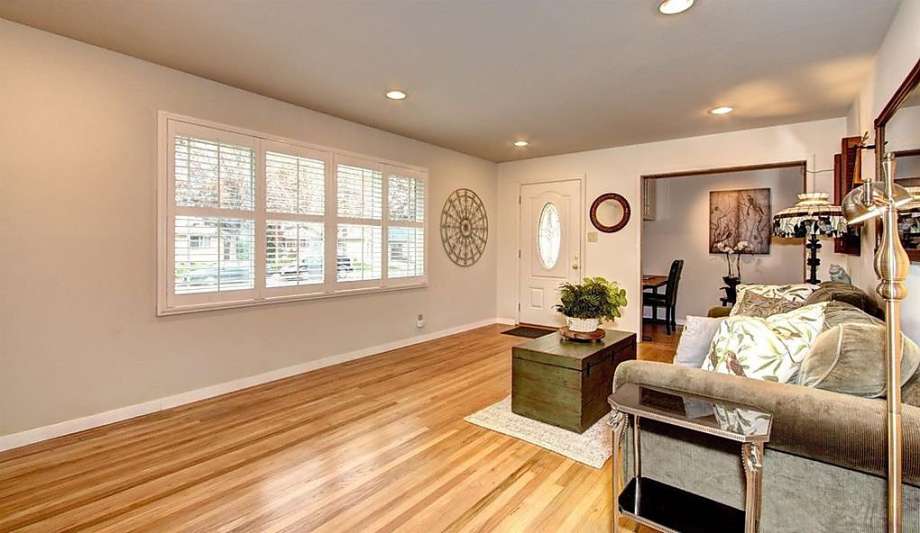
    This 848-square-foot Sunnyvale home, which sold for $2 million in February, made headlines as an example of Bay Area housing insanity.

    This 848-square-foot Sunnyvale home, which sold for $2 million in February, made headlines as an example of Bay Area housing insanity.


    Photo: Doug Larson / Coldwell Banker 2018

  •  Bay Area housing market cools, but it’s still nuts

Caption

Close

This 848-square-foot Sunnyvale home, which sold for $2 million in February, made headlines as an example of Bay Area housing insanity.

This 848-square-foot Sunnyvale home, which sold for $2 million in February, made headlines as an example of Bay Area housing insanity.


Photo: Doug Larson / Coldwell Banker 2018


The Bay Area real estate market went into 2018 with a bang and out with a whimper.

In the first half of the year, the median price rose almost 17 percent to an all-time high of $875,000 in June. In the second half, it fell 10.3 percent from that peak, ending at $785,000 in December.


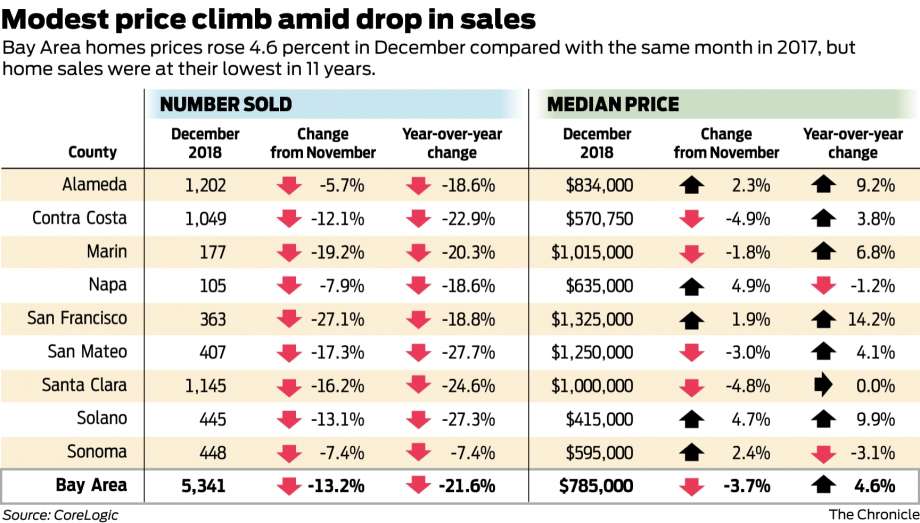
The December price was down 3.7 percent from November but up 4.6 percent from December 2017, according to a report Thursday from research firm CoreLogic. It includes all new and existing homes and condos in the nine Bay Area counties.

An earlier report from the California Association of Realtors — which includes only existing, single-family homes entered into a multiple listing service — said the Bay Area median price fell to $850,000 in December, down 6.1 percent from November and down 3.6 percent from December 2017. That was the first year-over-year drop since March 2012.


Any way you look at it, the market downshifted in the last three months of 2018. As the stock market plunged and mortgage rates rose a half percent to almost 5 percent, buyers backed off, inventory grew, price cuts surged, and price appreciation slowed from the double to single digits on a year-over-year basis.

The number of homes sold in December fell to 5,341 across all nine counties, down 13.2 percent from November and 21.6 percent from December 2017. That was the lowest sales count for a December in 11 years, CoreLogic said.

Many sellers, perhaps unaccustomed to a less-than-ridiculous market, took their homes off the market or let their listings expire. A total of 2,493 listings in the nine Bay Area counties were withdrawn or expired in December, compared with only 1,154 in December 2017 and 1,487 in December 2016, according to analyst Patrick Carlisle of the Compass real estate firm.


fd279 920x1240 Bay Area housing market cools, but it’s still nuts


“December was rock bottom,” said Chad Eng, a Redfin agent in Silicon Valley. “Buyers are hesitating, on the sidelines. Sellers are still focusing on comps from six months ago.”

Instead of selling in days like they were earlier in the year, homes took weeks or even months to sell. Homes that closed in December had been on the market 29 days before getting into contract. That was up from 23 median days on market in November and 17 in December a year ago, the Realtors association reported.

Eng said things picked up around the middle of January, as the stock market recovered and mortgage rates fell back into the 4.5 percent range. “I wonder if it’s a sign of what we will see in the spring,” or just a normal seasonal rebound, he said.


Santa Clara County was the hottest market in the Bay Area — and most of the country — for the first part of the year as prices rose in the teens and 20s year over year. In February, its median price topped $1 million for the first time, rising to $1,080,000, up 27.8 percent.

That was the month a two-bedroom, one-bathroom, 848-square-foot home on Plymouth Street in Sunnyvale sold for $2 million cash — making headlines as the height of Silicon Valley insanity.

That was and still is a record price-per-square-foot for Sunnyvale, said Doug Larson, a Coldwell Banker agent, who represented the seller. “Now with the softening market, I doubt that anybody will beat it, at least for a while,” he said.

After hitting $1.15 million in June, Santa Clara’s median price has fallen to $1 million in December, exactly where it was a year ago.

January is always a slow month for the real estate market, as sellers recover from the holidays and get their homes spruced up for the busy spring season.

“Homes that sell in the winter are typically homes that have been sitting on the market awhile and have to take a price cut,” said Redfin Chief Economist Daryl Fairweather.

Right now, “buyers are in a holding pattern,” she added. “They don’t know if this is as good as it’s going to get, if prices come down or more homes come on the market.”

She noted that a slower market is good for buyers because “they have more negotiating power” and for sellers who are moving up to a more expensive home because “overall they are going to be saving more money.”

Fairweather predicts that prices will end the year about where they are now. “I would be surprised if they go down,” she said.

Nancie Allen, president of Bay East Association of Realtors, said the government shutdown in January made it hard to tell where the market is headed. The next two weeks will be a better indicator. The market now “is all over the place,” she said. Some homes in Fremont have been sitting on the market for a while, while one had 15 offers.

Aaron Terrazas, a senior economist with Zillow, said his data show that home prices in the last quarter of 2018 rose at their slowest annual pace for any quarter since 2010.

He predicts that prices will appreciate 5 to 6 percent this year in the San Francisco metro area and 7 to 8 percent in the San Jose metro area, assuming interest rates stay low.


Kathleen Pender is a San Francisco Chronicle columnist. Email: kpender@sfchronicle.com Twitter: @kathpender


Article source: https://www.sfgate.com/business/networth/article/Bay-Area-housing-market-cools-but-it-s-still-13578433.php

Posted in SF Bay Area News | Tagged | Leave a comment

The Bay Area neighborhoods where rent is actually going down, according to RentCafe


  • 3f0e9 920x920 The Bay Area neighborhoods where rent is actually going down, according to RentCafe

  •  The Bay Area neighborhoods where rent is actually going down, according to RentCafe

Caption

Close


If you’ve been perusing Craigslist lately, you may have noticed the rental market appears to be softening. Sure, the prices on those listings would still make most Americans’ eyes pop out of their heads. But it at least appears things may be leveling out a bit for the time being.

In certain pockets of the Bay Area, rent prices are even dropping — albeit not by much. RentCafe identified 10 Bay Area zip codes where the price of renting an apartment had dropped between January 2018 and January 2019.

ALSO: The most expensive zip codes for renters in the Bay Area

Most of the zip codes saw very little change, sometimes less than a one-percent drop. But we’ll take any savings, even if it’s just a bit.

See the Bay Area neighborhoods where rent prices are dropping in the slideshow above. 


Several Sonoma County cities saw softening rent prices in 2018. One possible explanation is rooted in tragedy: the North Bay fires of October 2017. In the aftermath of the fire, housing prices spiked due to an immediate shortage of homes and apartments. More than a year later, it’s likely the market was correcting for the extreme fluctuation.


The data in the slideshow was provided to SFGATE by RentCafe, an apartment listing website.

Read Alix Martichoux’s latest stories and send her news tips at amartichoux@sfchronicle.com

Start receiving breaking news emails on wildfires, civil emergencies, riots, national breaking news, Amber Alerts, weather emergencies, and other critical events with the SFGATE breaking news email. Click here to make sure you get the news.

Article source: https://www.sfgate.com/realestate/article/cheapest-rent-bay-area-san-francisco-apartments-13595252.php

Posted in SF Bay Area News | Tagged | Leave a comment

Cupertino Mayor’s ‘Wall’ Joke Draws Ire From Housing Advocates

CUPERTINO (CBS SF) – The Mayor of Cupertino faces scrutiny after apparently joking that his community should build a wall along its borders and have neighboring cities pay for it.

Mayor Steven Scharf made the comments in the introduction of his State of the City address on January 30th.

“You have heard about the wall along our southern border,” Scharf said, referencing President Donald Trump’s proposed border wall. “This is the wall around Cupertino. We have a big problem with all these Teslas coming through our city from Saratoga and other people from other cities, so we came up with this proposal.”

731f9 cupertino wall 020619 01 Cupertino Mayor’s ‘Wall’ Joke Draws Ire From Housing Advocates

Mayor Steven Scharf of Cupertino jokes about building a wall around his community during his State of The City address on January 30, 2019. (City of Cupertino / YouTube)

“San Jose will be mainly paying for it, so it’s not coming out of our own taxes. Saratoga will give a little bit too, since they are a big contributor to our traffic issue,” the mayor went on to say.

The mayor accompanied his comments with a PowerPoint slide that read “Securing Our Borders With the Cupertino Wall” and “Saratoga, Santa Clara, Sunnyvale, Los Altos, and San Jose Will Pay For It,” referring to the five communities that border the city.

• ALSO READ: 2 Cats Live By Themselves In $1500/Mo. Silicon Valley Studio

Scharf’s comments were roundly criticized by housing advocates who have often complained that the city of 60,000 and home to Apple has resisted new homes amid the ongoing housing crisis in Silicon Valley and the Bay Area.

Lan Diep, a city councilmember in neighboring San Jose, also responded to Scharf’s comments on Twitter. Diep, along with other members of the council, posed with signs saying they would not pay for such a wall.

• ALSO READ: Affordable Homes In San Jose Down 54 Percent To Lowest In U.S.

Advocates point to the long saga involving the redevelopment of the mostly empty Vallco shopping center as an example of the city’s attitude towards the housing crunch. After ballot measures and much debate, the City Council approved a mixed-use project with nearly 3,000 housing units, along with offices and retail on the site last September.

Several weeks later, opponents worried about potential traffic impacts and overcrowded schools gathered enough signatures to place a referendum on a future ballot to reverse the plan.

According to Zillow, the median home value in Cupertino is $2,255,700, and the real estate company expects home values in the city to rise more than 6 percent this year.

Article source: https://sanfrancisco.cbslocal.com/2019/02/06/cupertino-mayor-jokes-build-wall-san-jose-pay-for-it/

Posted in SF Bay Area News | Tagged | Leave a comment

Finally, some insight on the impact of IPOs on home prices

One of the hottest topics in local real estate is what will happen to home prices in and around San Francisco if an expected surge in blockbuster initial public offerings takes place.

There has been lots of talk about newly minted millionaires with fistfuls of IPO cash muscling out other buyers in an already challenging market, but there’s been little evidence to test that theory. Until now.

Three new studies that look at previous IPOs found that they do raise home prices somewhat, with the biggest gains coming closest to the headquarters of companies going public.

That could have big implications for San Francisco, which is the epicenter for an expected wave of offerings by tech companies with multibillion-dollar valuations. Lyft confidentially submitted paperwork for an offering in early December, sort of a precursor to an actual filing, the same week that Uber reportedly did the same. Slack Technologies announced it had filed confidentially on Monday. Other San Francisco companies said to be eyeing an offering include Airbnb and Pinterest.

A working paper first presented at an academic conference last month provides the most relevant insight. Entitled “Cash to Spend: IPO Wealth and House Prices,” it looked at 725 IPOs by California companies between 1993 and 2017 and an index of home prices within 1, 5 and 10 miles of each company’s headquarters.

 Finally, some insight on the impact of IPOs on home prices

It looked at the price index three months before and after three dates: the date the company filed for the IPO, the IPO date (when it sold shares to the public) and the end of the lockup period, when employees are free to sell their stock. (Most companies prevent employees from selling for a number of months after the IPO.)

 Finally, some insight on the impact of IPOs on home prices

It found that after the filing date, average home prices within a 10-mile radius of headquarters rose by 1 percent more than home prices throughout the same county. After the company went public, the index rose an additional 0.8 percent. Surprisingly, there was no additional gain after the lockup expired.

“Our initial guess was that the big effect was going to be at the expiration of lockup,” said Barney Hartman-Glaser, an assistant finance professor at UCLA who co-authored the study. Maybe it didn’t because “the lockup is anticipated. If I’m a seller, and I know that in two months a bunch of people will have a lot more money to spend, why would I accept a lower price two months earlier? I just won’t sell,” he said.

Could that explain the rash of sellers who took their homes off the market or let their listings expire in December? As I reported last week, 2,493 listings across the Bay Area were withdrawn or expired in December, compared with only 1,154 in December 2017, according to analyst Patrick Carlisle of the Compass real estate firm. In San Francisco, those numbers were 305 and 199, respectively. Carlisle said he thinks the jump “had mostly to do with a cooling market with more market uncertainty and fewer sales,” and was not a response to the Lyft and Uber news.

But the study’s authors thought there could be some connection.

Their surprising results about the lockup period also suggest that pre-IPO shareholders “change their housing demand when their wealth changes,” not when their liquidity increases, and that they “can finance their home purchases based on their illiquid wealth,” the authors wrote. “Banks in California may not be very restrictive in originating mortgages to entrepreneurs and workers at startup firms because of their relatively rich experience with this type of consumers.”

The authors did not consider the fact that many employees working for startups in the late stages of the dot-com boom, when many IPOs in their study took place, never really cashed in on IPOs because by the time their lockup period expired, shares in their companies had plummeted. Hartman-Glaser said they might look at that in the future.

The authors, not surprisingly, found that home prices increased more the closer you got to headquarters and that larger IPOs had a bigger impact than smaller ones. They also discovered that younger companies going public had a bigger impact on home prices than older ones of the same size.

“Managers and workers for those young firms tend to live closer” to work than do employees of older companies, said Jiro Yoshida, an associate business professor at Pennsylvania State University and one of the co-authors.

He figured that a company in the youngest quartile by age and the top quartile by amount raised hypothetically could have raised home prices by 3.7 percent within a 10-mile radius of headquarters (versus 1.8 percent for the average).

 Finally, some insight on the impact of IPOs on home prices

Hartman-Glaser suspects that the current crop of IPO candidates might have a smaller impact on home prices than those in his study.

“The flow of information from financial markets to real estate has improved,” since the 1980s, he said.

And companies are waiting so long to go public, by the time they actually file for an IPO, the prospect of new millionaire buyers might already be baked into real estate prices. Now, if IPOs from Uber and the rest are bigger than expected, that could cause home prices to rise, he said.

Hartman-Glaser also cautioned that “most of our results are for Silicon Valley, where the housing stock is very different” than San Francisco.

The biggest IPO in their study was Facebook in May 2012, which raised $16 billion.

In a different study released Tuesday, Zillow looked at the impact that blockbuster deal had on home prices in census tracts with a lot of people who government data suggested worked at Facebook in Menlo Park. It determined that between March 2012 and March 2013, home values in these tracts grew 20.9 percent, compared with 16.8 percent for the 13 surrounding counties.

A census tract roughly equates to a neighborhood. Using data from the U.S. Census Bureau, Zillow economist Jeff Tucker pulled out the 10 tracts that had the most probable Facebook employees in 2012. Redwood Shores was tops, with 50. Some tracts in Palo Alto and Menlo Park had around 30 each. As a share of all workers in those tracts, Facebook accounted for only 1 to 1.5 percent of all workers.

Tucker estimated that for every 10 Facebook employees in a census tract, home prices there grew by 1.6 percentage points more than prices in the 13 surrounding counties. Theoretically, the Facebook IPO could have increased prices in Redwood Shores by 8 percent, he said.

Many employees working for companies expected to go public this year are in the first-time home-buyer demographic. If those firms do go public, that could “mean more competition” for other first-time buyers, Tucker said.

After several years of breakneck growth, Bay Area home prices began appreciating at a much slower rate near the end of last year, and even declined in some cases month to month. IPOs, should they materialize, could halt that recent trend, especially in San Francisco.

“Where prices may have slid a bit, it could cause them to level off instead,” Tucker said.

The third study, “Local Economic Spillover Effects of Stock Market,” looked at the broader impact of IPOs on real estate, labor markets, migration and other factors. It studied about 2,400 IPOs nationwide from 1998 to 2015, but excluded those in 1999 and 2000 (the dot-com peak) and 2003 “because of the lack of income data at the ZIP code level.”

It looked at ZIP codes where a company went public and examined home prices in the same county.

It found that two years after the IPO, the price of “expensive” houses in a ZIP code within a 2-mile radius of the IPO headquarters had increased by 0.7 percent more than homes in the surrounding area. These are homes in the top third price-wise. The IPO did not affect the prices of less expensive homes, said co-author Larry Fauver, an associate finance professor at the University of Tennessee, Knoxville.

If you look just at large IPOs, in the top 20 percent by amount raised, the impact was bigger. In those cases, the value of expensive homes increased by 0.9 percent within 2 miles of headquarters or 0.65 percent within 2 to 5 miles. Many of these larger deals were in the Bay Area.

Kathleen Pender is a San Francisco Chronicle columnist. Email: kpender@sfchronicle.com Twitter: @kathpender

Article source: https://www.sfchronicle.com/business/networth/article/Finally-some-evidence-on-the-impact-of-IPOs-on-13589281.php

Posted in SF Bay Area News | Tagged | Leave a comment

Boston Properties to Co-Develop a 1.1 Million SF Class A Office Campus in San Jose, CA

c18de Owen D. Thomas Boston Properties to Co Develop a 1.1 Million SF Class A Office Campus in San Jose, CA
Owen D. Thomas

c18de Senior Living Banner horizontal 2019 Boston Properties to Co Develop a 1.1 Million SF Class A Office Campus in San Jose, CA

BOSTON–Boston Properties, Inc., one of the largest publicly-traded developers, owners and managers of Class A office properties in the United States, announced that it has entered into agreements with an affiliate of San Francisco-based TMG Partners, one of the Bay Area’s largest mixed-use developers to co-develop Platform 16, an urban campus near Diridon Station in downtown San Jose.

Platform 16 is a 1.1 million square foot Class A office development located on a 5.4-acre site that is adjacent to Google’s planned eight million square foot transit village and Diridon Station, the largest multi-modal transportation hub in the Bay Area consisting of Caltrain, VTA light-rail, the ACE train, and the planned BART and high-speed rail lines.

The planned three-building campus, designed by world-renowned architect Kohn Pedersen Fox Associates, will feature large floorplates ranging from 25,000 to 90,000 square feet, 15-foot floor-to-floor heights, 16 large outdoor terraces and multiple indoor and outdoor workspaces as well as on-site amenities including a large fitness and wellness facility and conference center. The project will have immediate access to the adjacent Guadalupe River Park and various retail and restaurant amenities.

The area near Diridon Station has become one of the region’s most prominent locations, home to more than 120 technology firms as well as consulting and financial organizations.

“I’m pleased that Boston Properties and TMG Partners will be co-developing this significant project and thank them for their investment in our city,” said San Jose Mayor Sam Liccardo. “This planned development will help bring thousands of jobs into our city center with easy access to public transit, and include a number of public space improvements that will help connect the Guadalupe River Park to Platform 16 and the rest of the Diridon Station area.”

Boston Properties expects to begin demolition and site improvements in the spring of 2019 allowing for a groundbreaking in mid-summer. The project could be completed as early as 2021.

“We are delighted to collaborate with TMG Partners to bring this project to life,” said Bob Pester, Executive Vice President for Boston Properties. “At the site of one of the biggest technology hubs in the country, Platform 16 will help companies attract and retain the best and brightest minds to the area by offering easy access to public transportation, housing, culture, food and entertainment in the heart of San Jose.”

“TMG and Boston Properties share the vision of a modern office campus that addresses the top priorities of today’s growing companies: a location uniquely transit-accessible, access to affordable housing with San Jose the number one housing-to-jobs ratio in the Bay Area, and a facility that promotes collaboration and efficiency through large floorplates and multiple outdoor spaces,” said Matt Field, CIO of TMG. “The building’s location will also allow employees to enjoy an exciting urban environment with the adjacent SAP Center, San Pedro Market, and the wide variety of cultural, culinary, and entertainment experiences in downtown San Jose.”

Boston Properties has decades of experience developing innovative office space for the Bay Area’s top technology companies. Last year, the company opened San Francisco’s new icon, Salesforce Tower, the tallest office building west of Chicago which is 100% leased. TMG Partners is one of the Bay Area’s leading developers with over 30 million square feet of office, residential, retail, and mixed-use projects since 1984. Boston Properties and TMG Partners previously collaborated on the widely acclaimed 680 Folsom Street project in San Francisco. The project was recognized for its elegant and functional design and is home to the headquarters of Macy’s.com, Riverbed, and Anaplan.

Under the terms of the agreements, Boston Properties has ground leased the land from TMG and its partner, Valley Oak Partners for a term of 65 years. In February 2020 the Company will have an option for 12-months to acquire the land at a fixed cost.

“The addition of Platform 16 underscores our strategy of investing in markets with the strongest economic growth opportunities to drive strong returns and durable cash flows over time,” commented Owen D. Thomas, CEO of Boston Properties. “We are delighted to expand our presence in the San Jose region and look forward to meeting the growing needs of the region’s business community.”

c18de 249 Vanderbilt Ave july2018 Boston Properties to Co Develop a 1.1 Million SF Class A Office Campus in San Jose, CA

Article source: https://bostonrealestatetimes.com/boston-properties-to-co-develop-a-1-1-million-sf-class-a-office-campus-in-san-jose-ca/

Posted in SF Bay Area News | Tagged | Leave a comment