Here’s how many Bay Area homes Lyft employees can buy with IPO cash

Every single home in San Francisco listed for sale on Thursday, nearly a third of all affordable homes in the Bay Area, or about half of the least expensive houses in San Francisco and the East Bay: That’s how many homes newly-minted millionaires at Lyft can buy with their IPO cash.

That is, if all of them went out to buy homes, say experts at Redfin, a real estate brokerage firm. Lyft’s stock was initially priced at $72 per share, meaning current and former employees now collectively hold nearly $1.5 billion worth of stock, Redfin estimates. But, the company is just the first of several, including Uber, Slack, Pintrest and Airbnb, that are all expected to go public this year or next.

It’s a somewhat unprecedented situation, says Daryl Fairweather, Redfin’s chief economist. The only real comparison is New York City, home to the country’s largest and most prominent financial institutions, she said. But, unlike New York City, which responded to increased wealth and demand from a growing economy by building taller buildings, San Francisco and the Bay Area, in general, has not. Between 2011 and 2017, the region added some 531,000 jobs but built only 124,000 new single-family homes, condos or townhouses, according to the Building Industry Association of the Bay Area.

“San Francisco hasn’t updated their zoning laws, they’ve haven’t built much new housing and there has been a very ‘not-in-my-backyard’ backlash to new development,” she said.

There were only 737 homes listed for sale in February in San Francisco, Fairweather said, and only 623 homes listed for sale on Thursday. That’s not enough to satisfy existing demand, let alone any new influx of would-be home purchasers.

When Facebook took its company public in 2012, sale prices in Palo Alto skyrocketed, rising 50 percent in just one year, Fairweather said. That’s compared to 12 percent in San Francisco and 6 percent across the country, which, by then, was beginning to recover from the Great Recession.

While it’s hard to separate out how much of that increase could be attributed to Facebook employees’ new, liquid cash, and how much was due to the tech wealth already growing in the company’s backyard, Fairweather said, “It’s just far and above anything you’d normally see in home values.”

“It was the most price growth we’ve see in Palo Alto since we started tracking the numbers in 2012,” she said.

But, whether the influx of the nouveau riche will all be concentrated in San Francisco and the Bay Area — or whether its reach will spread up the West Coast or even outside the state — remains to be seen, Fairweather said. In a recent poll conducted for this news organization and the Silicon Valley Leadership Group, about 44 percent of likely voters said they’re thinking of moving out of the Bay Area in the next few years, with 6 percent saying they have definite plans to leave this year.

The most popular destination for would-be expats, based on Redfin users searching for homes outside the Bay Area, is Sacramento. For those looking out of state, the most popular destination is the Seattle area, according to the real estate broker. Homes in both those cities sell for significantly less than San Francisco — where the average going price is $1.2 million — compared to $385,000 in Sacramento or $546,000 in Seattle.

“Typically, when someone gets a big windfall of cash, it motivates them to make a big life decision they may have been putting off,” Fairweather said, adding that could include purchasing a dream home elsewhere.

And, while Manhattan was able to remain the financial capital of the country by building taller buildings and allowing the industry to grow, Fairweather said there’s already evidence the Bay Area’s resistance to growth is prompting the tech industry to splinter, with new tech nodes emerging in Austin, Seattle and other cities across the country, where newly wealthy tech workers might find jobs — and more affordable homes.

But no matter how many people leave, one thing is clear, Fairweather said: “Prices will go up in San Francisco. I would bet money on that.”


How many homes can cash-flush Lyft employees purchase in the Bay Area?

Redfin used Lyft’s S-1 filing, combined with Redfin data, to determine the number of single-family homes, townhouses and condos that current and former Lyft employees could hypothetically purchase with their newly-minted stock wealth from the company’s IPO. That turned out to be approximately 8,600,322 shares, multiplied by Lyft’s share price at $72 per share, which was then added to $838.7 million in vested stock options as of Dec. 31, 2018. They totaled the listed price for active home sales in the respective areas.

  • $1.446 billion: All 623 homes listed for sale on Thursday in San Francisco, with roughly $12 million to spare
  • $1.457 billion: Nearly half of the least expensive homes for sale — 2,346 homes — in the San Francisco-Oakland-Hayward metropolitan statistical area, as defined by the U.S. census
  • $1.355 billion: The top 1 percent of homes for sale by list price, which includes 95 homes, in the San Francisco-Oakland-Hayward metropolitan statistical area for $1.355 billion
  • $1.408 billion: Nearly one-third of the least expensive homes for sale — 3,180 homes — in the San Jose-San Francisco-Oakland combined statistical area
  • $1.428 billion: The top 0.8 percent of homes for sale by list price, which includes 74 homes, in the San Jose-San Francisco-Oakland combined statistical area

Article source: https://www.mercurynews.com/2019/03/29/heres-how-many-bay-area-homes-lyft-employees-can-buy-with-ipo-cash/

Posted in SF Bay Area News | Tagged | Leave a comment

Who’s Really Buying Property in San Francisco?

Fascinatingly, Kahramaner could even list the number of buyers from each tech company. They were concentrated in the older tech firms. The top five make sense: Google, Apple, Salesforce, Facebook, LinkedIn. What’s missing from the top of the list are all the soon-to-IPO San Francisco companies. His data show that their workers purchased only 37 homes in 2018 among all seven of the SF firms. By and large, their money is still on the sidelines of the real-estate market.

 Who’s Really Buying Property in San Francisco?
The number of tech buyers by company in San Francisco identified by Kahramaner (Deniz Kahramaner)

Which might be the worst news for San Francisco’s housing market. The amount of cash that will be flowing out of these IPOs absolutely dwarfs any previous IPO cycle. Kahramaner estimated the total valuation of the biggest IPOs to be at least $250 billion. A decent fraction of that will end up in the hands of employees. After talking with some investors, his team created a rough hypothetical “cap table,” which describes how much money various employees might make, depending on when they were hired. Using this model, Kahramaner estimated that 5,000 new buyers will be entering the market, and his team attempted to show at what price points they’d be able to buy. He foresees 3,885 new buyers looking for houses less than $3 million, in a market in which fewer than 6,000 homes total sell per year. At the top end, it gets even crazier—with more than 1,000 buyers looking from $3 million on up.

If you’re a Bay Area resident like me, you have probably reached the stage of reading a real-estate story where you’re hyperventilating into a bag in between vertigo spells. You imagine all these IPO money explosions resonating together, the blast racing out of SOMA, reaching your neighborhood and pricing everyone out as you become part of a secondary explosion, racing 10, 20 miles farther out to El Cerrito, Richmond, San Mateo, Fremont, Vallejo, pushing people there outward to Fresno, Austin, Portland, Denver.

You can picture the longer commute, feel the rent going up, the people getting pushed out of their homes one way or another. People fight simple neighborhood improvements because to be desirable is to be devoured.

But while in individual neighborhoods the IPOs will create intense pressure on prices, as a whole, these IPOs will probably leave only a small, but detectable mark on the Bay Area housing market.

For example, the market in Marin has appreciated, but it’s remarkably removed from San Francisco and Silicon Valley because public transportation there is limited. “It’s not like every day the phone rings and the guy on the other end of the line is like, ‘Hey, I’m a new millionaire,’” says Rob Spinosa, a vice president of mortgage lending at Guaranteed Rate in Marin County. “We’re not seeing that.”

Article source: https://www.theatlantic.com/technology/archive/2019/04/san-francisco-city-apps-built-or-destroyed/587389/

Posted in SF Bay Area News | Tagged | Leave a comment

Median national home value spikes … to a quarter of San Francisco’s asking price


  • 34fc1 920x920 Median national home value spikes ... to a quarter of San Franciscos asking price

  •  Median national home value spikes ... to a quarter of San Franciscos asking price

Caption

Close


The housing slowdown that has given hope to price-squeezed buyers, struck fear into the hearts of sellers, and captivated real estate aficionados from coast to coast appears to have taken a break. Home list prices aren’t coming down, it seems—instead they reached a new all-time high as the busy spring market begins.

Median list prices crossed the $300,000 mark for the first time in March, according to a recent realtor.com® report. And while annual price growth had been slowing and is even down in a few parts of the country, nationally list prices shot up 7.2% year over year in March.


That’s significantly more than inflation, which was just 1.5% in February. But it still leaves the national median at a fraction of the Realtor calculation for the median asking price in San Francisco, where a home will set you back about $1.35 million, as of February. All Bay Area counties – other than Solano – have median asking prices of more than double the average sale price. But, thanks to a local slowdown, the rest of the country is beginning to close the gap a bit.


“Prices are continuing to rise and they’re going to get higher,” says Danielle Hale, chief economist of realtor.com. “The same property today that’s for sale is more expensive, and we’re seeing more higher-end homes for sale.”

So why are prices rising if the real estate market is supposed to be softening?

“In a slowing market, it’s not uncommon to have a gap between list prices and sale prices. It can take sellers a little bit of time to catch up to the reality,” Hale says.

The softening in the market began over the summer, when wild price acceleration of the past several years began slowing down. That was due to a rise in inventory as more sellers trying to capitalize on high prices rushed to list their properties—at the same time that many buyers took a pause when prices and mortgage rates simply got too high. The result? There were price cuts in some of the most expensive markets, and prices didn’t climb quite as high as they did in previous years.

Overall, there was a 4% bump in the number of homes for sale in March. That should be a boon for buyers as the greater the supply, the more prices typically fall. But hold on, optimists: The number of affordable homes priced at $200,000 and below was down 9% annually. That’s making it harder for first-time and other cash-strapped buyers to become homeowners.


The increase in housing inventory came primarily from the luxury market. There was an 11% yearly rise in the number of $750,000-and-up residences going on the market in March.

One bright spot for the nonmillionaire crowd is that mortgage rates fell to just 4.06% last week on 30-year, fixed-rate loans—giving buyers some much-needed financial relief. That’s the lowest they’ve been since January of last year. It’s also well under the nearly 5% mark they were hovering around in November.

Just a single percentage point increase can add about $100 (or more) to a monthly mortgage bill on a $300,000 home. That adds up over time to thousands (if not tens of thousands) of dollars over the life of a 30-year loan.

Where prices are rising and falling the most

So where are prices going down, rather than up? In the nation’s most expensive market—Silicon Valley’s San Jose, CA, metropolitan area—prices plummeted 12% in March compared with the previous year. But don’t get too excited—homes still cost a median $1.1 million as of March 1, according to realtor.com data.

(The report included only the 50 largest metros, which include the main city and the surrounding suburbs and urban areas.)

“It’s a reflection of the huge influx of homes sitting on the market [in that area],” says Hale. The San Jose–area listings were up 114% in March over the previous year. “There’s more choices for buyers and more competition among sellers.”

Prices were also down 3% in San FranciscoDallasHouston, and Jacksonville, FL; 2% in Nashville, TN, and Austin, TX; and 1% in Miami and Orlando, FL.

On the other end of the spectrum, Milwaukee saw the biggest jump as median home prices were up 16% year over year in March. That’s likely due to the shortage of properties for sale as listings were down 8% annually. Median prices were $270,000 as of March 1.

“There has been this chronic shortage of homes on the market,” says Milwaukee-based real estate broker Betsy Head of Milwaukee Executive Realty. “People are finally getting to the point where they’ve tried to buy a home a few times and they may have failed because they wanted to negotiate on price. They are figuring out … they have to go in close to asking prices—or over it.”

But the median home price in the Milwaukee area is still reasonable compared with many other parts of the county.

Milwaukee was followed by Rochester, NY, near the Canadian border, at 14%. MemphisKansas City, MOIndianapolis; and Birmingham, AL, all experienced 13% rises. The other metros seeing double-digit rises were Seattle, at 11%, and Tucson, AZ, at 10%.

The post Home Prices Have Reached Record Highs—Despite the Housing Slowdown appeared first on Real Estate News Insights | realtor.com®.


Article source: https://www.sfgate.com/realestate/article/Home-Prices-Have-Reached-Record-Highs-Despite-13741336.php

Posted in SF Bay Area News | Tagged | Leave a comment

SF home sales continue to drop

Orange County-based data firm Core Logic reports in its latest suite of housing numbers that, for the ninth month in a row, the number of homes sold in the Bay Area has fallen year over year, with February’s 4,993 homes sold marking the lowest figure since 2008.

According to Core Logic economist Andrew LePage, this is the third month in a row that represents an 11-year low.

However, LePage also notes in the report that “the year-over-year decline in sales has ratcheted down the past two months,” from a gasp-inducing 21.6 percent in December to a less drastic 13 percent in February.

San Francisco’s decline remained among the smallest regionally. Meanwhile, the actual price of a home in SF in February was flat year over year. Some highlights of Lepage’s February findings:

  • The number of homes sold in SF in February was 303, down 8.5 percent from 331 in February of the previous year. The median price of a home in SF—both condos and single family units—was $1.25 million, a zero percent change from the same time in 2018. In January, the price rose slightly year over year (up five percent to $1.15 million) in Core Logic’s report.
  • Across all nine counties, the number of homes sold dropped 12.8 percent compared to February 2018, while the Bay Area median price bounced up 2.7 percent from $750,000 to $770,000 across all types of units.
  • The county with the biggest year-over-year depreciation in February was Sonoma County, where the number of homes sold slid 21.1 percent and the price dipped 4.4 percent (to a median of $540,000).
  • Marin County was the only place in the region where sales were up from 2018, rising 7.1 percent year over year and spiking prices 15.7 percent to a median of just over $1 million. However, Marin County also had the second smallest number of homes sold—and thus the second smallest and most volatile sample size in the region—at 180 in February.
  • Median price was down year over year in four counties: Napa, San Mateo, Sonoma, and Santa Clara (1.7 percent, 4.3, 4.4, and 7.4 respectively). LePage concludes that “declines likely reflect a combination of a slower market and a rise in buyers’ negotiating power, as well as changes in market mix in some areas, where sales in higher-end communities represent a lower share of all activity.”

Core Logic’s monthly report reflects all public sales of homes in the Bay Area for the month of February.

The California Association of Realtors’ (CAR) monthly report breaks down just the sales of single-family homes in the Bay Area. According to CAR, single-family home sales activity in February was almost the exact inverse of what Core Logic reports, up 8.9 percent in San Francisco year over year.

Meanwhile, the price of an SF house declined more than 13 percent compared to 2018. Taken together, both reports suggest a significant decline in sales of condos but increasingly aggressive interest in larger homes.

According to the city’s most recent Housing Inventory Report released earlier this month, SF added only 37 new single family units in all of 2018, whereas “new housing units added over the past five years continues to be overwhelmingly (90.4 percent) in buildings with 20 or more units.”

Article source: https://sf.curbed.com/2019/3/29/18286749/sf-bay-area-homes-sold-corelogic-february-decline

Posted in SF Bay Area News | Tagged | Leave a comment

Quirky San Francisco Home That Looks Like Artwork Sells Over Asking Price

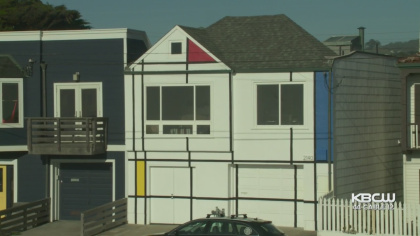
SAN FRANCISCO (KPIX 5) — It’s hard to miss the quirky, colorful home located at 2140 Great Highway in San Francisco’s Sunset District. Its facade pays homage to the 20th century Dutch painter Piet Mondrian and his most famous artwork.

82aef house Quirky San Francisco Home That Looks Like Artwork Sells Over Asking Price

A frontal shot of the artist-inspired home (CBS)

The home is now turning heads because of its selling price. It sold for $2.05 million, which is $550,000 over asking.

Listing agents Todd and Kim Wiley said they received multiple offers. The buyer paid in cash and closed in 10 days.

“I don’t think the person that bought this home bought it because of the way it’s painted, because that’s obviously easily changed,” said Compass listing agent Todd Wiley. “But I don’t think anyone wants to see him change that, either.”

They say the prior owner of the 2 bedroom, 1 bathroom house has a great appreciation for art.

“The house had a lot of really original art pieces in it. He actually is someone–one of the original folks who’s enjoyed Burning Man all these years and he’s just a great guy who has a really free spirit,” said Todd Wiley.

For 20 years, the whimsy house has been an attraction among locals it has recently become a hot spot for Instagram photos.

“It became an iconic kind of a landmark for walking tours and it’s made a lot of press, prior to us ever marketing it,” he added.

The neighborhood itself it getting more attention these days, attracting couples, young families and first-time home buyers. In the second half of 2018, The Sunset saw more homes sell for over asking price than any other area in San Francisco, according to Compass real estate data.

The Wileys have lived in The Sunset since 1989.

“We’re very close to downtown, but we’re not downtown. You’ve got the zoo over there and you’ve got the park over there and you’ve got the waves breaking out here, and it’s a good place to have a yard,” he said. “And the commercial stuff that’s been popping up, too, has just been incredible.”

Article source: https://sanfrancisco.cbslocal.com/2019/04/16/quirky-san-francisco-home-that-looks-like-artwork-sells-over-asking-price/

Posted in SF Bay Area News | Tagged | Leave a comment