“Get this: San Francisco has become so crowded and expensive, people are paying $2.25/hr to work…in a parking space. It’s being called #WePark,” Budman tweeted.
Tweet Embed: //twitter.com/mims/statuses/1123630525325824000?ref_src=twsrc%5Etfw Get this: San Francisco has become so crowded and expensive, people are paying $2.25/hr to work .. in a parking space. It’s being called #WePark. (Photo by @VictorPontis). pic.twitter.com/of0EqZz8wh
WePark pays for the parking space, which doubles as an office using free nearby WiFi or mobile-phone hot spots, Sophie Williams of BBC reported.
Victor Pontis set up WePark on April 25 near San Francisco City Hall after being inspired by Twitter, he told Williams: “Somebody posted a photo of a truck that someone set up with bike parking on it and somebody mentioned ‘What if you could work out of a parking spot?’ I thought it was a pretty funny idea.”
About 30 people showed up the first day, Williams reported. “We live in a very expensive real estate market,” the WePark visitor Jean Walsh told Williams. “It’s just so crazy to think the way we use our street is not reflective of that and so those parking spaces are just dirt cheap compared to all of the other real estate in San Francisco.”
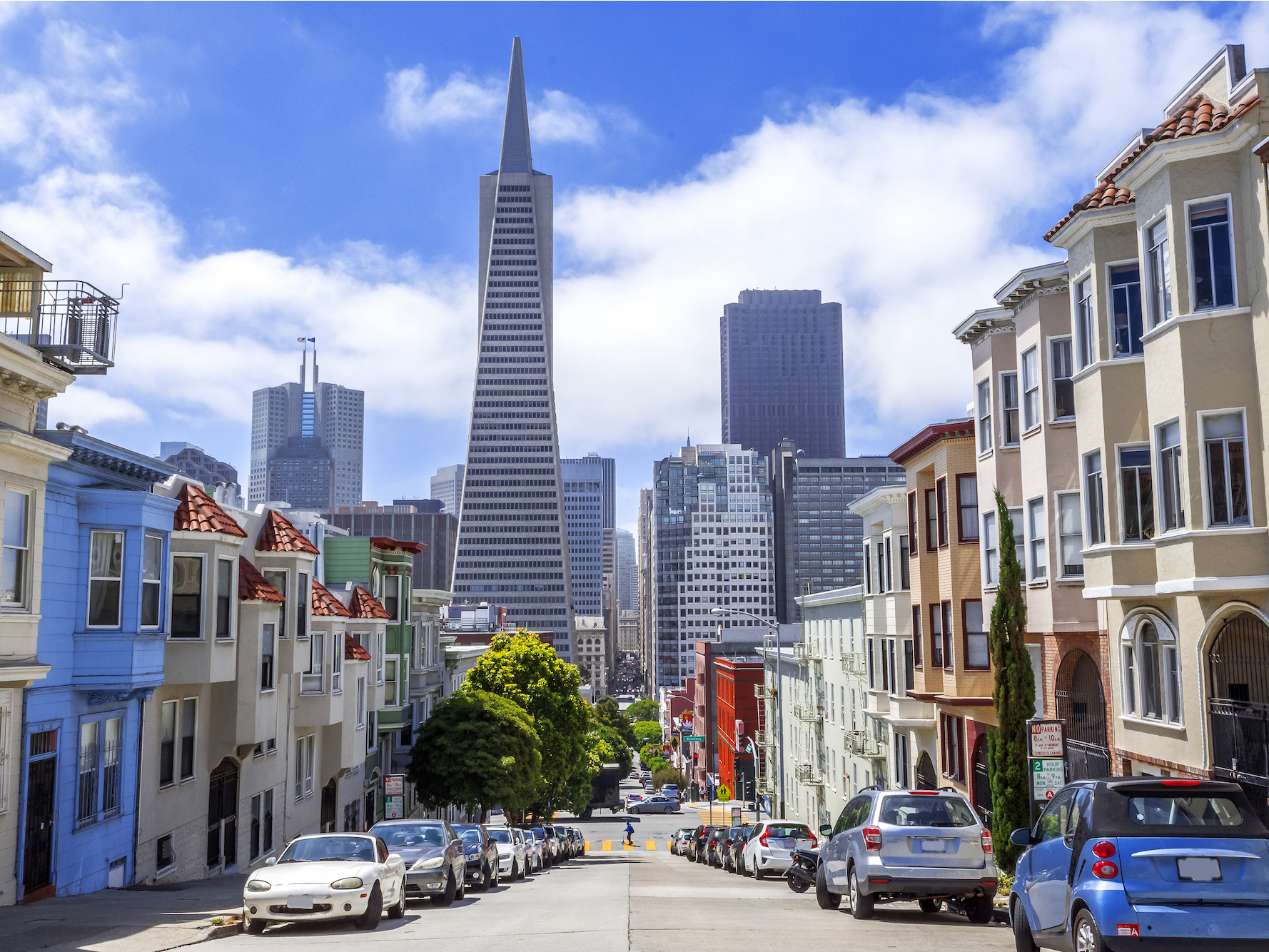
In San Francisco, the median price of listed homes nears $1.3 million and the median rent is $3,300, according to Zillow. That’s overwhelmingly more than the national medians of $285,000 and $1,675, respectively.
Tech giants have crowded the city with more people and have, in part, fueled the soaring real-estate prices. San Francisco also deals with a crowded homeless population of 7,500 and a consequent poop problem, Business Insider’s Ben Gilbert reported.
Some people on Twitter are wondering if WePark is a parody — but either way, its creation highlights how unaffordable and crowded San Francisco has become.
“WePark is serious! But it’s also a joke,” Pontis told Business Insider. “Setting up a desk and chair on a busy street is absurd.”
SAN FRANCISCO (KPIX 5) – The San Francisco Victorian home made famous by the popular late ’80s sitcom “Full House” and the Netflix reboot “Fuller House” is hitting the market this week with the whopping price tag of $5,995,000.
The outside was featured in the opening credits of both series. The inside looks nothing like the Tanner family home. The 3,728 square foot, four bedroom, three and a half bath home has been completely gutted, renovated with modern decor and seismically retrofitted.
“I think that the buyer for this home is somebody who’s going to appreciate a home that’s not just a cheap flip. Something that someone has put a lot of time, energy and care and thought into,” said Rachel Swann, Managing Partner of the Agency, the real estate broker handling the property. “I think somebody who also maybe appreciates a little bit of the iconicness of the house.”
Swann is the property listing agent. The owner, “Full House” show creator Jeff Franklin, resides in Los Angeles and has never lived at the home. He bought it for $4 million in 2016. He says the main reason was because he wanted to shoot “Fuller House” at the site.
“Full House” Victorian interior (CBS)
“We brought the cast up and we all had a blast and I think the fans really enjoyed the stuff that we shot up there,” said Franklin. “But now ‘Fuller House’ is coming to an end, and I love San Francisco but I don’t live there, and I really don’t want to be an absentee landlord, so it’s going back on the market.”
The home’s backyard features a secret garden. There are concrete slabs with hand prints of many of the cast members of “Fuller House.”
Swann says the tokens from the show can be written into the offer.
The house has been a full-time tourist attraction since “Full House” first debuted in 1987.
Mary Risley has lived across the street for more than 20 years.
“Doesn’t bother me, no. But I’m an old hippie,” Risley said. “I’ve been here for many years. And people are nice. They’re always nice.”
If the “Full House” house does sell for its asking price, it will be a record for the Lower Pacific Heights neighborhood.
Bay Area home sales in March were the slowest the region has seen in 11 years, according to new data released Monday by real estate research firm CoreLogic.
In fact, that’s been the case for every month since December. Year-over-year sales have been dropping steadily for 10 consecutive months, with double-digit drops from 12 to 21 percent for the last five months. March sales of newly built homes, including detached houses and condominiums, were roughly 42.6 percent below the month’s historical average. Resales of existing homes were 25.5 percent below average.
“Beginning in late spring last year, some potential buyers got priced out and others simply stepped out of the market amid concerns prices were near a peak,” analyst Andrew LePage said in a news release Monday.
LePage continued:
“The next two months will likely clarify whether many of those who put plans on hold in 2018 are being lured back into the market by this year’s lower mortgage rates, higher inventory and buyers’ improved negotiating position.”
Median home sale prices have been rising year-over-year since April 2012, 82 consecutive months, but they dropped slightly for the first time in March 2019 to $830,000, down from $831,000 in March 2018. Sales over $500,000 accounted for 79.1 percent of total home sales, up from 78.8 percent the year before.
The data presented was taken from Alameda, Contra Costa, Marin, Napa, Santa Clara, San Francisco, San Mateo, Solano and Sonoma counties. It does not include Santa Cruz and Monterey counties.
When Amazon created a contest for cities that wanted to host a second headquarters, or HQ2, the Bay Area turned in 160 pages arguing why it should win.
It didn’t. And though northern Virginia ultimately won a promise of thousands of new tech jobs, it didn’t much matter. The Bay Area already has more high-paying Amazon jobs than anywhere besides Seattle.
Call it a stealth HQ2. With a quiet presence stretching back decades, Amazon says it now has 7,000 white-collar workers in the Bay Area, which makes the region home to a third of its North American workforce outside its hometown. That’s three times as many employees as the next largest center, northern Virginia, according to Amazon. It is also hiring more actively in the Bay Area than anywhere else but Seattle.
Amazon has pledged to bring at least 25,000 additional jobs to a site in Virginia, where a new office near National Airport will greatly increase its presence in the region. But that project is years from completion.
Meanwhile, several key initiatives, from Kindle e-book readers to Twitch streaming to online ad technology, are run out of the Bay Area. Where Amazon seeks to compete most directly with other tech giants, it has tapped their workforce and planted offices in their backyards.
“Even when they go to another place and call it their second headquarters, you wonder if it really is,” said Jim Wunderman, head of the Bay Area Council, a public policy group that worked on the regional headquarters bid.
Amazon shows no sign of slowing its recruiting in the Bay Area, according to Thinknum, a data analysis startup that scours job listings to find hiring trends.
1of8Amazon has been gradually adding office space in 525 Market St., its main San Francisco office.Photo: Paul Chinn / The Chronicle 2of8Amazon’s AWS Loft in San Francisco welcomes developers who use Amazon Web Services, another division with a large Bay Area presence.Photo: Paul Chinn / The Chronicle 3of8Sameem Siddiqui is a senior product manager for Amazon Music. Amazon has thousands of employees in the Bay Area and is one of the largest tech employers in San Francisco.Photo: Paul Chinn / The Chronicle 4of8Amazon Music and Amazon Web Services are among the businesses the Seattle tech giant has employees working on in a San Francisco office at 525 Market St.Photo: Paul Chinn / The Chronicle 5of8An employee takes a phone call in a common area. While setting plans for a second headquarters in northern Virginia, Amazon is currently hiring more people in the Bay Area than any other region besides Seattle.Photo: Paul Chinn / The Chronicle 6of8Visitors work in Amazon’s AWS Loft.Photo: Paul Chinn / The Chronicle 7of8A foosball table is set up for visitors.Photo: Paul Chinn / The Chronicle 8of8
Thinknum did a custom analysis of Amazon’s hiring at The Chronicle’s request. In early April, Amazon had more than 1,700 job openings in San Francisco, Sunnyvale, Palo Alto, East Palo Alto, Cupertino and Santa Clara — roughly the number of positions in New York and northern Virginia combined. Amazon is still hiring most aggressively in Seattle, with 10,675 job openings, according to Thinknum.
“The Bay Area has an incredibly talented and highly educated workforce, with a strong culture of innovation,” an Amazon spokeswoman said in an email. “We look forward to continuing to hire locally for exciting roles in a number of fields.”
When Jeff Bezos founded Amazon.com as an online bookstore in 1994, he didn’t consider California. At the time, retailers shipping across state lines didn’t have to collect sales tax, so California’s large population ruled it out. He opted for Seattle instead, for its lower taxes and proximity to a big West Coast book distributor. Bezos did make frequent trips to the Bay Area — to raise $8 million from Menlo Park venture capital firm Kleiner Perkins, for example — and to snap up Bay Area startups, typically moving the companies wholesale to Seattle.
Amazon established a small presence in San Francisco in 1999, when it acquired Alexa Internet, a San Francisco maker of website measurement tools (not responsible for the virtual assistant also named Alexa). At founder Brewster Kahle’s insistence, it remained in San Francisco, a rare exception.
“We were pretty consolidated in the Seattle market. That was home base,” said Paul Capelli, an Amazon spokesman from 1998 to 2000. He remembers when the company could fit into a single auditorium for its all-hands meetings. Today, Amazon’s worldwide corporate workforce could fill Levi’s Stadium eight times over.
When Amazon made an acquisition, it was “buying both the technology and the people” behind it, Capelli said.
It folded those startup teams into the Seattle campus to tap their brainpower — and to make it harder for Silicon Valley employers to poach from them, he said.
It wasn’t until Amazon got into direct competition with search engines Google and Yahoo that it put down roots on their turf. In 2003, Amazon created a company, A9.com, working on search tools, and rented a large office in Palo Alto, where it could fish talent from other employers.
A year later, a group of Amazon hardware engineers set up shop in a Palo Alto law library to create the first Kindle device. It was the start of Amazon’s hardware research and development team, Lab126.
The poaching fears were justified: Of A9’s founding team, CEO Udi Manber went to Google; business chief Owen Van Natta went to Facebook; and engineering head Bill Stasior left to run Siri at Apple.
That was the trade-off of entering the Bay Area’s cutthroat market for talent: The same executives and engineers Amazon courts have more options than they might in Seattle, where Microsoft is the only other tech giant.
“I look at the massive amount of talent in the Bay Area, and the thing is, Amazon is not going to be the biggest player in town,” said James Thomson, who worked as a business development lead at Amazon from 2007 to 2013. “There are players who are equally able to steal talent away.”
Being here is about more than access to highly skilled workers, according to AnnaLee Saxenian, a professor and dean of the School of Information at UC Berkeley, known widely for her research on Silicon Valley. “It’s also keeping your finger on the pulse,” Saxenian said.
She pointed out that Nokia sold half of all smartphones in 2007, the year Apple introduced the iPhone. But with its headquarters in Helsinki, the distance from Silicon Valley may have contributed to its ultimate demise. “If they had had a bigger presence here, they wouldn’t have been so blindsided by Google and Apple, who innovated and created a mobile internet,” Saxenian said. “Not being here has been a risk for those companies.”
Though software employment in other regions is on the rise, the Bay Area added nearly 34,000 tech jobs last year, according to a study by the Computing Technology Industry Association — far more than any other metro area.
And Amazon is trying to hire more software engineers in the Bay Area than any other job category, according to Thinknum.
In San Francisco, Amazon Web Services, the company’s fast-growing cloud division, has hundreds of job openings. Twitch, Amazon’s video-game-focused YouTube competitor, is hiring dozens. In Sunnyvale, near Apple’s home turf, Lab126, Amazon’s gadget-design unit, wants to hire hundreds of hardware engineers.
What Amazon doesn’t have is a central presence in the region like Salesforce Tower, Apple Park or the Googleplex, or even Microsoft’s long-standing campus in Mountain View. Instead, its workers are spread between San Francisco skyscrapers and low-slung office parks in Silicon Valley.
The company has an estimated 16 office leases covering 1.5 million square feet in the Bay Area, according to real estate data firm CoStar. In San Francisco, Amazon leases more square footage than Airbnb, Twitter and Square, which are headquartered in the city.
Jesse Gundersheim, a market economist at CoStar, said he’s not surprised Amazon is stretching out in San Francisco, even as other local governments “bend over backwards” to bring Amazon to their doorsteps. In recent months, Virginia agreed to pay $750 million and Arlington County chipped in another $23 million in incentives for the company to build its second headquarters in Crystal City. Amazon doesn’t always win these fights: A plan for another huge Amazon office in New York was scrapped after it was criticized for being bad for residents and taxpayers.
Amazon’s quiet growth in the Bay Area, amid other tech giants, hasn’t drawn similar attention or controversy.
An A to Z guide
to Amazon
in the Bay Area
Amazon is now in a range of businesses, from video streaming to hardware. Here’s where it’s hiring in the Bay Area.
A9.com, a maker of search and advertising tools for Amazon and other clients
Alexa Internet, a web analytics company that tracks internet traffic; confusingly, this predates and is not related to the voice service Amazon also owns
Amazon Web Services, a vast array of cloud services that lets businesses run their applications on Amazon servers
Goodreads, a social media site that helps readers find and share books they love
Lab126, a hardware lab that developed the Kindle and Echo
Twitch, a popular online service for watching and streaming video games
Source: Chronicle research
“Their presence in San Francisco and their desire to locate in a top tech city,” Gundersheim said, “is not predicated on receiving additional tax breaks from city government.”
The legions of software engineers, a workforce unmatched elsewhere, are incentive enough.
Melia Russell is a San Francisco Chronicle staff writer. Email: melia.russell@sfchronicle.com Twitter: @meliarobin
Here’s how it works. Meanwhile, the media is busy publishing real-estate industry hype.
This is a shorter, less angry version of my podcast last Sunday (as many have found out, I’m freer when I talk than when I write).
It’s now a standard theme in San Francisco and Silicon Valley conversations, and it’s everywhere in the media: The wave of mega IPOs – including Lyft’s IPO last month and the forthcoming IPOs of Uber, AirBnb, Palantir, etc. – will cause the Bay Area to drown in millionaires that are all going to move out of their rinky-dink apartments and buy homes and cause the housing market that has been sinking since spring last year to make a violent U-turn and inflate a whole lot more. The entire real-estate industry is salivating and pushing this theme. But wait…
First, there’s history. The last two mega waves of IPOs were followed by, well, not further home price increases but housing busts.
The IPO boom in 1999 and early 2000 led to the same kinds of speculations that these newly minted millionaires in Silicon Valley and San Francisco would push up home prices. But then came the bust, and these startups cratered and people lost their jobs and couldn’t afford to live in the Bay Area without a job, and they packed up and left. Some dumped their homes. Others defaulted on the mortgage and walked away because they could: California is one of only 12 “non-recourse” states. Housing units began to empty out. Home prices, instead of being further inflated by this mega-wave of IPOs, fell.
Similar hype about IPO moola further inflating an already inflated housing market, with the entire real estate industry salivating, occurred in 2006. In 2007, the local housing market started to crash.
And there are reasons for this – as counter-intuitive as this may seem to folks who have never been through these boom-and-bust cycles.
Much of this hype is based on the assumption that these IPOs will suddenly generate billions of dollars of real wealth out of the hypothetical and unreal wealth of non-publicly traded shares, convertible notes, or stock options.
But that’s not how it works. This hypothetical money is not hypothetical. It’s real, it has been real for years, and it has grown over the years – in Uber’s case, in 10 years from a few million dollars to tens of billions of dollars. The equity of these companies has been worth many billions of dollars for years. People and entities that own this equity have gotten immensely wealthy by owning it.
The IPO, which is in essence a round of funding, might inflate the equity value a little further from the last round of funding and shift ownership a little. That’s about all it does.
If Uber’s IPO values the company at $90+ billion, as is being rumored, it doesn’t suddenly create $90 billion. At the last round of funding, Uber was already valued at $76 billion. And that has been real wealth – not hypothetical wealth. Here’s why:
One, during fund raising rounds, employees can often sell their shares or convertible notes to new investors. For example, in January 2018, a consortium led by Softbank bought $9.3 billion of Uber shares both from existing shareholders and from Uber itself. In this deal, former Uber CEO and co-founder Travis Kalanick reportedly sold $1.4 billion of his shares to Softbank. Other Uber employees sold too.
Two, some of these startup companies have programs in place where they buy back shares from employees to allow them to cash out some of their wealth.
Three, in tech centers such as San Francisco and Silicon Valley, some banks have departments dedicated to converting pre-IPO equity into cash by lending money to those people, with the equity being used as collateral.
Four, many employees have been able to sell their shares in the secondary market that exists for the shares of startup companies.
All these methods allow employees to cash out some of their wealth. And they went ahead and used this moola to buy expensive homes years ago.
This money has been circulating in San Francisco and Silicon Valley for years and was a big driver of the blistering housing bubble that peaked last year!
Are Uber billionaires somehow not billionaires just because the IPO hasn’t taken place yet? Nope. They have been billionaires for years. And their multi-millionaire underlings have been multi-millionaires for years as well. And they have already bought expensive homes based on their wealth.
But wait… that’s not all.
The biggest winners in an IPO are the institutional investors, such as venture capital funds; or for late-stage investments, private equity funds, pension funds, even mutual funds. Their money comes from around the globe. When they sell their Uber shares to the public during and after the IPO, they will make huge gains. But this is not San Francisco money. This is global money, and it goes back where it came from.
It took Uber 10 years to become what it is today. During this time, its “value” as determined by investors has skyrocketed. Uber employees that have worked there for years, and that are multi-millionaires based on their stock compensation plans, have been multi-millionaires for years. And they generally don’t live in some dumpy apartment with three other roommates. They cashed out some of their wealth years ago and bought a nice place years ago.
This home-buying by wealthy startup employees has been in part responsible for the surge in home prices in San Francisco. They’re not going to do this in the future. They already did. And that’s one of the reasons home prices are already so high.
But even if they’re suddenly buying an even more expensive home, they’d have to sell the home they’re in now. They’re not creating new demand. First-time buyers or new arrivals create new demand. But people selling their home and buying another home don’t create new demand. They’re just churning the market.
Certainly, there are some recently hired employees whose shares or convertible notes are going to be worth $100,000 or $300,000 dollars, assuming that the post IPO-shares don’t crash. And some of them – after the lockup period expires and they can sell the shares – can use this money for a down-payment on a ludicrously overpriced home.
They’ll buy a median apartment that may run them over a million bucks. And they’ll make huge monthly mortgage payments, and they pay home-owner association fees, and they pay property taxes on that inflated home price. And they have a good chance of losing money on their home because this is precisely how it happened after the last two big IPO waves.
Both those times – in 1999/2000 and 2006/2007 – institutional investors cashed out, and the global money went to global investors, not to San Francisco. And founders and early employees had gotten rich years before the IPO and had bought homes before the IPO, which contributed to the inflation in the housing market long before the IPO wave. When the startup boom crashed, as it always does, home prices sank with it.
What these mega-IPO waves tell us is this: It’s the peak of the cycle, or past the peak of the cycle. It’s when global money – VCs, PE funds, and other institutional investors – are trying to cash out by selling their shares at hugely hyped-up valuations to the public.
Enjoy reading WOLF STREET and want to support it? Using ad blockers – I totally get why – but want to support the site? You can donate “beer money.” I appreciate it immensely. Click on the beer mug to find out how:
Would you like to be notified via email when WOLF STREET publishes a new article? Sign up here.

 randy andy/Shutterstock