Bay Briefing: What the ‘Twitter tax break’ actually brought to Mid-Market

Good morning, Bay Area. It’s Thursday, May 9, and a study is pointing the finger at ride-hailing services for the rise in traffic congestion, California bans a widely-used farm pesticide, and we’re looking back at what became of the “Twitter tax break” in Mid-Market. Here’s what you need to know to start your day.

From Fifth to 10th

Eight years ago, San Francisco city leaders offered a tax break to draw companies to the Mid-Market neighborhood — a deal that became associated with one of its major beneficiaries: Twitter.

That tax break expires on May 20. To mark its end, three Chronicle stories look at the evolution of the street, the impact on commercial and residential real estate, and the benefits that flowed — or didn’t — to the city and its people.

“The people who were really against it are looking back and saying, ‘See, I told you so.’ ” Don Falk, CEO of the Tenderloin Neighborhood Development Corp. says. “And the people who were for it, are saying, ‘See, I told you so.’ ”

Congestion diagnosis

 Bay Briefing: What the ‘Twitter tax break’ actually brought to Mid Market

Ride-hailing services account for two-thirds of the rise in traffic congestion in San Francisco over the past six years, according to a study by a deputy director at the San Francisco County Transportation Authority and the University of Kentucky.

Sign up for Bay Briefing

Like what you’re reading? Subscribe to The Chronicle’s Bay Briefing newsletter, and get the Bay Area’s best journalism in your in-box every weekday.

Uber and Lyft previously contested data the Transportation Authority released in October, saying that the agency didn’t account for the growth in tourism, freight or delivery services that increased with the economic recovery.

But one of the study’s authors says without ride-hailing cars, congestion would have increased 22% within the city — instead of 62%.

“Many factors contribute to congestion — including population growth,” Joe Castiglione tells reporter Rachel Swan. “But the addition of TNCs (or transportation network companies, such as Uber and Lyft) is greater than all of them.”

More: Uber and Lyft drivers — outside of their cars — blocked Market Street during a protest ahead of Uber’s Friday public offering.

Meanwhile in transit: An equipment problem that has stymied Muni’s new light-rail fleet is bigger than the agency originally thought, a top official said this week.

Statewide ban

 Bay Briefing: What the ‘Twitter tax break’ actually brought to Mid MarketFILE – In this Aug. 28, 2013, file photo, a load of Sauvignon Blanc grapes are dropped into a bin during harvest in St. Helena, Calif. California regulators are recommending new restrictions on a widely used pesticide blamed for harming babies’ brains. The Department of Pesticide Regulation is issuing temporary guidelines Thursday, May 9, 2019, for chlorpyrifos while it considers long-term regulations. The department calls for banning its use in crop dusting, discontinuing it application on most crops and increasing buffer zones where it’s sprayed. The pesticide is used on grapes, almonds and oranges and other crops. (AP Photo/Eric Risberg, File)

California will ban the widely used farm pesticide chlorpyrifos, a chemical that studies have indicated can cause brain damage in children, Gov. Gavin Newsom’s administration said Wednesday.

The ban could take as long as two years to kick in, but in the meantime, the Department of Pesticide Regulation will order county agricultural commissioners to ban aerial spraying of the pesticide and allow its use only when no safer alternatives are available.

Chlorpyrifos was first developed as a nerve agent in World War II and was on track for a nationwide ban until the Environmental Protection Agency under President Trump sought — and received— a five-year extension for further study of the pesticide.

The hangover

 Bay Briefing: What the ‘Twitter tax break’ actually brought to Mid Market

A new Amy Poehler-directed comedy, “Wine Country,” is the newest entrant in a relatively small club of high-profile movies set in, well, Wine Country. Our wine critic, Esther Mobley, looks at what the movie gets right (and wrong) about wine tasting and tourism in Napa.

More: Esther on the female stereotypes the wine industry seems only too glad to preserve.

From a half-billion to $0

 Bay Briefing: What the ‘Twitter tax break’ actually brought to Mid Market

A pending deal to sell almost half of Park Tower, one of San Francisco’s tallest office buildings — and a home to Facebook in the city — could lead to $539 million changing hands and set the new skyscraper’s value at more than $1 billion — an almost unprecedented assessment.

But the city will get nothing from the deal, at least in the form of the transfer taxes it collects on most sales of real estate.

Roland Li reports on why.

Around the bay

Handing out waivers? San Francisco City Attorney Dennis Herrera is investigating whether a pediatrician gave unlawful medical exemptions to parents who did not want their children vaccinated.

Sharks bite: The San Jose Sharks win their series against the Colorado Avalanche and are headed to the conference finals.

Warrior down: Kevin Durant exits Game 5 against the Houston Rockets with a leg injury.

Running away: Why does a man who’s minding his own business, riding his bicycle, end up dead at the hands of a police officer, Otis R. Taylor Jr. asks.

Crack up: The Punch Line comedy club is moving — and nobody in the comedy world is laughing.

After the snow: Tom Stienstra on the best outdoor spots to spend this Memorial Day weekend.

• “The world was wide enough”: Back-to-back acts of generosity unfold outside SF ‘Hamilton’ show.

Chronicle Covers

 Bay Briefing: What the ‘Twitter tax break’ actually brought to Mid Market

“CRIME, MOBS MOVING IN STATE REPORTS” reads the headline of the the May 11, 1953 front page of The Chronicle.

“Harbingers of organized and syndicated crime” in San Francisco indicates “the integrity of local government is in trouble,” Charles Raudebaugh reported.

The Chronicle was especially interested in this investigation because the state’s findings reflected an exclusive series on San Francisco crime that the paper had featured on its front pages. “The Chronicle’s series is supported,” reads a short item packed in the front page, adding that the newspaper’s stories “had city-wide repercussions” — something we’re still doing in 2019.

See more Chronicle Covers from the archives here.

Bay Briefing is written by Taylor Kate Brown and sent to readers’ email in-boxes on weekday mornings. Sign up for the newsletter here, and contact Brown at taylor.brown@sfchronicle.com

Article source: https://www.sfchronicle.com/bayarea/article/Bay-Briefing-What-the-Twitter-tax-break-13830647.php

Posted in SF Bay Area News | Tagged | Leave a comment

Bay Area housing market showing signs of normalcy – KGO

LOS GATOS, Calif. (KGO) — There are signs of hope for potential home buyers in the Bay Area. Inventory is up, and in the South Bay, home values have dropped at least a small amount.

In the San Francisco metro area, inventory is up nearly 25-percent, and home values are up slightly — about two-percent from a year ago.

In the San Jose metro area, inventory is up nearly 45-percent, and home values have actually dropped. It’s only point-two percent, but that’s still a drop.

RELATED: Bay Area housing market cooling off, but prices still expected to rise in 2019

What a difference a year makes. There are more homes for sale. That means buyers may not be competing against others and putting in offers above the asking price.

“The first-time home buyers that are operating can’t keep out-bidding each other,” said Skylar Olsen of Zillow, which released the home sales data. “That kind of home value appreciation was outsized. It was unsustainable. This is the market correcting itself.”

Gustavo Gonzalez is the owner of Valley View Properties. He sees the San Jose housing market starting to normalize. “I don’t know if we’ll open a floodgate,” he said. “I think what we’ll do is we’ll the buyers that are out there looking, maybe have a better opportunity of finding a house.”

RELATED: Survey: 44 percent of Bay Area residents are considering moving

There is also good news when it comes to mortgage rates. Compared to a year ago, a 30-year fixed loan is running about one percent lower.

What does that mean? Let’s use a house on the market for about $1.2 million — the median price for San Jose. The one percent difference in mortgage rates — from 5 percent last year to 4 percent now — translates into a $600 lower monthly payment with a 20 percent down payment.

To put it another way, a lower interest rate means you might qualify to buy a more expensive home. Still, Jim Hamilton of Alain Pinel Realtors in Los Gatos says buyers need to be careful.

“When you’re qualifying for a loan and you’re getting to that max of what you can qualify for when that interest rate drops, it affords you more home,” said Hamilton. “But one thing caveat is, I’d say, be careful of that too. Depending on what loan you’re getting, make sure that you can afford it.”

The Zillow analysis is an indication of an adjustment, but how long will it last? No one appears willing to forecast that.

Check out more stories and videos about Building a Better Bay Area.

Article source: https://abc7news.com/realestate/home-inventory-is-up-as-values-decline/5267068/

Posted in SF Bay Area News | Tagged | Leave a comment

‘It’s hard to imagine a better place’: People who left the Bay Area tell us what brought them back


  • e1534 920x920 Its hard to imagine a better place: People who left the Bay Area tell us what brought them back


    Debra Jones

    I do not have “plans,” I have dreams. San Francisco is my home. It’s where I was born and raised. I am a graduate of SFUSD, SF State and UC Berkeley. I bleed blue and gold. I rep the Warriors, Raiders, even though my heart belongs to the Pittsburgh Steelers. But I ache for another 49er championship. I miss Muni, BART, flaming hot days in September, foggy damp mornings, the fog horn, the siren on Tuesdays at noon. As I age, my income level will not allow me to age in the place that shaped and molded who I am and my world view.

    less


    Photo: Max Whittaker/Prime, Special To The Chronicle

  •  Its hard to imagine a better place: People who left the Bay Area tell us what brought them back

Caption

Close


Debra Jones

I do not have “plans,” I have dreams. San Francisco is my home. It’s where I was born and raised. I am a graduate of SFUSD, SF State and UC Berkeley. I bleed blue and gold. I rep the Warriors, Raiders, even though my heart belongs to the Pittsburgh Steelers. But I ache for another 49er championship. I miss Muni, BART, flaming hot days in September, foggy damp mornings, the fog horn, the siren on Tuesdays at noon. As I age, my income level will not allow me to age in the place that shaped and molded who I am and my world view.

less


Photo: Max Whittaker/Prime, Special To The Chronicle


They left their hearts in San Francisco.

The saying is trite but true for many, who leave the Bay Area for reasons we’ve all heard before: it’s expensive, crowded, tech-filled.

But it’s also complicated.

“There’s a lot out there but it’s still not the Bay Area,” said Gary Pischke. He moved back to the region in 2017, after a decade in Oregon.

Over the past few years, I’ve written a series of stories about folks leaving the Bay Area for elsewhere. Is the grass really greener in Austin? Sacramento? Portland? Many of those I interviewed responded with a resounding, yes!

Sacramento’s got craft beer bars, too, they said, and Austin is the land of plentiful tech jobs and housing. But have you heard what’s happening in Atlanta? Up-and-coming, indeed.

We read their stories, and sometimes daydreamed about moving ourselves. Yet so many of us stayed, resigning ourselves to sweat on cramped BART trains and cloister with roommates in short-term rentals.


There’s got to be some magnet in this city that keeps us here, in spite of it all – or rather, a series of micro-charges that add up to a pull we couldn’t deny if we tried. But where, exactly, can one locate these currents?

They might be in the stalls at the Ferry Building or the seals on the pier. They could be in the sounds of the early-morning foghorn or the fog itself. Or, maybe, it’s not about the place at all, but the people who assemble within it, like a West Coast Island of Misfit Toys.

I spoke with a handful of longterm Bay Area residents who left and came back. The answer to my inquiries, I thought, might be found in their reasons for returning.


“The Bay Area is like a self-selected crew of quirky misfits, and when you’re a quirky misfit yourself, it’s hard to imagine a better place to be,” said Oakland resident Marion Denny.

Denny moved to Atlanta for a work opportunity in May 2016. He didn’t last long, and moved back to the East Bay in October 2017, without the thing he left for in the first place – a job.

“We had the best of everything at our fingertips in the Bay,” he said. It took leaving to realize that.

When you move away, he said, “a lot of stuff just feels like a step down.” Food and weather, sure, but politics especially.

The 2016 presidential election only heightened this sense for Denny, who considers himself more conservative than most Bay Area residents. It doesn’t matter if you’re in a blue dot such as Atlanta, a “hostile state government” made him realize the place could never be a home like California.


A West Coast state like Oregon, Pischke found, also lacks the political openness of the Bay Area.

“Even the liberal types were conservative there,” he said of his 10 years “abroad” in Roseburg, a city in Oregon’s Umpqua River Valley.

Pischke and his wife enjoyed the first half-decade in the Oregon town, but time – and a devastating mass shooting at Umpqua Community College – made them realize there’s no place like home, especially when it comes to finding like-minded folks.

“We ended up living in an area that sounded great on paper, but was not what either of us had anticipated,” he said.

“So back to California for us.”

No place is perfect, but some are better than others (at least subjectively speaking). It’s not always a matter of finding “the right city,” but one that’s simply more tolerable than others. No matter where you live, concessions must be made, priorities codified.

Family was the first priority for Mike Lee, a San Francisco native who recently returned to the Bay Area after more than a decade in Honolulu. He and his partners recently bought a house in Pleasant Hill, a shorter commute to Lee’s elderly mother in Marin, compared to a five-hour flight from the islands.

“Being back, just to be close to her, is an important value to me,” he said.

Plus, the Bay Area modus operandi is “imprinted” on him. “Here, I can express my values and be around people of like mind,” he said. “That’s special.”

That is the exact reason Annie Gray cites for having to leave the Bay Area after college: “I needed to remove myself from the bubble I grew up in.”

Gray says her two years in Boston taught her valuable lessons, like don’t complain about the Bay Area’s weather unless you’ve experienced an East Coast blizzard. Weather notwithstanding, Gray said a few years away made her realize “what a West Coast brat I was.”

“Not everyone wants to be a Californian,” she said.

She eventually moved back, too, buoyed by a common phenomenon she observed in Boston. Many of her friends lived with their parents, often into their late-20s. She decided to do the same, and moved back in with her parents in Marin for a few months before securing a place in San Francisco.

“In Boston, I came to respect people who have strong relationships with a multigenerational unit,” she said.

So she returned, and in her short time away, the Bay Area felt very much changed. That’s a risk you take when you leave and come back: Sometimes you find your city looks different from the one you left.

“Everything has changed [in the last 10 years], even the freaking skyline! The Bay Bridge!” said Jen de Lumen, an Emeryville resident who spent a brief stint in Los Angeles a few years ago.

But, “you’ve got to expect that in a big city like this,” she said. “I think it’s always been that way in San Francisco.”


San Francisco, as Herb Caen famously wrote, “isn’t what it used to be, and it never was.”

The city changes and, in turn, changes those who live in it.

“Did it ruin me?” mused Denny, a native of the southern U.S. “Yes. I would say I’m hooked.”

“It’s hard to imagine leaving again,” he continued. “I learned my lesson the first time.”

Michelle Robertson is an SFGATE staff writer. Email her at mrobertson@sfchronicle.com or find her on Twitter at @mrobertsonsf.

Article source: https://www.sfgate.com/expensive-san-francisco/article/People-who-left-the-Bay-Area-tell-us-why-they-13738860.php

Posted in SF Bay Area News | Tagged | Leave a comment

Zephyr Real Estate Welcomes Back Christian Nguyen

SAN FRANCISCO, May 06, 2019 (GLOBE NEWSWIRE) — After working successfully for a few years at another local real estate company, Christian Nguyen has returned to his first home, the Noe Valley office of Zephyr Real Estate, bringing with him his vast local market knowledge and expertise. His loyal clients are happy to welcome him back too.

“He is by far the most honest, hard-working, caring realtor you could hope for. Aside from his experience (over 10 years in SF) and responsiveness, perhaps his most important quality is his honesty. As first-time home buyers, I can’t tell you how valuable that is,” commented David L., Dublin. “Now, 4 Years later, we went back with Christian Nguyen to help us with selling our home in San Francisco (SOMA). Christian crushed it once again! We were in contract in less than two days with an offer that far exceeded our expectations.“

Christian was drawn to San Francisco by the many opportunities to buy and sell investment properties. He has an extensive background working with developer partners and managing contractors. In the past 11 years, he has handled over $175 million in real estate sales and has earned an enviable reputation among his clients and peers.

He received his BA in Finance from the University of Maryland, after which he was an assistant producer manager at Warner Brothers Animation. With his aptitude for numbers, organizational ability and communication skills, he quickly honed his talents.

Christian teams with Laura Kaufman, a Top Five Zephyr Producer who is also in the top one percent of San Francisco realtors. Together, they are on top of marketing and technology as well as Bay Area market trends.

“Christian is a most welcome addition to our team,” commented Christine Lopatowski, Sales Manager of Zephyr’s Noe Valley office. “His expertise, superb reputation and respect from his colleagues are a sure-fire formula for success.”

Christian Nguyen may be reached at Christian@zephyrsf.com or 415.298.4453.

About Zephyr Real Estate
Founded in 1978, Zephyr Real Estate is San Francisco’s No. 1 independent real estate firm with nearly $2.3 billion in gross sales and a current roster of more than 350 full-time agents. Zephyr’s highly-visited website has earned two web design awards, including the prestigious Interactive Media Award. Zephyr Real Estate is a member of the international relocation network, Leading Real Estate Companies of the World; global luxury affiliate, Mayfair International; the local luxury marketing association, the Luxury Marketing Council of San Francisco; and the regional luxury real estate affiliation, the Artisan Group. Zephyr has nine locations across San Francisco, Marin, Alameda and San Mateo Counties and two brokerage affiliates in Sonoma County, all strategically positioned to serve a large customer base throughout the San Francisco Bay Area. For more information, visit www.ZephyrRE.com.

A photo accompanying this announcement is available at http://www.globenewswire.com/NewsRoom/AttachmentNg/cdea20c3-4770-4991-901b-c1edd578241d

8bd5f spaceball Zephyr Real Estate Welcomes Back Christian Nguyen Zephyr Real Estate Welcomes Back Christian Nguyen

Media contact: Melody Foster
Zephyr Real Estate
San Francisco, CA
415.426.3203
melodyfoster@zephyrsf.com 

Article source: https://finance.yahoo.com/news/zephyr-real-estate-welcomes-back-173000756.html

Posted in SF Bay Area News | Tagged | Leave a comment

Homeless and lost in SF — until a Chronicle photo led his brother to him

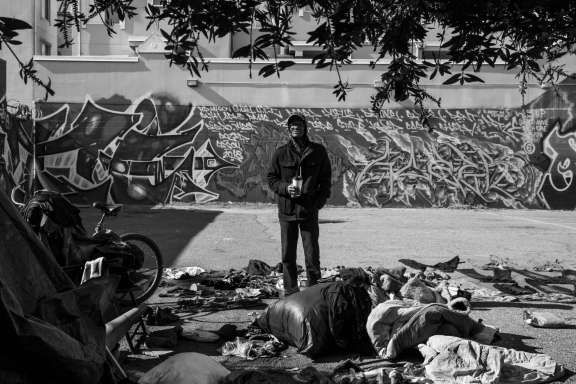
Standing stock still on a Tenderloin sidewalk in chilly darkness, heroin needles at his feet and sirens keening in the distance, Baron Feilzer’s world narrowed to the face in front of him.

Looking back at him for the first time in seven years and what seemed like a lifetime ago was his brother, Tyson.

Tyson’s eyes held the thousand-yard stare of a man tortured by seven years of heroin and homelessness. Baron’s eyes were misty. Relief and sadness warred in his head, but Baron had just one clear thought: “What do I do now?”
3b529 920x1240 Homeless and lost in SF — until a Chronicle photo led his brother to him

Baron reunites with Tyson after seven years.

(Nick Otto / Special To The Chronicle | San Francisco Chronicle)

It flickered for only an instant. Baron had prepared for this moment. He knew what to do.

“Want to go for a ride?” he asked his brother.

“Yeah,” Tyson said. They got in the car.


The hunt for Tyson Feilzer began about a week before that moment on the sidewalk.

Baron, 38, got a call at his home in Ohio from a relative who’d just read a story in The Chronicle about homeless people along the Embarcadero. It quoted 40-year-old Tyson saying he thought putting a new shelter on the waterfront was “a great idea.”

His picture ran with the April 14 story. There was no doubt it was Baron’s brother. Baron called The Chronicle.

“We haven’t seen him in more than seven years, not since my wedding, had no idea where he was, and when I saw that photo it hit me hard,” Baron said. “I figured he was probably homeless but was hoping maybe he wasn’t. I know I have to come get him.”

The Chronicle had come upon Tyson near a parking lot where a Navigation Center is being proposed. Seated on a piece of cardboard in the bright sun, he was thoughtful. Regretful.

“I’ve been out here for a lot of years,” Tyson said quietly. “If I could get a place for a few months, I could get back to a real life.”

Sleeping on the street in San Francisco, addicted to heroin and methamphetamine, was an unlikely fate for a man who grew up the privileged son of an accountant and a real estate agent in the upscale suburb of Danville.

3b529 920x1240 Homeless and lost in SF — until a Chronicle photo led his brother to him

Tyson (left) and Baron attend Baron’s wedding in 2012 with their father, Jim Feilzer.

(Courtesy Baron Feilzer 2012 | San Francisco Chronicle)

At Monte Vista High School he played football, breezed through classes and was a popular jokester. After graduation he went to Chico State University. He didn’t graduate but started a career as a mortgage broker and salesman.

Baron, younger and quieter, was on the wrestling team in high school and earned a master’s degree in management at Penn State University. Today he’s an operations manager at an industrial plant in Peninsula, Ohio.

Both drank a bit too much as young men. Baron overcame it. Tyson didn’t.

When the recession hit in 2008, Tyson wound up living with his grandmother in Pleasant Hill. Joblessness set in, and his 94-year-old grandmother fell, broke her hip and died. The house she was in got sold, and Tyson had to leave. After a couple of temporary jobs in the East Bay, he went broke, with no place left to live. So he hit the streets.

Tyson went to San Francisco, and stayed. The booze habit degenerated into heroin and meth. Life became a desperate daily hunt for dope and a place to crash. Petty crimes — breaking into cars, drug busts — led to a few months in jail here and there.

Embarrassed at being on the street, he broke off with everyone. He stayed disconnected so long he lost track of everyone — including his family.

“I’d never even seen heroin before I was on the streets, and just smoked it for the first two years trying to tell myself I could control it,” Tyson said. “Then I started injecting. And then I was lost.

“I am lost.”


After seeing Tyson’s picture in the paper, Baron booked a spot in a residential detox center in the Sierra foothills. The next day, he started a GoFundMe page to raise the $40,000 needed to pay for a 45- to 90-day rehab program. Then he booked a flight to San Francisco. He asked the Chronicle reporter to lead him and an intervention specialist he hired through the streets to look for Tyson.

“I’m either coming to take him to rehab, or to say goodbye if that’s what he wants,” Baron said. “But I need help finding him. I have to. He’s my big brother.”

At 11 a.m. on April 26, just an hour after Baron landed at SFO, he, the reporter and the interventionist, Vicki Lucas, set out on the Embarcadero. The search started at the spot where Tyson had sat just days before. It continued along the waterfront, up Market Street and into the Tenderloin. They showed photos of Tyson to everyone who would look.

The trail would stretch 6 miles over nearly 12 hours.

  • 3b529 920x920 Homeless and lost in SF — until a Chronicle photo led his brother to him

    Lucas and Baron ask Shawn Swanson, better known as Seven, whether they have seen Tyson.

    Lucas and Baron ask Shawn Swanson, better known as Seven, whether they have seen Tyson.


    Photo: Nick Otto / Special To The Chronicle

  •  Homeless and lost in SF — until a Chronicle photo led his brother to him

Caption

Close

Lucas and Baron ask Shawn Swanson, better known as Seven, whether they have seen Tyson.

Lucas and Baron ask Shawn Swanson, better known as Seven, whether they have seen Tyson.


Photo: Nick Otto / Special To The Chronicle

Every time Baron bent low toward a sleeping shape on the sidewalk, the grass or a bench, he hoped. “Hi, how are you doing? Got a second?” he said.

Each time, his heart skipped while he waited for a hand to reach out from beneath a sleeping bag or blanket and unveil a face. Each time, when it wasn’t Tyson’s, Baron’s heart fell. He’d show the picture, ask, “Have you seen this guy? He’s my brother,” then move to the next shape on the street.

It took about a dozen queries before he got his first lead.

“Yeah, I know that guy, he’s a good dude,” said a 47-year-old homeless man with a neatly groomed salt-and-pepper beard, sitting on a concrete wall facing the Ferry Building. He gave his name only as T. “He’s got some wisdom to him.”

Baron’s face lit up. “Where can we find him?”

“Well, he’s kind of a loner, real smart, but sleeps in different spots. You’ll have to look around.”

Baron nodded, silent.

“You miss your brother?” T asked.

“Yeah.”

“Keep looking. He needs you,” T said. “Me? My family passed away. Nobody’s looking for me. And you stay out here long enough, like me, it gets deep. When s— happens to you it’s like a tattoo. It never leaves. It’ll kill you.

“But Tyson,” he said, patting his chest, “at least he has you. Go find him.”


More stops, more tips. Tyson slept on Second Street, along the Embarcadero, maybe at a rundown hotel in the Tenderloin, maybe near a post office. He’d been seen days ago, weeks ago, years ago.

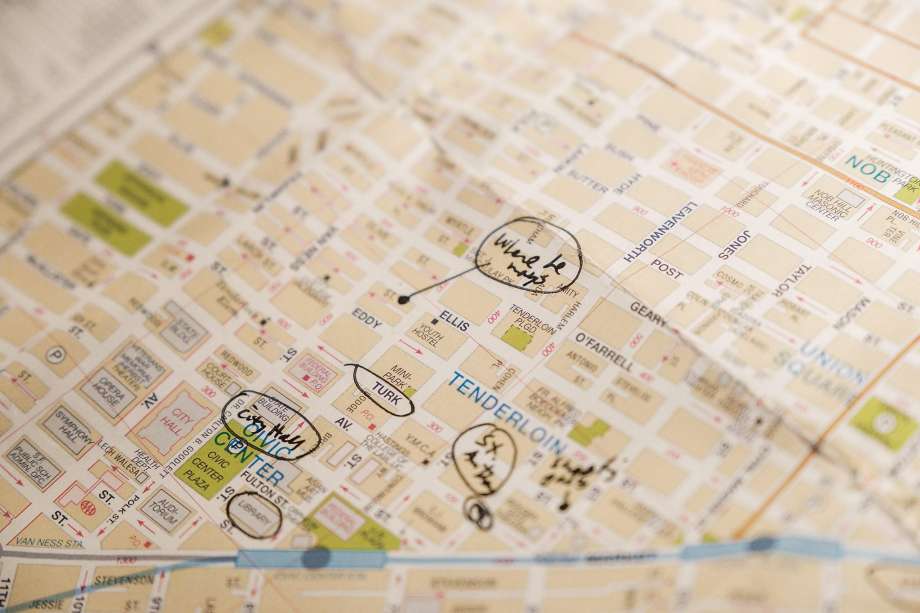
Then came the best lead: Tyson liked to shoot up at an unsanctioned injection center on Turk Street in the Tenderloin. The group set off.

3b529 920x1240 Homeless and lost in SF — until a Chronicle photo led his brother to him

Baron and Lucas document their search for Tyson on a San Francisco map.

(Nick Otto / Special To The Chronicle | San Francisco Chronicle)

There, sitting outside the center with a dozen other addicts was a guy called Seven, a middle-aged, longtime homeless man otherwise known as Shawn Swanson.

Seven lurched to his feet when he heard Tyson’s name.

“You have to find him, man, you have to find him,” he said. “Tyson has been convinced beyond what normal people usually are that his family is looking for him. He’s been saying that for a few years now. Lots of people are stuck out here.

“I lost faith in it; my family’s done with me. But Tyson? He needs to be with people who love him, not brother junkies. He’s smart. He just needs the chance.”

Baron and Lucas took out one of the photos they carried and wrote their phone numbers on it. They gave it to Seven.

“Call us, please, if you find him,” Baron said, shaking Seven’s hand.

“You bet, brother,” Seven said.

At 10:15 p.m., he did.

At 10:36, Baron stood in front of Tyson on Larkin Street.


More than 40,000 people are reported missing every year in California, according to the state Department of Justice. San Francisco counted 2,155 chronically homeless people — those, like Tyson, who have lived outside for more than a year with debilitating factors such as addiction or mental illness — in its latest one-night survey in 2017.

Related

Off and on over the past few years, Baron had called soup kitchens throughout the Bay Area, filed missing person reports, and found records of Tyson’s short jail terms in the Bay Area for petty theft and drug possession. But he could never pinpoint where he was. That’s not unusual, drug rehab specialists say.

People lost to dope and the gutter exist under the radar. San Francisco has vigorous street counseling outreach teams but can’t help unless a homeless addict accepts an offer of shelter or programs. Tyson didn’t. He was embarrassed. He’d lost almost all hope.

“When you’re using, some part of you thinks you still have control, but you don’t,” said Thomas Wolf, 49, a Salvation Army case manager in San Francisco addicted to heroin in the same Tenderloin streets as Tyson before being helped into rehab by his brother more than a year ago.

“I smoked heroin right where Tyson used, and if you’re not in a rehab center to get clean, you won’t deal with the underlying issues,” he said. “You’re not going to get clean on the streets.”

It’s not clear just what issues drove Tyson to the needle and the pavement. His father, Jim Feilzer, who lives in Missouri, suggested a few possible factors: Baron was ill as a toddler and required more attention, the parents divorced when the kids were young, he partied too much in high school, he started drinking as a teenager, sorrow over his grandmother’s death.

“I can’t say what makes people do what they do,” said Feilzer, 71. “That is all in the past. What I know is that Baron has a good frame of mind for what he wants to do for Tyson. Tyson probably doesn’t think anyone cares. But they do. We all love him.”


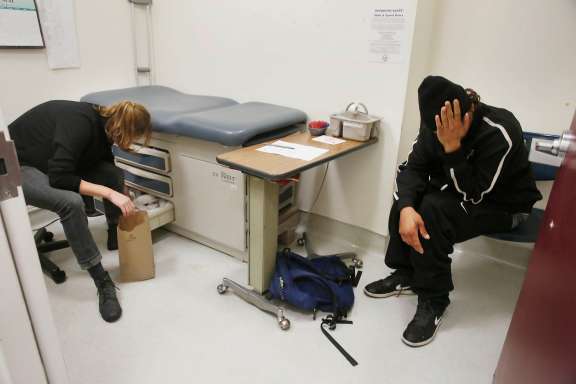
Tyson had just finished scrounging women’s clothing out of a dumpster to sell on Larkin Street when Seven strolled up to him that Friday night. He called Baron, who raced over from his hotel room, stepped out of his car and walked over.

“Hey Baron,” Tyson said, matter-of-factly, masking the shock. He tried to shake Baron’s hand, but his brother pulled him into a tight hug.

Then came that moment of staring into each other’s eyes. They left the stuff Tyson was hawking and drove to Baron’s hotel.

Minutes later, Tyson was sitting on the first clean bed he’d seen in longer than he could remember.

Lucas gave him a few minutes to think and make a little small talk. Then she asked: “How would you feel about getting detoxed and going home with Baron to meet your niece?”

In any intervention, this is a key juncture. Some addicts say OK but ask to take care of some business first, which almost always means they’ll disappear as soon as they hit the door. Others just say no. Tyson had tried briefly to kick dope twice before and failed — typical, considering most addicts need several attempts for one to stick.

Sitting in the hotel room with Baron and Lucas, he didn’t hesitate.

“OK, yeah,” Tyson said, his head bowed. Then he looked up.
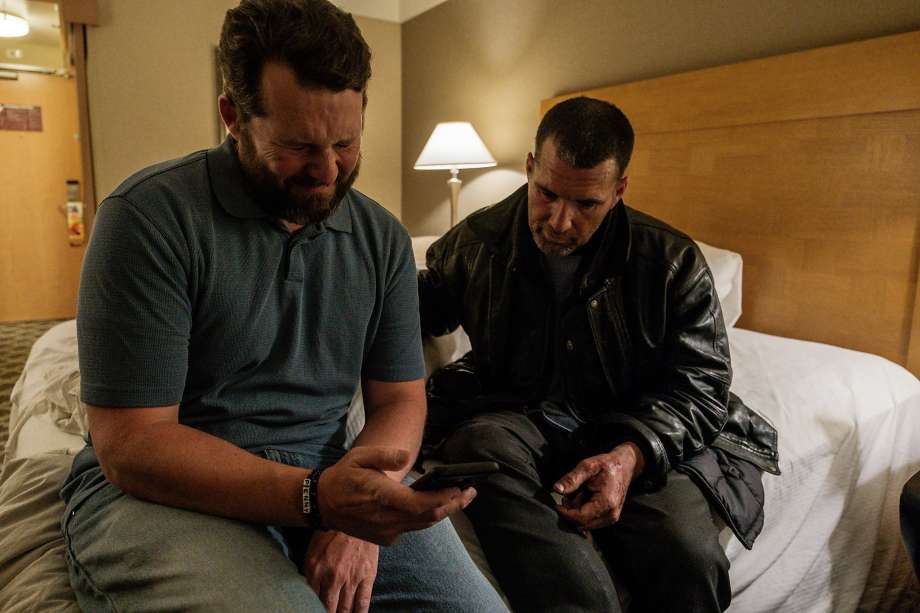
c835b 920x1240 Homeless and lost in SF — until a Chronicle photo led his brother to him

Baron Feilzer (left) reunites with his brother, Tyson Feilzer, after reading about him in The Chronicle.

(Nick Otto / Special To The Chronicle | San Francisco Chronicle)

“I hate being homeless,” he said, his voice flat and low. “I could have gone to Oakland or some other place, but I stayed here in San Francisco because I wanted you to be able to find me. I just felt like my family would come for me someday.”

He scratched at a nickel-sized abscess on his right forearm. “This is what happens when you’re on the street,” he said. “You get sick. You get infections. … You get pushed around. People look right through you.

“It’s an earned reputation,” Tyson said. His eyelids sagged.

“Growing up in Danville definitely didn’t prepare me for this kind of life.”

Baron pulled out his phone, a sheaf of photos and a piece of paper. “I have a letter here from Dad,” he said. He sat next to Tyson on the bed, handed over the photos — of Tyson as a baby, of family vacations — and began to read:

I’m writing this letter because I love you. When you were born it was the happiest day of my life. I regret you did not hear that enough.

Baron wiped his eyes. Tyson fingered the photos with street-grubby hands, staring. Listening.

Drugs and alcohol have not helped you, Tyson … our family wants you back. You have a life worth living. Please choose to live it. I know you can do this.

Baron finished reading, and the brothers sat silent for a long moment. “Tyson, you know how hard it was for Dad to say that kind of stuff.” Tyson nodded, eyes to the floor. “He really cares.”

Baron held out his phone. He pulled up a video of his 3-year-old daughter, Penny, saying hello to the uncle she’d never met. By now Baron was weeping.

“When you come home with me after you do rehab, you’re going to have to get used to Disney movies,” Baron told Tyson. “You haven’t seen ‘Frozen,’ have you?”

Tyson smiled, his first that night. “No, I haven’t,” he said, looking up.

“Well, you’re going to have to,” Baron said. “About a million times.”


Tyson slept in the bed that night, Baron on a foldout nearby. In the morning, a freshly showered Tyson ate breakfast and was ready to go. But he hadn’t shot up for several hours and started to get dope-sick — the nausea of early withdrawal. So he did what so many people headed to rehab do.

A cousin had driven in from the Central Valley to take them to the detox center in the Sierra, and the entire group drove to the Tenderloin. Lucas got out with Tyson, and in five minutes he’d scored a $10 strip of Suboxone — a withdrawal medication for heroin addicts — from a dealer. The aching went away.

Two and a half hours later, he was in detox and preparing to head to rehab at the Oxford Treatment Center in Etta, Miss.

On the sidewalk on Larkin Street, where the hunt for Tyson had ended but his rescue had only begun, Seven and the half-dozen pals who were there when Baron showed up took stock of what they’d seen. Two days later, Seven wrote a note to Baron:

We are all so proud of Tyson. Change is scary and it is something most of us avoid. He’s facing this head on. And more importantly we love him unconditionally, high or sober in stable housing or not.

A lot of us deal with guilt and shame because we let a family member down or disappointed them when our addictions caused us to slide off the road. We don’t want him feeling that way about us.

We’re blessed to know him and experience life with him. He’s a great man.

Baron flew home to Ohio after the weekend, where he and his wife are making accommodations for Tyson in their home. They know nothing will be easy.

“I think he’s gonna do it,” Baron said. “I think he’s learned the lessons he needed to learn.”

Tyson seemed to feel the same way. In the hotel room the night he was found, he mused, “There have been so many bottoms it boggles the mind.

“Why did I have to suffer through days without being able to get out of the rain? Dope sick? Being a heroin addict? I don’t know what God has in mind for me, what the point is.

“But I’m going to try to find out,” he said. “Thank God Baron came looking for me.”

“I love you,” Baron said.

Tyson nodded. “Yeah,” he breathed.

Kevin Fagan is a San Francisco Chronicle staff writer. Email: kfagan@sfchronicle.com Twitter: @KevinChron

Article source: https://www.sfchronicle.com/bayarea/article/Once-homeless-now-found-Danville-native-13817848.php


Posted in SF Bay Area News | Tagged | Leave a comment