Poll after poll find Bay Area residents anxious about housing, the cost of living, and the homeless crisis—and often suggest that those surveyed may not be long for the region.
The latest annual poll by the Bay Area Council (BAC), a business-sponsored public policy advocacy group, confirmed all of these trends yet again, but also found that most residents still consider the Bay Area a great place to live—in fact, respondents qualify the Bay Area as the “best place on Earth,” warts and all.
BAC conducted the survey of 1,000 registered voters in all nine Bay Area counties via email in March. Most respondents were from Alameda or Santa Clara counties—22 percent for each—with 12 percent of those polled hailing from San Francisco.
Many of the results are comparable to those found in similar surveys in recent years:
Asked whether or not “things in the Bay Area are going in the right direction,” 57 percent of those polled said they believe the region is “on the wrong track.” This is up two percent from the 2018 poll. It’s also an inversion of the response from five years ago when 57 percent believed the Bay Area was going in the right direction.
Asked about the number-one problem in the Bay Area, 43 percent said housing, up just one percent from last year but up 15 percent compared to 2017. Traffic and congestion came in second place with 21 percent. Homelessness was the third most common response and the biggest year-over-year gain with 20 percent, up from 14 last year.
Only three percent of those polled said that the Bay Area was an affordable place to live. Ninety-six percent said otherwise.
Echoing sentiments from similar polls, 49 percent of those surveyed said they are “likely” to relocate within a few years, up from 46 percent in 2018. Only 40 percent said they’re likely to stay.
Despite this, asked whether they agree with the statement, “Even with its challenges, the Bay Area is still the best place on Earth to live,” 57 percent agreed, versus 39 percent not in accord. Note that this is the first year this question was asked.
Of those polled, 74 percent called the Bay Area a good place to live. A smaller majority—55 percent—called it a good place to raise a family.
A plurality of those polled—28 percent—said they make more than $150,000 per year; five years ago it was 17 percent. The number of respondents making less than $100,000 annually is down to 38 percent in 2019, versus 56 percent five years ago.
(The number of voters who prefer not to disclose their income is also up, from 10 to 18 percent since 2015.)
A majority of those polled—75 percent—have lived in the Bay Area for more than ten years, down a bit from 78 percent in 2015.
In March, a Bay Area News Group poll of 1,568 registered voters in San Francisco, Alameda, Contra Costa, Santa Clara, and San Mateo counties found that 44 percent of those surveyed plan to leave the Bay Area, but only six percent had real plans to depart in 2019.
Chicago-based public relations firm Edelman released its annual Trust Barometer for California in February. Of the 500 Bay Area residents polled, 50 percent said they plan to leave California.
The same month Joint Venture Silicon Valley released its annual Silicon Valley Index and reported “for the third year in a row, people are moving out of Silicon Valley nearly as quickly as they are moving in.”
It’s important to note that planning to leave the Bay Area is not the same thing as actually leaving. Most Bay Area counties saw their population increase in 2017 and 2018.
In San Francisco, immigration buoys census figures in the face of domestic migration, although SF population growth has slowed in recent years.
As people from all walks of life struggle to afford housing in the Bay Area, one group is particularly vulnerable to the crisis, but often forgotten — people with developmental disabilities.
A new housing complex that just broke ground in Pleasanton is trying to change that, becoming one of just a handful of local projects designed to house low-income adults with Autism Spectrum Disorder, cerebral palsy, epilepsy and other developmental disabilities.
Experts say Sunflower Hill at Irby Ranch takes a tiny step toward addressing a massive — and growing — Bay Area need. Residents with developmental disabilities often can’t work and receive just a few hundred dollars a month in government benefits, not nearly enough to afford an apartment in the region’s overheated housing market. Complicating their housing search, they also may need help with everyday tasks such as laundry and grocery shopping.
“There is such a pent-up demand right now among young (special-needs) adults for housing,” said Lisa Kleinbub, executive director of the Regional Center of the East Bay, a non-profit that supports people with developmental disabilities. “They’re housed in settings that really aren’t what they want. They’re living with their parents, and they’re 30 years old … Some people are living in group situations, sharing bedrooms.”
Alameda and Contra Costa counties need an estimated 4,500 units of housing for people with developmental disabilities, Kleinbub said. But Housing Consortium of the East Bay, the main provider of affordable, special-needs housing in the region, operates fewer than 100 units there, said Executive Director Darin Lounds.
In the South Bay, the San Andreas Regional Center serves 17,500 people with developmental disabilities in Santa Clara, Santa Cruz, Monterey and San Benito counties. The center doesn’t have specific data on housing needs,but estimates that about 80 percent of the people it serves live with their parents.
In Pleasanton alone, about 700 housing units probably are needed, Kleinbub said. The Sunflower Hill project, which broke ground last week, will provide 31.
“It’s a drop in the bucket. But at least the bucket’s there, and somebody’s dropping some drops in it,” said Trudy Grable, director of community and family services for Parents Helping Parents, a San Jose-based nonprofit that works with families of people with special needs.
Meanwhile, the special needs population is expanding. Kleinbub estimates the Regional Center grows by between 600 and 800 people a year.
Having more special-needs housing available would take a huge weight off Sherrean Carr’s shoulders. The 60-year-old Gilroy resident has spent months trying to find housing for her 25-year-old daughter who has a seizure disorder, is nonverbal and uses a wheelchair.
Carr applied to the only affordable housing for people with developmental disabilities she could find in Gilroy — Villa Esperanza Apartments — and was told there’s a two to five-year waiting list.
For now, Carr’s daughter lives with her — but Carr constantly worries what will happen to her daughter once she’s gone.
“It’s a huge worry for parents,” Carr said. “It’s just immobilizing at times.”
When completed next year, the $19 million Sunflower Hill project will offer one and two-bedroom apartments at prices ranging from about $380 to $1,500 a month, depending on the resident’s income. While other buildings sometimes reserve a handful of units for special-needs residents, the Sunflower Hill project is unique because the entire complex will be for people with developmental disabilities. The building will cater to its residents’ needs with extra services, including access to a dining hall with a meal plan, a caretaker available to support the residents 24/7, a makers space for arts and crafts projects, a bocce ball court and social activities, said Sunflower Hill founder Susan Houghton.
Residents who need extra support can bring individual caretakers into their apartments at their own cost.
Funding for the Sunflower Hill project came from a variety of sources, including $2.2 million from the city of Pleasanton, $7 million from Alameda County’s 2016 Measure A1 bond, and $7 million from state tax credits.
Not everyone agrees that creating communities exclusively for people with developmental disabilities is the best approach. Instead, Regional Center of the East Bay prioritizes housing its population alongside the general community, Kleinbub said. But she said Sunflower Hill’s approach might work as long as residents have opportunities to venture beyond the building.
The Sunflower Hill project is still a year away from opening, but already more than 300 people have expressed interest. There are few other projects in the pipeline. Sunflower Hill won approval from the city of Livermore in 2017 to build housing for another 44 people with developmental disabilities but has held off on the project as it hunts for more funding.
Kathy Layman hopes one of the Sunflower Hill at Irby Ranch units will go to her 20-year-old grandson who has epilepsy and other developmental disabilities. Like most adults with special needs in the Bay Area, he lives at home with his mother and grandmother in Pleasanton. But Layman, who is on the board of Sunflower Hill, thinks it would be good for him to live on his own, near people his own age who have similar disabilities.
“He likes being around people,” she said. “He needs that social interaction.”
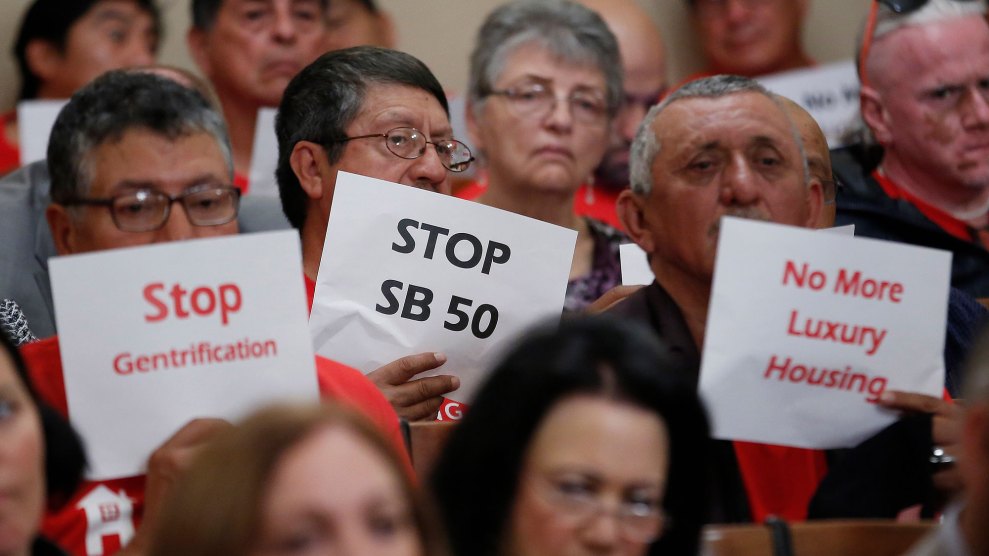
Opponents of SB 50 gather as lawmakers discuss the bill in Sacramento, California.Rich Pedroncelli/AP
“Everyone hates SB 50—everyone hates it,” said California state Sen. Scott Wiener at a recent forum on the state’s housing crisis. “You hear people getting upset about it, yelling about it, coming down to City Hall and yelling.” Flanked by real estate developers and housing rights advocates, Wiener, a Democrat who represents San Francisco, had come to discuss his ideas for solving the problem—which meant talking about the heated reaction to his signature piece of legislation, Senate Bill 50—the housing bill Californians seem to love to hate.
Everyone agrees that California is facing a housing crisis. Rents and home prices are soaring: The median home price in the San Francisco Bay Area is $830,000; in Los Angeles County it’s almost $600,000. Homelessness is increasing: Nearly a quarter of the nation’s homeless population lives in California. Low-income residents are being displaced by the wealthy: More than half of all home buyers in San Francisco last year work in the software industry. And there just isn’t enough housing to go around. Wiener likes to cite a report by McKinsey that found that California has 3.5 million fewer homes than it needs.
“The fundamental problem is that we have a massive housing shortage, which explodes housing costs and which puts enormous pressure on tenants in particular because the rents go so high,” Wiener told me just before the forum. “We have to lessen that pressure by adding more housing of all varieties at all incomes.” SB 50 is his attempt to expand the housing market to allow for faster, bigger, and denser residential construction. It’s an idea that many people agree with in the abstract, but in trying to make a workable plan, Wiener has grabbed one of the third rails of California politics.
SB 50’s opponents have called it “an act of war on homeowners” and “a Trojan horse for big developers’ profits.” One housing rights group said it would cause “Negro removal.” While complaining about the bill, the vice mayor of Beverly Hills likened pro-housing “Sacramento politicians” to the Old Testament villain Haman. Politicians from SF to LA worry the bill would undermine local housing plans; suburban NIMBYs don’t want apartment buildings in their neighborhoods; and housing rights activists lambast the bill’s “trickle-down” approach, which they say will only further fuel gentrification.
At SB 50’s core is “upzoning,” overriding local zoning laws that prohibit higher-density housing construction in residential areas. Currently, zoning requirements in 80 percent of California forbid building anything other than single-family residences (with some allowances for in-law units). SB 50 would open up some of those areas—particularly those near major transit hubs, job clusters, and good schools—to higher-density residential construction. Developers would be allowed to build taller buildings with more units, with a requirement that a certain number must be rented below market rate.
The bill’s critics say it would not make a real dent in housing prices. “What the Wiener bill really is about is raising housing opportunities for highly skilled, relatively high-income people,” said Michael Storper, a professor of urban planning at the University of California-Los Angeles. SB 50 is built on the assumption that the market will react to upzoning by building more housing. That’s true, said Storper, but he warns that “the market will respond in the areas where the price of the construction is met by an effective market demand—a return on its investment.” And that means housing for the well-off.
Upzoning cannot change the high cost of building, nor can it make lower-income neighborhoods more desirable to developers, said Storper. “It will gentrify what’s left to gentrify in the highly desirable areas,” he predicted.
Opponents of SB 50 point to Chicago, where smaller-scale, targeted upzoning laws did not lead to the expected boom of new units. As a recent study found, real estate speculation soared and housing and land prices increased in the upzoned areas. Another study found that upzoning in New York City further fueled the displacement of minority and working-class residents. Its authors recommended that upzoning needs to be balanced with policies to prevent displacement. Francisco Dueñas, the housing campaign director at the Alliance of Californians for Community Empowerment, said, “We think that in general, similar to what happened in Chicago, [SB 50] is just going to increase the value of that land, fueling greater speculation, and then that gets translated into increased rent and more people getting pushed out.”
“If anything, this would lightly create the conditions for more luxury housing for neighborhoods that don’t necessarily need them,” said Rene Christian Moya, director of Housing is a Human Right, a branch of the AIDS Healthcare Foundation. (In April, the AHF sent out mailers attacking Wiener, comparing SB 50 to the urban renewal policies that author James Baldwin had called “Negro removal.” In response, Wiener called AHF a “fake non-profit” with “zero credibility.”)
Despite the vitriol and backlash, Wiener says he is optimistic about his bill’s chances. “When you actually look at polls on SB 50…it consistently polls well,” he said. A poll from April found that 61 percent of Californians support SB 50. In February, a poll by the San Francisco Chamber of Commerce found that 74 percent of people in the city supported the bill. Its broad range of supporters includes groups like the California Labor Federation and the California Chamber of Commerce, as well as the California League of Conservation Voters, Habitat for Humanity, and the Non-Profit Housing Association of Northern California.
Wiener says his desire to tackle the housing crisis is personal. Before his career in politics, he did pro-bono legal work for renters, defending clients facing no-fault evictions in San Francisco. “Seeing the terror that they were living in, saying things to me like, ‘If I lose my apartment I will have to leave San Francisco and leave my whole community behind.’” Later, as part of his neighborhood association, he saw the glacial pace of the approval process for building housing that was “100 percent within zoning.”
In 2011, he was elected to the San Francisco Board of Supervisors. Housing costs in the city had always been high, but around then they went “through the roof—everything exploded.” One story sticks out to him: “I was walking down the street where I lived, and my neighbor, an older gentleman, said, ‘Scott, I’m really scared.’ And I said, ‘Why are you scared?’ And he said, ‘My landlord is painting my building.’ Normally, as a tenant, you should be thrilled that your landlord is painting your building, but immediately he saw that as a sign that he was going to sell the building, which meant he was going to be evicted.”
Wiener’s first housing bill, which he introduced last year, met a quick and fiery demise. It lacked any meaningful affordability standards and didn’t make it out of its first committee hearing. Wiener took the criticism to heart, tweaked the bill to add protections for renters and to set up affordability requirements, and reintroduced it as SB 50 in December. It has passed through two committees and is now slated for the Senate Appropriations Committee in mid-May, its last hurdle before it can go to the Senate floor. California Gov. Gavin Newsom hasn’t weighed in on SB 50, but he has pledged to make up the state’s 3.5 million home gap by 2025.
Wiener says he understands the concerns about his approach. He’s also pared down one of the most controversial aspects of the original version of SB 50, which allowed developers to pay a fee that would go toward building affordable units elsewhere rather than build them into their projects. Those affordable units must be built nearby, said Wiener, and “the certificate of occupancy can’t be granted for the market rate units until the affordable project is underway.”
Unlike his previous bill, SB 50 allows “sensitive communities” at risk of displacement to opt out of its requirements for five years. It would not change existing affordability requirements in cities that have them. For cities that don’t, it mandates that between 15 and 25 percent of newly built units are below market rate, depending on the size of the project. But the bill’s critics say that won’t do enough for the Californians struggling the most to pay for housing. “If you just say you’ll build more with the current inadequate affordability protections, you’ll get more inadequately affordable housing,” said Storper. “It’s not Scott Wiener’s fault—the basic affordability provisions that he’s bringing into his bill are so bad that merely reproducing them will not change much anywhere.”
Wiener said there’s a fine line here: If you boost the number of affordable units that developers have to incorporate into their projects, it can make those projects financially unfeasible. “If you do that, then you end up with no housing and no affordable units,” he said. “So you try to find the sweet spot where you’re pushing the percentage as high as you can go without jeopardizing the project.”
Wiener’s detractors also point to his ties to the real estate and construction industries. The Action Center on Race and the Economy recently published a report that found that California’s real estate industry spent $110 million on lobbying and campaign spending since 2008. Some of the biggest spenders—the California Building Industry Association, the California Apartment Association, and the California Association of Realtors—have spent heavily against tenant protection measures and have also contributed to Wiener’s campaigns. “That’s part of the broader context,” said Dueñas. “The affordable housing organizations aren’t on a level playing field; we don’t have the money to lobby as much as market rate developers.” Wiener claims the donations don’t affect how he votes. Real estate and developers “contribute to a lot of members of the legislature, including members who aren’t supporting the bill,” he notes.
The larger problem, according to Storper, is that SB 50 doesn’t address the economic inequality that is the root of the California’s housing crisis. The only way to deal with it, he said, is through subsidies and public housing. “Inequalities of income plus urbanization are really toxic combos,” he said. “How deep is society’s commitment to dealing with [the crisis]?”
Wiener and his allies have continued to tinker with SB 50 as it moves through the capital. It will likely be bundled in a package of related bills. Its latest version has been amended to incorporate elements of a competing bill from state Sen. Mike McGuire, and a group of progressive lawmakers have introduced pro-tenant legislation to address rent gouging and evictions that may become part of the package.
Even if SB 50 passes, results may be a long way off. “When it comes to development and housing, nothing is fast,” Wiener said. “I think sometimes people have this perception that the governor signs a bill and, you know, the next day apartment buildings descend from the sky in people’s neighborhoods. It unfolds very gradually over time.” For people who have concerns about how it will change their communities, he highlights the bill’s slow rollout. For those who would like to see a lot more housing yesterday, he acknowledged, “it’s very frustrating.”
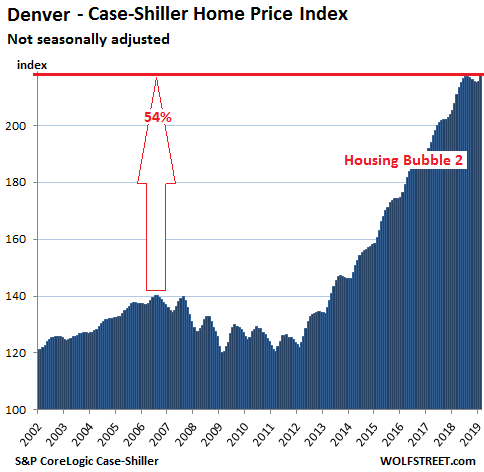
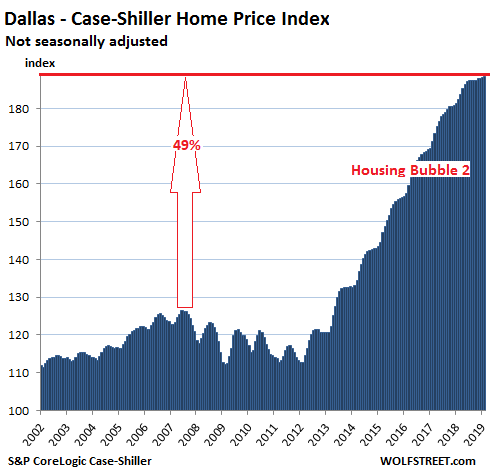
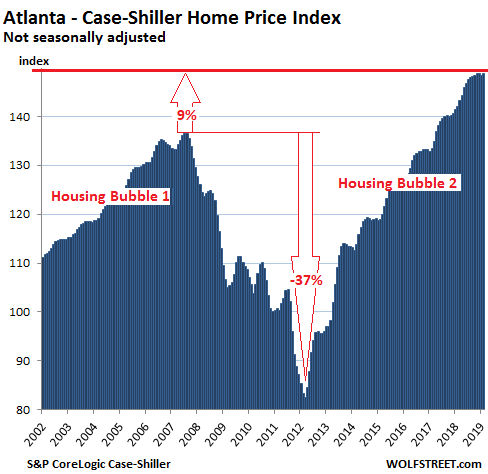
Condo prices fall year-over-year in New York. In San Francisco, SoCal, Seattle, year-over-year price gains shrink to nearly nothing. Despite the hype, Boston prices decline. Denver, Dallas Atlanta eke out records.
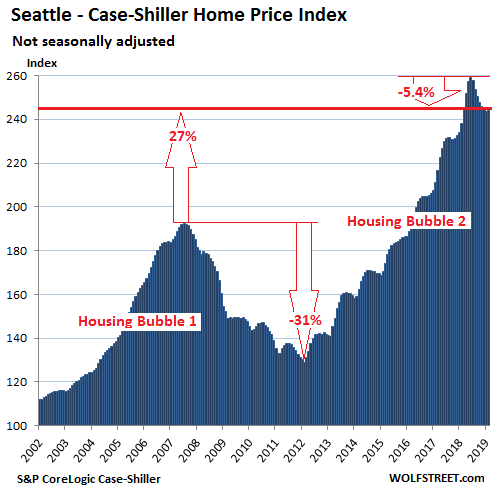
After seven months in a row of month-to-month declines, prices of single-family houses in the Seattle metro ticked up 0.57% in February and are now down 5.4% from the peak in June last year, according to the CoreLogic Case-Shiller Home Price Index released this morning. The index is now flat with March last year, and the year-over-year gain has been whittled down to just 2.8%, the thinnest such gain since June 2012, as Seattle was beginning to bounce off the bottom of Housing Bust 1.
And this monthly increase of 0.57% is merely one-third of the monthly increase in February 2018 of 1.74%. The index remains up nearly 27% from the peak of Seattle’s Housing Bubble 1 (July 2007):
The Core-Logic Case-Shiller Home Price Index is a rolling three-month average; this morning’s release represents closings that were entered into public records in December, January, and February.
San Francisco Bay Area
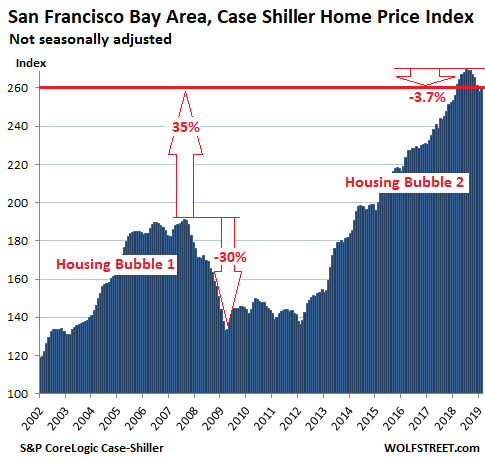
After six months in a row of month-to-months declines, prices of single-family houses in the five-county San Francisco Bay Area – the counties of San Francisco, San Mateo (northern part of Silicon Valley), Alameda, Contra Costa (in the East Bay), and Marin (in the North Bay) – ticked up 0.6% in February.
This leaves the index down 3.7% from its peak last July, and the year-over-year gain shrank to just 1.4%, the meagerest year-over-year gain since April 2012 when Housing Bust 1 had bottomed out. The index remains 35% above the peak of Housing Bubble 1:
For the San Francisco Bay Area, Case-Shiller also provides a separate index for condo prices, which, after eight months of declines, also ticked up 0.6% in February from January. Condo prices are now down 4.8% from their peak last June, clinging by their teeth to a year-over-year gain of 0.3%:
A measure of house price inflation
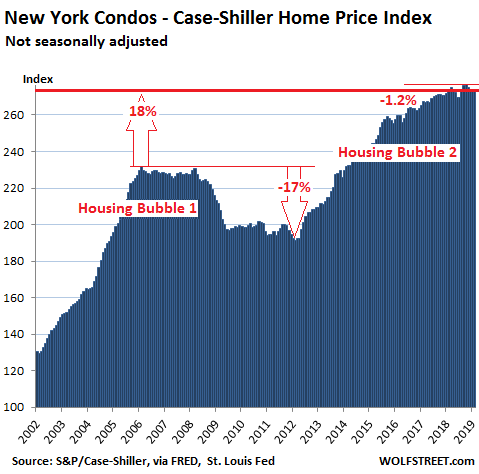
The Case-Shiller methodology is based on “sales pairs”: It compares the sales price of a house in the current month to the last transaction of the same house, which might have occurred many years earlier. This eliminates the issues of “mix” that can skew median price indices and the issues of a few big outliers that can skew average price indices. The Case-Shiller index tracks changes in price of the same house (sales pairs) over time, and thereby it tracks how much more dollars it takes to buy the same house: in other words, it tracks the purchasing power of the dollar with regards to the same house over time. This makes the index a good measure of house-price inflation.
The index was set at 100 for January 2000; a value of 200 means prices have doubled since the January 2000. Every market on this list of the most splendid housing bubbles in America, except Dallas and Atlanta, has more than doubled since then.
New York Condos:
Condo prices in the New York City metro remained essentially unchanged in February, compared to January, are down 1.2% from the peak in October, and are down year-over-year a tiny 0.2% from February last year. This is the first metro on this list of the most splendid housing bubbles in America where prices are down year-over-year:
San Diego:
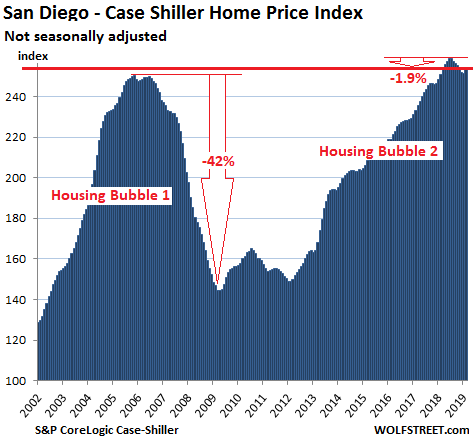
After six month-to-month declines, house prices in the San Diego metro rose 0.9% in February from January and are now down 1.9% from the peak last July. Compared to February last year, the index is up just 1.1%:
Los Angeles:
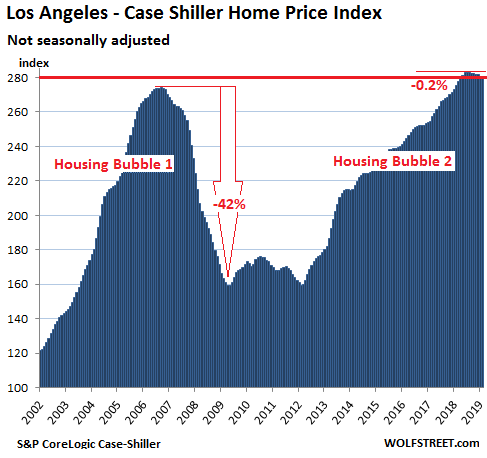
The Case-Shiller index for the Los Angeles metro was flat in February compared to January, leaving it down a tiny tad (-0.2%) from the peak in July. The index is up just 1.8% from February last year:
Boston:
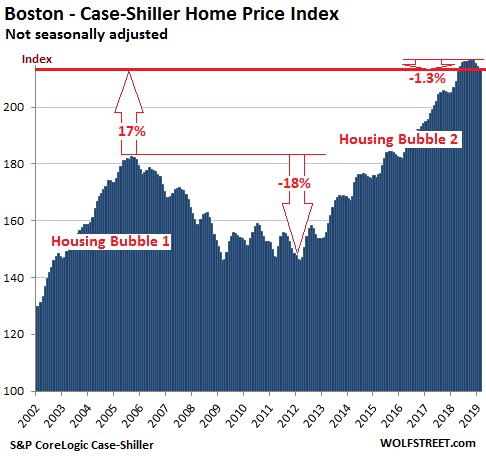
House prices in the Boston metro declined 0.4% in February from January and 1.3% from the peak in November. The year-over-year gain eroded to 3.2%:
Portland:
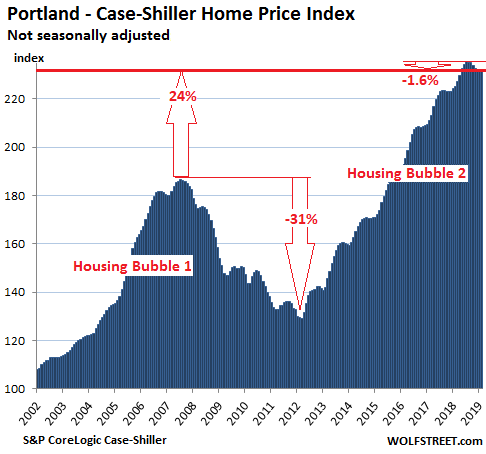
House prices in the Portland metro were essentially flat in February compared to January, and remain down 1.6% from the peak in July 2018. The year-over-year gain shrank to 3.0%:
New York City Condos:
Denver:
After ticking down by tiny increments month after month from their peak in July last year, House prices in the Denver metro rose 0.9% in February compared to January, which made up for the tick-downs of the prior month and surpassed by a hair the prior peak in July. But the year-over-year gain shrank further to 4.7%:
Dallas-Fort Worth:
The Case-Shiller index for the Dallas-Fort Worth metro ticked up in February from January to eke out a new record. Since June last year, the index has inched up only 0.7%. This leaves the index up 3.4% year-over-year, the slowest price gains since 2012:
Atlanta:
In the Atlanta metro, house prices ticked up in February from January matching the record levels in November and December for a flat spot at the top. The index is up 4.7% year-over-year:
Enjoy reading WOLF STREET and want to support it? Using ad blockers – I totally get why – but want to support the site? You can donate “beer money.” I appreciate it immensely. Click on the beer mug to find out how:
Would you like to be notified via email when WOLF STREET publishes a new article? Sign up here.
Out in the Ingleside district sits a little yellow house where Melanie Brandt lives with roommates. She gardens out back and manages to communicate a little with her Cantonese-speaking neighbors over the fence. She hands out candy to the neighborhood kids on Halloween.
But the neighbors don’t know what kind of house it is. They don’t know that inside live people who are now stable after experiencing severe mental health or drug addiction crises like those that play out before horrified San Franciscans on our downtown sidewalks every day. Those crises make us wonder why such a rich city — with an $11 billion annual budget — can’t do better.
San Francisco can do better, and the little yellow house is one solution.
It’ll be replicated with the backing of $25 million if two city supervisors have their way. Supervisors Hillary Ronen and Matt Haney on Tuesday will introduce legislation to set aside money in the city’s next round of windfall funding — property taxes left over after the public schools are funded at the required level — to pay for more of these co-ops in neighborhoods around the city. The city would use the money to buy up more homes like the one in the Ingleside, which nonprofits would manage. Currently, 183 people live in these co-ops in San Francisco, and the nonprofits that run them say they could easily house twice as many.
“We have a broken mental health and substance abuse system in San Francisco. Everyone will cop to and agree that it’s a mess,” said Ronen. “The financial waste is absurd. The human cost is absurd. And the frustration of San Franciscans is absurd.”
She said 44 percent of people released from 90-day residential treatment beds are sent back to the streets, where they risk falling back into mental health crisis and drug addiction almost immediately. Others wind up in large supportive housing facilities in the Tenderloin, South of Market and the Mission, where the lure of drugs is right outside.
Brandt’s journey to the yellow home’s front bedroom, with a twin bed and a stack of novels beside it, began one scary night in February 2009. She’d been homeless about a year after getting evicted from the Sunset District home she and her mother rented. Both she and her mom struggled with depression and anxiety and soothed themselves with addictions — drugs and alcohol for Brandt and spending too much money shopping for her mother.
They lived in her mom’s Ford Explorer for eight months before it was impounded. Her mother moved in with family in Texas, but Brandt didn’t want to leave her hometown. She said she used crack and meth and slept in shelter beds or on the sidewalk in front of the Main Library. That February night, she felt suicidal and took herself to San Francisco General Hospital’s psychiatric emergency room.
“That’s when I said, ‘I just want to die. I can’t do this. I’m scared,’” Brandt recalled.
Brandt said she assumed her only long-term option would be a big mental health hospital somewhere far outside San Francisco. But the nurse told her about a different path. She learned she could stay for two weeks in an “acute diversion unit” for those deep in crisis and then could move to a residential treatment facility for 90 days. After that, she could live indefinitely in a co-op with roommates who also struggle with mental illness and have help from a case manager.
That’s the path she took, with some drug rehab facilities in between, and she’s lived in the co-op for six years.
“I was just delighted that it was a house — it was not a facility,” Brandt said, adding that she was also thrilled it was in a quiet neighborhood and not one rife with drug dealers trying to lure her back into addiction.
She’s had a couple of short relapses, but said she’s been clean and sober for two years. She works as a peer counselor for a nonprofit. She and her roommates meet weekly as a group to discuss chores and other household issues and meet individually with a case manager once a week, as well. The home is rented and managed by Progress Foundation, a nonprofit that runs community-based homes and treatment facilities for mentally ill people.
It makes a whole lot of sense — so, of course, it’s become increasingly scant in San Francisco. Progress Foundation ran 12 co-ops housing 54 people 10 years ago, and now runs seven co-ops housing 33 people. Two other nonprofits also run the co-ops and have seen similar declines. The city’s exorbitant real estate market is largely to blame. Because the nonprofits rent from private landlords, they’re often squeezed out in favor of tenants who can pay more.
Brandt’s home rents for $3,394.80 per month. She and her three roommates each pay $350. A subsidy from the county covers the rest.
Ronen and Haney said they’re determined to fix the city’s broken mental health system and will have some more announcements soon. But another potential solution — opting into an expanded conservatorship program to compel mentally ill people to accept treatment — doesn’t have their backing. Ronen opposes it because she thinks it’s “unworkable” for a number of reasons, and Haney hasn’t taken a position.
State Sen. Scott Wiener, the backer of expanded conservatorship, said he’s hopeful six supervisors will end up supporting it. Currently, it doesn’t have the votes to pass the full board.
“It’s not progressive or compassionate or humane to stand by while people unravel and ultimately die on our streets,” Wiener said. He added that the city can both embrace conservatorship and expand programs to house and treat the mentally ill. The two are not at odds with one another, he said.
“To sit back and say that someone who is sleeping in their feces or screaming at cars in the middle of the street, that we should just expect that person to make coherent decisions about their health care, that’s not a reasonable position,” Wiener said. “The answer is all of the above.”
San Francisco Chronicle columnist Heather Knight appears Sundays and Tuesdays. Email: hknight@sfchronicle.com Twitter: @hknightsf