A: The San Francisco Bay Area, a popular location for Chinese investors, continues to attract home buyers. According to the National Association of Realtors, for the sixth consecutive year, China exceeded other countries in both the number of units and the dollar volume of residential housing in the U.S.
California, and in particular, the Bay Area, continues to be the favorite among Chinese home buyers, due to its good weather, strong economic growth and already large concentration of Chinese communities.
According to the NAR’s annual report, 90% of all international investment is on one coast or the other–as it’s more appealing, a better investment and the appreciation is stronger.
Traditionally some wealthy buyers come here to invest in expensive properties, and these days we do find more parents are buying homes for their children who work or study in the Bay Area (and an NAR survey found that Chinese buyers were the most likely to purchase a house for student housing).
However, analysts have pointed to China enacting tight, new restrictions on U.S real estate investment, in which the Bay Area real estate market may now start to feel the effects of—and investment and purchases did slow mid-third quarter of 2018.
A: The United States and China have many synergies and some polarizing differences. Tariffs have certainly been the one common theme we’ve been reading about most recently, and the reliance on both countries to get along so each can benefit from the others products and natural resources.
Both economies depend on exports to keep our economies going. Another economic component is the stability of the U.S. dollar and how the Chinese see this stability as a safe harbor for investing in U.S. real estate. Unlike China, where the land is owned by the government and the home owner basically owns the home with a long term land lease.
The Chinese government also has a large investment in US treasuries because of the stability of the U.S. dollar. On the real estate front both places are very desirable locations to live and there isn’t much excess land in either spot so our real estate both trade at a premium. This premium forces both the U.S. and China to struggle with affordable housing for the working class.
I think this has continued to change not only living arrangements with more people sharing their living accommodations or alternatively forcing longer commutes to reach more affordable areas.
Matt Heafey, the Grubb Co., 510 541-1754, heafey@grubbco.com.
A: Bay Area real estate’s strong ties with Chinese buyers continue at upper end and entry level markets.
This spring home shopping season started off on a cautious note at the tail of the sluggish fourth quarter of 2018, but eventually pulled through with super high-end and entry level homes seeing the most activity.
We are seeing no hesitation by the well-heeled Chinese closing all-cash deals at tens of millions price tags, despite China’s tightened policy. The market is being helped by a welcome phenomenon—an increased supply. Notably, Baby Boomers are finally selling to be close to their grandchildren. The San Francisco and San Jose areas are churning out new construction homes to feed the Chinese entry-level buyer to helping them realize their California Dream.
The energy is likely to carry over to the summer season when overseas Chinese families are coming for summer camps.
After 10 years of living on the streets in Oakland, California, Greg Dunston and Marie Mckinzie have a new normal thanks to a generous Bay Area homeowner who wanted to improve their lives and share the message that homelessness is not “contagious.”
The pair now live in a $4 million mansion in the upper-class East Bay neighborhood of Piedmont with Terry McGrath, who was determined to commit a simple act of kindness after a story was published about them in the San Francisco Chronicle.
When asked if they were worried about adjusting to life in a house, Mckinzie said “absolutely not.”
“I don’t want to live on the streets. A lot of people do, but I want to get in,” she added. “I love to cook a lot so I wanted a kitchen, bed and shower.”
“We wanted to do that,” Dunston said about moving into McGrath’s home. “There are a lot of people out on the streets but they have no choice.”
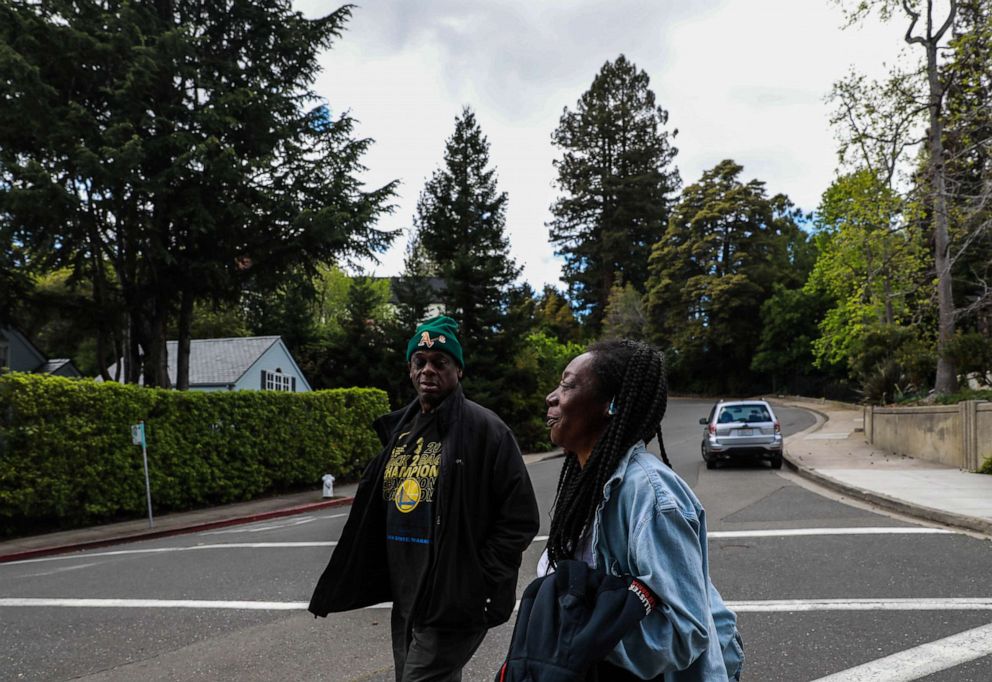
Yalonda M. James/San Francisco Chronicle via PolarisGreg Dunston, Sr. and his partner Marie Mckinzie walk back home after visiting Hampton Park, in Piedmont, Calif., on April 16, 2019.
But their “moving on up” tale of humanity was initially met with both positive and negative attention from local reporters and nearby residents.
Watch the full story on “Nightline” TONIGHT at 12:35 a.m. ET
One neighbor who was unaware of the situation called 911 and told dispatchers, “I just pulled into the driveway and there’s some strange folks hanging around the house.”
Another called Piedmont Police and Fire Dispatch, saying, “I just wanted to notify you that this woman is sitting at Lexford and Hampton … She’s smoking a cigarette — could be drugs.”
The couple has put a face on the growing homeless crisis in San Francisco.
The city by the bay is the wealthiest in the nation with more billionaires per capita than any other city in the country, according to the Wealth-X Billionaire Census 2019. San Francisco’s homeless population has also hit a record high, with nearly 8,000 people living on the street and in their cars.
Otis Taylor, a journalist for the San Francisco Chronicle who writes about homelessness in the Bay Area, has detailed the glaring disparity between the density of wealth and those who have little to nothing.
“You have people able to purchase multimillion-dollar homes in cash and then you have people who don’t even have enough money to eat on a daily basis. Who sleep in the same clothes in rags, they sleep in doorways and parking lots next to dumpsters,” Taylor told ABC News.
When he first met Dunston, who is blind in one eye, and Mckinzie, who has a bone disease that makes it difficult to stand or walk, Taylor said they weren’t bitter despite any of their disabilities.
“They were still engaged with meeting people and they still had love for each other through it all that bond,” he explained of what he called a “vibrancy of life” when he first wrote about the pair for the paper.
Real estate developer Terry McGrath, a divorced, empty nester and homeowner in the hilltop town of Piedmont in the East Bay, had nothing but space on his property and in his heart and wanted to connect with the homeless couple.
“The thing that struck me and got me right away was the love between Greg and Marie and how it was able to survive in probably one of the harshest environments on earth,” McGrath explained. “I could feel it.”
He met with Taylor and the couple in a cafe and said he was immediately moved to help them.
“There was no decision, there was no thought, there was no judgement. I was just like ‘this is done,’” Taylor recalled. “I didn’t vet them. These are human beings and they’re not serial killers. They want to get in out of the weather. They want a roof over their head. They want to be warm.”
McGrath offered the couple his in-law unit where his own children grew up and other relatives had previously lived and reached out to the Piedmont chief of police, Jeremy Bowers.
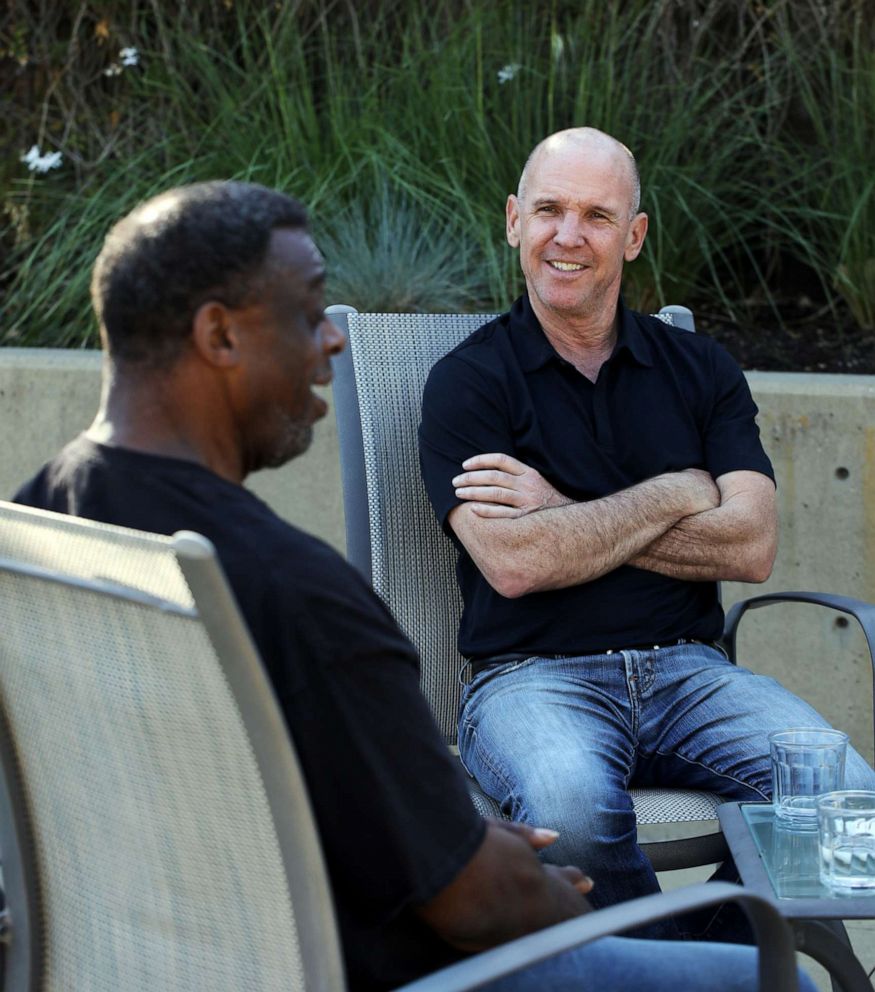
Yalonda M. James/San Francisco Chronicle via PolarisTerry McGrath, right, listens as Greg Dunston, Sr. speaks while they hang outside their home with Marie Mckinzie, not pictured, in Piedmont, Calif., on April 25, 2019.
“His email was very matter of fact,” Chief Bowers said. “[Terry] let me know he was opening his home to some folks.”
And once 911 calls started to come in from neighbors, the officers had already been counseled on how to handle it. He added that if the calls had been about a white couple at the house, the officers would have responded the same way.
Taylor said that Piedmont’s residents are 74 percent white, 18 percent Asian and less than 2 percent black.
“You have two black people sitting on the steps, people are driving by, you get homeowners looking out the window. That is unheard of in Piedmont,” he said.
McGrath said he never got calls about previous tenants that included an intern.
“I got a call at 9:30 at night on my cellphone — I thought she was calling about organizing the neighborhood summer block party,” McGrath said of one of the first responses. “I realized when she mentioned the word ‘situation’ that she was referencing Marie and Greg. And I said, ‘What situation?’ Are they vandalizing cars? Are they burglarizing homes?’”
He continued, “I just said, ‘This is one of the most offensive conversations I’ve ever had.’”
Despite the complaints from a few neighbors, McGrath said it was a simple decision to get closer to the problem that he thinks many other wealthy people avoid.
“Our natural tendency is to move away from that kind of pain,” he said. “That’s why we avert our eyes. That’s why they just become part of the background, part of of the wallpaper and it’s easier to just move past it.”
Yalonda M. James/San Francisco Chronicle via PolarisMarie Mckinzie, 54, and her partner, Greg Dunston, Sr., rest in bed inside the basement apartment where they’ve been living since February, in Piedmont, Calif., on April 18, 2019.
Taylor said a lot of his own coverage has centered on how people view homelessness.
“In fact, many of us choose not to see it. We’ve become numb to this despair and the plight of others who are obviously suffering,” the SF Chronicle reporter explained.
The issue has become a large one in San Francisco, capturing people’s attention in the bustling city.
City landmarks have been obscured by cardboard boxes and makeshift tents which highlights a clear juxtaposition in San Francisco with big name companies like Twitter just neighborhoods away from streets littered with syringe needles.
London Breed, the city’s mayor, said she decided to run for office in part to fix the homeless problem in the city she grew up in.
Breed has proposed a new kind of shelter that allows daytime stays and offers safer conditions and on-site job programs that could be built around all the neighborhoods in San Francisco.
“People aren’t just going to disappear because we don’t want to see them,” she said. “And that’s why we need solutions.”
McGrath called the mayor his hero for bringing the issue of homelessness to the forefront.
“Here’s a mayor in the most liberal city arguably probably in the United States, in the honeymoon phase of her mayoral term and she’s getting shouted down because [she] wants to build affordable housing in the neighborhoods,” he said. “It’s unconscionable — homeless is not contagious.”
He added that residents want homeless issues handled “but they don’t want it handled in their neighborhoods.”
“It’s not going to go away because you don’t want to see it,” McGrath said.
Although he knows his own efforts to fight homelessness is not a universal solution, McGrath felt like it could inspire others to not look away from the problem.
McGrath wants Dunston and Mckinzie to get back on their feet and find jobs but there’s no timetable for them to leave his home.
“They’re like family. There’s no way I’m going to let them go back to the street,” he said. “Most people who know me well know it’s easy to start and it’s hard to finish. And I’m never not going to finish.”
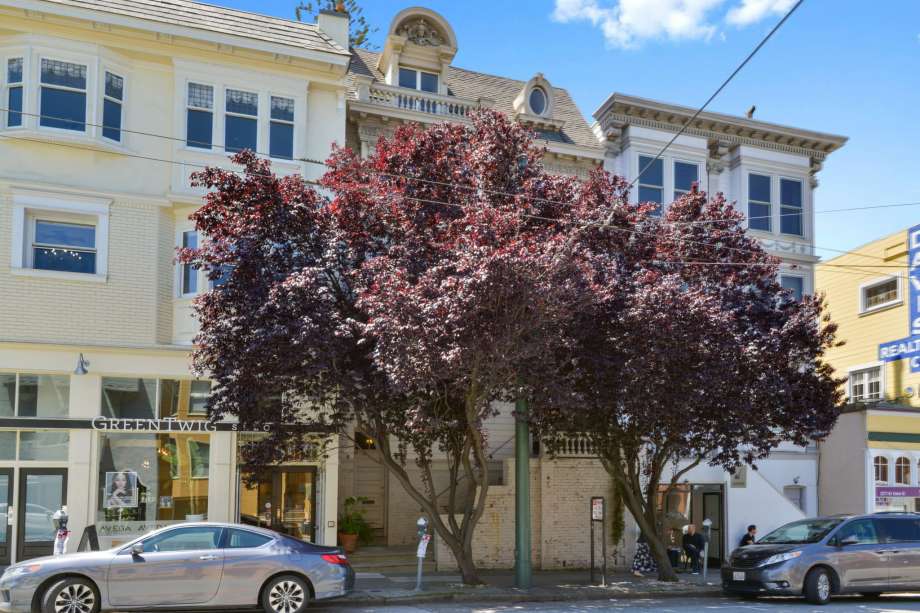
What would you do with this grand Victorian in SF’S Cow Hollow? $5M gives you the rights to decide.
What would you do with this grand Victorian in SF’S Cow Hollow? $5M gives you the rights to decide.
Photo: Daniel Lunghi For Sotheby’s
Caption
Close
What would you do with this grand Victorian in SF’S Cow Hollow? $5M gives you the rights to decide.
What would you do with this grand Victorian in SF’S Cow Hollow? $5M gives you the rights to decide.
Photo: Daniel Lunghi For Sotheby’s
Built in 1902, this stately San Francisco Victorian has a time-warp feeling, so preserved are its original features. It’s on the market now, billed as a “fixer,” for $4.9M. But does it need much fixing at all?
The home
The home is grand in both scale and spirit: There are four levels encompassing 3,545 square feet.
On the main level, dark wood floors, built-ins and wall paneling accent a living room with a brick hearth and a formal dining room whose French doors open to the garden. This dining room as well as additional parlor both have their own fireplaces.
The kitchen has had updates since 1902, but it’s likely buyers with this kind of money will also have ideas (and the needed funds) for this room. Whatever the next owners do, they can still enjoy the sunny eat-in nook and access to back deck.
There is also a half bath on this level.
Upstairs from the main floor are four bedrooms and another two and a half bathrooms. There is also an attic whose vintage wood stove and port window will thrill any lover of classic Victorian style.
Below ground, the home has a full, dry basement which certainly longs for love.
The property
The home is built on a 3,436-square-foot, south-facing lot. In the back, there is room for (and sunlight for) any number of gardening endeavors.
Since the date of this posting, the price of this home has been dropped to $3.775 million. Neill Bassi of Sotheby’s has the listing.
Anna Marie Erwert writes from both the renter and new buyer perspective, having (finally) achieved both statuses. She focuses on national real estate trends, specializing in the San Francisco Bay Area and Pacific Northwest. Follow Anna on Twitter: @AnnaMarieErwert.
Although the San Francisco housing market sputtered slightly over the past 12 months, the fact remains that most people will never be able to buy a home at market prices in the city.
According to the SF-based investment fund Unison, a home purchase in the city means decades of savings and upwards of $200,000 per year in income (taxes not included) just to keep up on payments.
Unison’s second annual Home Affordability Report, released in early June, assesses what potential homeowners need to procure housing in 35 major U.S. cities.
Naturally, San Francisco has the highest barrier of entry to buy.
“Nationwide, it takes 14 years to save for a 20 percent down payment on a median priced home for those earning the median income,” according to Unison. But in San Francisco that figure jumps up to a weary 40 years, the second highest in the nation behind only LA, which takes the top spot at 43 years.
It get worse: Assuming a down payment happens, keeping up with the mortgage can demand outrageous standards of income.
In San Francisco, Unison calculates a median monthly housing payment of $5,052, which means an estimated annual income of $202,094 to keep above water.
The report explains it reasoning thusly:
To estimate how much income it would take to a home [...we] calculate the associated monthly costs, assuming a 4.54 percent mortgage interest rate for 2018 data, and a 3.99 percent rate for 2017 data. Those rates represent the average annual Freddie Mac 30-year xed rates.
[...] In addition, property taxes of 1.25 percent per year on the median home value and home insurance costs of 0.4 percent per year on the median home value are included. [...] The required annual incomes reported are then constrained so that the monthly housing costs do not exceed 30 percent of gross income. This represents a conservative estimate of the percentage of income that can be spent on housing.
Based off a 2018 median home value (not price) of $1,031,732, that means roughly more than $200,000 annually to avoid extending monthly finances too far.
If that’s a 2018 estimate, then what does the same formula look like in 2019? Comparing Unison’s figurings with the most recent monthly analysis from mortgage firm HSH (released in May), a similar 4.53 percent mortgage rate and 20 percent down makes for a monthly payment of $4,345 and a recommended income of $186,250.
The lower figure comes as the result of a lower median housing price (not value) of $930,000 in HSH’s analysis.
However, when HSH says “San Francisco” it’s shorthand for the larger Bay Area, including San Francisco, Alameda, Marin, San Mateo, and Contra Costa counties, which is the main reason why the figures are lower.
Real Estate firm Compass estimated at in June of this year that a single-family median-priced house in SF costs $1.65 million, while a condo comes in at $1.25 million.
According to the U.S. Census, 21.2 percent of San Francisco households made $200,000 or more in 2017, and another 10.8 percent made between $150,000 and $199,000. The median income citywide was $96,265.
The technology giant announced earlier this week a $1 billion commitment to help offset the San Francisco Bay Area housing shortage. It’s a noble overture. But even that sizable amount is a very small drop in a very large ocean. And it doesn’t recognize the reality that building more houses won’t fundamentally solve the Bay Area housing crisis.
In fact, this approach perpetuates the antiquated notion that when your company expands, you build additional offices, add nearby housing to support all the new workers you bring to town, and fund more mass transit. And while alleviating burdens on existing infrastructure is wise, this approach ignores the fact that most work can be done remotely in the digital age, and we can spread opportunity more broadly as a result. (My company, Upwork, runs a digital platform that helps remote workers connect with clients.)
Year after year, the refusal to consider flexible work scenarios as a solution for housing woes results in more and more people crowding into urban areas. High-wage tech workers are driving up the cost of nearby real estate, forcing many workers to commute hundreds of hours each year to their jobs. Our roads are clogged, local infrastructure is strained, and quality of life is diminishing.
If we don’t enable more people to work where they choose, such tensions will only grow. Local housing prices will continue to skyrocket so long as the economy is booming. The median price of a single-family Bay Area home hit a whopping $990,000 in May. And every time workers from elite high-tech companies move into a neighborhood, prices rise—a lot. A Zillow report, for example, looked at how Facebook’s May 2012 IPO affected Bay Area housing prices between March 2012 and March 2013. “Home values where likely Facebook employees lived grew 20.9%, compared with 16.8% for the rest of the Bay Area. That translates to a $29,800 difference in appreciation in that first year after Facebook went public,” reads a press release that accompanied the report.
Commute times, already among the longest in the nation for many Bay Area communities, will also worsen if we cling to outdated urban planning approaches. When companies grow, they make their mark on the world by expanding the number of buildings they control. They start with one, then two, then four, then eight, and so on, doubling their space every few years. These campuses bring thousands of workers into areas that often lack the local infrastructure to adequately support them. We saw this with Salesforce’s skyscraper in San Francisco, with the moves by Facebook and Google to gobble up existing buildings or create their own all around the world, and with Amazon’s aborted HQ2 effort in New York City.
It doesn’t have to be this way. Younger generations are more than amenable to the idea of remote work. They’ve grown up in a digital world and almost see it as their right to connect to corporate networks where, when, and how they choose. As this generation rises in managerial ranks and begins to assert more influence over workforce planning, it’s likely workplaces will become more flexible anyway. In fact, our research finds that 69% of Gen Z and millennial managers already allow team members to work outside the office. Among those that allow remote work, 74% say this happens frequently.
While it’s fine to commit funds for local housing, as Google has done, such efforts do not go far enough. We should embrace the inevitability of the remote work movement rather than holding fast to outdated urban planning approaches. Companies should also expand their remote work programs for workers who do not need to be on corporate campuses every day of the week.
In addition, government leaders should make it easier for people to work remotely. Waiting patiently for companies to do it or for it to happen by osmosis will not solve our infrastructure and affordability problems. We need action now through incentives. This is a problem that affects everyone. And the only way to create meaningful incentives is through public-private partnerships.
California can look at similar moves to distribute the opportunities fueled by the Bay Area and Silicon Valley’s explosive growth more broadly throughout the state. Remote work provides an important first step toward that growth, and the state should do what it can to incentivize and promote remote options. This could have the dual impact of alleviating short-term burdens and creating long-term gains for more people in more places—all while increasing the revenue base for the state across the board.
There are many possible solutions to the lack of affordability in our communities. But no matter what, we must evaluate approaches other than building more housing.
A firm and strategic commitment to flexible work can jumpstart that search for solutions. By starting there, and quickly adding incentives driven through public-private sector collaboration, we can begin slowing and even reversing the ill effects of decades of urban expansion that have exacerbated inequality—and begin building a brighter future for the Bay Area.