Bay Area homes are getting more affordable, closing gap with rest of state

This may sound hard to believe if you’re house hunting, but Bay Area homes got significantly more affordable in the third quarter, thanks to a big drop in mortgage rates, rising incomes and lower home prices, according to a report issued Thursday by the California Association of Realtors.

The region is still the least affordable in California, but it’s closing the gap with the rest of the state.

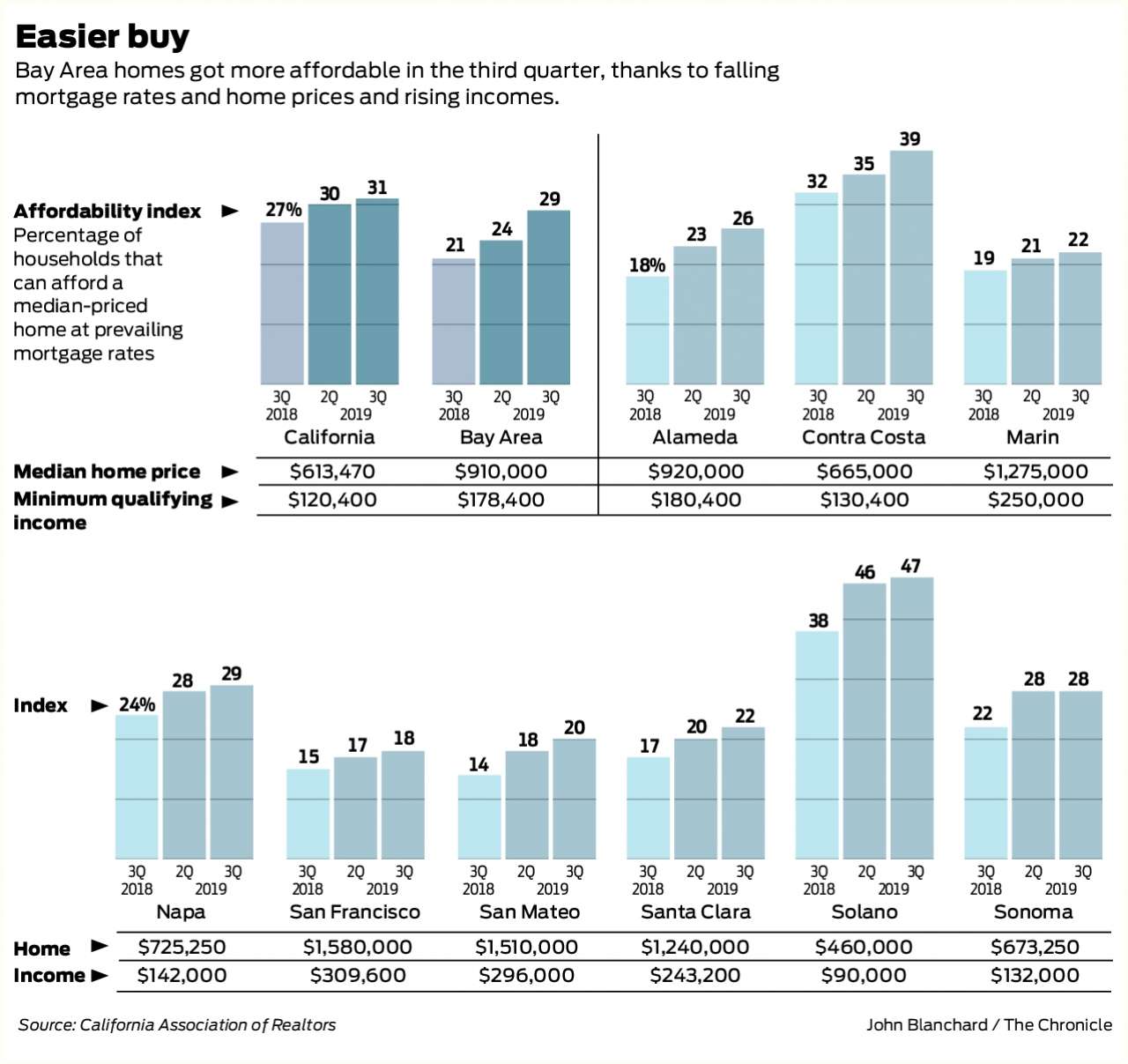
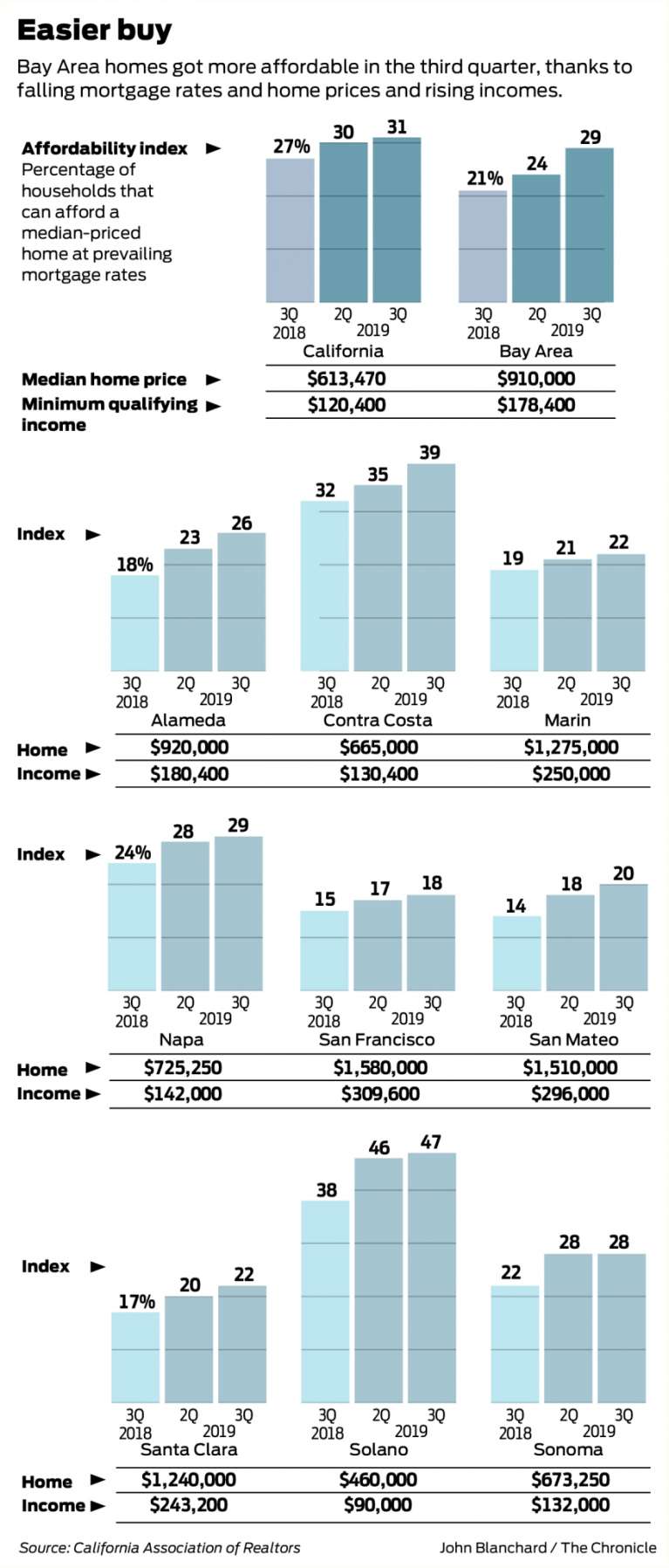
In the Bay Area, 29% of households theoretically could buy a median-priced, single-family home in the third quarter, up from 24% in the second quarter and 21% in the third quarter of last year, according to the association’s “affordability index.”

Statewide, 31% of households could afford a median-price home, up from 30% in the previous quarter and 27% a year ago.

The report calculates the annual household income needed to make the monthly payment (including mortgage, taxes and insurance) on a median-priced, single-family home with a 20% down payment and a 30-year fixed-rate mortgage at prevailing rates. It then estimates what percent of households in a county, region or state earn that much. The result is the affordability index.
73621 1280x0 Bay Area homes are getting more affordable, closing gap with rest of state73621 767x0 Bay Area homes are getting more affordable, closing gap with rest of state

By this measure, every Bay Area county got more affordable in the third quarter, but the improvement was generally greatest in the less expensive counties. In Solano, the index rose from 38% to 47% year over year. In Alameda, it went from 18% to 26%, and in Contra Costa it rose from 32% to 39%.

In San Francisco, the most expensive county, the affordability index rose from 15% to 18% year over year. In the city, you’d need to earn $309,600 a year to buy a median-priced home, but that’s down from a peak of $344,440 in the second quarter of last year.

Although 18% affordability still sounds low, it’s been worse in San Francisco. For most of 2005, during the previous housing boom, it was 9%. The highest it got during the housing bust was 29% in the first quarter of 2012.

The association’s index probably understates affordability, especially in San Francisco, because it excludes condominiums, which are generally cheaper than single-family homes. Oscar Wei, the association’s senior economist, said it excludes condos because statewide they only account for about 15% of sales, but in San Francisco they are about half.

The biggest contributor to rising affordability was a big drop in mortgage rates, Wei said. Mortgage rates have dropped nearly a percentage point, to 3.85% in the third quarter from 4.77% a year ago.

 Bay Area homes are getting more affordable, closing gap with rest of state

The other big drivers were rising incomes and falling home prices. The median Bay Area income for the year as a whole rose to $105,803 in 2019, up 8% from a year ago.

The median Bay Area single-family home price was $910,000 in the most recent quarter, down 7.1% from the previous quarter and down 4.2% from a year ago.

All of these things came together to help first-time buyer Carlos Villarreal buy a single-family home in Oakland.

“I’ve been looking since May,” he said. “All through the summer, the homes I liked were not affordable, they were outside of my price range. In the fall, prices did come down a tiny bit in the neighborhood I was looking at.”

He also got a raise at his job consulting with local governments three months ago, which helped, as did a drop in interest rates. When he started looking in May, “I was quoted 4.25%. A couple weeks ago I locked in 3.5%.” Villarreal also got help with the down payment from his parents. “Without that, I wouldn’t have been able to get it,” he said.

Elisabeth Watson, an agent with Abio in the East Bay, said, “There’s absolutely no question, it’s getting better for first-time buyers” as prices take a breather. “We are seeing buyers getting properties closer to asking price.”

Although median home prices have been mostly on the upswing statewide, in the Bay Area the median price on a year-over-year basis has fallen for eight consecutive months and nine of the past 10, the association reported in its monthly report for September.

The median price for a Bay Area single-family home that closed in September was $930,000, down 2.2% from August and 5.4% lower than September 2018. Bay Area homes are taking longer to sell; in September the median number of days on market was 23, up from 21 days in August and 19 a year ago.

 Bay Area homes are getting more affordable, closing gap with rest of state

“In 2017 and 2018, we saw some pretty solid increases in home prices. In 2019, the fact that it dropped, I’m not completely surprised, it’s just little bit of a giveback,” Wei said.

Prices “are taking a timeout,” said Elliot Eisenberg, an economist who does consulting for MLSListings, the multiple listing service for several counties, including San Mateo and Santa Clara. “There isn’t that much money around anymore.” Chinese buyers have retreated from the market since the government made it much harder to get money out of the country.

The big jump in prices that many thought would follow this year’s flood of initial public offerings hasn’t materialized, although they may have prevented prices from falling further, especially in San Francisco, where most of the newly public companies are headquartered. In San Francisco, the median home price was up 2.2% in September year over year. Employees and early investors in Uber, which raised $8.1 billion in its May 9 IPO, were only allowed to sell their shares after a six-month lockup period ended Wednesday.

“In the East Bay, we are starting to see things sitting on the market longer, but we are not seeing a big drop in prices,” said Compass agent Jessica Nance. “Buyers can breathe and determine their next steps. The market has slowed down but properties that are priced well and show well are seeing multiple offers.” She added that “lower rates are driving more buyers into the market than I saw six months ago.”

Kathleen Pender is a San Francisco Chronicle columnist. Email: kpender@sfchronicle.com Twitter: @kathpender

Article source: https://www.sfchronicle.com/business/networth/article/Bay-Area-homes-are-getting-more-affordable-14818700.php

Posted in SF Bay Area News | Tagged | Leave a comment

Californication: Denver has attracted satellite offices for 22 major Bay Area tech companies since 2010

Lamenting the “Californication” of Colorado is a favored pastime for some natives, but don’t expect commercial real estate agents to do much griping about the Bay Area-ification of the Denver metro area.

After all, big-time tech companies from in and around San Francisco have helped make their lives easier over the last decade, soaking up a combined 900,000 square feet of commercial space in the greater Denver-Boulder area since 2010, according to a new report. That’s a figure that makes the Mile High metro one of the country’s top 10 markets for attracting Northern California tech firms looking for outposts away from home.

The report, released earlier this month by real estate services firm Cushman Wakefield, is titled “The Great Tech Migration” and it details the expansion of 89 established technology and life-science companies headquartered in the Bay Area over the past decade. Of those companies, 58 have set up satellite locations in other cities across America since 2010. Twenty-two of those — more than one in three — have carved out homes away from home in Denver.

The names of the firms are familiar: Apple, Facebook, Google, Lyft. By now, factors that helped attract them to Denver are familiar too: A workforce where 43.9% have bachelor’s degrees or higher and a population that is 23.5% millennial, nearly 3% higher than the nationwide rate.

Beyond those measurables, there is something immeasurable that helps Bay Area companies feel at ease in Denver, said Steve Billigmeier, an executive managing director with Cushman Wakefield’s Denver office and part of the company’s emerging tech advisory group.

“I think just culturally, Denver as a community has similarities to the vibe to Northern California,” Billigmeier said last week. “There is a level of comfort expanding their footprint in Denver because of that fact. It’s a gut-feel-type deal that doesn’t go into the numbers, but it’s definitely a part of the conversations.”

Off the top 10 markets in Cushman Wakefield’s report, Denver is last in terms of square feet absorbed. It’s 900,000 total square feet is comparable to Dallas and Portland, Ore.’s 1 million square feet but well behind Seattle (5.1 million square feet) and Austin,Texas (6.1 million square feet), markets that are often held as comparable to Denver.

The discrepancy has a lot to do with single companies gobbling up heaps of real estate in those places, Billigmeier said, where it’s been more a case of many companies nibbling in Denver. Austin benefits from the University of Texas churning out software engineers at a rate the University of Colorado isn’t matching, he said.

Denver remains a bargain compared to other top-tier markets. Plenty of companies Cushman Wakefield tracked for its report chose to expand in the Bay Area itself. Billigmeier said he is working with a client now looking at lease rates of $100 per square foot in Northern California. Cushman Wakefield’s third-quarter analysis of the Denver office market put the average lease rate in town is $25.68 per foot.

But Denver isn’t as cheap as its once was, and other cities are now showing up on the radar of Bay Area firms looking for space.

“Second-tier markets like Kansas City and Minneapolis, those markets are a lot cheaper than Denver and if (companies) can get the talent they need in those markets, unfortunately, Denver might be missing out on those deals and more in the future,” Billigmeier said. “It’s absolutely a concern and an issue.”

Article source: https://www.denverpost.com/2019/10/16/colorado-california-tech-companies/

Posted in SF Bay Area News | Tagged | Leave a comment

Why is Walnut Creek the best-dressed place in the Bay Area?

To emerge on the other side, all it takes is going through the Caldecott Tunnel.

Heading east out of Oakland, you pass through the tunnel, over the rolling hills of Orinda and Lafayette and arrive in Walnut Creek. Here there is not a single Uniqlo puffer in sight. Instead, manicured women in Tory Burch dresses and well-preserved men in pastel Lacoste button-ups dot the town square, making tremendous effort on what seems like just an ordinary Friday afternoon. Whole families look like they’ve stepped out of a Draper James campaign. Matching bags and shoes, without a shade of irony. Coiffed hair and nails to match. In Walnut Creek, dressing to impress is the local currency.

When I moved to the Bay Area about seven years ago, someone well-meaning advised me to buy real estate in Walnut Creek. They advertised it as the perfect place to start a family, but it was already too late for real estate moves, and the promised land seemed too far from San Francisco.

I did, however, go to Walnut Creek to shop. I perused an entire floor of discounted items at a gloriously huge Anthropologie, searched out cheap Zara thrills across two levels and strolled through quiet, neat boutiques like Lou Grey and Aritzia. Walnut Creek, you see, is home to Broadway Plaza, an incredible open-air mall, which, unlike San Francisco’s Westfield or Stonestown Galleria, is actually fun to walk around in. It was then, on those shopping trips, that the realization started creeping in: Everyone in Walnut Creek was extremely dressed up.

San Francisco circa 2013 was deep in its Everlane phase — neutrals, denim and utility ruled. (Once, at San Francisco Opera, I was greeted by multiple sightings of North Face vests and hiking boots.) Today, San Francisco fashionistas have opened up to color and feminine silhouettes, but practicality and comfort still dominate. Compared to that, or to Berkeley’s year-long tie-dye festival, Walnut Creek seems like New York’s Upper East Side with a hint of Pleasantville. With its preppy, polished style, the wealthy suburb is 23 miles — and light-years — away.

“Oakland and Berkeley are laid-back and ‘crunchy’; granola-y, casual, eco-friendly, eclectic,” says Erin Alison, a recent Walnut Creek transplant. “It seems like people dress more for practicality than presentation.”

Alison, an e-commerce consultant, moved to Walnut Creek with her family from Emeryville a year ago, in pursuit of “more space and better-rated schools.” In her new ZIP code, she says, “people try to look very presentable all the time. You can tell they take pride in their appearance and maybe even want to show off. People overdress more often than underdress.”

But why?

 Why is Walnut Creek the best dressed place in the Bay Area?

An easy and crucial answer is affluence. According to historian Sheila Rogstad from the Walnut Creek Historical Society, in the late 1800s, the area served as a vacation destination for wealthy San Francisco lawyers and bankers, who’d often buy a ranch or a vineyard and move there in retirement. To this day, its population is older than San Francisco’s and nearby East Bay hubs: 29% of Walnut Creek citizens are 65 and up, compared with 15% in San Francisco and Berkeley and 13% in Oakland.

In recent years, before becoming unaffordable, Walnut Creek was one of the places San Francisco tech families escaped to, resulting in a 2005 Diablo Magazine article declaring a housing boom and prompt price increase. The same story called Walnut Creek an “increasingly stylish” spot. These days, according to the U.S Census Bureau, the median household income in Walnut Creek is $86,845, lower than San Francisco, but well above both Oakland and Berkeley.

But money alone can’t explain Walnut Creek’s dressed-up tendencies. After all, San Francisco — where the median income is $96,265 and the median home price hovers above $900,000 — is still a place where the new Allbirds store is packed with shoppers, while sophisticated multibrand boutiques like Unionmade and Pia are closing.

Perhaps it’s also Walnut Creek’s warmer, fog-free weather that allows for significant sartorial freedom, or the city’s safe distance from the never-try-too-hard standards of San Francisco’s It-crowd. (In Walnut Creek, it seems, trying hard is the norm.) Then there’s my own secret theory: a large Russian population. As someone who was born in Russia, let me tell you — many stereotypes might be wrong, but we do love dressing to the nines.

But the best explanation for Walnut Creek’s stylish culture is the high-end shopping center that anchors downtown.

 Why is Walnut Creek the best dressed place in the Bay Area?

In the 1950s, a major population boom in Walnut Creek coincided with the opening of Broadway Shopping Plaza, the open-air mall that serves as the town square to this day. It’s the city’s beating heart and an asset the local municipality takes very seriously.

In 2016, the center underwent a massive renovation and expansion, costing developers Macerich $250 million dollars, according to the Mercury News.

With over 50 stores and eateries, Broadway Plaza’s retail-dotted promenade is akin to the Grove in Los Angeles. Classic department stores like Macy’s, Nordstrom and Neiman Marcus mingle with Madewell and HM, while Peloton and Tesla have their own storefronts. Soft music pours from the speakers, mixing with the sound of water gurgling in the fountains, while moms with Gwyneth Paltrow hair push strollers. This is a place of leisure, not errands, a place to see and be seen.

“It’s a small suburban town, and chances are, if you go to the plaza you’ll run into people you know,” says Emma Krasov, a lifestyle reporter who has contributed to Walnut Creek Magazine. “You want to look good when you do.”

It’s no wonder that when Danetha Doe, an Emeryville financial journalist, planned an events arm for her finance-centered social club, Money and Mimosas, she named it Walnut Creek Socialites and based it there.

Hosting charitable and educational events, the open-invitation group takes the local affinity for standing out and capitalizes on it. About 60% of the socialites are Walnut Creek residents; the rest travel from around the Bay Area to attend, decked out in seasonal styles.

 Why is Walnut Creek the best dressed place in the Bay Area?

“People don’t expect to see dressed-up style in a suburban city,” Doe says of Walnut Creek’s fashion focus, “so you do get surprised.”

Doe chose the Contra Costa city for her group because she “was looking for a place that combines fitness, fashion and financial education. The energy of Walnut Creek is very magical. When women walk around Broadway Plaza in the middle of Tuesday afternoon, or dress up for Whole Foods, they live every moment fully. They’re really present.”

Or, as Alison puts it, “There’s money out here; there’s also a lot of stay at home moms, which creates a ‘Real Housewives’ culture.”

With its distinctive style and demeanor, Walnut Creek is the Bay Area outsider that, once exposed to its world, you can’t quite shake. You may find yourself infatuated or occasionally roll your eyes, but on foggy summer days, when San Franciscans stride about in their down coats and fleeces, I still cross the tunnel just to gaze at the unapologetically dressy denizens of Walnut Creek. It’s an act of self-care, of preserving my sanity. I may never be able to afford a house there (nor do I really want to), but basking in the fashionable effort of Walnut Creek’s residents is strangely agreeable — and free.

Flora Tsapovsky is a Bay Area freelance writer. Email culture@sfchronicle.com

Article source: https://www.sfchronicle.com/culture/article/Why-is-Walnut-Creek-the-best-dressed-spot-in-the-14812189.php

Posted in SF Bay Area News | Tagged | Leave a comment

Visa to vastly expand SF headquarters with move to Giants waterfront project

Visa plans to more than double the size of its San Francisco headquarters with a move to near the San Francisco Giants’ ballpark.

On Tuesday, the payments company signed a lease for an entire 300,000-square-foot, 13-story office tower planned at the Giants’ Mission Rock waterfront project, the company told The Chronicle. The building has space for 1,500 employees. Visa plans to move in early 2024 from One Market Plaza near the Embarcadero, where it has 650 workers.

Visa’s decision is unusual for a few reasons. While many financial services companies have reduced their San Francisco workforces amid the tech boom, Visa is expanding. Visa is also consolidating around 3,000 tech workers in a large satellite office in Foster City — moving them out of San Francisco at a time when many companies are making tech their primary focus in the city due to the soaring cost of office space.

Visa said having its tech team under one roof to collaborate on projects made more sense than splitting them between San Francisco and Foster City.

“It’s important to have a dynamic office environment that encourages collaboration, inspires creativity and reflects our stature as a world-class brand,” Visa CEO and Chairman Al Kelly said in a statement. “We’ve been very thoughtful about this decision and are excited to have two world-class locations for our Bay Area community of employees and partners.”

The company has been in the Bay Area for over 60 years, and it wants “to re-invest in San Francisco and Foster City to better support our talented team of employees and growing business needs,” Kelly said.

Workers will also move from a smaller Palo Alto office to Foster City. Other divisions, including administration, marketing, sales and human resources, will work out of San Francisco.

Some old-line financial companies like Wells Fargo and Charles Schwab have recently cut jobs in San Francisco and focused on growing in cheaper places like Austin, Texas, and Denver. (Visa also has a major technology hub in Austin.)

But Visa has a different business model, and taking a slice of all payments made with its credit cards has proved lucrative. Last month, the company reported strong earnings, with over $12 billion in profit for the year ending Sept. 30, up 11.5% from the previous year. Its stock hit a record high in September.

Thanks to its size, acquisitions and technology, Visa is “well-positioned for the evolution of digital commerce and (financial technology) and recession-resistant growth,” Bloomberg analysts wrote recently, as they forecast further revenue growth.

 Visa to vastly expand SF headquarters with move to Giants waterfront project

It’s a positive sign that Visa is staying in the Bay Area and not leaving California, said Ken Rosen, chairman of UC Berkeley’s Fisher Center for Real Estate and Urban Economics. Corporate giants McKesson and Bechtel, once San Francisco stalwarts, recently moved their headquarters out of state. Bank of America, which started the credit card program in 1958 that led to the creation of Visa, was based in San Francisco and is now headquartered in Charlotte, N.C., after being sold to NationsBank in 1998.

The Mission Rock project, for which the Giants are a co-developer, is 12 years in the making. It will start construction early next year, with plans to transform 28 acres of parking lots into 1,200 residential units and up to 1.4 million square feet of office space. An unprecedented 40% of the housing will be designated affordable, with the project’s fees for office space helping pay for it.

“I am excited Visa is coming to one of our city’s newest neighborhoods, staking their company’s future in San Francisco and bringing their headquarters to our amazing community in Mission Bay,” San Francisco Mayor London Breed said in a statement.

The project’s first phase includes four residential and office buildings, including Visa’s tower, and a new China Basin Park, just south of the Giants’ ballpark, Oracle Park. Scandinavian architecture firm Henning Larsen designed Visa’s tower, which was inspired by the Devils Postpile rock formation in the Mammoth Lakes area of Mono County. It has terraces with greenery and views of San Francisco Bay. The Giants’ partners are developer Tishman Speyer and the Port of San Francisco.

“Visa’s deep commitment to corporate responsibility, inclusion and improving lives makes them the perfect partner for Mission Rock, and we look forward to working with them over the coming months and years to create San Francisco’s newest neighborhood and destination,” Giants CEO Larry Baer said in a statement.

Visa didn’t disclose its rent, but prices in nearby Mission Bay and in new Transbay towers can exceed $100 per square foot, according to brokerage data.

The company moved its headquarters from San Francisco to Foster City in 2012, but it signed its lease at One Market Plaza in San Francisco the following year. It moved its headquarters back to San Francisco in 2014.

“Having a major corporation commit to a significant expansion in San Francisco speaks to the desire for prime space in an urban, mixed-use, transit-oriented environment,” said Robert Sammons, Bay Area senior research director for Cushman Wakefield, a real estate brokerage. “This can certainly be a recruiting tool for the kind of workforce all companies need today in competing in a ‘full employment’ environment.”

San Francisco’s unemployment rate fell to a record-low 1.8% in September.

Visa’s deal, which comes before Mission Rock starts construction next year, also reflects the limited opportunities for office expansion in San Francisco’s red-hot market. Last year, Salesforce leased a tower in the Transbay district, near Salesforce Tower, that hasn’t been approved. Pinterest signed a deal in March at 88 Bluxome St. in the South of Market district, months before the project was approved. Companies traditionally sign leases when an office project is already under construction and within a couple years of opening, which reduces the risk of delays. But companies are committing earlier in the Bay Area amid strong competition for new offices.

Another payments company, the $35 billion startup Stripe, is leaving San Francisco because of lack of office space and moving to South San Francisco. Visa’s market capitalization is $386.5 billion, more than 10 times Stripe’s private valuation.

Roland Li is a San Francisco Chronicle staff writer. Email: roland.li@sfchronicle.com Twitter: @rolandlisf

Article source: https://www.sfchronicle.com/business/article/Visa-to-vastly-expand-SF-headquarters-with-move-14814671.php

Posted in SF Bay Area News | Tagged | Leave a comment

Why is Walnut Creek the best-dressed spot in the Bay Area?

To emerge on the other side, all it takes is going through the Caldecott Tunnel.

Heading east out of Oakland, you pass through the tunnel, and on the other side, past the rolling hills of Orinda and Lafayette, is Walnut Creek, where dressing to impress is the local currency. There is not a single Uniqlo puffer in sight. Instead, manicured women in Tory Burch dresses and well-preserved men in pastel Lacoste button-ups dot the town square, making tremendous effort on what seems like just an ordinary Friday afternoon. Whole families look like they’ve stepped out of a Draper James campaign. Matching bags and shoes, without a shade of irony. Coiffed hair and nails to match. The other side, past the rolling hills of Orinda and Lafayette, is Walnut Creek, where dressing to impress is the local currency.

When I moved to the Bay Area about seven years ago, someone well-meaning advised me to buy real estate in Walnut Creek. They advertised it as the perfect place to start a family, but it was already too late for real estate moves, and the promised land seemed too far from San Francisco.

I did, however, go to Walnut Creek to shop. I perused an entire floor of discounted items at a gloriously huge Anthropologie, searched out cheap Zara thrills across two levels and strolled through quiet, neat boutiques like Lou Grey and Aritzia. Walnut Creek, you see, is home to Broadway Plaza, an incredible open-air mall, which, unlike San Francisco’s Westfield or Stonestown Galleria, is actually fun to walk around in. It was then, on those shopping trips, that the realization started creeping in: Everyone in Walnut Creek was extremely dressed up.

San Francisco circa 2013 was deep in its Everlane phase — neutrals, denim and utility ruled. (Once, at San Francisco Opera, I was greeted by multiple sightings of North Face vests and hiking boots.) Today, San Francisco fashionistas have opened up to color and feminine silhouettes, but practicality and comfort still dominate. Compared to that, or to Berkeley’s year-long tie-dye festival, Walnut Creek seems like New York’s Upper East Side with a hint of Pleasantville. With its preppy, polished style, the wealthy suburb is 23 miles — and light-years — away.

“Oakland and Berkeley are laid-back and ‘crunchy’; granola-y, casual, eco-friendly, eclectic,” says Erin Alison, a recent Walnut Creek transplant. “It seems like people dress more for practicality than presentation.”

Alison, an e-commerce consultant, moved to Walnut Creek with her family from Emeryville a year ago, in pursuit of “more space and better-rated schools.” In her new ZIP code, she says, “people try to look very presentable all the time. You can tell they take pride in their appearance and maybe even want to show off. People overdress more often than underdress.”

But why?

 Why is Walnut Creek the best dressed spot in the Bay Area?

An easy and crucial answer is affluence. According to historian Sheila Rogstad from the Walnut Creek Historical Society, in the late 1800s, the area served as a vacation destination for wealthy San Francisco lawyers and bankers, who’d often buy a ranch or a vineyard and move there in retirement. To this day, its population is older than San Francisco’s and nearby East Bay hubs: 29% of Walnut Creek citizens are 65 and up, compared with 15% in San Francisco and Berkeley and 13% in Oakland.

In recent years, before becoming unaffordable, Walnut Creek was one of the places San Francisco tech families escaped to, resulting in a 2005 Diablo Magazine article declaring a housing boom and prompt price increase. The same story called Walnut Creek an “increasingly stylish” spot. These days, according to the U.S Census Bureau, the median household income in Walnut Creek is $86,845, lower than San Francisco, but well above both Oakland and Berkeley.

But money alone can’t explain Walnut Creek’s dressed-up tendencies. After all, San Francisco — where the median income is $96,265 and the median home price hovers above $900,000 — is still a place where the new Allbirds store is packed with shoppers, while sophisticated multibrand boutiques like Unionmade and Pia are closing.

Perhaps it’s also Walnut Creek’s warmer, fog-free weather that allows for significant sartorial freedom, or the city’s safe distance from the never-try-too-hard standards of San Francisco’s It-crowd. (In Walnut Creek, it seems, trying hard is the norm.) Then there’s my own secret theory: a large Russian population. As someone who was born in Russia, let me tell you — many stereotypes might be wrong, but we do love dressing to the nines.

But the best explanation for Walnut Creek’s stylish culture is the high-end shopping center that anchors downtown.

 Why is Walnut Creek the best dressed spot in the Bay Area?

In the 1950s, a major population boom in Walnut Creek coincided with the opening of Broadway Shopping Plaza, the open-air mall that serves as the town square to this day. It’s the city’s beating heart and an asset the local municipality takes very seriously.

In 2016, the center underwent a massive renovation and expansion, costing developers Macerich $250 million dollars, according to the Mercury News.

With over 50 stores and eateries, Broadway Plaza’s retail-dotted promenade is akin to the Grove in Los Angeles. Classic department stores like Macy’s, Nordstrom and Neiman Marcus mingle with Madewell and HM, while Peloton and Tesla have their own storefronts. Soft music pours from the speakers, mixing with the sound of water gurgling in the fountains, while moms with Gwyneth Paltrow hair push strollers. This is a place of leisure, not errands, a place to see and be seen.

“It’s a small suburban town, and chances are, if you go to the plaza you’ll run into people you know,” says Emma Krasov, a lifestyle reporter who has contributed to Walnut Creek Magazine. “You want to look good when you do.”

It’s no wonder that when Danetha Doe, an Emeryville financial journalist, planned an events arm for her finance-centered social club, Money and Mimosas, she named it Walnut Creek Socialites and based it there.

Hosting charitable and educational events, the open-invitation group takes the local affinity for standing out and capitalizes on it. About 60% of the socialites are Walnut Creek residents; the rest travel from around the Bay Area to attend, decked out in seasonal styles.

 Why is Walnut Creek the best dressed spot in the Bay Area?

“People don’t expect to see dressed-up style in a suburban city,” Doe says of Walnut Creek’s fashion focus, “so you do get surprised.”

Doe chose the Contra Costa city for her group because she “was looking for a place that combines fitness, fashion and financial education. The energy of Walnut Creek is very magical. When women walk around Broadway Plaza in the middle of Tuesday afternoon, or dress up for Whole Foods, they live every moment fully. They’re really present.”

Or, as Alison puts it, “There’s money out here; there’s also a lot of stay at home moms, which creates a ‘Real Housewives’ culture.”

With its distinctive style and demeanor, Walnut Creek is the Bay Area outsider that, once exposed to its world, you can’t quite shake. You may find yourself infatuated or occasionally roll your eyes, but on foggy summer days, when San Franciscans stride about in their down coats and fleeces, I still cross the tunnel just to gaze at the unapologetically dressy denizens of Walnut Creek. It’s an act of self-care, of preserving my sanity. I may never be able to afford a house there (nor do I really want to), but basking in the fashionable effort of Walnut Creek’s residents is strangely agreeable — and free.

Flora Tsapovsky is a Bay Area freelance writer. Email culture@sfchronicle.com

Article source: https://www.sfchronicle.com/culture/article/Why-is-Walnut-Creek-the-best-dressed-spot-in-the-14812189.php

Posted in SF Bay Area News | Tagged | Leave a comment