Yes in God’s Back Yard: Bay Area’s new answer to the housing crisis might be church property

Before St. Paul’s Presbyterian Church closed for good in December, its Sunday services were often lonely affairs.

One week there would be six worshipers, the next week seven. On Dec. 13, when the white wooden building at 43rd Avenue and Judah Street in the Sunset District held its final farewell service, just 20 congregants showed up to bid the church adieu, filling only the first few pews in the spacious sanctuary.

But the church’s next chapter could attract a great deal more attention than its swan song as a place of worship. That’s because the property is being considered as a future affordable-housing site — one of dozens of struggling churches around the city that could help address San Francisco’s housing crisis.

Supervisor Gordon Mar, who represents the neighborhood, says his district is home to more than 50 places of worship, many of which have dwindling congregations or are no longer active.

Mar says that taken together the churches represent the Sunset District’s best bet for affordable-housing development. Mar’s office has also been in talks for a project — likely about 50 units — at the defunct United Methodist Church at 1400 Judah St., which is home to the Wah Mei School.

Churches are “by far the largest set of privately owned sites in the Sunset that have development potential,” said Mar.

Mar said that what happens with the two Judah Street properties “will create a model for other churches.”

The push to develop church sites comes as Assemblywoman Buffy Wicks, D-Oakland, and state Sen. Scott Wiener, D-San Francisco, are working on separate legislation to make it easier to build affordable housing on church-owned properties. Wicks has introduced legislation that would exempt church properties from minimal parking requirements. Wiener is working on a bill that would allow affordable housing to be built on church properties not zoned for housing.

 Yes in God’s Back Yard: Bay Area’s new answer to the housing crisis might be church property

“There are a lot of churches and other places of worship that have excess land,” said Wiener. “Some of them have parking lots and they want to help homeless residents. But it can be extremely challenging for them. The land might not be zoned the right way. Or there might be really severe parking requirements.”

Landis Graden, a real estate consultant, said he has been hired by churches looking into the possibility of development in San Jose, Berkeley, Hayward, Vallejo, Richmond, Oakland, San Francisco, Campbell, Rohnert Park and other cities.

“We are working with 40 to 50 churches in the Bay Area,” he said.

Some housing projects on church property are already far along. In the Tenderloin, the Fifth Church of Christ Scientist won approval in 2018 at 450 O’Farrell St. to build 176 apartments, retail space and new offices by demolishing an old church on the site. Still, the project has not yet broken ground.

The Rev. Theresa Cho, a Presbyterian minister who leads the congregation at St. John’s Presbyterian Church on Lake Street, is looking at how the church might use its real estate to help solve the housing crisis. There are 22 Presbyterian churches in San Francisco alone, several of which have fading congregations. The same could be said for other denominations.

“For a city that is not very religious, we really are saturated with faith-based communities,” she said.

Cho said that she and other local religious leaders are looking at creating a community land trust for church properties to ensure they’re used for nonprofit housing.

“It’s all seeds right now, all dreams,” said Cho. “But it’s dreams that have legs, that aren’t just pipe dreams.”

David Garcia, policy director for the Terner Center for Housing Innovation at UC Berkeley, said he is working on a statewide inventory of church-owned potential development sites.

“We are looking at what is the acreage of land that is zoned for religious uses and trying to figure out how much is developable,” he said.

Graden, the real estate consultant, said churches tend to be inexperienced about development, and he wants to make sure the congregations don’t get taken advantage of. Many churches are cash-strapped and could benefit financially by selling air rights or executing a ground lease.

“Too often the churches get the short end of the stick,” he said. “They need to understand their development options internally before they talk to anyone.”

 Yes in God’s Back Yard: Bay Area’s new answer to the housing crisis might be church property

Peter Cohen, co-director of the Council of Community Housing Organizations, said that churches in San Francisco looking to build affordable housing will benefit from Proposition E, which rezoned large lots and public sites to allow for 100% affordable housing.

That will give neighborhood opponents fewer opportunities to block housing, which is what happened in 2018 when residents helped kill a senior project at the Forest Hill Christian Church.

“(Churches) have been looking into this for years and nothing has happened,” said Cohen. “This is not what churches do. They are not in the business of building stuff. Every congregation is starting at zero.”

But he said he is hopeful that the churches can help spread affordable housing into neighborhoods, like the Sunset District, which has not produced housing in decades, affordable or market rate.

For now St. Paul’s Church is eerily quiet. Posters advertise services and events from before the church closed. Outside, neighbors work in the church’s community gardens. Cho said the church’s desire to house poor people there is guided by a passage in the Gospel of Matthew, which instructs folks to “act boldly and compassionately to serve people who are hungry, oppressed, imprisoned or poor.”

“The scripture is real concrete,” said Cho. “What are you to do as a church? You are to feed the hungry. You are to clothe the naked. Whatever is within that scope is within our mission. Affordable housing fits under that.”

J.K. Dineen is a San Francisco Chronicle staff writer. Email: jdineen@sfchronicle.com Twitter: @sfjkdineen

Article source: https://www.sfchronicle.com/bayarea/article/Yes-in-God-s-Back-Yard-Bay-Area-s-new-answer-15002873.php
Posted in SF Bay Area News | Tagged | Leave a comment

The Most Splendid Housing Bubbles in America, Dec. Update

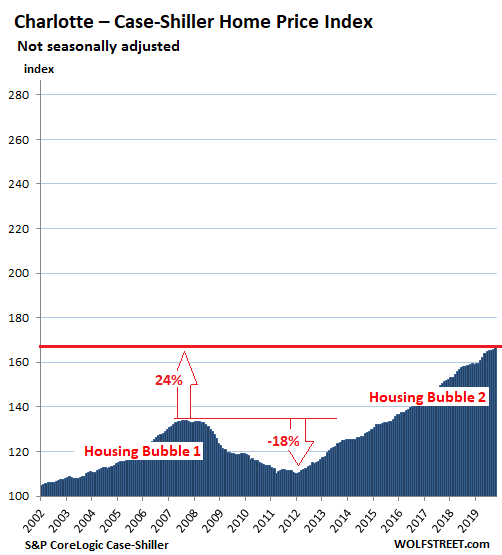
Prices fall year-over-year in San Francisco Bay Area New York condo market. Seattle below June 2018. Chicago nearly flat year-over-year. Other markets lose steam. Phoenix, Tampa, Charlotte surge.

By Wolf Richter for WOLF STREET.

Powered by the innumerable millionaires and multimillionaires that the mega IPOs would be suddenly printing in 2019, home prices in the San Francisco Bay Area would be doomed to surge this year, thus exacerbating the “housing crisis,” as it’s called locally, even further, the media have promised us incessantly earlier this year, having fallen once again for real estate industry hype. Now we got another data point that demolishes this myth.

San Francisco Bay Area House Prices

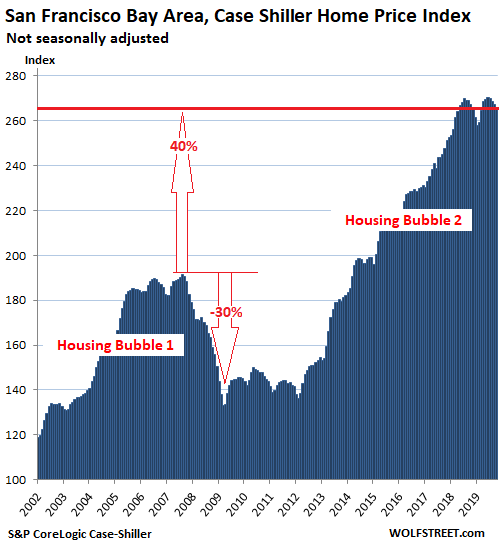
Prices of single-family houses in the five-county San Francisco Bay Area – the counties of San Francisco, San Mateo (northern part of Silicon Valley), Alameda and Contra Costa (East Bay), and Marin (North Bay) – fell 0.4% in October from September and were down 0.4% from the same month a year ago, and were down 1.5% from the peak in June, according to the SP CoreLogic Case-Shiller Home Price Index released on December 31. This put the index back where it had first been in May 2018. Note the double peak in 2018-2019, and note a similar double-peak in 2006-2008:

1e680 US Housing Case Shiller San Francisco Bay Area 2019 12 31 The Most Splendid Housing Bubbles in America, Dec. Update

The Case-Shiller Index is a rolling three-month average. This release includes closings that were entered into public records in August, September, and October. The index was set at 100 for January 2000. San Francisco’s index value of 266 means prices in the metro have soared 166% since January 2000.

New York Condo Prices:

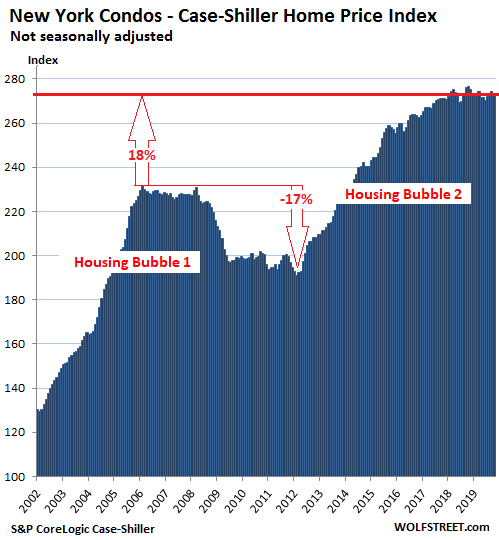
Condo prices in the vast New York City metro ticked down 0.3% in October from September and were down 1.3% from a year ago, and below where they’d first been in February 2018, and were up only 0.7% from October two years ago.

The Case-Shiller Index, which mostly uses standard Metropolitan Statistical Areas for its city indices, uses a custom area for New York City that includes numerous counties in the states of New York, New Jersey, and Connecticut “with significant populations that commonly commute to New York City for employment purposes.”

1e680 US Housing Case Shiller New York condos 2019 12 31 The Most Splendid Housing Bubbles in America, Dec. Update

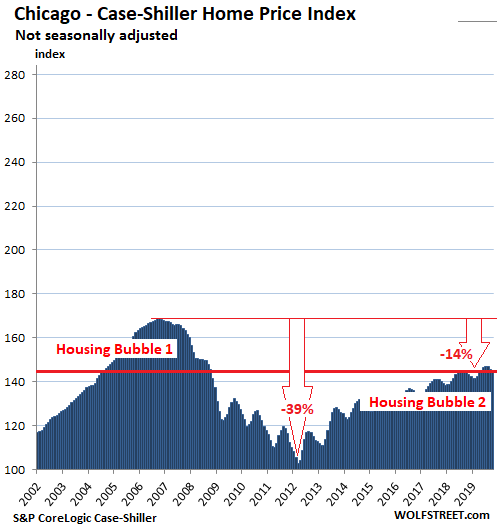
All charts in this series are on the same scale, with the vertical axis going from 100 to 290, which has the effect that there is more white space above the curve in markets where house prices have not soared as much as they have in Los Angeles, San Francisco, Seattle, or Miami. These charts show that there is no “national” housing market and no “national” housing bubble, and that all markets are local, with different dynamics, price levels, and price changes, and that the bubbles, where they exist, are local too.

The Case-Shiller Index methodology is based on “sales pairs,” comparing the sales price of a house that sold in the current month to the price of the same house when it sold previously. This method avoids some of the problems other indices have, such as “median price” indices, which are skewed by “mix”; and “average price” indices, which are skewed by a few big outliers.

Seattle House Prices:

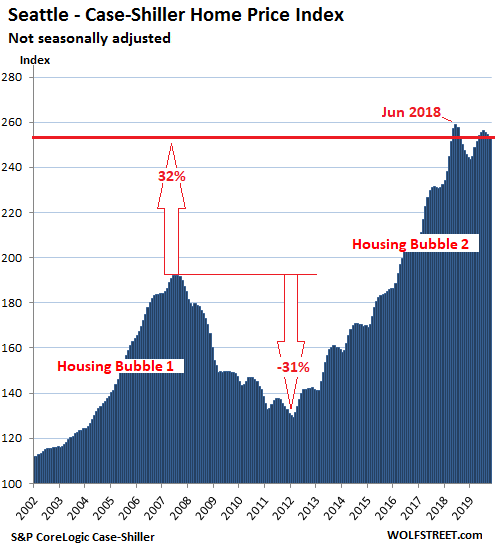
House prices in the Seattle metro declined 0.3% in October from September, and where down 2.0% from the peak in June 2018. This put them below where they’d first been in May 2018. In a testament to how steep the declines were last year from August through December, and that were followed by a bounce, the index in October 2019 was up 2.5% from a year ago. Note the double peak, with the lower high in June and July 2019:

14866 US Housing Case Shiller Seattle 2019 12 31 The Most Splendid Housing Bubbles in America, Dec. Update

Los Angeles House Prices:

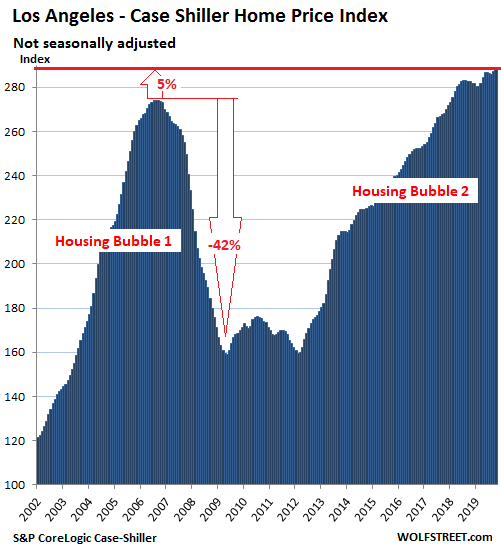
The Los Angeles metro is now the US market where house prices, according to the Case-Shiller Index, have risen the most since January 2000: With the index at 288, house prices are now 188% higher than they were in January 2000. In October, the index rose 0.4% from September and was up 2.0% year-over-year:

14866 US Housing Case Shiller Los Angeles 2019 12 31 The Most Splendid Housing Bubbles in America, Dec. Update

San Diego House Prices:

House prices in the San Diego metro edged down 0.2% in October from September and were essentially flat for the past five months. They’re up 2.9% year-over-year:

14866 US Housing Case Shiller San Diego 2019 12 31 The Most Splendid Housing Bubbles in America, Dec. Update

Portland House Prices:

House prices in the Portland metro fell 0.5% in October from September but were up 2.7% year-over-year. The index has been essentially flat for the past five months. At 240, the index is up 140% from January 2000:

ca0a9 US Housing Case Shiller Portland 2019 12 31 The Most Splendid Housing Bubbles in America, Dec. Update

Miami House Prices:

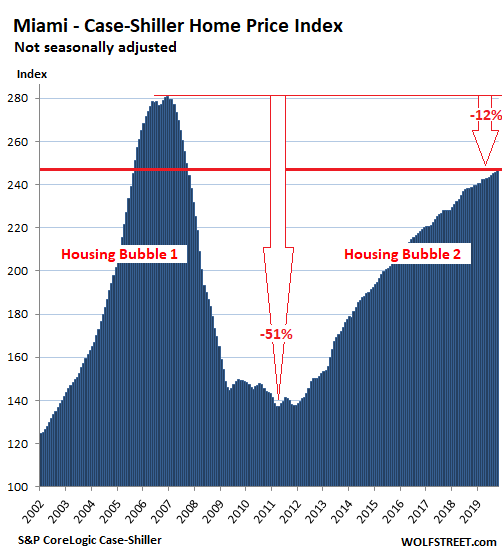
The Case-Shiller index for the Miami metro rose 0.3% in October from September and 3.3% year-over-year, but remains down 12% from the most splendid craziness at the end of 2006:

ca0a9 US Housing Case Shiller Miami 2019 12 31 The Most Splendid Housing Bubbles in America, Dec. Update

Tampa House Prices:

House prices in the Tampa metro rose 0.6% in October from September and were up 4.9% year-over-year, the second largest year-over-year increase of the metros in this series, behind Phoenix (+5.9%). The index is closing in on the craziness in 2006:

ca0a9 US Housing Case Shiller Tampa 2019 12 31 The Most Splendid Housing Bubbles in America, Dec. Update

Denver House Prices:

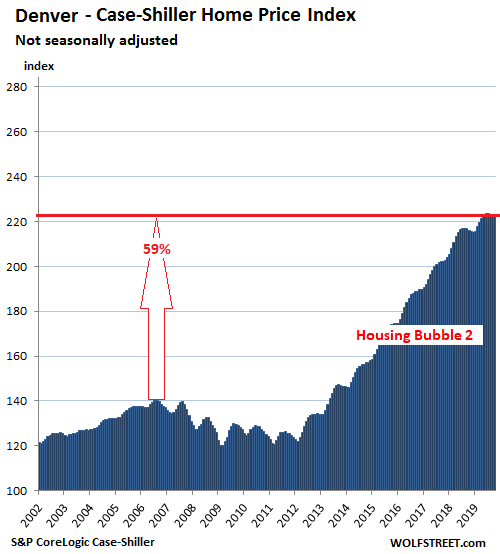
House prices in the Denver metro remained essentially flat in October for the fifth month in a row (down a smidgen from June), but were up 3.0% year-over-year:

49e4b US Housing Case Shiller Denver 2019 12 31 The Most Splendid Housing Bubbles in America, Dec. Update

Las Vegas House Prices:

The Case-Shiller index for the Las Vegas metro ticked down in October from September and was roughly flat for the past four months. This whittled down the year-over-year gain to 2.3%, the smallest such gain since August 2012, when prices began to emerge from the collapse. House prices have skyrocketed 118% since March 2012:

49e4b US Housing Case Shiller Las Vegas 2019 12 31 b The Most Splendid Housing Bubbles in America, Dec. Update

Phoenix House Prices:

House prices in the Phoenix metro rose 0.5% in October from September and were up 5.8% from October last year, the fastest year-over-year growth among the metros. And it’s closing in on the craziness of 2006. House price have nearly doubled in the eight years since September 2011:

49e4b US Housing Case Shiller Phoenix 2019 12 31 b The Most Splendid Housing Bubbles in America, Dec. Update

Boston House Prices:

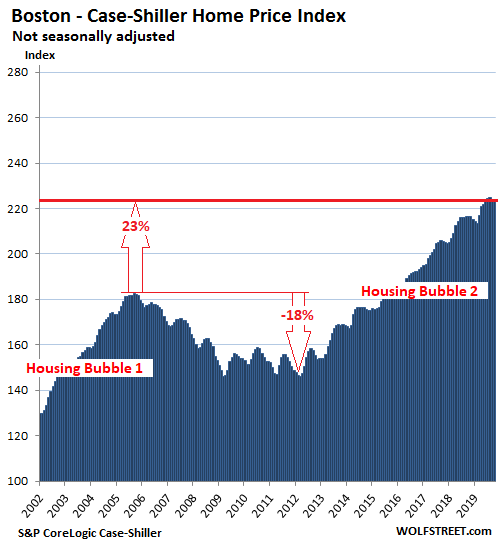
House prices in the Boston metro were flat in October compared to September, and were down a tad from June, which trimmed their year-over-year gain to 3.4%:

146f6 US Housing Case Shiller Boston 2019 12 31 The Most Splendid Housing Bubbles in America, Dec. Update

Washington DC:

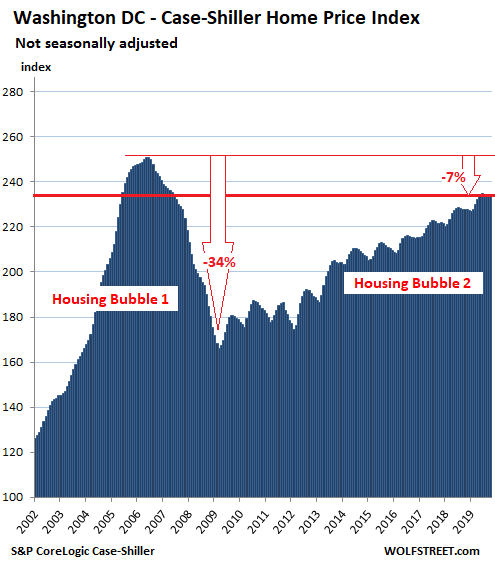
House prices in the Washington D.C. metro ticked up 0.3% in October from September and were essentially flat for the past five months, but were up 3.0% year-over-year:

d27a8 US Housing Case Shiller Wash DC 2019 12 31 The Most Splendid Housing Bubbles in America, Dec. Update

Dallas-Fort Worth House Prices:

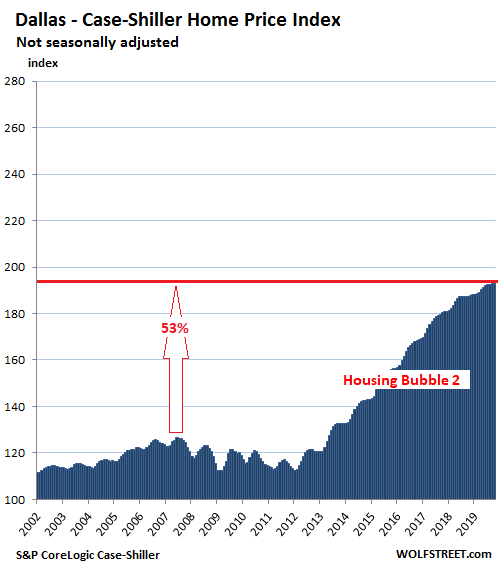
In the Dallas-Fort Worth metro – counties of Collin, Dallas, Delta, Denton, Ellis, Hunt, Johnson, Kaufman, Parker, Rockwall, Tarrant, and Wise – house prices ticked down a smidgen in October from September, and have been about flat for the last four months. This whittled down the year-over-year gain to 2.9%:

d27a8 US Housing 2Case Shiller dallas 2019 12 31 The Most Splendid Housing Bubbles in America, Dec. Update

Minneapolis house prices:

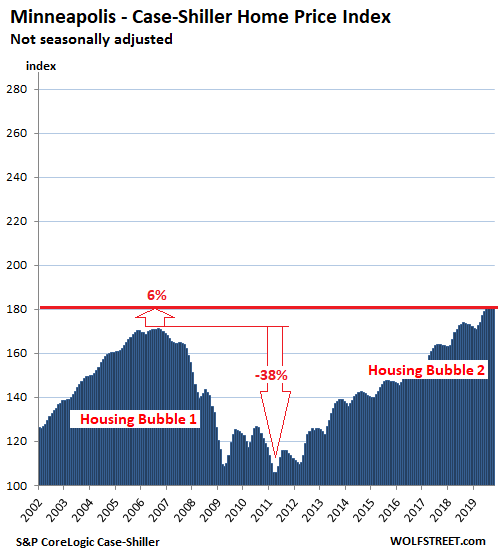
In the Minneapolis metro, house prices dipped 0.2% in October from September and have been flat for the past four months. On a year-over-year basis, prices rose 4.2%:

2eec5 US Housing 2Case Shiller Minneapolis 2019 12 31 The Most Splendid Housing Bubbles in America, Dec. Update

Charlotte house prices:

House prices in the Charlotte metro rose 0.4% in October from September, which increased their year-over-year gain to 4.8%, the third highest gain on this splendid list, behind Phoenix and Tampa:

2eec5 US Housing 2Case Shiller Charlotte 2019 12 31 The Most Splendid Housing Bubbles in America, Dec. Update

Chicago House Prices:

In the Chicago metro – the counties of Cook, DeKalb, Du Page, Grundy, Kane, Kendal, McHenry, and Will – house prices fell 0.4% in October from September, whittling down the year-over-year gain to just 0.5%:

2eec5 US Housing 2Case Shiller Chicago 2019 12 31 1 The Most Splendid Housing Bubbles in America, Dec. Update

Atlanta house prices:

The Case-Shiller Index for the Atlanta metro jumped 0.7% in October from September and rose 4.1% year-over-year. Note that during Housing Bust 1, the index had plunged 40% to a value of 82.5 in March 2012, back where it had been in 1996, but in the 7.5 years since then, it has surged 87%, including at year-over-year rates ranging from 10% to 20% in all of 2013 and through mid-2014:

d0b23 US Housing 2Case Shiller Atlanta 2019 12 31 The Most Splendid Housing Bubbles in America, Dec. Update

This is house price inflation.

The Case-Shiller Index, by comparing the sales price of a house in the current month to the price of the same house when it sold previously, tracks how many more dollars it takes to buy the same house over time, thus tracking the purchasing power of the dollar with regards to houses in various markets. This makes the index a measure of local “house-price inflation.” When the index shows that prices in Los Angeles shot up 188% in 19 years, despite the plunge in the middle, it doesn’t mean that houses have nearly tripled in size or opulence, but that in that metro, the dollar’s purchasing power with regards to houses has gotten crushed.

Enjoy reading WOLF STREET and want to support it? Using ad blockers – I totally get why – but want to support the site? You can donate. I appreciate it immensely. Click on the beer and iced-tea mug to find out how:

d0b23 BeerMug2 The Most Splendid Housing Bubbles in America, Dec. Update

Would you like to be notified via email when WOLF STREET publishes a new article? Sign up here.


Article source: https://wolfstreet.com/2020/01/01/the-most-splendid-housing-bubbles-in-america-december-update/

Posted in SF Bay Area News | Tagged | Leave a comment

SF Real Estate Developer Sentenced for Illegally Funneling Campaign Donations

A 74-year-old real estate developer from Fremont who
funneled large amounts of his own money through front donors into two campaigns
for a member of the U.S. House of Representatives was sentenced to 15 months in
prison Friday by a federal jury in San Francisco.

Evidence was presented that James Tong made donations
totaling $38,000 through intermediaries in 2012 and 2013 to the congressional candidate
for initial and reelection campaign.

“Tong provided envelopes of cash to his bank manager and another business associate and directed them to give the cash to individuals in the community, who then used Tong’s cash to write checks in their own names to the campaign for the U.S. congressional candidate Tong was supporting,” the United States Attorney David Anderson said in a news release.

Local


05d43 BillWalsh49ers SF Real Estate Developer Sentenced for Illegally Funneling Campaign Donations


05d43 gilroy strong SF Real Estate Developer Sentenced for Illegally Funneling Campaign Donations

“Tong leveraged financial obligations and the implied
loss of business opportunities to induce his bank manager and business
associate to distribute cash in the community to be donated.”

Dozens of conduits were involved in funneling the funds to
the candidate, including one foreign national ineligible to make donations to federal
elections, Anderson said.

“Tong also directed his middlemen to conceal the scheme
by instructing the straw donors not to deposit the cash; and he later directed one
of the middlemen to withhold information from the FBI after he was interviewed,”
Anderson said.

U.S. District Judge Jon Tigar also sentenced Tong to one
year of supervised release and a $380,000 fine.

Article source: https://www.nbcbayarea.com/news/local/san-francisco/sf-real-estate-developer-sentenced-for-illegally-funneling-campaign-donations/2220778/

Posted in SF Bay Area News | Tagged | Leave a comment

More people want to move to San Francisco

While SF remains ever-growing, we’ve also been inundated with polling data suggesting that denizens yearn to leave, making SF simultaneously one of the most popular unpopular cities in America.

Recently the city had more outmigration than in—that is to say, more people moved out of SF to other cities than vice versa. The population still increased, but it was mostly due to other factors, like the local birthrate.

Indeed, the “outmigration” stats have been the go-to for SF doomsayers for quit sometime. That’s what makes recent findings by San Francisco-based rental site Apartment List so interesting; for the first time in a long time, data shows more people interested in moving to the Bay Area.

In the newly published migration report, SF came in fifth place for cities that outsiders are eyeing, with 42 percent of home searches in the area coming from other cities.

But San Francisco landed in seventh place for locales people want to leave, with 38 percent of apartment shoppers in SF searching for homes elsewhere.

Note that “all results are aggregated at the metro level,” so the San Francisco designation includes a significant part of the East Bay and Peninsula as well—which is a good thing in this case, because it minimizes distortion created by people considering moves out of SF to nearby Bay Area locales instead.

Lots of home and apartment sites attempt similar “migration reports,” and while they’re an interesting statistic, they’re also limited in scope, being as they only reflect the users on that site.

Still, this one stands out compared to, say, real estate site Redfin, which has told us every couple of months for years now that, according to their metrics, more site users want to leave the Bay Area.

That trend continues in Redfin’s most recent report, which puts SF in second place for “outflow.”

So what does all of this data mean for the average person? Well, if Apartment List is right and more renters were at least hypothetically interested in moving here last year, then despite population growth tapering off in recent years, the city may keep growing.

And if the competing perspective of Redfin is right, then the city will probably still keep growing, because they’ve been saying the same thing for years.

Bottom line, we can’t sit around and hope that interest in San Francisco will wane enough to solve our problems: housing, traffic, transit crowding, rent prices, market competition, and even more mundane concerns like long lines in public are not going to disappear via urban flight.

Keep watching the indicators, sure. But in the meantime, the city has to work for active solutions.

Article source: https://sf.curbed.com/2020/1/22/21076938/people-moving-to-san-francisco-apartmentlist-migration-report

Posted in SF Bay Area News | Tagged | Leave a comment

There are an estimated 46,000 vacant homes in the Bay Area, but why? – KGO

SAN FRANCISCO (KGO) — Is too much money harming the Bay Area? According to the latest U.S Census Bureau, there are 46,000 vacant homes in our region and some landlords want to keep them that way.

“Generated by success in large part and our inability to accommodate that success and accommodate the growth that we’ve had in our economy. That’s the basic problem we’re experiencing,” said Matt Regan, Senior Vice-president of Public Policy for the Bay Area Council.

A problem that according to the Bay Area Council has several protagonists.

RELATED: Leaving California: Former residents tell us the good and the bad after they left the Golden State

“Many landlords have their units off the market currently trying to figure out what’s going to happen in the rental market going forward,” said Regan.

With more Tech companies approaching IPO’s there’s also this, “Is it also greed? Well, it’s a market like any other and you will get individuals who are greedy. It’s human nature, but I think we’ve created an imbalance in the market that encourages greed, “added Regan.

According to the U.S, Census Bureau San Francisco has the most vacant homes with 11,760, followed by Oakland with 5,898, San Jose 3,985, Berkeley 1,738 and Richmond 1,560.

Let’s move over to the East Bay where there are close to 8,000 vacancies according to the census.

RELATED: Developer wants to build 65 affordable housing units underground in San Francisco

Nancie Allen with the Bay East Association of Realtors says these numbers are driven by buyers having a hard time obtaining building or remodeling permits.

“What we see in our area is just because the buyers are making it their own and not moved in. We’ve seen them take up to a year sometimes,” said Allen.

Online real estate Database Company, Zillow has data that shows a low inventory of homes for sale right now.

In the San Francisco Metro Area, there are a little over 7,000 homes on the market, San Jose in the 2,000 range. But they have a different explanation as to why this number of vacancies:

“Constructed and they are not occupied yet. So, a chunk of those will be there. We know there isn’t a ton of supply that is coming in now. We also know that some homes are not ready to be sold,” said Zillow’s Senior Economist, Cheryl Young.

Article source: https://abc7news.com/realestate/there-are-an-estimated-46000-vacant-homes-in-the-bay-area-but-why/5820129/

Posted in SF Bay Area News | Tagged | Leave a comment