Coronavirus slows, but doesn’t stop Bay Area real estate agents

Realtor Alan Wang sat on the sidelines for two weeks.

The government had called his work nonessential, the grand opening of his Santa Clara office was scotched by a shelter-in-place order, and he spent more time with his children’s homework than selling homes.

The veteran Silicon Valley agent just earned a work-release, of sorts. The government lock-down on real estate sales loosened last week — agents and other professionals now were deemed essential workers, although some had continued to show homes during shelter-in-place restrictions. New strict Bay Area guidelines still ban open houses and close contact.

Bay Area agents, inspectors and homebuyers waiting for the green light accelerated swiftly back into action. Wang escorted a young couple around an immaculate Eichler for sale in Foster City — four bedrooms, 1,700 square feet and $1.6 million of sweetness.

The only thing missing was a handshake. But despite the rubber gloves, paper masks and social-distancing dances from room to room, the deal seemed near.

“Scale of 1 to 10,” Wang asked his clients, “what do you give it?”

The couple, Nicole Huang and Steve Young, gave it close to a perfect 10. “If this was three weeks ago, we would have been fighting for this place,” Huang said. “It’s an opportunity.”

Even though restrictions were loosened, agents were given plenty of caveats:  no flyers, appointments only, no more than two family members in a house. Once inside, social distancing mandates apply. Homes must be unoccupied by sellers.

“Virtual showings are highly encouraged,” advised public health officials in Santa Clara and San Mateo counties.

But in the touchy-feely world of residential real estate, pictures and videos can only carry a buyer’s imagination, heart and checkbook so far. Agents are driving back into the neighborhoods with gloves, masks and as much hand sanitizer as they can get.

The $445 billion residential and commercial real estate industry in California has been a vital fuel in the state’s economy. Sky-high prices for Bay Area homes have made multimillionaires out of long-time homeowners and long-time renters out of would-be owners.

The regional housing market had begun to rebound in the first two months of the year, with solid gains in median home prices and strong buyer demand after a flattening of prices in 2019. But the lockdowns, stock market turmoil and long-term uncertainty caused by the pandemic have slowed Bay Area listings and sales.

Bay Area transactions in March and April tumbled from the same time last year, and buyers and sellers backed out of more deals, according to MLSListings data from the counties of San Mateo, Santa Clara, Santa Cruz, San Benito and Monterey. It’s still unclear what restrictions apply to people who want to move.

The number of home sales in escrow that fell through increased by 50 percent from the same time last year. Twice as many sellers pulled their properties from the market in the past two months compared with last year. The total number of home sales fell 9 percent, according to an analysis by MLSListings done for this news organization.

The initial shelter-in-place guidelines — loosely enforced and largely self-regulating — were ignored by some agents seeing loopholes and looking to please clients. Some continued to advertise open houses and broker tours until MLSListings disabled the feature March 21 on its database.

2ff18 SJM L REALTOR 0405 90 01 Coronavirus slows, but doesn’t stop Bay Area real estate agentsThe pressure to hit sales goals, satisfy clients and score deals kept many agents busy despite concerns about the coronavirus.

Will Doerlich, a San Ramon agent with Realty One Group, said showings have slowed down dramatically during the lockdown, but he opened a few vacant houses to insistent clients. He pulled on a pair of gloves and a mask, unlocked the door and let the buyers tour the property themselves.

“When it comes down to it, it’s the client’s decision,” he said. “If they have a pressing need, you have to respect that.”

Another couple Doerlich was helping bid on a house they saw just before the lockdown, he said. They thought they would have one of the only offers. But about 10 other bids came in — with many shoppers likely seeing the home during the black-out period, he said.

Wang said a client called to set up a home tour shortly after the shelter-in-place order came down. Wang apologized, saying they could make the tour only after the county loosened restrictions. Last week, Wang called the client back — but he had already visited the home with another agent.

“Some agents have been following the rules,” Wang said. “Some have not.”

CAR has urged members to follow local rules, but some remain confused about the policies, said Dave Walsh, a San Jose agent and president-elect of the Realtors group. Lenders, escrow agents and some county clerk offices remained open during the shelter-in-place, while other parts of the home-selling business were closed.

“It’s clearly in the code of ethics that you obey the law,” Walsh said. The association has daily updates and video-conferencing to answer questions, and share tips for safe, private showings.

In curbing the pandemic’s spread, he added, agents “need to play our role.”

Vanessa Bergmark, owner of Red Oak Realty in the East Bay, pulled her agents from the field, although she knows some of her competitors did not. “I don’t point fingers,” she said. “It’s just disappointing behavior.”

Red Oak agents now are back, cautiously. Bergmark and her team pulled together a work plan to safely negotiate the complexities of photographing, marketing, showing, financing, inspecting, closing and cleaning a property during the pandemic.

“There’s still, frankly, a lot confusion about what can be done and what can’t be done,” said Bergmark, who has sold in the East Bay for two decades.

One type of home remained appealing — fixer-uppers. Home flippers have been submitting low-ball offers on dilapidated houses, sight unseen. Agents say investors need mainly to study the numbers — comparable sales and asking prices — to make a decision.

Brian Schwatka with Keller Williams in Los Gatos has been trying to sell a client’s fixer-upper electronically for almost a month. The only face-to-face contact needed is between a notary and an agent for the buyer — held outdoors at an appropriate distance, he said.

The seller accepted four offers, only to have every deal canceled the following day. He’s optimistic he can close on a fifth offer next week. “It’s almost a miracle when you get things through,” Schwatka said. “If you’re not selling a vacant house, then you’re not selling a house.”

Alan Wang was ready when the panoply of government offices released Realtors back into the world.

Wang met Young, general manager and partner in the Ramen Nagi restaurants, and his partner, Nicole Huang, Thursday morning in a suburban neighborhood six blocks from the bay. Wang provided masks, rubber gloves and sanitizer for the visitors.

The couple had been searching aggressively in January and February but took a break during the shelter-in-place. They are expecting a child in July and would like to have a new home to move into.

The Foster City home looked promising — remodeled, well-staged, lots of light, and in a good school district.

Wang believed it was a good time to put in an offer. Huang and Young said they would talk it over with family.

Within a day, nearly a dozen other buyers had shown serious interest. Wang expected several to make bids.


Article source: https://www.mercurynews.com/coronavirus-slows-but-doesnt-stop-bay-area-real-estate-agents
Posted in SF Bay Area News | Tagged | Leave a comment

San Francisco County real estate most hard hit due to the coronavirus


  • 645d9 920x920 San Francisco County real estate most hard hit due to the coronavirus

    Of the Bay Area counties, San Francisco County “has seen the greatest impact of the crisis,” said Patrick Carlisle, Compass Realty’s Chief Market Analyst.

    Of the Bay Area counties, San Francisco County “has seen the greatest impact of the crisis,” said Patrick Carlisle, Compass Realty’s Chief Market Analyst.


    Photo: Patrick Carlisle | Compass

Caption

Close

Of the Bay Area counties, San Francisco County “has seen the greatest impact of the crisis,” said Patrick Carlisle, Compass Realty’s Chief Market Analyst.

Of the Bay Area counties, San Francisco County “has seen the greatest impact of the crisis,” said Patrick Carlisle, Compass Realty’s Chief Market Analyst.


Photo: Patrick Carlisle | Compass


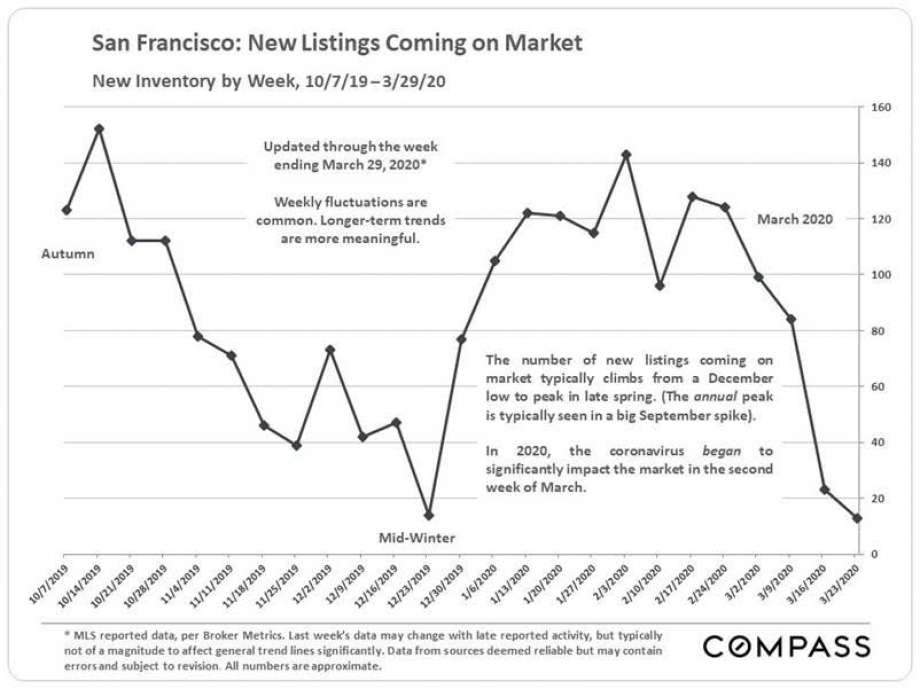
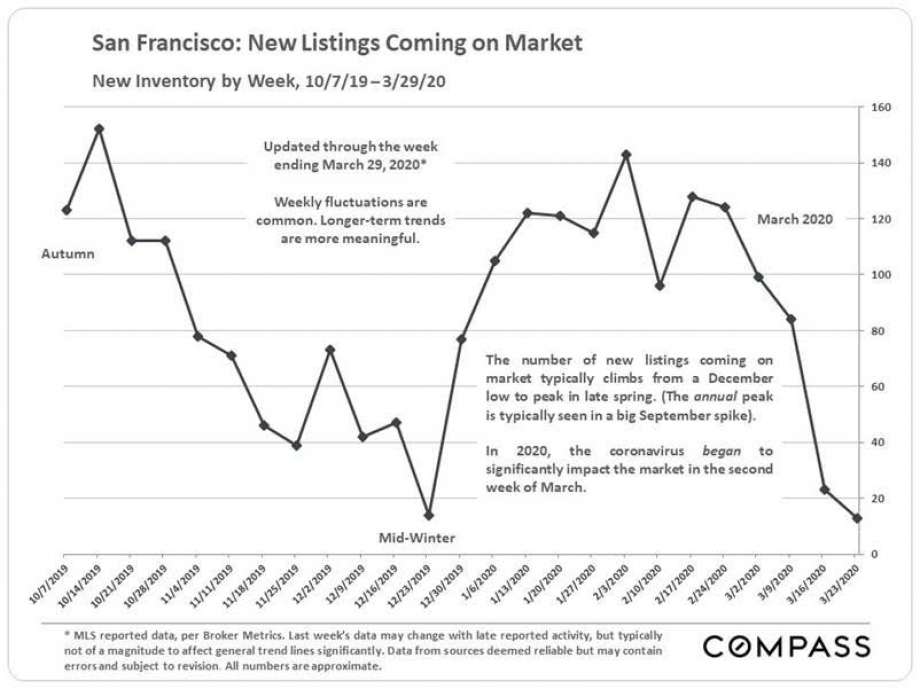
Historically, the spring selling season in San Francisco is the most active of the year, with new listings, sales and market prices all climbing steadily out of the mid-winter slowdown. But today, the coronavirus has changed all that, altering the typical San Francisco housing market in the same way it has altered so many other aspects of our lives.

Of the Bay Area counties, San Francisco County “has seen the greatest impact of the crisis,” said Patrick Carlisle, Compass Realty’s chief market analyst. While it’s too soon to chart a change in sales prices, the striking shortage of new listings (less than 20 by the second week of March) is telling, as is the sharp decline in accepted offers.


(This data is depicted in many Compass infographics in the gallery above.)


There was also a huge spike in withdrawn listings, further limiting the number of active listings, which according to Carlisle’s records was only 550 the third week of March. The luxury market (homes listing at over $2.5 million) shows particular shrinkage, with less than 145 active listings in that price range during the same period.


According to San Francisco Bay Area Realtor Robert Collett, “The virus is impacting the market logistically and financially in the short-term. Open houses are halted, down payments have slimmed, and virtual media is king. Serious buyers can evaluate properties online and offer subject to evaluating further during escrow. Buyers are interested in deals, but sellers have not changed price expectations, because inventory remains scarce. Long-term, residential real estate should hold firm, because homes and self-sufficiency remain essential.”


It’s early to be making any conjecture. Due to the lag time between offers being accepted and sales closing escrow – typically three to five weeks — it is too soon for sales volumes (or sales prices) to reflect any significant impact of the virus. “April sales statistics will begin to give us insight into how and whether median home sales prices will change,” Carlisle said.

Since the subprime crisis is the last time San Francisco experienced a real slump, we asked Carlisle to compare the two catastrophes. “The 2005-2007 bubble was fueled by tens of millions of people buying and refinancing homes with loans they couldn’t afford, loading households with exorbitant debt promoted by predatory lending practices.


“Today, due to huge improvement in underwriting standards and close to historically low interest rates, U.S. homeowners pay less for their mortgage debt as a percentage of their disposable income than at any time in the past 40 years (see chart in gallery above). So, while overall household debt levels – cars, credit cards, student debt, etc. – have been growing dangerously high in recent years, mortgage debt levels are actually in good shape.”

Carlisle stressed that the rental market would shift more quickly than the real estate market since the combination of shelter-in-place regulations and job loss would hit tenants and would-be tenants hard, and federal interventions like low interest rates do nothing to help renters.

We’ve seen that the rental market so far was taking a hit.

Before the coronavirus, the bullish economy showed an equally bullish real estate market across the country. Nationally, home prices rose 3.9% annually, up from 3.7% in December, according to the SP CoreLogic Case-Shiller Indices.

The 10-City Composite showed an increase of 2.62%, up from 2.3% in December.  Those 10 metro areas include San Francisco, Washington D.C., New York City, Miami, Boston, Denver, Los Angeles, Denver, Las Vegas and San Diego.

Cities that have been hard hit by the virus were enjoying huge year-over-year gains. In January, prices in Phoenix, Ariz., were up 6.9% year-over-year, while Seattle and Tampa, Fla., each saw prices up 5.1%. Locally, virtually every county in the Bay Area saw year-over-year first-quarter increases in median sales prices.

All of this growth came to a skidding halt in March, including in San Francisco, where usually at this time, the market would be heading steadily up. “If unemployment gets as deep as some people are predicting, if it gets to the mid-teens, then it could be far deeper than the subprime crisis,” said Sanjiv Das, CEO of Caliber Home Loans.

Anna Marie Erwert writes from both the renter and new buyer perspective, having (finally) achieved both statuses. She focuses on national real estate trends, specializing in the San Francisco Bay Area and Pacific Northwest. Follow Anna on Twitter: @AnnaMarieErwert. 

Article source: https://www.sfgate.com/realestate/article/coronavirus-hurts-San-Francisco-real-estate-market-15178318.php

Posted in SF Bay Area News | Tagged | Leave a comment

San Francisco County real estate most hard hit due to the coronavirus


  • 645d9 920x920 San Francisco County real estate most hard hit due to the coronavirus

    Of the Bay Area counties, San Francisco County “has seen the greatest impact of the crisis,” said Patrick Carlisle, Compass Realty’s Chief Market Analyst.

    Of the Bay Area counties, San Francisco County “has seen the greatest impact of the crisis,” said Patrick Carlisle, Compass Realty’s Chief Market Analyst.


    Photo: Patrick Carlisle | Compass

Caption

Close

Of the Bay Area counties, San Francisco County “has seen the greatest impact of the crisis,” said Patrick Carlisle, Compass Realty’s Chief Market Analyst.

Of the Bay Area counties, San Francisco County “has seen the greatest impact of the crisis,” said Patrick Carlisle, Compass Realty’s Chief Market Analyst.


Photo: Patrick Carlisle | Compass


Historically, the spring selling season in San Francisco is the most active of the year, with new listings, sales and market prices all climbing steadily out of the mid-winter slowdown. But today, the coronavirus has changed all that, altering the typical San Francisco housing market in the same way it has altered so many other aspects of our lives.

Of the Bay Area counties, San Francisco County “has seen the greatest impact of the crisis,” said Patrick Carlisle, Compass Realty’s chief market analyst. While it’s too soon to chart a change in sales prices, the striking shortage of new listings (less than 20 by the second week of March) is telling, as is the sharp decline in accepted offers.


(This data is depicted in many Compass infographics in the gallery above.)


There was also a huge spike in withdrawn listings, further limiting the number of active listings, which according to Carlisle’s records was only 550 the third week of March. The luxury market (homes listing at over $2.5 million) shows particular shrinkage, with less than 145 active listings in that price range during the same period.


According to San Francisco Bay Area Realtor Robert Collett, “The virus is impacting the market logistically and financially in the short-term. Open houses are halted, down payments have slimmed, and virtual media is king. Serious buyers can evaluate properties online and offer subject to evaluating further during escrow. Buyers are interested in deals, but sellers have not changed price expectations, because inventory remains scarce. Long-term, residential real estate should hold firm, because homes and self-sufficiency remain essential.”


It’s early to be making any conjecture. Due to the lag time between offers being accepted and sales closing escrow – typically three to five weeks — it is too soon for sales volumes (or sales prices) to reflect any significant impact of the virus. “April sales statistics will begin to give us insight into how and whether median home sales prices will change,” Carlisle said.

Since the subprime crisis is the last time San Francisco experienced a real slump, we asked Carlisle to compare the two catastrophes. “The 2005-2007 bubble was fueled by tens of millions of people buying and refinancing homes with loans they couldn’t afford, loading households with exorbitant debt promoted by predatory lending practices.


“Today, due to huge improvement in underwriting standards and close to historically low interest rates, U.S. homeowners pay less for their mortgage debt as a percentage of their disposable income than at any time in the past 40 years (see chart in gallery above). So, while overall household debt levels – cars, credit cards, student debt, etc. – have been growing dangerously high in recent years, mortgage debt levels are actually in good shape.”

Carlisle stressed that the rental market would shift more quickly than the real estate market since the combination of shelter-in-place regulations and job loss would hit tenants and would-be tenants hard, and federal interventions like low interest rates do nothing to help renters.

We’ve seen that the rental market so far was taking a hit.

Before the coronavirus, the bullish economy showed an equally bullish real estate market across the country. Nationally, home prices rose 3.9% annually, up from 3.7% in December, according to the SP CoreLogic Case-Shiller Indices.

The 10-City Composite showed an increase of 2.62%, up from 2.3% in December.  Those 10 metro areas include San Francisco, Washington D.C., New York City, Miami, Boston, Denver, Los Angeles, Denver, Las Vegas and San Diego.

Cities that have been hard hit by the virus were enjoying huge year-over-year gains. In January, prices in Phoenix, Ariz., were up 6.9% year-over-year, while Seattle and Tampa, Fla., each saw prices up 5.1%. Locally, virtually every county in the Bay Area saw year-over-year first-quarter increases in median sales prices.

All of this growth came to a skidding halt in March, including in San Francisco, where usually at this time, the market would be heading steadily up. “If unemployment gets as deep as some people are predicting, if it gets to the mid-teens, then it could be far deeper than the subprime crisis,” said Sanjiv Das, CEO of Caliber Home Loans.

Anna Marie Erwert writes from both the renter and new buyer perspective, having (finally) achieved both statuses. She focuses on national real estate trends, specializing in the San Francisco Bay Area and Pacific Northwest. Follow Anna on Twitter: @AnnaMarieErwert. 

Article source: https://www.sfgate.com/realestate/article/coronavirus-hurts-San-Francisco-real-estate-market-15178318.php

Posted in SF Bay Area News | Tagged | Leave a comment

San Francisco County real estate most hard hit due to the coronavirus


  • 6f8a6 920x920 San Francisco County real estate most hard hit due to the coronavirus

    Of the Bay Area counties, San Francisco County “has seen the greatest impact of the crisis,” said Patrick Carlisle, Compass Realty’s Chief Market Analyst.

    Of the Bay Area counties, San Francisco County “has seen the greatest impact of the crisis,” said Patrick Carlisle, Compass Realty’s Chief Market Analyst.


    Photo: Patrick Carlisle | Compass

Caption

Close

Of the Bay Area counties, San Francisco County “has seen the greatest impact of the crisis,” said Patrick Carlisle, Compass Realty’s Chief Market Analyst.

Of the Bay Area counties, San Francisco County “has seen the greatest impact of the crisis,” said Patrick Carlisle, Compass Realty’s Chief Market Analyst.


Photo: Patrick Carlisle | Compass


Historically, the spring selling season in San Francisco is the most active of the year, with new listings, sales and market prices all climbing steadily out of the mid-winter slowdown. But today, the coronavirus has changed all that, altering the typical San Francisco housing market in the same way it has altered so many other aspects of our lives.

Of the Bay Area counties, San Francisco County “has seen the greatest impact of the crisis,” said Patrick Carlisle, Compass Realty’s chief market analyst. While it’s too soon to chart a change in sales prices, the striking shortage of new listings (less than 20 by the second week of March) is telling, as is the sharp decline in accepted offers.


(This data is depicted in many Compass infographics in the gallery above.)


There was also a huge spike in withdrawn listings, further limiting the number of active listings, which according to Carlisle’s records was only 550 the third week of March. The luxury market (homes listing at over $2.5 million) shows particular shrinkage, with less than 145 active listings in that price range during the same period.


According to San Francisco Bay Area Realtor Robert Collett, “The virus is impacting the market logistically and financially in the short-term. Open houses are halted, down payments have slimmed, and virtual media is king. Serious buyers can evaluate properties online and offer subject to evaluating further during escrow. Buyers are interested in deals, but sellers have not changed price expectations, because inventory remains scarce. Long-term, residential real estate should hold firm, because homes and self-sufficiency remain essential.”


It’s early to be making any conjecture. Due to the lag time between offers being accepted and sales closing escrow – typically three to five weeks — it is too soon for sales volumes (or sales prices) to reflect any significant impact of the virus. “April sales statistics will begin to give us insight into how and whether median home sales prices will change,” Carlisle said.

Since the subprime crisis is the last time San Francisco experienced a real slump, we asked Carlisle to compare the two catastrophes. “The 2005-2007 bubble was fueled by tens of millions of people buying and refinancing homes with loans they couldn’t afford, loading households with exorbitant debt promoted by predatory lending practices.


“Today, due to huge improvement in underwriting standards and close to historically low interest rates, U.S. homeowners pay less for their mortgage debt as a percentage of their disposable income than at any time in the past 40 years (see chart in gallery above). So, while overall household debt levels – cars, credit cards, student debt, etc. – have been growing dangerously high in recent years, mortgage debt levels are actually in good shape.”

Carlisle stressed that the rental market would shift more quickly than the real estate market since the combination of shelter-in-place regulations and job loss would hit tenants and would-be tenants hard, and federal interventions like low interest rates do nothing to help renters.

We’ve seen that the rental market so far was taking a hit.

Before the coronavirus, the bullish economy showed an equally bullish real estate market across the country. Nationally, home prices rose 3.9% annually, up from 3.7% in December, according to the SP CoreLogic Case-Shiller Indices.

The 10-City Composite showed an increase of 2.62%, up from 2.3% in December.  Those 10 metro areas include San Francisco, Washington D.C., New York City, Miami, Boston, Denver, Los Angeles, Denver, Las Vegas and San Diego.

Cities that have been hard hit by the virus were enjoying huge year-over-year gains. In January, prices in Phoenix, Ariz., were up 6.9% year-over-year, while Seattle and Tampa, Fla., each saw prices up 5.1%. Locally, virtually every county in the Bay Area saw year-over-year first-quarter increases in median sales prices.

All of this growth came to a skidding halt in March, including in San Francisco, where usually at this time, the market would be heading steadily up. “If unemployment gets as deep as some people are predicting, if it gets to the mid-teens, then it could be far deeper than the subprime crisis,” said Sanjiv Das, CEO of Caliber Home Loans.

Anna Marie Erwert writes from both the renter and new buyer perspective, having (finally) achieved both statuses. She focuses on national real estate trends, specializing in the San Francisco Bay Area and Pacific Northwest. Follow Anna on Twitter: @AnnaMarieErwert. 

Article source: https://www.sfgate.com/realestate/article/coronavirus-hurts-San-Francisco-real-estate-market-15178318.php

Posted in SF Bay Area News | Tagged | Leave a comment

Coronavirus in San Francisco: How are open houses doing?

The last place most people want to find themselves amid growing public concern about COVID-19 is in the close quarters of a living room with dozens of strangers walking in off the street—and yet when potential buyers show up to open houses, that’s exactly where they will be.

A handful of realtors tell Curbed SF, anecdotally, that showings have slowed in the last week, while others say that even with “social distancing” advisories in effect, people are still willing to show up with the right motivation.

“On Sunday there were huge crowds,” Vanessa Bergmark, CEO of Red Oak Realty, tells Curbed SF. “Buyers are out there, and they want Purell.”

Of course, last weekend, when COVID-19 concerns jumped to the top of most major news outlets, especially in San Francisco, it was a different world in terms of public sentiment about the story.

“There’s an overwhelming amount of information, and that leads some to believe that it’s a complete panic while others think it’s no big deal,” Paul Kitchen, a realtor with Compass, tells Curbed SF of the market mood this week. “Generally, that uncertainty is bad for business.”

Kitchen says some sellers have delayed listings for homes they had previously been hot to sell, hoping that in a few weeks or months the public will be less anxious.

“For listings that are on the market already, it is certainly a bit unfortunate,” he says.

Derek Jackson, a Vanguard Properties realtor, told Curbed SF that showing for this Waller Street studio in the Upper Haight last weekend had “lower than expected turnout,” but he remains confident that those who did show up were “serious and well-prepared buyers.” He suggests that those with a casual interest are more likely to skip open houses, but that moneyed folks who want to cash in on low interest rates will make an appearance.

However, Marco Carvajal, a fellow Vanguard Properties broker, says that this week brought disquieting developments. “I had a building listed with two units for sale for $1.5 million, and over the weekend we had probably 30 showings and 28 information requests in spite of virus fears,” Carvajal tells Curbed SF. But then as stocks plummeted Monday, only four people followed up, a showing that Carvajal calls “historically low.”

A few other homeowners who were ready to list decided to sell off-market—meaning they listed without any publicity—in order to avoid the dozens of people an open house would attract to their home, he says.

Carvajal adds that some buyers could treat the crisis as an opportunity, noting that interests rates are down and median earners, less worried about market antics, might see the chance to buy where deeper pockets once outbid them.

“If you want to live on a specific block, you have one shot when that property comes up,” he says.

Patrick Carlisle, a market analyst with Compass, tells Curbed SF that it’s too soon to guess how novel coronavirus will influence SF home buying. But in the meantime, he says, “I’m not seeing or hearing of any big negative change.”

Over the past week, there have been more homes falling out of escrow, but it’s too soon to tell if that’s related to COVID-19 concerns. Compass hasn’t seen a decline in listings yet, he says, adding, “To my surprise, I’ve been hearing of open houses that were jammed last weekend.” But things change fast.

Anthemos Georgiades, CEO of SF-based homes site Zumper, said in an emailed statement that the site’s search traffic declined 8 to 10 percent last week. He proposes that “people are postponing going to open houses as they wait to see how the dust settles.”

The National Association of Realtors issued new coronavirus guidelines last week, which stop short of advising against open houses, but do promote “alternative marketing opportunities for your seller’s consideration” like virtual tours, and stress the importance of disinfecting hands and doorknobs alike.

“Do not panic, stay informed, and use your best judgment,” say the guidelines.

Those are good guidelines for buyers too, especially in a digital age when robots give home tours and there are an increasingly diverse suite of options for viewing properties remotely. Everyone has to make those decisions for themselves, but don’t let the sound of opportunity knocking lull you into undue risk.

Article source: https://sf.curbed.com/2020/3/13/21177199/coronavirus-covid19-open-house-sf-real-estate-market

Posted in SF Bay Area News | Tagged | Leave a comment