Sound Off: What’s been the most difficult transition for real estate sales and marketing because of COVID-19 and shelter-in-place?


  • 0ffd0 920x920 Sound Off: What’s been the most difficult transition for real estate sales and marketing because of COVID 19 and shelter in place?

    Man and woman thinking about housing

    Man and woman thinking about housing


    Photo: Takasuu / Getty Images/iStockphoto

Caption

Close

Man and woman thinking about housing

Man and woman thinking about housing


Photo: Takasuu / Getty Images/iStockphoto


A: The COVID-19 pandemic, and the resulting shelter-in-place edict, have significantly changed the way homes are now bought and sold in the San Francisco Bay Area.

Prepping a home for sale (painting, staging, gardening) is now once again permitted. The tradespeople have been allowed to resume their services as long as shelter-in-place requirements are observed—masks, gloves and social distancing.


Weekly broker tours, in which agents preview new listings, are not permitted, and as a result are now being conducted “virtually” in many areas.

Weekend open houses are similarly not permitted. Many tech-savvy agents are using Facebook, Instagram, and Zoom meetings to showcase their properties live, by appointment and with videos.

Property showings in person are now permitted as long as we restrict the number of people allowed into a home at any given time, require masks and gloves, and have buyers sign an entry-authorization document in which the buyer assumes the risk of potential exposure to the virus, prior to entering the home.


Regardless of the more cumbersome nature of the process, clients who are serious about selling or buying are moving forward successfully. Demand remains high and many homes are still selling in multiple offer.


Where there’s a will, there’s a way. Take care. Stay safe.

Karen Starr, the Grubb Co., 510-414-6000, starr@grubbco.com; Brenda Schaefer, the Grubb Co., 510-453-2401, bschaefer@grubbco.com.

A: Texts, tweets, zoom, virtual staging — the new normal.

But they do not take the place of personal interactions, of in depth, on-site discussions for example of what modifications might add value to a property.


Is it best to wait to put my house on the market? Maybe not, given that with so little available, competition is low, interest rates are the lowest in 20 years.

Will prices drop? No indication of that today.

Still more buyers than sellers, still rising prices, albeit more slowly, still little or no new construction to alleviate the market imbalance. Real estate is a long-term hold. Ask anyone who bought five, 10 years ago. Bet they are happy with the price they paid back then. Providing long-term, in-depth perspective is best done in person.

Like in the old days.

You know, like two months ago?

Astrid Lacitis, Vanguard Properties, 415-860-0765, astrid@vanguardsf.com.


A: The Covid-19 pandemic and subsequent Shelter in Place order have brought about many challenges for the sale and marketing of residential real estate. Perhaps the most significant and difficult transition has been the restrictions placed on showing property in person.

This is probably not a surprise. While real estate agents have been defined as “essential businesses,” appointments and other residential views must only occur virtually, unless a virtual appointment is “not feasible.”

While virtual showings using video, 3D Matterport, and photography can be a compelling tool for sellers and very useful for buyers, nothing truly replaces the experience of actually being inside the home. Buyers need a personal connection in order to get “a feel” for the property. Housing is an emotional, high stakes game and even the most professionally produced video can’t completely replace the in-person tour. This will be one of the biggest challenges for our market going forward.

Eric Altree, Compass, 415-218-4047, eric.altree@compass.com.

Article source: https://www.sfgate.com/realestate-advertisement/article/Sound-Off-What-s-been-the-most-difficult-15260736.php
Posted in SF Bay Area News | Tagged | Leave a comment

“Pent-up Supply” is Building up in the Housing Market: Example of San Francisco Bay Area’s North Bay

“The next big shoe to drop will be when appraisers call a declining market in early August.”

By Wolf Richter for WOLF STREET.

The Virus has thrown the housing market into turmoil. Housing moves slowly. It took the last housing bust four years to play out. But the underlying dynamics can change quickly. So here are some of the underlying dynamics from the four counties that form the North Bay of the San Francisco Bay Area: Marin (just north of the Golden Gate Bridge), Sonoma and Napa (Wine Country), and Solano (easternmost part of the North Bay).

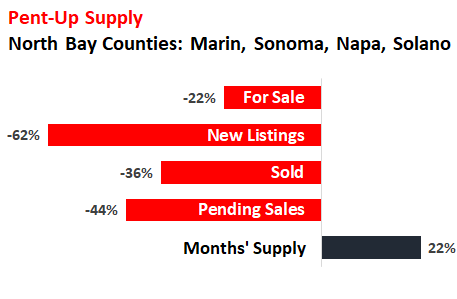
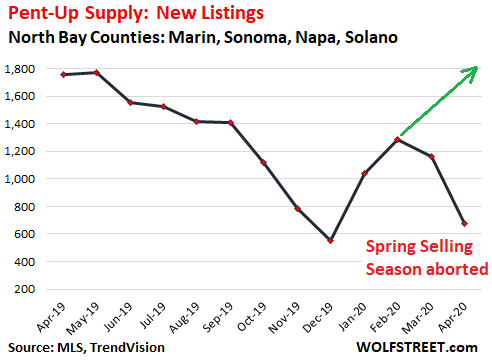
New listings plunged 62% in April from a year ago to just 675 houses and condos, after having already dropped in March. This is supposed to be the spring selling season, and new listings are supposed to surge, but sellers aren’t interested in having potentially infected people traipsing through their home; and they know that buyers are woefully absent, and it doesn’t make that much sense to list the home because previously listed homes are still languishing on the market.

The drop in new listings in March and April are early signs that pent-up supply is building up.

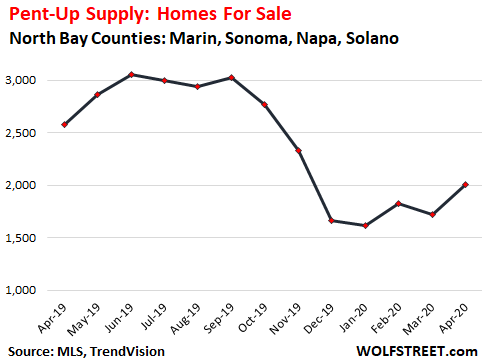
As many of the homes that have been listed in prior months haven’t sold, and despite the terribly weak new listings, inventory of homes for sale fell only 22% from a year ago (to 2,010 homes), and has been rising sequentially since January.

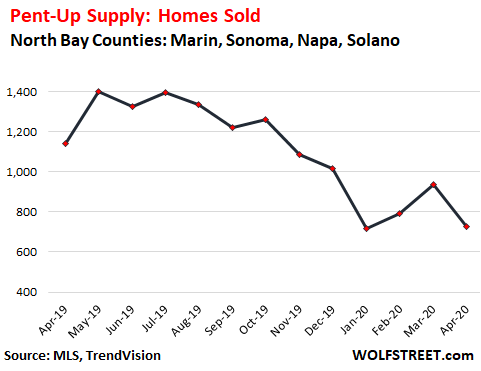
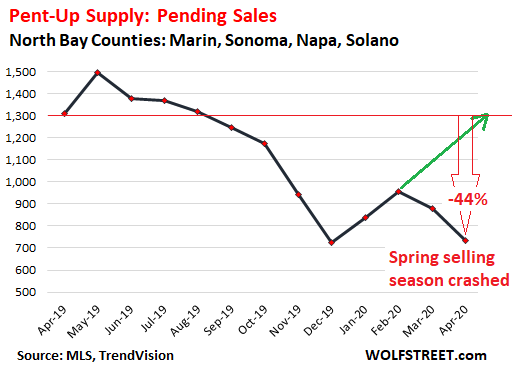
Sales are horrible: The number of closed sales, many of them from contracts signed before April, dropped 36% (to just 729 homes). And pending sales – contracts signed in April and an indication of what future closed sales might look like – plunged 44% (to 733 homes).

The drop in closed sales caused months’ supply, despite plunging new listings, to jump by 22% to 2.8 months.

21c72 US housing North Bay summary 2020 04 “Pent up Supply” is Building up in the Housing Market: Example of San Francisco Bay Areas North Bay

The charts below show the progression for some of those metrics over the past 12 months, from April 2019 through April 2020.

This is the collapse in new listings depicting how the spring selling season crashed in March and April. The green arrow indicates where new listings went last year:

3f933 US housing North Bay new listings 2020 04 “Pent up Supply” is Building up in the Housing Market: Example of San Francisco Bay Areas North Bay

The inventory of homes for sale ticked up sequentially despite plunging new listings, as much of what was put on the market in prior months hasn’t sold yet:

3f933 US housing North Bay homes for sale 2020 04 “Pent up Supply” is Building up in the Housing Market: Example of San Francisco Bay Areas North Bay

Closed sales fell 22% from March to April, which is in the spring selling season when sales are supposed to roar higher. Last year at this time, sales jumped 21%. This produced the year-over-year plunge in April of 36%:

3f933 US housing North Bay sales 2020 04 “Pent up Supply” is Building up in the Housing Market: Example of San Francisco Bay Areas North Bay

Pending sales show that the spring selling season crashed. Last year, from March to April, pending sales jumped 15%, which is in the normal range. This year from March to April, pending sales fell 17%, after having already dropped 8% in March from February. This created the year-over-year plunge in April of 44%:

3f933 US housing North Bay pending sales 2020 04 “Pent up Supply” is Building up in the Housing Market: Example of San Francisco Bay Areas North Bay

Thomas Stone, a Realtor in Sonoma County, threw three issues into the mix going forward:

  • Appraisals
  • Already hard-to-get jumbo loans (which many homes in these counties require) made even harder to get by dropping appraisals
  • The coming onslaught of new supply from vacation rentals that owners need to shed.

“The next big shoe to drop will be when appraisers call a declining market, probably in August but perhaps as early as July,” Stone said. “Due to the nature of their business, they have to wait for closed sales to show two or more months of price declines.”

“An Appraisal is a ‘reasonably supported opinion of value.’ Even though they see the train is out of control, they have to wait until it is off the tracks before calling it,” he said.

And this bleeds into the difficulties of getting a mortgage. “Think getting a loan is hard now?” he said. “‘We’re sorry, Mr. Stone, but the property didn’t appraise high enough, and we can’t make the loan,’”

The North Bay with its Wine Country has a large number of vacation rental houses. They’re dead now. And this isn’t likely to change a whole lot in the foreseeable future.

“This will bring both lower rents as the owners with strong hands rent long term, and an increase in inventory as the smarter ones with weak hands try to get out while the getting is good,” Stone said.

So there you have it: A most splendid housing bubble and an equally splendid vacation-rental boom that were both caught at the peak in their most vulnerable state by The Virus that upended everything. Stone sees a very rough market for years to come.

Mall tenants’ collapsing one after the other without replacement has a pernicious impact on property prices. Read... US Commercial Real Estate Prices Plunged in April, Mall Prices Collapsed

Enjoy reading WOLF STREET and want to support it? Using ad blockers – I totally get why – but want to support the site? You can donate. I appreciate it immensely. Click on the beer and iced-tea mug to find out how:

970e8 BeerMug2 “Pent up Supply” is Building up in the Housing Market: Example of San Francisco Bay Areas North Bay

Would you like to be notified via email when WOLF STREET publishes a new article? Sign up here.


Article source: https://wolfstreet.com/2020/05/11/pent-up-supply-is-building-up-in-the-housing-market-example-of-san-francisco-bay-areas-north-bay/

Posted in SF Bay Area News | Tagged | Leave a comment

Bay Area Housing: Will Remote Work and COVID-19 Affect SF Rent?

“Having made this move, at least for now, we’re in a better financial situation,” she said.

Despite the recent outflow of high-salaried, telecommuting workers from the Bay Area, local housing economist Issi Romem is quick to deflate the idea that the San Francisco residential rental market is likely to soften in the long term.

“There could be a temporary short-term exodus,” Romem said. “But things will revert.”

Romem said it’s only a matter of time before bustling urban centers like San Francisco become attractive to workers once again, and those workers will want to have in-person meetings — at least occasionally.

But the economist does see a longer-term trend — driven by the ongoing shift towards telecommuting — of people migrating to the suburbs.

“If you’re only getting into the office once or twice a week, you have much more tolerance for long commutes,” he said. “And that means that it’s easier for people to live in far-flung suburbs, where there’s more space to be had more cheaply.”

Not everyone gets to be picky about where they live, though. In rent-controlled San Francisco, hanging on to a longtime apartment may still be many residents’ best, and only, option.

But even that’s getting tougher, with the pandemic wiping out more than 100,000 Bay Area jobs. Romem said living conditions for the city’s poorer citizens are likely to get worse until employment bounces back.

Article source: https://www.kqed.org/news/11820692/bay-area-housing-will-remote-work-and-covid-19-affect-sf-rent

Posted in SF Bay Area News | Tagged | Leave a comment

Realtors Say They’ll Sue to Block Restaurant Rent Abatement Plan

Real estate groups across California say they’ll sue to kill legislation that would let bars and restaurants pay back missed rent payments over the next year

Forner San Francisco Supervisor turned State Senator Scott Wiener proposed California State Bill 939 earlier this month, a plan he concocted with Sen. Lena Gonzalez that would allow bars and restaurants to end leases early, pay back rent payments missed during the pandemic over a 12-month period, and ban commercial evictions during the crisis. On Friday, the Senate Judiciary Committee voted 5-1 to advance the bill, the SF Chronicle reports, progress that dismayed real estate groups that say the plan will deal a mortal blow to the state’s landlords.

At Friday’s hearing, Rob Lapsley, the president of business lobby the California Business Roundtable (BBR), said that his organization would sue to block the bill, should it be approved by the state Senate and Assembly. The CBR isn’t the only one opposed to the plan, as Justin Thompson, a real estate partner with global law firm Nixon Peabody tells the Commercial Observer that “it was illuminating to see so many industry organizations come out ‘so vehemently opposed’” to the bill.” Matthew Hargrove, senior VP of government relations for the California Business Properties Association, joined the chorus of opposition, saying that the law, if enacted “could cause a financial collapse” for the state’s commercial real estate industry.

For his part, Wiener says that he understands the concerns of property owners, but “restaurants, bars, and cafes are expected, frankly, to just suck it up, and magically come up with the high rent that was obtained in pre-COVID circumstances.”

“These landlords aren’t going to be able to collect the pre-COVID rents from these restaurants, bars and cafes,” Wiener tells the Commercial Observer. “That is not the reality. The choice is not between full rent and reduced rent. The choice is between reduced rent and no rent.”

And in other news…

  • Andy Mousalimas, a World War II hero who owned (among other establishments) King X, Oakland’s first sports bar and where the past time of fantasy football reportedly began, died last week in a Manteca hospital. He was 95. [The Stockton Record]
  • Novelist and Lower Haight resident Andrew Sean Greer worries over the shops, restaurants, and bars in his neighborhood, all of which are struggling during the pandemic. [Esquire]
  • A $100 million ballot measure championed by SF-based food delivery service Doordash (as well as Uber and Lyft) that seeks to exempt the companies from classifying its workers as employees with benefits has qualified for the November 2020 election. [Sacramento Bee]
  • Moni Frailing, a grill cook at the Progress, has launched an Instagram-based bread, spread, and pickle delivery service that’s now selling out a week in advance. [SF Chronicle]
  • Closed since Mid-March, Bay Area-based candy company See’s has reopened its kitchens and even some stores. [KPIX]
  • Popular Los Gatos restaurant Nick’s Next Door has reportedly closed for good, Chef/owner Nick Difu said in a Facebook post that “After a lot of careful consideration, and partly because of the uncertainty of the restaurant world, I have sadly decided to walk away from the restaurant.” [San Jose Mercury News]
  • The Outer Richmond’s Balboa Theater, which is of course shuttered to patrons, is doing occasional popcorn and movie treat pop-ups that — so far — are drawing blockbuster-level crowds. [Richmond Review]

Article source: https://sf.eater.com/2020/5/26/21270513/rent-abatement-nicks-next-door-sees-fantasy-football-popcorn

Posted in SF Bay Area News | Tagged | Leave a comment

San Francisco Foundation CEO: ‘We Need To Have A Higher Aspiration Than Going Back To Normal’

A Bay Area economic recovery should go beyond going back to normal, nonprofit leaders said during Bisnow’s weekly Bay Area webinar Thursday afternoon. 

As the first region to implement shelter-in-place orders, the Bay Area has taken as sustained a hit to its economy as anywhere in the U.S., and not far behind its six-county decree was a statewide stay-at-home order that has since caused California’s unemployment rate to skyrocket.

Since March 7, the state has processed over 3.5 million unemployment claims, its Economic Development Department said Thursday. Nearly one in five workers in California have been left jobless by the coronavirus epidemic and accompanying economic slowdown, Gov. Gavin Newsom said Wednesday.  

Moreover, the slowdown has also exacerbated pre-existing issues within the Bay Area’s economy, San Francisco CEO Fred Blackwell and others said Thursday.

“Sheltering in place in Palo Alto, or Piedmont or Sausalito is very different than sheltering in place in a place like the Tenderloin,” Blackwell said, speaking alongside Bay Area Council President and CEO Jim Wunderman and Tenderloin Neighborhood Development Corp. CEO Don Falk.

“Recovery conversations should not be about how we go back to normal,” Blackwell said, echoing affordable housing developers who spoke in a Bisnow webinar the prior week. “We need to have a higher aspiration than going back to normal.”

Falk, chief executive of an affordable housing developer himself, said he agrees.

“We’ve spent a lot of time thinking about the connections between housing and health and between health and homelessness, and this crisis has made that clear, really, to the whole world,” he said.

Blackwell said the situation is sparking momentum in the state legislature for housing reform. A sweeping housing bill authored by state Sen. Scott Wiener, a Democrat representing the 11th District, failed again this year, but other housing bills have passed and given wins to housing advocates in recent years. 

Another shift in the Bay Area’s status quo is happening in the office sector, Wunderman said. 

“I think there’s going to be some impetus to support some people telecommuting,” he said, predicting a change to “the nature of commercial real estate.”

“A lot of the commercial real estate has been driven by a few companies that have grown like weeds,” he said. “Strategically, if they see things differently as a result of this, that set of companies can have a profound impact on what happens in commercial real estate.”

One such company, Google, may have recently given a sign of things to come, reportedly stopping talks on plans for over 2M SF of office space throughout the Bay Area. 

“In some ways, the pause button might be a nice button to hit,” Wunderman said. “When we make the comeback, how do we want to come back?”

Related Topics: Google, Palo Alto, Tenderloin Neighborhood Development Corp., Bay Area Council, Gavin Newsom, Don Falk, Scott Wiener, Tenderloin, Jim Wunderman, webinar, Bisnow Webinar, Fred Blackwell

Article source: https://www.bisnow.com/san-francisco/news/economic-development/bay-area-webinar-thursday-afternoon-104185

Posted in SF Bay Area News | Tagged | Leave a comment