Oakland, S.F. neighborhoods fastest gentrifying in U.S.

Nearly one-third of poor neighborhoods in Oakland and San Francisco experienced gentrification between 2013 and 2017, the highest rate in the country according to a new national study.

San Jose was also among the top 10 cities in the U.S. where families with low median household incomes were replaced by high wage earners with college degrees, according to a report released Thursday by the National Community Reinvestment Coalition.

The study spotlights the Bay Area’s rare bubble — poor communities in other cities across the country have seen little new investment and gentrification over the last decade, NCRC research showed. But high-wage tech workers and expensive housing have continued to push lower-wage neighbors out of West Oakland, Uptown, East Palo Alto and other communities.

The study quantifies what Bay Area residents have seen for years: historically low-income neighborhoods rapidly changed by new, higher-income residents. “It’s a combination of economic activity, land use and geography,” said NCRC director of research Jason Richardson. The nonprofit coalition advocates for private reinvestment in under served communities.

The researchers looked at census data in poor communities from 2012 to 2017 for substantial rises in median household income, housing prices, and the share of residents with four-year degrees to find gentrification.

Researchers identified 41 of 131 low- and moderate-income tracts in San Francisco and Oakland that saw substantial increases in household income, education and home prices. The San Francisco and Oakland metro are saw 31 percent of its eligible communities gentrify, outpacing Denver (27. 5 percent) and Boston (21 percent) as the most intense changes in the country, according to NCRC.

In San Jose, 13 of 72 tracts — about 18 percent — had large gains in wealth and educational status.

In West Oakland, for example, median household income rose from $80,700 to $86,300 between 2010 and 2017, while the percent of population with four-year degrees rose from one-third to nearly one-half, according to the study.

The study also considered the possible future effects of federal opportunity zones on low and moderate-income neighborhoods. The opportunity zones, established in the 2017 Tax Cuts and Jobs Act, allow tax breaks for certain investments in distressed communities. The program is designed to fuel investment in 8,000 urban and rural zones designated as disadvantaged by state governors.

NCRC researchers found nearly 70 percent of the opportunity zones overlap or run adjacent to communities most likely to experience gentrification. “These are some of the most distressed neighborhoods in the U.S.,” said report co-author Bruce Mitchell. The investments could bring opportunities for residents — but studies have shown long-time residents are usually displaced by the community make-overs. Renters and people of color are most vulnerable.

Critics worry that the investment program may accelerate gentrification in many neighborhoods, even as properties are redeveloped.

NCRC researchers said its too soon to gauge the impact of opportunity zones on communities. Mitchell noted that reinvestment will likely be slowed as the economy is hampered by the coronavirus pandemic.

California Housing Partnership CEO Matt Schwartz said the long-running trend in the Bay Area has been driven by booming job growth in the tech sector. Other factors, including lack of new construction and state property tax laws, have driven up housing prices across the region.

In a 2019 report, the partnership found the mounting cost of housing hit households of color hardest. A 30 percent increase in rents, for example, led to a nearly 30 percent decline in low income minority residents in Bay Area communities. Existing white residents, however, were likely to stay put as their neighborhood changed, the study found.

“The impacts were not equal,” Schwartz said.

The runaway housing prices in the Bay Area have pushed basic needs for renters well out of reach in recent years. An exclusive analysis of Zillow housing data by this news organization last year found moderate and low-income residents have been slowly priced out of the region since 2012.

Families with a household income of $100,000, about the median income in the Bay Area, could not afford the typical rent in 7 in 10 zip codes in the region, including all of San Francisco, San Mateo and Marin counties. For a family earning less than $64,000 — common for two, minimum wage workers — no Bay Area neighborhoods had an affordable median apartment rent.


Article source: https://www.mercurynews.com/oakland-s-f-neighborhoods-fastest-gentrifying-in-u-s

Posted in SF Bay Area News | Tagged | Leave a comment

Bay Area Rental Prices Dropping As Exodus From Region Continues

SAN FRANCISCO (KPIX 5) — The decrease in Bay Area rental prices has been significant this year, especially in the most expensive cities.  Some median prices have even dropped by double-digit percentages.

San Francisco is still the most expensive city in the country to rent an apartment. But new numbers show there’s been an exodus of residents who have better options. Renters are simply walking away from their leases.

“People are leaving and ditching their apartments, or leaving roommates hanging, or trying best to find a sublease or just leaving San Francisco and moving back home,” said tech salesman Anthony Natoli, who decided to move back to New Jersey with his parents after paying more than $4,000 a month for his apartment in Cow Hollow.

“All of the normal things that we see as driving demand for rental housing in San Francisco have pretty much dried up,” said J.J. Panzer, President of Real Management Company.

In June, rent prices year-over-year dropped more than 9% in San Francisco, Mountain View more than 15%, and Cupertino down 14% according to Zumper, which provides listings of available rental properties and services.

“A lot of people are moving out to Southern California, moving out to Central Valley, moving up to the Sacramento area, Tahoe, and Sonoma County,” said Bobby Fallon of Shamrock Moving Storage. “It’s definitely been a trend that’s going on. ”

A new survey from the San Francisco Apartment Association shows more than 7% of renters simply broke their leases over the last three months.

Some 2.7 million adults in the country moved in with their parents in March and April. That’s a trend that could lead to more than $700 million in lost rent for landlords this year according to Zillow, an online real estate database company.

“Landlords want a commitment that they’re not going to have a vacancy at this time when we’re looking at with such incredible supply and lots of units opening up and no demand to fill it,” said Panzer.

There may be a way for renters to take advantage of the trend if they approach it correctly.

“You’ll get farther by recognizing landlords want that base rent to be kept basically where it’s at,” said Panzer. “Ask for a free month’s rent.  Sign a new one-year lease and the effective rate goes down for 13 months essentially.”

According to Zillow the most affordable cities in the Bay Area now are Vallejo and Concord with the median rent for a one-bedroom going from $1450-$1750.

Article source: https://sanfrancisco.cbslocal.com/2020/06/18/bay-area-rental-prices-dropping-as-exodus-from-region-continues/

Posted in SF Bay Area News | Tagged | Leave a comment

Once Booming San Francisco Apartment Market Goes in Reverse

Rents in San Francisco, the most expensive apartment market in the U.S., are tumbling as the city’s vaunted tech sector sheds jobs and more tenants leave the city.

The apartment vacancy rate in San Francisco rose to 6.2% in May, according to apartment data firm RealPage. That’s up from 3.9% only three months ago, after stay-at-home orders went into effect and more people in the city decided not to renew their leases.

San…

Article source: https://www.wsj.com/articles/once-booming-san-francisco-apartment-market-goes-in-reverse-11592472602

Posted in SF Bay Area News | Tagged | Leave a comment

Bay Area Unemployment Hits 13 Percent, Labor Force Shrinks

a4359 San Francisco Employment 04 20 Bay Area Unemployment Hits 13 Percent, Labor Force Shrinks

Based on employment data through the second week of April, at which point the ongoing impact of the COVID-19 pandemic was still picking up steam, the estimated number of San Francisco residents with a paycheck has dropped by nearly 92,000 over the past two months to 482,100 and the labor force has shrunk by nearly 36,000 for an unemployment rate of 12.6 percent.

As a point of reference, the unemployment rate in San Francisco maxed out at around 9.4 percent at the height of the Great Recession in January of 2010, at which point there were 45,400 fewer people employed in San Francisco than today.

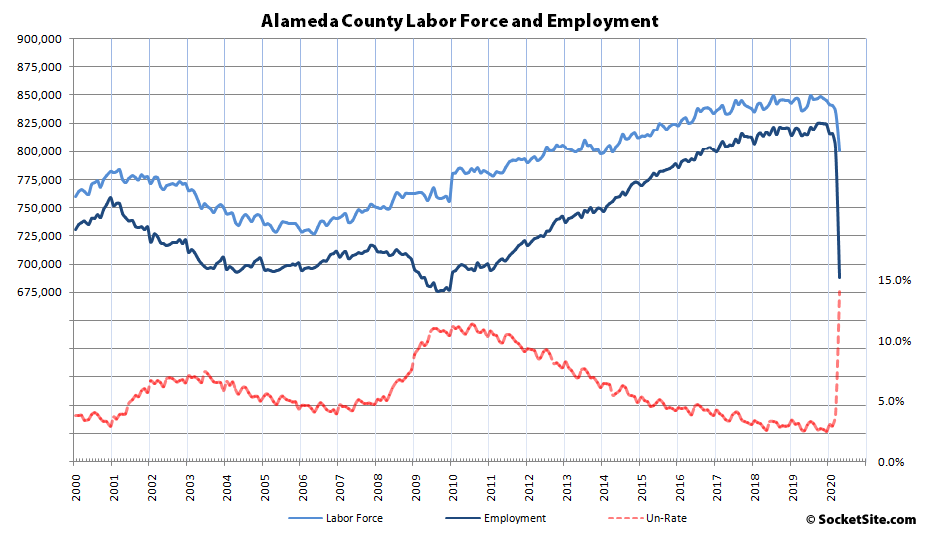
Over in Alameda County, which includes the City of Oakland, the estimated number of employed residents has dropped by 127,600 over the past two months to 687,800 and the unemployment rate has just ticked over 14 percent.

b3299 Alameda County Employment 04 20 Bay Area Unemployment Hits 13 Percent, Labor Force Shrinks

Across the greater East Bay, including Solano County, total employment has dropped by 240,000 to 1,317,000 with a blended unemployment rate of 14.3 percent.

Up in Marin, the number of employed residents has dropped by 22,000 over the past two months to 114,500 with an unemployment rate of 11.1 percent. Employment in Napa is down by 10,000 to 61,200 for an unemployment rate of 15.8 percent. And employment in Sonoma County has dropped by 51,700 over the past two months to 199,800 with an unemployment rate of 15.3 percent.

Down in the valley, employment in San Mateo County has dropped by 72,600 over the past two months to 380,600 and employment in Santa Clara County has dropped by 133,600 to 894,500 for a blended unemployment rate of 11.6 percent.

b3299 Silicon Valley Employment 04 20 Bay Area Unemployment Hits 13 Percent, Labor Force Shrinks

And as such, total employment across the Bay Area – which peaked at a downwardly revised 4,113,700 this past October, which shouldn’t catch any plugged-in readers by surprise – has dropped by over 620,000 over the past two months to 3,449,700 and the labor force has contracted by 216,000 for an unemployment rate of 13.1 percent.

b3299 Bay Area Labor Force and Employment 04 20 Bay Area Unemployment Hits 13 Percent, Labor Force Shrinks

Article source: https://socketsite.com/archives/2020/05/bay-area-unemployment-ticks-over-13-percent.html

Posted in SF Bay Area News | Tagged | Leave a comment

Bay Area home sales fall by half in May vs. last year; prices off 2.5%

The coronavirus pushed Bay Area home sales off a cliff in May.

The number of existing, single-family home sales that closed last month fell 51.1% compared with the same month last year and the median price dropped 2.5%, according to a report issued Tuesday by the California Association of Realtors.

Between April and May, sales fell 6.7% and the median price dropped 1.5% to $965,000, said the report, which excludes condominiums, newly built homes and homes that were not advertised on a Multiple Listing Service.

“May is going to be where you see the full brunt” of the COVID-19 crisis, said Jordan Levine, the association’s deputy chief economist. Because it generally takes 30 to 60 days for a sale to close after an offer is accepted, a lot of May sales went into contract in April, when the Bay Area was still under a strict lockdown. Since then the rules have eased a bit, the stock market has rebounded and it’s a little clearer which sectors of the economy are most affected.

Statewide, sales fell 41% year-over-year in May, following drops of 11.5% in March and 30.1% in April.

“It was the first time we saw three back-to-back months of double-digit declines,” Levine said.

Pending sales — the number of homes going into a contract — is a more forward-looking indicator than sales. They rebounded 67% between April and May statewide, and by a similar percentage in the Bay Area.

“We saw the pit for pending sales in mid-April,” Levine said. The sales rebound continued through the end of May but “the last couple weeks we have seen slower growth in pending sales.”

Normally, sales peak in the spring and tail off in the summer but this year “our summer will be more like spring and summer combined, or two springs combined,” said Brian Witchel, an agent with Corcoran Global Living in Marin.

Considering the drop in May sales, the 2.5% drop in prices year-over-year, which followed a 0.8% drop in April, seems fairly tame.

One reason prices haven’t dropped more is that there are fewer fundamental problems in the housing market than there were during the financial crisis, which was fueled by shoddy mortgage underwriting. And most of the job losses this year have been in service industries, where employees are more likely to be renters than buyers in the expensive Bay Area, Levine said.

“On the inventory side, sellers took a much bigger step back than buyers,” Levine said. So even though there are fewer buyers, they are competing for a much smaller number of homes.

Sellers who did not have to move have been reluctant to put their homes on the market during the pandemic.

In the Bay Area, open houses, for brokers and the public, are not allowed. One-on-one showings are allowed only if a virtual showing is not feasible, and then only by appointment with strict social distancing and health rules enforced. Before early May, agents could not even show a home unless the occupants had moved out. Now they generally can, but the occupants must be gone at the time of the showing. Even if their homes can be shown, many owners are reluctant to have strangers coming through.

Finally, low mortgage rates have made buyers eager to make a deal, perhaps more than sellers.

 Bay Area home sales fall by half in May vs. last year; prices off 2.5%

Among Bay Area counties, median prices rose the most year-over-year in Solano (8.1%) and Marin (7.1%). They fell the most in Napa (-7.2%) and San Mateo (-6.6%), according to the report.

Month to month, prices rose the most in Marin (9.9%) and Sonoma (2.6%) and dropped the most in Napa (-10.3%), Alameda (-7.3%) and San Francisco (-4.2%).

Anecdotally, agents in the Bay Area suburbs say they’ve had a surge of interest from potential buyers coming from San Francisco, as the coronavirus has made working from home at least part time a more viable option long-term. Many are looking for larger homes with space for one or two offices, a yard and — since they’re spending more time at home — a pool.

“Every year a certain amount of people move from San Francisco to Lafayette, Moraga, Orinda. It’s the natural flow, they get to their early 30s, have a child or aspirations of a child. This year we are getting this year’s people and next year’s,” Compass agent Paddy Keohe said. “San Francisco is one of the most beautiful cities but between COVID and restaurants and bars closing down, that romantic feature is gone,” he said. “Now (they’re) working from home in a two-bedroom apartment and it’s like, ‘Get me out of here.’”

Nicole Allen and her husband have been looking to move from their one-bedroom apartment in San Francisco’s Marina district to Berkeley, the Oakland hills or Rockridge.

“The biggest thing for us is how much more you can get for your money outside the city. We are looking for something with more space, a yard, flex room, something where you can raise a family and not feel completely crammed for a couple years,” she said. “With companies updating their work-from-home policies, we are more excited about the prospect of being outside of the city. We wouldn’t necessarily have to take BART every day.”

Chris Meadors, a Compass agent in Napa, said, “The only phone calls we have received in the last three months” are from people wanting to move from San Francisco to someplace like Napa County. He and his partner “have put five deals in contract with that exact buyer at a couple different price points in the last month,” he said. Second-home buyers are acting “with more urgency” than usual, he added. They want to know “How fast can I move in? I want to use the pool the July 4 weekend.”

Paul O’Neil, a Corcoran agent in Marin, started working with three clients wanting to move from San Francisco since before the coronavirus hit.

“They were on the fence for a while, all of a sudden they are active,” he said. All can work from home more than they used to. As a result, some are willing to look at homes farther from the city, for example in Fairfax rather than Mill Valley.

Tim Johnson, a Compass agent in San Francisco, said “it’s a little early” to say whether this is more than a seasonal trend, since summer is when families with children often move from the city to suburbs before schools reopen. He said families are also looking for bigger homes within San Francisco, with room for offices and home schooling.

“That tends to drive people toward larger accommodations rather than out of the city,” he said.

Paul Barbagelata of BarbCo Group in San Francisco has heard of people wanting a second home “in the Wine Country, Tahoe, or a place where … there is fresh air, some elbow room and they won’t go crazy” sheltering in place, he said. But “I have not personally experienced any fallout yet” from people moving out of the city entirely. “By September or fall we will have a better understanding if there is a flight to the suburbs or not.”

 Bay Area home sales fall by half in May vs. last year; prices off 2.5%

In a report earlier this month, Compass Chief Market Analyst Patrick Carlisle noted that San Francisco “was more deeply and more quickly affected by COVID-19 and shelter-in-place” than other local markets. It saw larger initial drops in activity. “Even with the remarkable rebound of buyer demand in May, its recovery is, so far, lagging other counties on a year-over-year basis.”

In a chart, he plotted the number of homes going into contract last month compared with May 2019. Among Bay Area counties, the highest was Sonoma at 100%, which means Sonoma’s activity was about the same as last year. The next highest were Solano (98%) and Marin (88%). The lowest were San Francisco (62%) and Alameda (68%).

But, he added, “one cannot come to conclusions in the middle of a crisis. In 1989, right after the earthquake, there was talk about turning the entire Marina district into a park. After 9/11, it was said in New York City that no one would want to live in condo penthouses anymore.”

Kathleen Pender is a San Francisco Chronicle columnist. Email: kpender@sfchronicle.com Twitter: @kathpender

Article source: https://www.sfchronicle.com/business/networth/article/Bay-Area-home-sales-fall-by-half-in-May-vs-last-15344931.php

Posted in SF Bay Area News | Tagged | Leave a comment