$100 million fund to convert Bay Area hotels to homeless housing draws 20 applications — 1 so far in SF

California’s new Homekey program, which will dish out $100 million to convert Bay Area hotels and motels into permanent homeless housing, has attracted about 20 applicants in its first three weeks as cities and counties race to beat Thursday’s tight filing deadline. And though there has been just one solid bite in San Francisco, there may soon be more.

As the coronavirus crisis stretches on and many hotels remain shuttered, some antsy owners are becoming more open to the idea of selling rather than hanging on to see how long they can survive the crippled economy. In hyper-expensive San Francisco, where plummeting tourism has led to 40% of the hotels temporarily closing, some owners might feel more confident than those in other regions in recovering financially once the pandemic eases.

But it doesn’t mean they’re not thinking about selling, officials said. San Francisco homeless policy leaders have said since early summer that they are hoping to buy two or more hotels for conversion, and some leading players in the city’s Homekey process say several properties are in play — including one that sent in an application to the state Friday.

The challenge, they say, is finding buildings that don’t need prohibitively expensive updating — in-unit bathrooms, disabled access and the like — whose owners are willing to sell at a fair price. All of that is no small ask, considering that while rents have dipped significantly during the pandemic, real estate prices have not.

Then there’s the follow-up cost. Overseeing a supportive housing operation costs about $30,000 a year — per person — so a modest, 50-unit complex alone would require $1.5 million a year. Most Bay Area counties say this doesn’t counteract the benefit of getting help buying real estate, particularly in San Francisco, where Mayor London Breed’s office sees the program fitting neatly into her plan to add 1,000 supportive housing units in the city over the next 12 months.

 $100 million fund to convert Bay Area hotels to homeless housing draws 20 applications — 1 so far in SF

Breed has several divisions, including the Department of Homelessness and Supportive Housing, scouting for prospective properties, and Supervisor Aaron Peskin played a leading role in persuading the owner of a 237-room residential hotel in his northeastern district to submit an application Friday.

“Every once in a while, things line up right,” he said. “This is great news.”

He said another building in his district is also in the running, and he hopes others in the city will send in Homekey applications.

“Before and during the pandemic, people have been buying and selling stuff for affordable housing and supportive housing, and I’m not seeing marketplace desperation,” Peskin said. “It’s very promising.”

Rebecca Foster, head of one of the key funding organizations helping arrange Homekey deals in the city, said she was optimistic about finding projects “with this opportunity to bring tens of millions of dollars to San Francisco.” The pressure is on, though: The first deadline for applications is Thursday. And though subsequent bids will be taken up to the end of September, everyone is encouraged to get in before the money runs out.

“There are definitely a few possibilities in San Francisco,” said Foster, CEO of the San Francisco Housing Accelerator Fund, a public-private fund that raises money to build affordable housing. “When there are state funds like this available and you have a huge need like we do, you have to work really hard to get that application in. This is a sprint.”

The state’s Homekey fund consists of $550 million in federal coronavirus aid and $50 million in state general funds. The federal money must be spent by the end of December, and properties accepted into the program must be occupied within 90 days. Those deadlines, tight by housing industry standards, have created a near frenzy as cities, counties and nonprofit agencies race to assemble their prospects.

Of that money, $100 million is aimed at the Bay Area’s nine counties.

 $100 million fund to convert Bay Area hotels to homeless housing draws 20 applications — 1 so far in SF

Throughout the state, about 100 applications — actually pre-applications, with further paperwork to follow — have been received, according to Gov. Gavin Newsom’s office. The program builds on Newsom’s Project Roomkey, which has rented hotel and motel rooms for more than 14,000 vulnerable or coronavirus-stricken homeless people statewide. Homekey will accept not just hotels and motels, but vacant apartment complexes and other buildings as well.

Homekey’s money could buy more than 3,000 or more units of housing around the state — hundreds of those in the Bay Area — and the aim is to make them permanent supportive housing, though interim housing can also be allowed. Considering there are 151,000 homeless people in California, the biggest such population in the nation, several thousand rooms of new housing seems small. But in the perpetual struggle to house street people amid funding shortages, homeless policy leaders say the program is a big plus.

“I am confident we will use this as a great resource,” said Vivian Wan, chief operating officer of Adobe Services, a homeless aid nonprofit that oversees programs, including Roomkey complexes throughout the Bay Area. “It’s a crazy tight deadline, but if COVID-19 has taught us anything in California, it’s taught us that we can move quickly when we have to.”

She said she is helping agencies in Santa Clara and Alameda counties with several Homekey applications, and county officials in Contra Costa and Marin counties are vigorously pursuing several properties as well. Calls to several hotels for comment went unanswered.

Tomiquia Moss, CEO of the All Home nonprofit, which works on Bay Area-wide strategies for ending homelessness, pointed out that converting existing buildings can cost half or less that of new construction, depending on the area — “which is quite a savings, considering it can cost about $700,000 a unit to build new in San Francisco.”

Moss advised state planners as they crafted the Homekey program, and her organization is helping counties with applications. “There’s an incredible appetite for this,” she said, and not just for the money but for the prospect of housing people within 90 days.

“You can’t keep telling homeless people to wait five years for a unit to be built new,” she said. “We have to be creative.”

San Francisco Supervisor Hillary Ronen, who with other supervisors has been urging the mayor to lease more hotel rooms to temporarily shelter homeless people, said there should be few holds barred in the hunt for properties.

“If we can’t find willing sellers, we should consider addressing this major problem by eminent domain,” she said. “Homekey is a solution, but we need much more like it. We have to do everything we can.”

Kevin Fagan is a San Francisco Chronicle staff writer. Email: kfagan@sfchronicle.com Twitter: @KevinChron

Article source: https://www.sfchronicle.com/bayarea/article/100-million-fund-to-convert-Bay-Area-hotels-to-15465521.php

Posted in SF Bay Area News | Tagged | Leave a comment

EXCLUSIVE: Huge Bay Area Mall Hits Market As Potential Biotech Hub

The owner of Richmond’s 78-acre Hilltop Mall property is taking it down a new path in an abrupt, coronavirus pandemic-induced change of plans.

LBG Real Estate Cos. is looking to sell its 1.2M SF Shops at Hilltop property as a future East Bay science and technology center, the company told Bisnow Thursday. Led by Newmark Knight Frank Vice Chairmen Steven Golubchik and Nicholas Bicardo, marketing of the East Bay property will officially begin Friday, according to LBG Managing Partner Leslie Lundin.

LBG’s decision marks a relatively sudden turn of events for the Hilltop property caused in large part by the coronavirus pandemic, LBG Managing Partner Doug Beiswenger told Bisnow in an interview.

“We think it’s an opportune time with how things have changed with COVID. Needless to say, the office market is moving quickly from city centers to more suburban locations,” Beiswenger said. “From the life sciences and biotech perspective, it’s all of those things, plus the biotech industry is on an absolute tear, and we don’t expect that to change.”

The move is also reflective of brick-and-mortar retail’s accelerated decline, which has been exacerbated by the pandemic. Beiswenger said the West Coast shopping center owner’s evolving plans for Hilltop tended to involve a decreasing amount of retail through the years. 

LBG acquired the already struggling property in 2017 with plans for both a new roster of retail tenants at the 1M-plus SF mall and thousands of new homes. But by June, the company was looking at redeveloping a chunk of the property into 800K SF of offices, Bisnow reported at the time

Now, LBG said it envisions Hilltop having 100K SF to 150K SF of retail serving mostly as an amenity for Hilltop’s other uses, according to Beiswenger.

“Whereas before, the retail would have been the anchor to a development like this 10 years ago, now the retail development will be much smaller and be an amenity,” Beiswenger said. 

The property is zoned as commercial mixed-use, allowing for retail, office, hotel, life sciences and residential uses. It is entitled for as much as 16.7M SF of building area, which would allow for as many as 9,760 units. Beiswenger said LBG is open to partial sales and also a lease or master-lease agreement and to staying on and developing part of the property.

Given the property’s flexible zoning, Beiswenger said LBG expects life sciences and tech-oriented buyers and tenants to show interest, as well as residential developers and master-planned community developers. It has not yet set a price for the property. 

“We’re open to all these alternatives depending on the larger users’ needs for the properties,” he said.

Hilltop is currently 16% occupied, and it is LBG’s intent to deliver it “primarily vacant” to give investors an “ideal canvas to create a premier mixed-use community,” according to marketing materials for the property.

Article source: https://www.bisnow.com/san-francisco/news/commercial-real-estate/exclusive-78-acre-bay-area-mall-property-hits-market-as-office-life-sciences-opportunity-105684

Posted in SF Bay Area News | Tagged | Leave a comment

Number of Homes for Sale Nearing Recession-Era Levels in SF

906c6 SF Inventory Chart 07 20 20 Number of Homes for Sale Nearing Recession Era Levels in SF

Continuing a trend which shouldn’t catch any plugged-in readers by surprise, the number of homes on the market in San Francisco, net of new sales and contract signings, ticked up another 6 percent over the past week to 1,360, which is now over twice as much inventory as there was at the same last year, a new 9-year high, and within 8 percent of its mark in July of 2008.

At a more granular level, while the number of single-family homes currently listed for sale in San Francisco (350) is only running 48 percent higher than at the same time last year, the number of condos (1,010), which tends to be a leading indicator for the market as a whole, is up by over 130 percent and tallied over a thousand for the first time since the fourth quarter of 2010.

With nearly 30 percent of the homes now on the market in San Francisco having been listed for under a million dollars, there are now over twice as many sub-million dollar listings on the MLS than there were at the same time last year.

And as we highlighted last week, there are now over 150 percent more reduced listings on the MLS than there were at the same time last year, over six times (6x) more than there were in July of 2015, and the most reduced listings since the fourth quarter of 2011.

Keep in mind that inventory levels should be ticking down, based on typical seasonality patterns, before jumping again in September. We’ll keep you posted and plugged-in.

Article source: https://socketsite.com/archives/2020/07/number-of-homes-for-sale-in-s-f-nearing-recession-era-levels.html

Posted in SF Bay Area News | Tagged | Leave a comment

Bay Area real estate: SF family uses holiday card-like introductions to find home

With a red-hot real estate market in the East Bay, a San Francisco family took a more personal approach to ensure the seller this would be an “simple sale,” and secure the home of their dreams. Here’s what they did.

Article source: https://news.yahoo.com/bay-area-real-estate-sf-013914503.html

Posted in SF Bay Area News | Tagged | Leave a comment

Bay Area residents still want to stay in California despite ‘mass exodus’ myths


25f68 920x1240 Bay Area residents still want to stay in California despite mass exodus myths

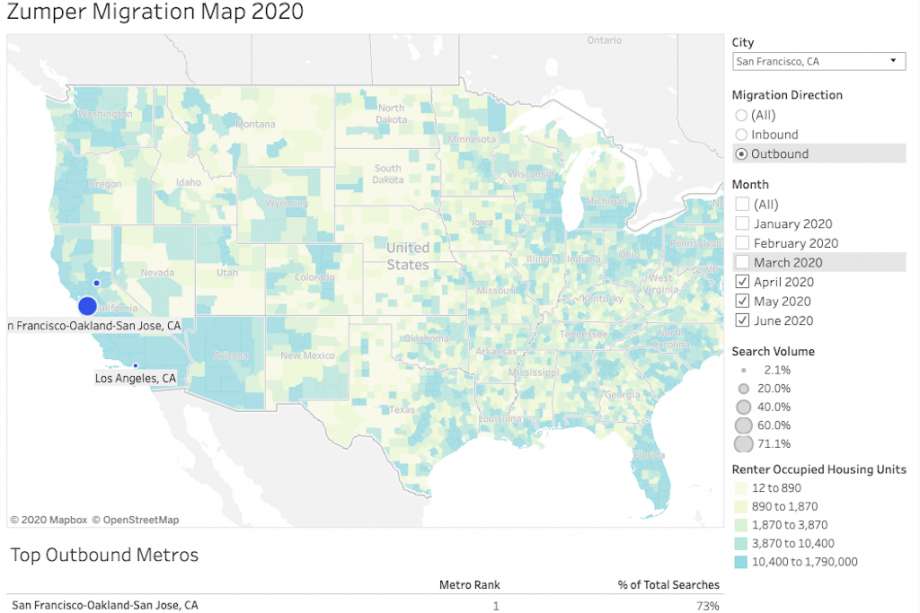
Zumper’s first ever migration report uses search data to analyze patterns and trends across the U.S. to see where renters are most interested in moving to and where renters are most interested in leaving.

Zumper’s first ever migration report uses search data to analyze…


There’s been a lot reported about San Francisco residents fleeing the city, causing rents to plummet and SF home sales finally embracing transparent pricing. But when looking at data from online real estate platforms, most of the real estate searching is still happening within the metro area and throughout California.

According to Zumper, if you look at where people in San Francisco are searching to move on their site, in April and May 2020, the San Francisco Bay Area metro was still the #1 most searched for area, taking up 72% of total searches. This was followed by Sacramento, Los Angeles, Sonoma County and Seattle-Tacoma, showing that people seem to want to stay in California and definitely on the West Coast if they can.


Redfin data shows a similar trend, with most Bay Area residents searching the real estate site within the Bay Area itself. Sacramento is the second most searched city, followed by Los Angeles and Seattle.


“We’re seeing that people want more space and more land during this time,” said Redfin lead economist Taylor Marr. “Homebuyers are increasingly searching for only single-family homes. For people who may only commute into the office one day a week and work from home the rest of time, I think it will cause some of them to move to the suburbs, exurbs and second-cities like Sacramento, that are a long commute away from the Bay Area but still within a two-hour drive.”


A recent study done by Apartment List showed there may actually be less people considering moving out of the Bay Area than before the pandemic. There were 37.1% of San Francisco users considering leaving the region altogether and moving to a different metro now as compared to 39% prior to the pandemic.


RELATED: SF homebuyers get pickier amid pandemic concerns, agents say

The share of San Francisco users looking to move to suburban parts of the metro increased from 20% prior to the pandemic to 21.8% from April through June. There has been a nine percent quarter-over-quarter increase San Francisco residents searching for apartments in nearby secondary cities, such as Oakland and Berkeley, but interest in leaving the Bay Area, and especially leaving California, has declined substantially, according to the Apartment List study.

Most notably, the share of users searching for apartments in lower-density cities remains stable, signaling that for many San Franciscans, moves are motivated by the search for more affordable housing, rather than a decreased interest in an urban lifestyle.


“People have always left the Bay Area for less expensive places,” Marr said. “As more companies follow in the footsteps of Facebook, Twitter and Slack in announcing permanent remote work policies, some tech workers are moving to different parts of the country — but most of them have other reasons to stay put, like friends, family and culture. I think with remote work being an option for more people, the trend of leaving the Bay Area will accelerate slightly but not dramatically.”

Tessa McLean is a digital editor with SFGATE. Email her at tessa.mclean@sfgate.com or follow her on Twitter @mcleantessa.

Article source: https://www.sfgate.com/realestate/article/Bay-Area-residents-still-want-to-stay-in-15416652.php

Posted in SF Bay Area News | Tagged | Leave a comment