What would happen to Bay Area home prices if a recession hit?

For those who never bought a home near the peak of a housing market, or tried to sell one during a trough, it may seem as though prices never fall, because over the long term they tend to go up, at least as fast as inflation.

Since 2000, Bay Area home prices — as measured by the SP CoreLogic Case-Shiller home-price index for the five-county San Francisco metro area — have outstripped both inflation and home prices nationwide, by a significant margin.

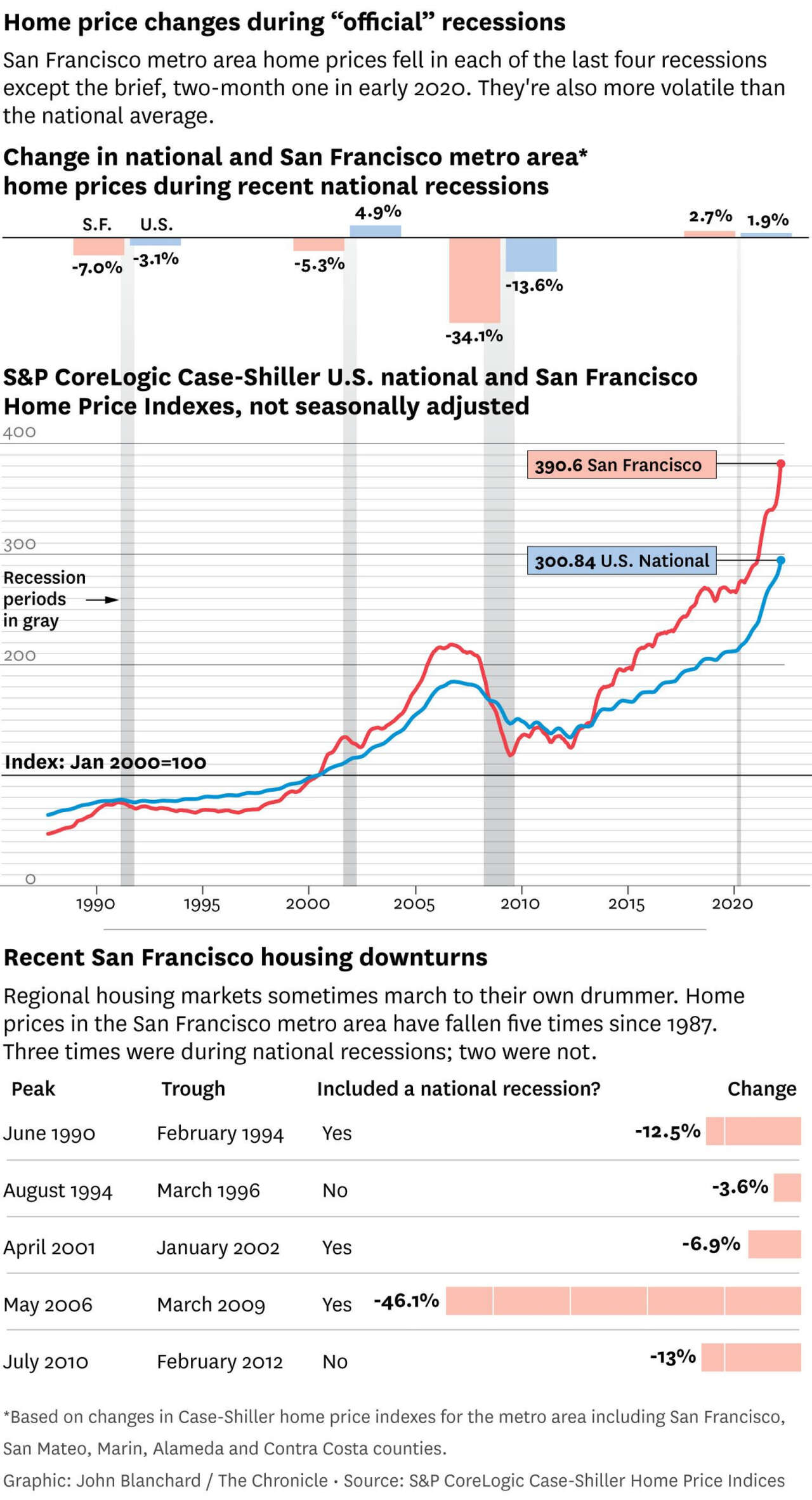
But since its inception in 1987, this index has fallen five times — three times during the previous four recessions and twice outside of recessions. It rose slightly during the latest recession, which lasted only two months in early 2020.
e61a7 1280x0 What would happen to Bay Area home prices if a recession hit?e61a7 767x0 What would happen to Bay Area home prices if a recession hit?

Bay Area home prices are also more volatile than the national average. They typically rise faster during boom times and fall further during recessions, mainly because the region is tied to the boom-bust tech sector and has “a relatively tight supply” of homes, said Craig Lazzara, managing director with SP Dow Jones Indices.

As recession fears heat up, so do questions about what could happen to Bay Area home prices if we enter one.

Although prices typically fall during recessions, each one is different and “hits local economies completely differently,” said Christopher Thornberg, director of UC Riverside’s Center for Economic Forecasting. You can also have “regional catastrophes,” such as the oil price collapse that tanked Texas home prices for much of the 1980s.

In the early 1990s, while the nation experienced a mild recession, California endured a major one. Southern California was slammed by shutdowns of military bases and aerospace plants. That followed a period of overbuilding “that led to restrictions that now prevent us from building enough houses,” Thornberg said.

San Francisco metro home prices fell 12.5% between June 1990 and February 1994. The dot-com boom of the late 1990s revived the Bay Area economy, and by mid-1997, prices had surpassed their previous peak.

Los Angeles prices, however, fell 27% between June 1990 and March 1996 and didn’t fully recover until early 2000.

Although regional downturns are common, before the Great Recession, there was a widespread belief that prices nationally had never fallen on an annual basis since the Great Depression.

Two national home-price indexes — compiled since 1950 by Freddie Mac and since 1975 by Freddie’s federal regulator — had never declined over a full year, the New York Times reported in August 2007.

The idea that home prices never fall helped fuel the speculative excesses that led to the mid-2000s housing bubble, the financial crisis of 2007-08 and the worst recession since the 1930s.

Before the Great Recession, Bay Area home prices typically rose quickly during an expansion and stopped climbing when a recession hit. “Then you usually have a flat period, then a decline in the 5 to 10% range,” Carlisle said.

Here’s why: When the Fed raises interest rates to cool inflation, buyers back off. As prices fall, homeowners who don’t have to sell take their homes off the market. “Sales volume drops dramatically, but prices move ever so slowly,” said Edward Leamer, an economist with the UCLA Anderson Forecast.

The 2008 collapse “was an anomaly,” Carlisle said. “The 2005-2007 bubble was fueled by home buying and refinancing with unaffordable amounts of debt on a staggering level, promoted by predatory lending practices, promises of endless appreciation, and an abysmal decline in underwriting standards — and then eagerly facilitated by smug, rapacious, Wall Street flimflammery and self-abasing credit ratings agencies,” he wrote in a report last year. “Millions came to own homes they could never afford to pay for and the rot was distributed throughout the financial system.”

 What would happen to Bay Area home prices if a recession hit?

A foreclosure-sale sign is displayed in San Pablo in 2010.

Mike Kepka/The Chronicle 2010

When the Fed raised interest rates and prices came down, people who bought homes with little or no money down and adjustable-rate mortgages owed more than their homes were worth and stopped making payments.

Banks ended up with the homes, but “they couldn’t hold onto them like homeowners could,” Leamer said. They dumped them at fire-sale prices, prices spiraled downward, financial institutions failed and a painful recession ensued.

The “official” recession lasted from December 2007 to June 2009. The Case-Shiller San Francisco home price index fell 34% during this period (more than twice the national average) but measured from peak to trough, it plunged 46%. It didn’t surpass its previous peak for almost a decade. (The index tracks repeat sales of existing, single-family homes in San Francisco, San Mateo, Marin, Alameda and Contra Costa counties.)

Although some parts of the Bay Area were hit harder than others, the mayhem was so widespread that hundreds of thousands of property owners who bought near the peak received temporary property-tax reductions without even asking.

In California, property is generally assessed at market value when it changes hands. In between sales, the assessment for property taxes can’t go up by more than 2% a year, plus the value of major improvements. However, if a property’s market value drops below its assessed value, under Proposition 8, property owners can ask to have their property tax assessment temporarily reduced to current market value. This generally happens when people buy near a peak or grossly overpay for a home.

During the Great Recession, county assessors proactively reduced tax assessments on many homes purchased near the peak. As prices recovered, they restored these assessments to where they would have been without the temporary reduction.

In fiscal 2011-12, about 657,000 properties in the nine-county Bay Area had temporary price reductions. By 2020-21, only about 57,000 had them.

The counties with the largest percentage of Prop. 8 reductions, relative to their populations, were Contra Costa and Solano.

“If there was a subdivision with 1,000 homes, we would give out 998” temporary reductions, said Contra Costa County Assessor Gus Kramer.

High-end homes were the last to lose value and the first to recover. If there’s another recession, “I would predict it would be the same scenario,” Kramer said. “People who live in very large expensive homes have planned their economic life better.”

As the bubble inflated and burst, the number of licensed real estate agents and brokers in California swelled from about 324,000 in 2002 to 542,000 in 2008, then fell to 402,000 in 2015. Today there are 435,371.

 What would happen to Bay Area home prices if a recession hit?

A foreclosure sign in Vallejo.

Lea Suzuki/The Chronicle 2008

After the financial crisis, the government clamped down on predatory lending and the Fed took unprecedented steps to drive down interest rates and boost the economy. Homeowners took out or refinanced mortgages at record low rates and home prices soared, especially after the pandemic hit.

“The pandemic brought forward a lot of demand,” Lazzara said. “I know some young families that would have moved to the suburbs in 2022-23.” When cities shut down and remote work became possible, “They said, ‘Why don’t we go now?’”

If we do head into recession, a housing crisis akin to the last one is unlikely.

Unemployment is extremely low, and most homeowners have fixed-rate mortgages at ultra-low rates. Moreover, they are sitting on record amounts of home equity, reducing the risk of foreclosures.

That doesn’t mean today’s nosebleed prices won’t come down. In April, Case-Shiller’s San Francisco index was up 23% year over year, but 11 of the 20 largest markets had even bigger gains, up to 35.8% for Tampa.

Its 20-city composite home price index rose 21.1%, putting it in the 99th percentile of year-over-year gains. As the late economist Herb Stein used to say, “If something can’t last forever, it won’t,” Lazzara quipped.

Demand for Bay Area homes has already weakened. There are fewer offers, more price reductions, homes are taking longer to sell, and there are more of them on the market. Mortgage rates are rising at their fastest pace in decades.

Yet the supply remains constrained, and there are many high-income families in the area.

“My guess is we have seen the peak of one of the longest, most dramatic cycles in history,” Carlisle said. As of June, median year-over-year appreciation rates are dropping fast in virtually all Bay Area markets. “That doesn’t mean we are in for a crash; we are in for some sort of normalization,” he added.

Mark Zandi, chief economist for Moody’s Analytics, sees prices falling 5% to 10% on a national basis. “Some of the most juiced-up markets in the Mountain West and South will see double digit declines. The Bay Area, I think, basically goes flat, although some communities will see declines,” he said.

In addition to perennial issues such as water, earthquakes and fires, climate risk is becoming a real concern for California, Zandi added. And for the state’s big urban areas like San Francisco and Los Angeles, so is remote work.

Thornberg, however, does not expect a recession in the next 12 months nor a drop in home prices.

“Home prices historically have fallen only when there is an economic calamity in the housing market,” he said. “Today we have record equity levels, low (homeowner) debt-to-equity, a low supply of housing, low debt burdens and great credit quality. This is not a market that is about to get hit by a calamity.”

Kathleen Pender is a freelance writer and former columnist for The San Francisco Chronicle. Twitter: @KathPender

More: What is a recession, and are we in one yet?

Article source: https://www.sfchronicle.com/realestate/article/home-prices-recession-17306384.php

Posted in SF Bay Area News | Tagged | Leave a comment

Bay Area home prices see largest May-to-June drop on record

The Bay Area’s once-scorching pandemic housing market continued to cool in June, with home prices plunging to the largest monthly drop for this time of the year in at least three decades.

In June, the median price of existing single-family houses in the nine-county region declined 7% from the previous month — from just over $1.5 million to $1.4 million, according to data for the California Association of Realtors. That’s the steepest May-to-June dip ever recorded in the association’s regional home sales data, which dates back to 1990.

What’s behind the record price drop? Real estate experts point to rising interest rates squeezing buyers, more homes staying longer on the market and an increasingly uncertain economy — all signaling the Bay Area housing market may have peaked after prices hit all-time highs earlier this year.

“From this point on we probably won’t see another record price, at least for this year, for either the Bay Area or for the state,” said Oscar Wei, deputy chief economist with the California Association of Realtors.

Wei noted it’s uncommon to see such a significant price decline in June in the middle of what is traditionally the busy summer home-buying season.

In the core Bay Area, Alameda County saw the largest monthly price drop of 8% to $1.42 million. That was followed by San Francisco County with a 6% decline to $1.9 million, Santa Clara County with a 6% drop to $1.82 million, Contra Costa County with a 5% dip to $976,940 and San Mateo County with a 3% drop to $2.16 million.

Still, Bay Area home prices were up 5% in June compared to the same time a year ago. But some counties did see year-over-year drops, including San Mateo (-5%), San Francisco (-3%) and Contra Costa (-1%).

Throughout most of the pandemic, home values soared as house hunters — many untethered from the office by remote work and buoyed by historic-low interest rates — were locked in a mad scramble for homes, sometimes bidding hundreds of thousands of dollars over the asking price.

But as the Federal Reserve has raised the cost of borrowing this year in a bid to slow runaway inflation, mortgage rates have spiked accordingly to around 5.5% for both jumbo and conforming 30-year fixed home loans. That’s up from as low as under 3% during the depths of the pandemic.

Volatile financial markets that have put a dent in investment portfolios, increased job layoffs and raised fears of a coming recession have also taken some buyers out of the market.

In turn, Bay Area home sales dropped 27% in June year over year, the largest decline since pandemic lockdowns halted most home buying in spring of 2020, Wei said.

2507b SJM L HOMESALES 0726 90 Bay Area home prices see largest May to June drop on record
Chart showing the largest May-to-June drop in the price of existing single-family homes in the Bay Area. 

South Bay Realtor Mary Pope-Handy said the drop in demand has resulted in price reductions and homes staying for sale longer, after some sellers jumped into the market hoping to cash in on soaring prices in recent months. Now, she said, many buyers and sellers are holding to see who blinks first.

“It’s a lot of everybody waiting for the market to go up or go down,” Pope-Handy said. “At some point the logjam will break because people still need to buy and sell.”

That dynamic has likely contributed to home inventory increasing throughout the region. In Alameda County, the number of available listings has nearly doubled since last year.

Paddy Kehoe, a real estate agent with Compass in the East Bay, said active sellers now have to be more thoughtful about how they put homes on the market.

“If it is marginally overpriced it’s not going to sell,” Kehoe said. “Today, you have to know 100% what the price should be.”

Wei, the California Association of Realtors economist, said that despite the current state of the market, it’s unlikely the Bay Area will see another month-to-month price drop as large as 7%. That’s in part because even though the number of homes on the market is growing in the short term, supply in the Bay Area remains tight compared to the rest of the state and country, after years of sluggish housing construction in the region.

“Going forward,” he said, “we will continue to see some slowdown, but it’ll be in line with the traditional seasonal slowdown rather than the sudden dip in that price shift.”


Article source: https://www.mercurynews.com/2022/07/26/bay-area-home-prices-see-largest-may-to-june-drop-on-record

Posted in SF Bay Area News | Tagged | Leave a comment

House Prices in San Francisco & Bay Area Experience Steep Declines from April Peak Craziness, Down Year-over-Year

Sales volume plunged 38%.

By Wolf Richter for WOLF STREET.

The median price of single-family houses in the San Francisco Bay Area peaked in April and has dropped every month since then. By July, the median price, at $1.33 million, was down by about $220,000 from the peak and by 2% year-over-year, undoing most of the huge gains in 2021 and early 2022.

In San Francisco itself, the median price of single-family houses also peaked in April – at $2.06 million, according to the California Association of Realtors. And then it sagged, and then it plunged. In July, it hit $1.68 million. Median prices are volatile from month to month, and they’re easily skewed by a change in the mix of what sold, and by other factors, so we need to be careful here. But this is nevertheless a huge plunge at the wrong time of the year.

Year-over-year, the median price in San Francisco dropped by 9% in July, the second month in a row of year-over-year declines, following the 4% year-over-year decline in June. The first time the median price hit this level was in February 2018. In this chart, the seasonal low points are generally Decembers and Januarys. The summer months tend to be in the upper part of the range – but obviously not this July. The purple line connects the Julys.

8993a us california housing San Francisco 2022 08 11 House Prices in San Francisco & Bay Area Experience Steep Declines from April Peak Craziness, Down Year over Year

Sales volume in July plunged by 38% year-over-year in the Bay Area, according to MLS data cited by Patrick Carlisle, Chief Market Analyst at Compass, San Francisco Bay Area.

“Across the Bay Area, markets have continued to slow and cool, with dramatic changes in buyer demand, inventory, overbidding, price reductions, and year-over-year appreciation rates,” Carlisle said.

“Median home sales price appreciation rates in the Bay Area have generally seen steep declines from those in 2021/early 2022, with some counties experiencing year-over-year median price declines in July,” Carlisle said.

“These changes vary in degree by county and market segment – and monthly data can be volatile, fluctuating according to a wide variety of factors, including market seasonality – but the direction of these shifts is near universal,” Carlisle said.

San Francisco’s extra-special stew of housing market factors.

The spike in mortgage rates to over 5% is tough for homebuyers to digest, and for home sellers to adjust to, and it’s tough for them everywhere.

But San Francisco, with its focus on tech and startups, has become heavily dependent on venture capital funding, and on SoftBank’s funding, and on the hiring by these and other companies, with employees getting huge salaries and fantastical stock options, and all this has become dependent on booming stock and crypto prices. So here we go:

Prices of the most speculative assets have plunged, such as cryptos and stocks that recently had their IPOs or SPAC mergers. Many of these stocks of companies that are headquartered or were headquartered in San Francisco have collapsed by 70% or 80% or 90% and have made it into my Imploded Stocks column. And more broadly, despite the blistering summer rally, the Nasdaq is down 21% from its November high.

The funding of startups has fizzled, particularly the huge amounts that SoftBank used to throw willy-nilly at Bay Area startups, at valuations that turned them into instant pop-up unicorns. But SoftBank got waylaid by the plunge in stocks and disclosed a gazillion dollars in losses on its investments so far this year, and then shut off the money spigot.

Venture Capital firms have pulled back from funding the craziest stuff as the exits via IPO or via merger with a SPAC that they rely on to cash out have been barricaded by the brutal collapse of many of these stocks.

Population declined. From July 2020 to July 2021, the population of San Francisco dropped by nearly 55,000 people, or by 6.3%, to 815,000 people, the lowest since 2010, according to the Census Bureau. But the decline started in 2019. According to estimates by California’s Department of Finance, the population peaked in 2019 at 890,000. So since 2019, the population has dropped by about 75,000 people, or by 8.4%. For people who live here, the City is still immensely crowded and congested, but just a little less so than during peak craziness.

Working remotely and corporate move-outs have left the previously bustling Financial District and the South of Market area a shadow of its former self. According the Savills, 26% of the entire office space in the City is on the market for lease, which is huge. Among the big cities, only Dallas/Fort Worth and Houston are in worse shape.

New housing units have been added at a rate of 2,000 to 4,500 every year. All of them have been multifamily, as no single-family housing has been built in over a decade. Density in the city is growing, and huge areas are being redeveloped. This includes Candlestick Point/Hunters Point Shipyard, Treasure Island, Parkmerced, Potrero Power Station, and others, most of which are industrial wastelands, some of them decorated with nuclear contamination from the US military during the Cold War, the cleanup of which has become its own forever soap opera of scandals. Tens of thousands of housing units are planned for these areas.

But much lower home prices would solve a host of big economic and business issues in the Bay Area – including the entire phenomenon called Housing Crisis.

Enjoy reading WOLF STREET and want to support it? Using ad blockers – I totally get why – but want to support the site? You can donate. I appreciate it immensely. Click on the beer and iced-tea mug to find out how:

02bae BeerMug2 House Prices in San Francisco & Bay Area Experience Steep Declines from April Peak Craziness, Down Year over Year

Would you like to be notified via email when WOLF STREET publishes a new article? Sign up here.

02bae placeholder2 House Prices in San Francisco & Bay Area Experience Steep Declines from April Peak Craziness, Down Year over Year


Article source: https://wolfstreet.com/2022/08/11/house-prices-in-san-francisco-bay-area-experience-steep-declines-from-april-peak-craziness-down-year-over-year/

Posted in SF Bay Area News | Tagged | Leave a comment

Bay Area housing market sees rise of ‘second home’ sales

“I can’t afford a $2 million condo where I’m at in my business [in San Francisco]. This way I have a little summer house, a place where I can go jump in the pool … where I can move my stuff out of my San Francisco storage unit,” Shell said. “I’m excited to spend slow season and weekends there and host friends and family and have some hosting space.”

Shell even got licensed as a real estate agent in Nevada so he can help friends and clients do the same thing he did. He said especially for people working in tech that are now able to work remotely, not only is it a good investment, a way to build equity and a nice place to visit, it can also be a great way to save money because the state lacks an income tax. The idea is that, eventually, buyers can use those funds to buy something closer to home.

This trend has been increasing in the past five years, said Carl Medford, an agent with HomeLight.

“As prices started going up and up in the Bay Area it was becoming increasingly difficult for individuals to buy a home,” Medford said. “We started counseling them that a great strategy would be to start purchasing properties out of state or in a more affordable part of the state instead to at least get into the market so they could begin building equity, and once they had enough equity built in that property, transfer that into [their own] Bay Area property.”

In a recent HomeLight survey, agents estimated that utilizing this tactic of purchasing your “second” home as your first property in the Pacific region “can help to save an estimated $177,000 on the cost of a home.”

For many of Compass real estate agent John Townsend’s clients, buying a secondary home is simply a safer investment right now. Few buyers can guarantee they will be in the Bay Area for five to seven years, the minimum amount of time Townsend said it would take to make money on the property, but they can always hold onto a secondary home as an investment property much longer than that. If they’re living primarily in a rental in San Francisco, if they have a major life change like a new job or a baby, they can always move without the trappings of a mortgage. Meanwhile, they can continue to rent out or Airbnb the second home indefinitely. 

Townsend himself has run into this conundrum. He owned a home in the Richmond District of San Francisco for 10 years until recently. His family sold the house and planned to save up and move to Marin County and in the meantime move into a rental in the Presidio.

It turned out not to be so temporary, as the family fell in love with the neighborhood. Now, they’re looking to buy a second home instead, since they want to own real estate and have a place to get away, but don’t see themselves moving out of the Presidio any time soon. They’ve put a few offers in, but the right deal hasn’t come up, Townsend said. They’re still keeping an eye on the market and plan to buy as soon as the place and time is right. 

Townsend said he’s seen many clients do the same, keeping their rental in San Francisco while they purchase a home in places like Tahoe or the Sonoma/Napa area. “We’re not talking small price points here either. We’re talking $2 to $3 million, but that still doesn’t get them the house that they want to live in for the rest of their lives in San Francisco,” Townsend said. “They’re using it for their personal enjoyment but they’re very much looking to build equity in general.”

Many of those people use the property as a vacation rental to generate extra income, which subsidizes the mortgage, Townsend said, while they still use the house themselves when they want. 

The secondary home market has already come under scrutiny in recent years, with towns within the Lake Tahoe area issuing a moratorium on short-term rentals amid a local housing crisis.

Sometimes those second homes might even be a little farther away. Real estate agent Marcus Grogans recently had a client who wanted to purchase a condo in the Bay Area. He said they saw dozens of condos, but his friend eventually decided he couldn’t buy anything because, for the places he wanted, he’d end up “house poor” — he may be able to afford the mortgage in practice but it would significantly alter his lifestyle. 

Grogans knew his client had lived in Houston previously and enjoyed the city, so he encouraged him to purchase there instead. Grogans is helping him find, ideally, a two- to four-unit apartment building, where he’ll live part-time with a roommate while also renting out the other apartments. The idea is that with the roommate’s portion of the rent plus the income from the other units, he’ll generate a return after a year or so, be able to refinance, and then use that equity plus his income to offset his dream condo purchase in San Francisco.

“Real estate is still one of the safest bets, especially when you go into these metropolitan cities. You may not be able to afford in San Francisco, but you can afford in Austin or Miami or one of those places,” Grogans said. “If all things go to plan he’ll be a homeowner in the Bay Area next year.”

Others aren’t using their new property themselves at all — their first real estate purchase is an investment property, as they can’t afford anything locally. Daniel Flores has lived in San Francisco for 15 years and he had always dreamed of buying a home here, but he never felt like he could afford the home he wanted in the area. A few years ago, he decided he wasn’t going to be able to “save his way into a home,” especially with prices continuing to increase, but he had recently met someone who was flipping homes.

The flips were in Kokomo, Indiana, and Flores decided to invest in the renovation projects there. Flores figured this would be a good way for him to learn about flipping houses and hopefully make money faster than in traditional savings or stocks. He invested about $40,000, he said, and within four months he said he doubled that investment. He did that two more times with the same partner in Indiana, each time making a good profit that he could roll into his next investment. He was still a full-time real estate agent, but now he felt like he could start doing projects like this on his own locally, all with the intent to one day buy a home for his family in San Francisco.

He started with a duplex in San Rafael, renovating it and renting out the units. Just months later, it appraised for more than when he bought it, and so he refinanced and used the profits to fund a new project in South San Francisco. He’s added another property since then in Marin County, and all the units are rented out and he earns a small profit. The problem now is that because interest rates have more than doubled since his original purchases, he doesn’t want to refinance the properties at the moment to buy his San Francisco home just yet. It doesn’t seem like the right time.

“[The properties] are fully rented and the mortgages are paid, but I still can’t buy in San Francisco in the area I want to live now with interest rates so high. I can’t refinance, so I’m kind of stuck,” Flores said.

He’s going to wait out the market a bit and see what happens. For now, he, his wife and child will continue living in their rent-controlled two-bedroom apartment in Russian Hill.

Medford said he often recommends buying in Austin for buyers who work in tech, but he’s also seen a big increase in people interested in Tennessee and the Carolinas. He said while many people take his advice and buy out-of-state property, some choose to continue to save for a down payment.

“The wealth of a person that actually owns a property is 44 times that of those that rent,” he said. “It’s a vicious cycle. They want to be able to buy a property, and unfortunately, they would try to save up to get a down payment and it’s being eaten up by the ever-increasing rents in the Bay Area as these property values go up.”

“Those that wait end up getting priced out typically,” he said.

Article source: https://www.sfgate.com/realestate/article/bay-area-housing-market-second-homes-17362269.php

Posted in SF Bay Area News | Tagged | Leave a comment

Luxury developer ousting liveaboards in South San Francisco

KPIX says that the corporate developer served notices to longtime OCM residents on June 16, 2022. 

“As a part of our planning for the neighborhood, we are currently re-evaluating the long-term use of the marina and intend to terminate all OCM leases on October 15, 2022,” the notice reportedly said. “We will not be providing return rights of any kind to existing tenants of OCM.”   

Meanwhile, the “liveaboard” residents — all of whom are reportedly on fixed incomes — must leave by then or face eviction. Even though Kilroy offered a $10,000 relocation payment to those who sign the agreement within two weeks, longtime OCM resident Matt Klein and his neighbor, Lucia Lachmayr, told the outlet that it’s still “devastating” to the community.   

“We are going to be left homeless,” Klein told KPIX. “We were given a very, very swift notice after very little warning.” 

“It’s a huge, not just an endeavor, but it’s a life change for people who have been here for decades,” Lachmayr told the station. “It’s basically saying, here, go somewhere far, far away, and just uproot your life.” 

The city of South San Francisco is reportedly asking Kilroy to accommodate the boat residents by extending their time to leave, if needed. In response, a Kilroy spokesperson issued the following written statement to SFGATE: 

“As the Oyster Point development moves forward, we are re-evaluating the long-term use of the marina. As a result, we will be requiring existing boat owners to relocate,” it says. 

“We understand the uncertainty that these changes will introduce to our boat owners, which is why we are working with them to make their transition as painless as possible. We are providing all boat owners with four months to prepare for their next move, while offering to waive their rental fees in the interim. Additionally, we are offering $10,000 to the 14 liveaboard boat owners to help cover the inconvenience of their impending move. We will continue to offer our support to these boat owners throughout this process and look forward to working with them collaboratively as we prepare for the next phase of Oyster Point.”

KPIX says that 11 out of 14 residents have accepted the $10,000 and the deadline to accept has been extended to July 31. 

Article source: https://www.sfgate.com/local/article/developer-ousting-South-SF-boaters-17305567.php

Posted in SF Bay Area News | Tagged | Leave a comment