When S.F., Bay Area companies are reopening offices: Facebook, Google, Uber and more

Uber

Reopening date: San Francisco headquarters reopened March 29. Uber was the first major office employer in San Francisco to reopen on March 29 after the city entered the orange tier of the state’s coronavirus reopening system, which allowed nonessential offices to reopen. The company opened its new Mission Bay headquarters on a voluntary basis at 20% capacity. The 1 million-square-foot, four-building complex next to Chase Center has room for roughly 5,000 employees.

Uber plans to increase cleaning services and require face coverings. To qualify to work at the office, employees must take daily health screenings and temperature checks at home. Others can work remotely until Sept. 13.

Real estate plans: Uber sought to reduce its office commitments in San Francisco buildings prior to the pandemic, listing sublease space at its previous headquarters at 1455 Market St. and other downtown locations prior to the Mission Bay move. It’s also listed sublease in Dallas and New York during the pandemic.

Read more about Uber’s reopening here.

Twitch, Amazon

Reopening date: Twitch, the video game streaming website owned by Amazon, has reopened some offices, including in San Francisco, at limited capacity with safety protocols. The company, which is headquartered at 350 Bush St., didn’t provide an exact date but said offices have been open throughout the pandemic where health safety guidelines allow them.

Amazon has a separate reopening plan and expects to gradually reopen offices during the summer, with most workers returning by early fall. Globally, 10% of office workers have already returned, including many in Asia. The company didn’t provide Bay Area information.

Real estate plans: Twitch signed its headquarters lease in 2016. Amazon has not canceled any leases during the pandemic, a spokesman said. The company’s warehouses and delivery systems never stopped during the pandemic and it hired 500,000 people last year and has nearly 1.3 million employees. In December, it bought a San Francisco site for $200 million, where it proposed a new distribution center.

Facebook

Reopening dates: Menlo Park headquarters reopens May 10; Fremont offices on May 17; Sunnyvale offices on May 24; 181 Fremont and Park Tower in San Francisco on June 7.

Facebook will open at 10% capacity and on a voluntary basis. Employees who have been working remotely will be allowed to continue until offices reach 50% capacity, which will likely be after Sept. 7 for large sites.

Real estate plans: Facebook has continued to expand its offices despite CEO Mark Zuckerberg’s belief that half the company’s workforce could be remote within a decade. Facebook has new offices opening this year in Burlingame for its Oculus virtual reality division and in Sunnyvale and expanded last year in Fremont. It has also a major expansion proposed at Willow Village in Menlo Park. Last August, Facebook leased 730,000 square feet in Manhattan near Penn Station.

Read more about Facebook’s reopening here.

Google

Reopening dates: In April, some U.S. employees can return to the office on a voluntarily basis or continue working remotely until September. Reopenings will be based on vaccine availability and coronavirus trends. The company wouldn’t say whether Bay Area offices are reopening.

Real estate plans: Google is one of the Bay Area’s biggest companies, with over 20 million square feet of office space across San Francisco and Silicon Valley. The company is investing another $1 billion on California real estate this year and has over 52,000 employees in the state.

Read more about Google’s reopening here.

Wells Fargo

Reopening date: 200,000 employees will stay remote through at least Sept. 6, subject to minor changes. Around 60,000 are currently working in branches and offices. Wells Fargo, which is San Francisco’s second-largest private employer, is an essential business.

Real estate plans: The bank wants to reduce its real estate holdings by 15% to 20%, according to corporate filings. It is marketing sublease space at 45 Fremont St. in San Francisco, according to brokerage data.

Read more about Wells Fargo’s reopening here.

Dropbox

Reopening date: Targeting July reopening of San Francisco headquarters, but will be determined by public health guidelines.

Real estate plans: The company reported a loss of $398 million in the fourth quarter related to its shift to remote work first. That could rise by another $50 million this year. Dropbox is trying to sublease over half of the 750,000 square feet at its headquarters and has signed deals with two biotech companies.

Salesforce

Reopening date: Salesforce has not provided a reopening date.

When Salesforce reopens its headquarters in San Francisco, employees will have work options to choose from: working one to three days a week in the office, working remotely full-time or working four to five days per week in the office if their role requires it. Workers can stay remote until the end of July.

Real estate plans: Salesforce is listing part of its 350 Mission St. offices for sublease after canceling a separate deal at a nearby San Francisco project, Parcel F.

Cisco Systems

Reopening date: Targeting July 1 to begin a gradual return to the office, but will depend on coronavirus trends. The company has not decided whether the return will be mandatory or voluntary, but they will likely embrace a hybrid work model post-pandemic.

Real estate plans: The company has no plans of reducing its real estate yet, but will look into making adjustments based on “the demands for hybrid work in our business.” They’re also exploring the idea to create “collaboration hubs” to increase creativity and productivity when offices reopen.

Charles Schwab

Reopening date: Some employees have returned to offices, but a spokesman for Charles Schwab did not provide a reopening date. About 95% of employees continue to work from home. A full return to the office will depend on coronavirus trends. The company will provide a 60-day notice to allow employees to prepare but it has not yet decided whether it will be voluntary or mandatory.

Real estate plans: The company in 2019 announced it would move its headquarters from San Francisco to the Dallas-Fort Worth area.

No announced office reopening dates

Twitter, Yelp, PayPal

Article source: https://www.sfchronicle.com/business/article/When-S-F-Bay-Area-companies-are-reopening-16072456.php
Posted in SF Bay Area News | Tagged | Leave a comment

Berkeley home sells for $1 million over asking price

While bidding wars and multiple offers are not uncommon in San Francisco and the surrounding area, listing agent Jill Carrigan said she had never brokered a deal like this before.

She said Alameda County has been incredibly popular with people moving from San Francisco and the home itself was perfect for what people are searching for right now. “It’s kind of a unicorn that you’re close to hiking trails, and you have spectacular views and it has a yard,” Carrigan said. “Usually if you have a view, you don’t have a yard.”

The home is located in Harvard Circle at the end of a cul-de-sac near the Lawrence Hall of Science. It spans 2,400 square feet and includes three bedrooms and two bathrooms, as well as a home office.


ALSO READ: Citrus Heights home receives 122 offers in one weekend, sells within three hours

Alameda County home sales have climbed in 2021, up 22% when compared to the same time period last year, according to recent data from Compass. Overbidding was most common in Alameda County when compared with all Bay Area counties in the past year, with homes selling for an average of 7.2% over list price.

Overall, Bay Area home prices are up 6% as compared to the same time last year.

Article source: https://www.sfgate.com/realestate/article/berkeley-home-sells-for-1-million-over-asking-16067210.php

Posted in SF Bay Area News | Tagged | Leave a comment

Black California homeowner lowballed by $155K in appraisal, believe race and biases are factors – KGO

OAKLAND, Calif. (KGO) — Two longtime friends and business partners reached out to ABC7 News with a story of what they believe is discrimination in the appraisal process. The men believe the East Oakland home was hit with a lower value due to the color of their skin and because of who lives in their neighborhood.

“Something’s not adding up here,” said homeowner Braunz Courtney.

Courtney and his longtime friend and business partner Jamar Mears were stunned when an appraisal for the home on 57th Avenue in East Oakland came in at $575,000 in December of 2020.

“I was initially shocked and I thought I was seeing something different than what I was seeing,” said Courtney.

RELATED: State assembly holds hearing on racial disparities in housing, advocates call for review of federal standards

He purchased the 96-year-old home in 2015 at the low price of $305,000 when it required a considerable amount of updates.

Courtney added a second bathroom to the three-bedroom home and updated floors and appliances.

Earlier, in 2019 Courtney got the home appraised so he could take out money for an even larger project of building an Additional Dwelling Unit (ADU).

He tells ABC7 News the home appraised for $631,000 then.

Courtney then built a 500 sq/ft one bed, one bath ADU in his backyard that he now rents out on Airbnb. An ADU is an Additional Dwelling Unit, often referred to as an in-law suite.

The home then appraised lower after the massive renovations.

That’s when Courtney’s business partner Jamar Mears, a licensed real estate agent, realized something was amiss.

VIDEO: Bay Area Black, Latina real estate couple lowballed $250K in home appraisal

“After putting over $150,000 into the home you’re telling me a year later, it’s $25,000 less?” said Mears.

Mears began investigating the comparable homes used in the appraisal report and found the homes used were in worse shape and the in-law unit Courtney built on the lot was only valued at $10,000.

That’s when the duo asked their mortgage broker to see what could be done.

Glover: What makes you feel as though there was something discriminatory happening?
Mears: The comps he tried to present — this doesn’t even make sense even just looking at the pictures of them and the square footage. He’s supposed to be an appraiser and have some type of formal training and this is what (he) says is a comp? For me, there was definitely some discrimination going on. And then when I come in as the licensed realtor and say ‘hey here are some comps right here’ and he wasn’t even receptive to it and your response is ‘those are exclusive neighborhoods’?
Courtney: He was just like, let me give you the bottom of the barrel as a comp versus something that’s truly comparable: the size, the AUD, the updating.

The men said the appraiser would not budge on the evaluation and the lender sided with the appraiser.

That’s when the unexpected happened and three months into the refinance process, the mortgage broker advised the men to pull out and go with a different lender.

The broker also agreed to pay for the new appraisal.

A month later, the property appraised for much higher.

“It came back at $730,000. Over $100,000 more than what it originally appraised for,” said Courtney.

After reviewing the appraisals, ABC7 News calculated a $155,000 difference between the appraisals conducted a month apart.

The biggest difference in the two appraisals is the comparable homes listed to determine value.

The six homes surveyed in the December 2020 appraisal average $591,000 in value when adjusted.

VIDEO: Black California couple lowballed by $500K in home appraisal, believe race was a factor

Comparatively, the six homes surveyed in the final appraisal averaged $703,000 dollars when adjusted.

The in-law suite was also valued at $20,000 in the final appraisal compared to just $10,000 in the 2020 appraisal.

Courtney and Mears believe the difference in the reports shows the appraiser in question had implicit biases about the value of homes in East Oakland, an area that’s predominately Black and Latino.

As our reporting has shown, undervaluation of Black-owned property is a systemic issue that can affect the value of entire neighborhoods over time.

San Francisco Assemblymember David Chiu acknowledge this in a recent interview with ABC7 News.

“If years ago a particular property was appraised at a lower level because of the color skin of whoever owned (the property). You compound that over the years as ownership changes and these appraisals can get baked in whether someone knows it or not,” said Chiu.

ABC7 News has led the charge on uncovering discriminatory practices in home appraisals that’s now getting the attention of lawmakers in Sacramento to come up with a fix.

Until those changes are in place, this discrimination continues to affect Bay Area families every day.

RELATED: $10K student loan forgiveness? That won’t cut it for many Black, Latina women

ABC7 News reached out to The Appraisal Foundation for comment.

TAF is the U.S. organization authorized by Congress to set standards for real estate appraisers.

TAF President Dave Bunton provided the following statement:

“Any allegations of discrimination are a serious matter as the very standards an appraiser must follow in conducting an appraisal prohibit bias of any kind. The consumer’s lender is responsible for determining how a home is valued in a refinance and hiring an appraiser if they deem one necessary. If a consumer feels that their home has been undervalued, they should go to the lender for next steps, including the possibility of requesting a reconsideration of value.”

But in Courtney’s case that did not work.

Courtney and Mears now join the list of families who have shared their story with ABC7 News with similar claims of racially biased appraisals and call for elected representatives to take action.

“We have a community now of other people who’ve been through it and we can work together,” said Courtney.

“I’m happy that you’re out here giving people voices so we can address the situation,” said Mears.

Article source: https://abc7news.com/black-homeowner-problems-california-bay-area-housing-discrimination-minority-homeownership-anti-black-policy-sf/10460659/

Posted in SF Bay Area News | Tagged | Leave a comment

In Housing Market Gone Nuts, Condo Prices Sag in San Francisco Bay Area, Hover in 3-Year Range in New York, Rise at Half Speed in Los Angeles

But low-tier prices of single-family houses in the vast New York City metro explode by 15%, powered by fleeing Manhattanites?

By Wolf Richter for WOLF STREET.

The headlines are everywhere: The housing market has gone nuts with silly bidding wars and ludicrous price increases. Record low interest rates last year and $3 trillion of the Fed’s miracle moolah triggered that phenomenon, along with people leaving some big expensive cities for the suburbs, outer areas, and distant places, whose prices soared under the influx, while many leavers haven’t yet put their vacant old homes on the market, hoping to ride up the price surge, thereby constraining inventory for sale. But not all things are equal, as we’ll see with condos and houses by price tiers in the San Francisco Bay Area, Los Angeles, and the New York City metro, based on today’s SP CoreLogic Case-Shiller Home Price Index.

San Francisco Bay Area condo prices sag.

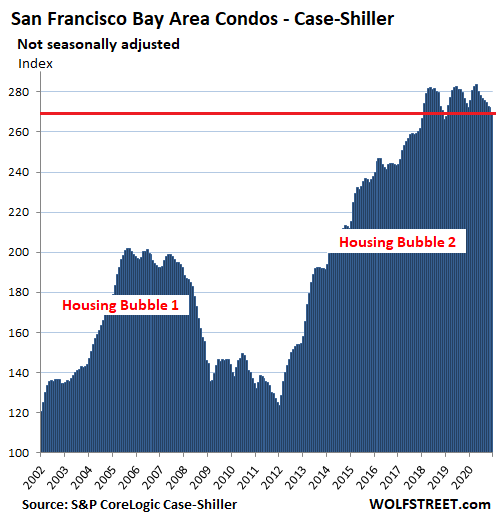
Condo prices in the five-county San Francisco Bay Area dropped 1.2% in January from December, the eighth month in a row of month-to-month declines. The index is down 1.5% from January last year, down 5.1% from the peak in May 2020, and roughly back where it had first been in February 2018:

63351 US Housing Case Shiller 2021 03 30 San Francisco Bay Area condos In Housing Market Gone Nuts, Condo Prices Sag in San Francisco Bay Area, Hover in 3 Year Range in New York, Rise at Half Speed in Los Angeles

The Case-Shiller Index for “San Francisco” covers the counties of San Francisco, San Mateo (northern part of Silicon Valley), Alameda and Contra Costa (East Bay), and Marin (North Bay). It doesn’t cover the southern part of Silicon Valley, including San Jose, and the largest portions of the North Bay (Wine Country counties of Sonoma and Napa) and Solano County.

In San Francisco county, condos are the majority of the market. In the other counties, houses are the majority.

Quite a few people have moved from San Francisco to the outer regions of the Bay Area. The move to Marin County cancels out because it is included in the index. But people have also moved to the other counties that are not included in the index, such as Sonoma County, whose housing market is red hot in part due to the influx of people from San Francisco.

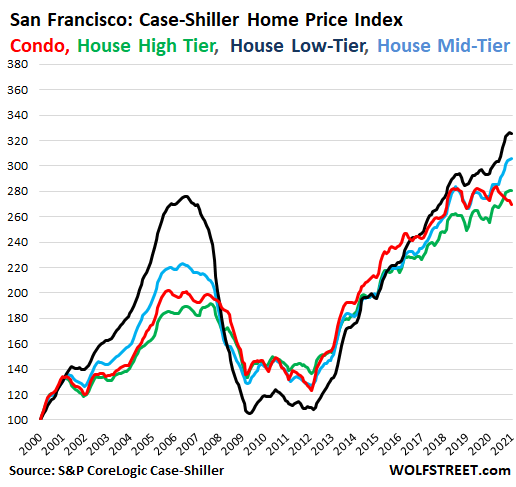
Prices of all single-family houses in the five-county San Francisco Bay Area, ticked up 0.2% in January from December and rose 9.5% year-over-year. By price tiers:

  • Low-tier prices (black line) fell 0.4% in January from December, the first month-to-month decline since 2019, after having surged the most in 2020. The January drop reduced the year-over-year gain to 10.8% (from 11.4% in December)
  • High-tier prices remained flat with December, and were up 7.9% year-over-year.
  • Mid-tier prices rose 0.4% in January from December and were up 10.8% year-over-year.

63351 US Housing Case Shiller 2021 03 30 San Francisco Bay Area price tiers In Housing Market Gone Nuts, Condo Prices Sag in San Francisco Bay Area, Hover in 3 Year Range in New York, Rise at Half Speed in Los Angeles

Los Angeles condo prices left behind by house prices.

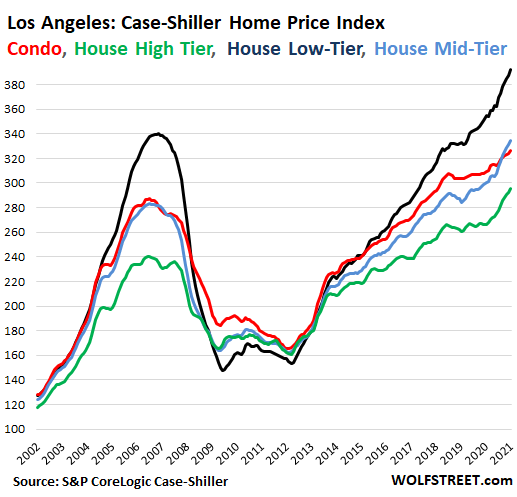
Prices of single-family houses in the Los Angeles metro rose 1.0% in January from December and 10.8% from January 2020. By price tiers, different trajectories become apparent:

63351 US Housing Case Shiller 2021 03 30 Los Angeles price tiers In Housing Market Gone Nuts, Condo Prices Sag in San Francisco Bay Area, Hover in 3 Year Range in New York, Rise at Half Speed in Los Angeles

Low-tier house prices show by far the largest surges during booms and by far the largest plunges during busts, having collapsed by 56% from the peak of Housing Bubble 1 to the bottom of the Housing Bust. Since then, they have skyrocketed 163%, nearly quadrupling since January 2000. In January, low-tier prices surged 1.4% from December and 10.4% year-over-year.

High-tier house prices are the least volatile. They have “not even tripled” (this sounds nuts) since January 2000. During the Housing Bust, they plunged only “33%” and since then have risen “only” 84%. In January, they rose 0.9% from December and 8.7% from a year ago.

Condo prices rose 0.6% from the prior month and 5.2% year-over-year, about half the rate of the year-over-year price gains for mid-tier and low-tier houses.

New York City metro condo prices still range-bound.

The Case-Shiller Index for New York City covers New York City and numerous counties in the states of New York, New Jersey, and Connecticut. This is a vast and diverse market.

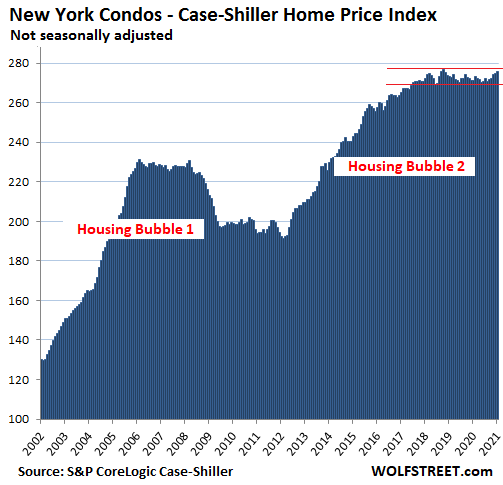
Condo prices in the area rose by 0.5% in January from December and are up 1.7% year-over-year, remaining in the same narrow range since January 2018, speckled with some bigger moves up and down:

63351 US Housing Case Shiller 2021 03 30 New York Condos In Housing Market Gone Nuts, Condo Prices Sag in San Francisco Bay Area, Hover in 3 Year Range in New York, Rise at Half Speed in Los Angeles

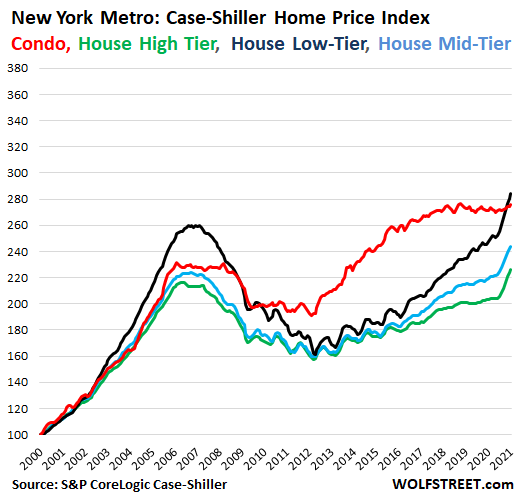
But prices of low-tier houses in the New York metro in January jumped 1.4% from December and 14.9% year-over-year. This includes houses in lower-cost areas of the market where Manhattan leavers have scurried to, thereby driving up prices.

Mid-tier house prices jumped 11.2% year-over-year. High-tier house prices jumped 11.3%; it is just over the past few months that high-tier prices began to exceed the peak of Housing Bubble 1. But condos did not participate in the price surges that houses reveled in.

The chart is on the same scale as the equivalent charts for Los Angeles and San Francisco, to show just how much faster prices have surged over the years in the two California metros than in the New York City metro. But since 2020, house prices in the New York metro are on fire across the board, though condos are not:

41026 US Housing Case Shiller 2021 03 30 New York price tiers In Housing Market Gone Nuts, Condo Prices Sag in San Francisco Bay Area, Hover in 3 Year Range in New York, Rise at Half Speed in Los Angeles

Enjoy reading WOLF STREET and want to support it? Using ad blockers – I totally get why – but want to support the site? You can donate. I appreciate it immensely. Click on the beer and iced-tea mug to find out how:

41026 BeerMug2 In Housing Market Gone Nuts, Condo Prices Sag in San Francisco Bay Area, Hover in 3 Year Range in New York, Rise at Half Speed in Los Angeles

Would you like to be notified via email when WOLF STREET publishes a new article? Sign up here.

41026 placeholder2 In Housing Market Gone Nuts, Condo Prices Sag in San Francisco Bay Area, Hover in 3 Year Range in New York, Rise at Half Speed in Los Angeles


Article source: https://wolfstreet.com/2021/03/30/in-a-housing-market-gone-nuts-condo-prices-sag-in-san-francisco-bay-area-hover-in-3-year-range-in-new-york-rise-at-half-speed-in-los-angeles/

Posted in SF Bay Area News | Tagged | Leave a comment

COVID impact: Will San Francisco’s commercial real estate market go back to normal?

SAN FRANCISCO, Calif. (KRON) – In San Francisco, there are signs that the coronavirus pandemic may be easing, but what will it take to attract workers back to the city and reinvigorate the commercial real estate market.  

Since the pandemic started just over a year ago, the number of workers commuting into San Francisco has plummeted.  

Many San Francisco-based companies, like Salesforce, have said that their employees can work from home permanently if they so choose.

As the number of coronavirus cases in San Francisco continues to drop and restrictions are eased, how many workers will return to the city and what will that mean for the commercial real estate market downtown?

“That is the million-dollar question,” Rodney Fong said. 

Rodney Fong is the President CEO of the San Francisco Chamber of Commerce.  

He says that in order to reinvigorate the market San Francisco must attract employers and employees back by confronting crime and cleanliness problems and working to get small businesses back into the many empty storefronts across the city.

“We need to step on the gas. These vacant spaces, whether they are cool little spaces in North Beach, their creative entrepreneur to open a flower stand. A flower stand would be so welcoming in San Francisco. We want to stimulate that kind of creativity. Encourage people to open businesses. Take chances on certain things and give them as many tools as possible to do that,” Fong said. 

He also says it’s important to attract visitors back to the city. Before the pandemic, 25.8 million people would visit San Francisco every year pumping huge amounts of money into the local economy.  

He says the key to getting them back is dealing with the pandemic and embracing what makes San Francisco great.

“I think for San Francisco I’m long term bullish,” Fong said. 

“We have to make sure that we put emphasis on the culture the arts and all the things that make San Francisco unique and the business community will follow.

Article source: https://www.kron4.com/news/bay-area/covid-impact-will-san-franciscos-commercial-real-estate-market-go-back-to-normal/

Posted in SF Bay Area News | Tagged | Leave a comment