Are Wall Street hedge funds buying up homes in the Bay Area?

Given that the Bay area is one of the priciest regions in the country with one of the most acute housing shortages, it raises the question, are we seeing an investment fund-led surge here?

Not really, according to local housing advocates, real estate experts, and sales data. While institutional investors do have a presence here, the reality of the Bay Area’s housing crunch is far more complicated, without a single cause or corporate villain.

The Chronicle obtained summary data from the John Burns Real Estate Consulting group, which looks at the percentage of homes where the property tax’s ZIP code differs from the ZIP code of the home address to determine roughly how many homes are bought by someone who doesn’t intend to live there, a good proxy for whether the home was purchased by an investor.

As of 2020, the percentage of homes in the Bay Area bought by investors each year was 15%, up from 10% in 2005. However, experts say it’s likely much of that increase happened around the 2008 mortgage crisis, when institutional investors purchased foreclosed homes en masse nationwide. As of the first quarter of 2021, the estimated share of homes purchased by investors has only increased by 1% so far this year, to 16%.

Furthermore, the percentage of homes bought by investors in the Bay Area remains substantially lower than in the United States overall. According to their data, 24% of homes were purchased by investors in the first quarter of 2021, an increase from about 21% in 2020.

The John Burns Real Estate data doesn’t specify which types of investors are buying homes — it includes anyone from a large corporation like American Homes 4 Rent, a company originally owned by Blackstone (a private equity firm often confused with BlackRock) to a smaller home-flipper or even a single family purchasing a vacation home.

But John Burns, the CEO of John Burns Real Estate Consulting, said in his experience, most Bay Area investors are house flippers and international companies and individuals. National hedge funds and other large corporate investors have been less active in the Bay Area during the pandemic than in more affordable housing markets like Phoenix and parts of Texas.

“The big money that is moving in (right now) is not moving into the Bay Area,” Burns told The Chronicle. “It’s going where homes are less expensive because they can rent them out more profitably.”

Burns said the Bay Area’s housing affordability crisis is due less to institutional investors and more to land shortages, strict zoning regulations and anti-development politics.

Nationwide, corporate institutional investors owned 300,000 single-family rental units as of 2019 — just 2% of the roughly 15 million rental homes that exist, according to Radian, a mortgage insurance company. The idea that hedge funds have bought substantially more single-family homes since then — and that this is a primary driver of the current housing affordability crisis in the Bay Area — does not appear to be supported by the data, Burns said.

“These big major single family rental operators … nationwide, all of them own single digits in terms of the rental stock in the country,” Dean Wehrli, a principal at Burns’ firm, told The Chronicle. “I think they will just gradually increase that market share but… it will take forever before they have a dominance in market share, if ever.”

Instead, the primary driver of California’s worsening housing affordability crisis appears to be the same thing it’s been for years: a severe shortage of homes. The state would need an estimated 3 million housing units to substantially improve affordability as of 2018, according to UCLA economist Jerry Nickelsburg. The squeeze on housing supply is particularly acute in the Bay Area, where a recent report from the National Low Income Housing Coalition estimated that a shortage of over 160,000 homes existed for households in poverty alone, not to mention working and middle-class families.

Adding to that are pandemic-led factors, like a huge number of young families entering the housing market for the first time and interested in their own space, plus historically low interest rates.

That’s not to say housing companies and big investors haven’t played an important role in the Bay Area’s current housing landscape, said Desiree Fields, a professor at UC Berkeley focusing on the financialization of the housing market. In one recent example, Wedgewood Inc., a private equity firm that flips houses, came to notoriety early last year when a group of Oakland mothers called Moms 4 Housing occupied one of the at least 125 properties it then owned across the Bay Area.

But most of the companies that own lots of Bay Area properties aren’t Wall Street-based; they’re smaller and local, Fields added.

These smaller investors, like Neil Sullivan of Sullivan Management Company/REO Homes in the East Bay and Mosser Capital, plus Veritas Investments in San Francisco, continue to acquire buildings to rent out, Erin McElroy, a founding member of the Anti-Eviction Mapping Project, told The Chronicle.

“What we are seeing is these other investment companies that are not Wall Street-based but nevertheless large. And they model some of the Wall Street investment companies’ strategies and tactics and are now the biggest landlords in the city and sometimes the worst evictors,” McElroy said.

Local institutional investors gained market share in the Bay Area following the mortgage crisis of 2008, when many lower-income families of color — particularly in the East Bay — were forced to default on their mortgages, causing their homes to be foreclosed. Corporate investors acquired nearly half of the homes that foreclosed in Oakland, and the properties they acquired were almost entirely in the city’s lower-income neighborhoods, according to a 2012 report by the Urban Strategies Council.

“You had these institutional, large and terrible landlords who were abusing tenants, kicking them out, trying to get a different class of clientele into their homes and totally changing the neighborhoods,” Kevin Stein, deputy director of the advocacy group California Reinvest Coalition, told The Chronicle.

A recent report by the Strategic Actions for a Just Economy found that areas in Los Angeles with higher concentrations of corporation-owned residential buildings tend to see larger rent increases than those with lower concentrations. Housing advocates are particularly concerned for tenants in single-family homes, which don’t have the same rent-control protections as multifamily units in California thanks to the Costa Hawkins law.

And while big investment firms may not yet be snapping up a bunch of homes in the Bay Area, Stein said, he and other housing advocates believe many are poised to start buying once California’s foreclosure protections expire.

“The foreclosure prevention is still in place. Right? The moratoriums are still in place. So we’ll see what happens right after,” California Reinvest organizer Jyotswaroop Bawa said, citing a recent report from the Institute of Policy Studies that found that the 20 largest landlords in the United States — 10 of which operate in California — have amassed at least $245 billion to purchase homes and related companies in the market.

Bawa and Stein are working to pass AB1199, a bill that would impose a tax on corporate landlords that rent out 10 or more properties and require companies to disclose their owner information on public documents.

Still, experts say that whatever institutional investors end up doing in the Bay Area will have been enabled by a housing shortage that predates them — caused by antidevelopment ordinances and officials, too much single-family zoning and homeowners that support policies to keep housing stock low and their own home values high.

“I think what drives people nuts about BlackRock investing in residential real estate is it gives away the whole game,” Jake Anbinder, a doctoral candidate in history at Harvard University, wrote on Twitter. “The largest investor isn’t BlackRock. It’s American homeowners. And they already have exactly the same incentive.”

Susie Neilson is a San Francisco Chronicle staff writer. Email: susie.neilson@sfchronicle.com Twitter: @susieneilson

Article source: https://www.sfchronicle.com/local/article/Are-Wall-Street-hedge-funds-buying-up-homes-in-16260880.php

Posted in SF Bay Area News | Tagged | Leave a comment

‘Sticker shock’: 49ers rookies warned about Bay Area housing cost – San Francisco 49ers Blog- ESPN

Jun 6, 2021

SANTA CLARA, Calif. — The day after Trey Lance became the No. 3 overall pick in the 2021 NFL draft, he arrived at the San Francisco 49ers’ facility for his first in-person meeting with coach Kyle Shanahan.

Shanahan had about 15 minutes to chat with Lance and his family, who were about to begin the process of looking for a place for him to live. Given the importance of the quarterback-coach relationship, some discussion of X’s and O’s or other football-related subjects would have been an understandable topic of conversation.

Instead, Shanahan offered a warning.

“We were hanging out and they were going to look for houses and things like that. I told him, ‘Don’t be too depressed. Everyone is very upset after the first couple of days and you realize you’ve got to change what you were looking for,’” said Shanahan of Bay Area housing prices. “And they’re like, ‘No, everyone’s told us.’ I’m like, ‘No, everyone told me, you’ll see, it’s real.’”

For all NFL rookies, there’s a necessary adjustment that goes beyond football. There’s an off the field element that goes with striking out on your own for the first time as an adult.

For 49ers rookies, there’s even more to consider as they arrive in one of the most unique — and expensive — markets in the NFL.

While San Francisco has long ranked among the costliest places to live in the United States, few 49ers actually stay in the city. The team’s Santa Clara headquarters are about 45 miles from the city, and even without traffic (good luck), that would be about a 50-minute commute each way. Alas, it doesn’t get much cheaper closer to Levi’s Stadium.

According to Monica Thomas, an agent at Compass Realty who works closely with the 49ers, the average sales price of a single-family home in Santa Clara County is $1.96 million, which buys a home that is roughly 1,800 square feet. Renting a two-bedroom apartment measuring 900-1,200 square feet averages somewhere between $2,500 and $4,000 per month, depending on amenities and location.

Thomas often advises players to get to know their surroundings and what they’re looking for before jumping into a decision.

“There’s definitely a period of time where it takes a day or two of kind of hitting the pavement and seeing different variations of what’s out there before what I see is guys feeling really comfortable and adjusting and getting used to the sticker shock of what you can get,” Thomas said.

For comparison’s sake, the average price of a single-family home in Green Bay, Wisconsin, the NFL’s smallest market, is $230,000 which would buy a 1,909-square-foot home. A 900-1,000-square-foot two-bedroom apartment rents for $800 to $1,200 per month (though those close to Lambeau Field can go for up to $3,000), according to Tiffany Holtz, a Coldwell Banker agent based there.

In Lance’s hometown of Marshall, Minnesota, the average sales price of a single-family home is $198,685, with an average size of about 2,100 square feet (including finished below-ground space). A two-bedroom apartment averages $700 per month for about 600-800 square feet, according to Jana Reilly of Keller Williams Realty in Marshall.

Considering those numbers, it’s easy to understand why rookies such as third-round cornerback Ambry Thomas gasp at the mere mention of the Bay Area’s cost of living.

“Once I got the phone call [I was drafted] I was happy, excited, then I thought about everything and I’m like, ‘California, tax, taxes’ and I started thinking about all that and the cost of living,” said Thomas, who grew up in Detroit before playing at Michigan. “I’m like, ‘Hey, it’s kind of expensive, very expensive.’ But I’m just grateful for the opportunity, honestly. Skip the cost of living and all that right now. I feel like my play will take care of my pockets.”

To that end, the 49ers work to ensure their players take care of their pockets before their play enters the conversation.

Much of that responsibility falls on Austin Moss II, the 49ers’ director of player engagement. It’s his job to “engage, educate and empower” players to “reach their full potential both on and off the field.” A big part of that job is helping players transition into and out of the NFL.

That work begins during the draft process as Moss learns which players are being targeted so he can begin putting plans in place to help them adjust. Soon after players are drafted, Moss introduces himself and lets them know he’s the go-to guy for any help needed making the transition to the league.

When the rookies arrive in Santa Clara, the real work begins. Moss, along with player engagement coordinator Shelby Soltau, provides a structured curriculum that essentially amounts to rookie school.

The group meets for an hour every day from Monday through Thursday for about four weeks.

The first week covers how to be a pro, with discussions on culture, expectations, setting a routine and maximizing available resources. Week 2 focuses on finances, with lessons on budgeting, building credits and expenses. Week 3 is called roadblocks, with talks on stress management, decision-making, relationships, life skills and leadership. The final week covers success beyond the game — helping the community, building a platform and preparing for what comes after football.

There’s even discussions on learning opportunities at notable Silicon Valley companies such as Apple, Tesla and Google that allow for players to take tours, meet executives and pursue offseason job shadows and internships.

Mixed into those conversations are plenty of guest appearances from other players on how to handle things like housing. Tight end George Kittle, a former fifth-round pick who lived with his now-wife and two teammates in an apartment during his rookie season, is always willing to share his experience.

“The one thing that’s really nice about playing football in Santa Clara is football’s the No. 1 priority at all times,” Kittle said. “You got to go out of your way to find something to do or find a way to get into trouble. I think it’s a great place to be able to go play football and just focus on it every single day. So for rookies, you tried your entire life to get to this level. Just because you have a couple dollars in your pocket, there’s no reason to change what you’ve been doing.”

Rentals and roommates are common for most Niners rookies. In fact, for any rookie taken lower than the second round, Moss recommends they do not buy a house until they’ve proved themselves on the field.

The 49ers foot the bill for housing through training camp, and when the roster and practice squad are set, players have options, including corporate housing, hotels and apartments. Beyond roommates, they are offered multiple avenues that can help save money. One method is to sign a shorter-term lease.

Although most buildings charge a premium for shorter or month-to-month leases, the Niners have relationships that can help facilitate such agreements a bit easier. It might cost more on the front end, but that money can be saved by moving and training in more cost-effective locales in the offseason.

Most young players tend to opt for condos or townhouses close to the team’s training facility, which helps them be on time for team activities but provides the added bonus of easy access to team-provided meals and weights.

That doesn’t mean it’s always easy. Monica Thomas took one player to 20 rental properties in a three-day span. Most players will look at five or six places and find themselves having to adjust their criteria because certain things aren’t necessarily attainable in their price range.

“It’s important for them to get established, get comfortable with the areas, and there’s so many little pockets in Santa Clara County that we advise maybe a rental the first year to get really comfortable with the area for a year before jumping into home purchasing, unless they really want to get it done,” Thomas said. “But we just want to make sure, especially in their age group, that they have a full grasp of what they’re getting into because every investment is important.”

In 2021, the rookie minimum base salary of $660,000 is still a lofty number for the average citizen. But California’s 13.3% state income tax rate remains the highest in the country. Although players are paid only in regular-season game checks based on where those games are played, the Niners are certain to have at least nine checks paid at the California rate every season.

So, while Lance will soon sign a fully guaranteed, four-year, $34.1 million contract with a $22.1 million signing bonus, he will ultimately take home something closer to $18.7 million, according to Spotrac. That’s more than enough for a large, comfortable home, but it helps explain why Lance is leaning toward renting for at least his first season and why he was grateful for his coach’s warning.

“I knew it would be kind of crazy, but it definitely helped giving me a little bit of a heads-up,” Lance said.

Article source: https://www.espn.com/blog/san-francisco-49ers/post/_/id/39107/sticker-shock-49ers-rookies-warned-about-bay-area-housing-cost

Posted in SF Bay Area News | Tagged | Leave a comment

As the Pandemic Appears to Wane, the Number of Homes for Sale Rises

Everybody has their ideal dream home in their dream city. Some yearn for a white picket fence in a quiet suburb. Others love the hustle and bustle of a New York apartment. San Francisco, the city by the Bay, has a little of both which may be why the number of homes for sale has since ticked up another 4 percent from a previous low. The new high is around 920, which is 10 percent more homes on the market than at the same time last year. The number of single family homes on sale is hovering around the same number as last year where while the number of condos on the market (650) is up 15 percent with the list price for 23 percent of the condos on the market having been reduced at least once. [SPONSORED]


ffadd best residential real estate agents sf As the Pandemic Appears to Wane, the Number of Homes for Sale Rises
Best S.F. Realtors


ffadd best residential real estate agents sf As the Pandemic Appears to Wane, the Number of Homes for Sale Rises
Best Marin Realtors


ffadd best residential real estate agents sf As the Pandemic Appears to Wane, the Number of Homes for Sale Rises
Best Oakland Realtors


ffadd best real estate agents in silicon valley As the Pandemic Appears to Wane, the Number of Homes for Sale Rises
Best San Jose Realtors


ffadd best property management companies in sf As the Pandemic Appears to Wane, the Number of Homes for Sale Rises
Best SF Property Managers


ffadd top commercial real estate brokers As the Pandemic Appears to Wane, the Number of Homes for Sale Rises
Commercial Real Estate Brokers


ffadd rental real estate agents As the Pandemic Appears to Wane, the Number of Homes for Sale Rises
Best Rental Realtors

Fortunately for realtors and bankers, expensive homes are up relative to last year, especially homes listed for more than $1 million. The share of views to homes listed for less than $300,000 shrank by 4.7 percentage points this year, while the share of traffic to homes listed between $300,000 and $1 million rose 3.3 percentage points. Traffic to listings above $1 million picked up the other 1.4 percentage points of traffic share. For renters, the metros that saw urban rents shrink the most compared to suburban rents are: Memphis (difference of 3.6 percentage points), Dallas (3.2), Sacramento (3.0), San Francisco (2.7), and New York (2.5).

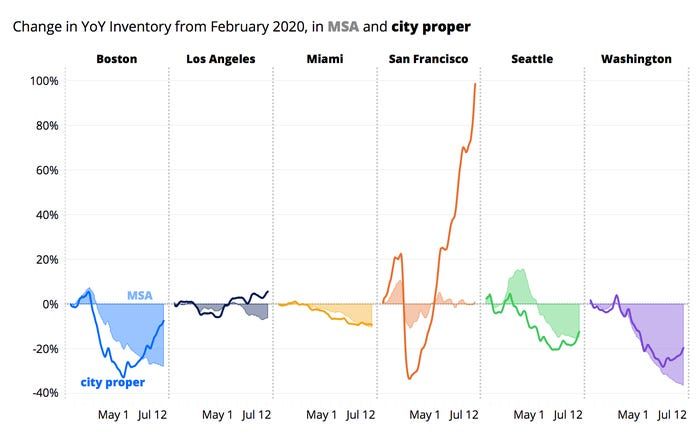
Housing inventory, or the number of homes on sale, within the city of San Francisco proper has skyrocketed by 96% since February, wildly different from similar housing markets like Miami, Boston, and Washington, DC. That spike in the central city hasn’t been matched by a shift in homes on the market elsewhere in the San Francisco metro area.

 As the Pandemic Appears to Wane, the Number of Homes for Sale Rises
Zillow Research

This, according to Zillow, is largely due to many of residents trying to sell their houses without a commensurate increase in buyers. Quite a shift for someone who has lived San Francisco since 2013 where sellers held onto their homes like their property was the Holy Grail. There are a multitude of theories and reasons why recent San Franciscan home owners are trying to sell, one being simply to be less crowded. The big jump in homeowners trying to sell in the city proper is consistent with an upswing in people looking for homes in less densely populated parts of northern California. Will that change when more and more people get the COVID-19 vaccine and again yearn for city life in San Francisco? Maybe.

California Policy Lab reported an exodus of residents during the coronavirus pandemic, with the net number of exits increasing 649% in 2020.

They also stated, “Although net migration to the Bay Area and San Francisco has dropped since this time last year, most movers appear to be sticking close to home, with approximately two-thirds of San Franciscan movers remaining in the Bay Area economic region and nearly 80% remaining in the state.”

Safe to say, previous residents didn’t go far.

Article source: https://sfist.com/2021/05/30/pandemic-appears-to-wane-the-number-of-homes-for-sale-rises/

Posted in SF Bay Area News | Tagged | Leave a comment

San Francisco ranks near the bottom of U.S. metro areas in home value increases

By comparison, home values in the U.S. overall rose 11.6% over the past year. And in some regions, including Phoenix and Austin, Texas, home values soared by more than 20%.

The S.F. and San Jose metropolitan areas actually rank at the very bottom of all major metropolitan areas for home value appreciation, noted Jeff Tucker, a senior economist at Zillow.

But, he said, these trends look very different at the county level.

“The big takeaway that I’m seeing here is, the most expensive parts of the Bay and the most urban parts of the Bay have had the slowest growth rates,” Tucker said.

That’s for a number of reasons, but a big one is that people are leaving San Francisco for other parts of the Bay Area and California, lowering demand compared to previous years.

These ex-San Franciscans and San Joseans are contributing to price increases in the more “affordable” Bay Area counties located within the San Francisco metropolitan area, like Alameda and Contra Costa: In those counties, home values increased by 14% and 14.3%, respectively, this year, even more than the U.S. average. Meanwhile, in San Francisco proper, home values actually decreased by 2.8%.

Not that any county in these metropolitan areas comes close to what most Americans would consider “affordable.” In San Jose, median home values are up to $1.36 million, while the San Francisco metro area’s home value has cracked an all-time high of $1.23 million. (Again, the S.F. metropolitan area includes those relatively more affordable counties, like Alameda and Contra Costa.)

Supply may also have affected the differences between the Bay Area and the rest of the country. While the home inventory nationwide was down 30.3% this April compared to last year, both the San Francisco and San Jose metro areas saw their home inventories increase compared to the previous year — inventory was up by 32% in the S.F. metro area and by 37% in San Jose.


Part of why the bay saw such a dramatic increase in supply stems from its strict response to the pandemic: The region’s housing market essentially shut down last April, normally the best time for home sales. That shutdown deflated housing stock for last April, making this April’s supply increase look especially large.

The Bay Area’s April 2020 real estate market pause likely had an especially strong effect because the region had so little housing supply to begin with, Tucker said: “In San Francisco, the levels of inventory are kind of notoriously low; it’s just not a market that has a deep liquid pool of homes trading and available.”

Still, prospective home buyers should take heart from the inventory increase — it reflects a real trend toward equilibrium between buyers and sellers in the Bay, according to Tucker.

“The pandemic and remote work has given more people options,” he said. “Maybe (they) keep that Bay Area job without having to live in the Bay Area.”

Susie Neilson is a San Francisco Chronicle staff writer. Email: susie.neilson@sfchronicle.com Twitter: @susieneilson

Article source: https://www.sfchronicle.com/local/article/The-pandemic-housing-boom-affected-the-Bay-Area-16196568.php

Posted in SF Bay Area News | Tagged | Leave a comment

S.F.’s real estate market is an outlier in one big way, according to latest Zillow data

Inventory in San Francisco has been rising monthly since February, according to the report, but nationwide, inventory saw its first monthly rise since July 2020. And inventory in San Francisco has been seeing year-over-year gains since last August, while nationwide inventory in May was down 31% from last year.

Matt Kreamer, a data public relations senior manager for Zillow, said the Bay Area is a “definite outlier” compared to the rest of the U.S.

“The Bay Area is really the only place inventory has been up from last year,” he said.

 S.F.’s real estate market is an outlier in one big way, according to latest Zillow data

For-Sale Inventory in San Francisco in May 2021.

Zillow Economic Research

However, “That hasn’t done a lot to slow home value growth or the pace of sales,” he said. “Much of that annual change has to do with how incredibly low it was a year ago, so there’s still a long way to go before inventory catches up to demand.”

While more homes are available, the Bay Area’s housing market has remained red-hot: Prices are at record levels and rising, selling within days, often at well over asking price, according to Zillow’s May market report.

A typical home in San Francisco is worth $1.26 million, which is the record high for the city, according to Zillow. That’s up 11.6% from a year ago and 2.8% since April. The value of a typical home as calculated by Zillow is an average of the middle third of the market, minus the top and bottom 5%. The full methodology can be found here.

 S.F.’s real estate market is an outlier in one big way, according to latest Zillow data

Zillow Home Value Index in San Francisco in May 2021.

Zillow Economic Research

Homes in San Francisco are staying on the market for about nine days before going under contract, with 61% of homes selling above the list price in March compared to 46% in March 2020.

Zillow data shows that, in San Jose, a typical home is worth $1.38 million, up 11.4% more than a year ago and 3.3% since April. Homes in that city stayed on the market for about 11 days before being scooped up, and 60% of homes sold above the list price in March compared to 48% in March 2020.

Kreamer said while home values are up more than 11% from a year ago in the Bay Area, growth in the region was still behind the national rate of 13.2% and well behind some popular destinations for local residents seeking to relocate to elsewhere in the state — such as Sacramento and San Diego, where growth in home values was near 20%.

“The Bay Area is the most expensive housing market in the country, and growth had slowed and even turned negative in places before the pandemic because so many people simply couldn’t afford to buy there,” Kreamer said. “But the pandemic brought with it the Great Reshuffling — masses of Americans moving to homes that better suit their new needs — and much of the current growth is being carried by suburbs in the East and North Bay, while it’s much slower in the city of San Francisco.”

Kreamer said Zillow expects home values to keep rising at a similar pace in the short-term with continued high demand, low mortgage rates and increasing numbers of Millennials looking to buy homes amid record-low inventory.

“Our current forecast calls for 15% growth nationally by a year from now,” he said. “The Bay Area’s likely to be slightly below that, but still incredibly high by historical standards.”

 S.F.’s real estate market is an outlier in one big way, according to latest Zillow data

Zillow Observed Rent Index in May 2021.

Zillow Economic Research

Rental prices are also increasing in the Bay Area, going up 1.6% since April in San Francisco with a typical rent of $2,867. Typical rents are found by calculating price differences for the same rental unit over time, then aggregating those differences across all properties repeatedly listed for rent on Zillow. The company also created weights for the index based on the latest U.S. Census Bureau data. Find the methodology here.

Rental prices in San Francisco bottomed out at $2,786 in January and have been increasing monthly ever since, according to Zillow. In San Jose, typical rent was $2,874, up 1.6% since April. Prices in that city bottomed out in February at $2,801 and ticked up each month since.

Rents in the Bay Area are still well below their prices a year ago — down 5.9% year-over-year in San Francisco and down 4.9% year-over-year in San Jose — but the gap is closing, the Zillow report said.

Kellie Hwang is a San Francisco Chronicle staff writer. Email: kellie.hwang@sfchronicle.com Twitter: @KellieHwang

Article source: https://www.sfchronicle.com/local/article/S-F-s-real-estate-market-is-an-outlier-in-one-16256383.php

Posted in SF Bay Area News | Tagged | Leave a comment