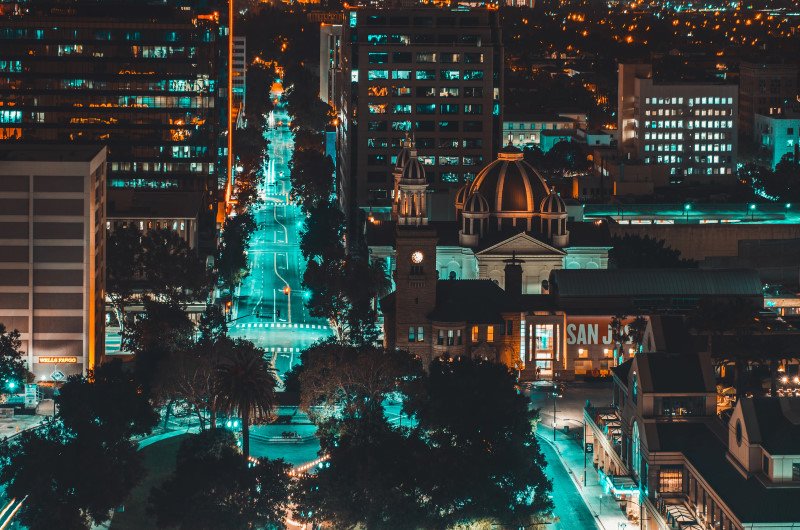
The American Dream may or may not still be that white-picket fence surrounding a lush green lawn and a big tree that supports a wooden swing. With our current megadrought, of course, most grass is turning brown for now, and for those living in San Francisco that dream of owning a house with a yard may be more of a fantasy anyhow. Those seeking to buy a property in Marin, find the perfect home in Oakland, or settle into San Jose real estate do often have the opportunity to find such outdoor spaces, but it comes at a price. Aesthetics aside, the cost can be prohibitive for those who don’t have a significant annual salary. Unfortunately, San Francisco and San Jose are the top two metro areas with the highest share of million-dollar homes, according to a new report from LendingTree.
Million-dollar homes are relatively uncommon throughout most of the country. Only 4.27% of the owner-occupied homes in the nation’s 50 largest metros are valued at $1 million or more. Luckily for us non-millionaires (statistics show that there were 5.32 million people in the United States who had financial assets worth at least $1 million in 2018) not all houses are worth that much but, for those few looking to buy real estate, San Francisco and San Jose is the cream of the crop.
For those familiar with Bay Area real estate, it comes as no surprise that San Jose actually outranks San Francisco, stealing the top spot for number of single-family, owner-occupied dwellings that were valued over $1 million — due in no small part to its proximity to Silicon Valley and the relative distance from the hustle-and-bustle of city life. In San Jose, there are roughly 373,000 single-family housing units in total, and the number of real estate properties valued at or above $1 million stands at around 176,243, or about 47.29%. The median value of owner-occupied housing units is $968,800.
San Francisco ranks number two on the list. The City by the Bay’s overall number of housing units hovers around 931,032. The number of units valued at or above $1 million is 337,480, thus the percentage of units in this $1+ million range is 36.25%. Today, the median value of owner-occupied housing units is at $840,600 in San Francisco.
Two other California metro areas round out the top four on the list: Los Angeles ranked third after San Francisco, with 17% of its homes valued at or over $1 million, followed by San Diego at 12.2%, according to LendingTree’s analysis. Economic analysts for LendingTree expect that the percentage of million-dollar homes in these areas to push further still in 2021. LendingTree used Census data to look at the share of million-dollar homes in the nation’s 50 largest metros.
The sunshine state, after a hard year of COVID restrictions and ongoing fires, still reigns supreme in the housing market. Of the 10 metros with the largest share of million-dollar homes, the four with the highest percentage of million-dollar homes are all in California. Driven by a high concentration of wealth originating in the tech and entertainment industries, an average of 28.19% of homes across San Jose, San Francisco, Los Angeles, and San Diego are valued at at least $1 million.
Article written by Mitchell Duran. Sponsored Content.
There are dance parties on weekends, bike and hiking trails and fishing ponds. Children can take a golf cart on wide, low-traffic roads to attend the local elementary school — parents optional, depending on age. In the Bay Area, it can take a year or two to secure child care. There’s no wait in Austin.
“I feel like we have more friends here now than we’ve ever had in California,” Josh Rubbicco said. “People were so welcoming and friendly.”
The weather is warm and similar to the East Bay, said Rubbicco, who works for a software company with a Bay Area office that’s allowing permanent remote work. Texas Hill Country’s offerings are reminiscent of Napa, thanks to an array of wineries and distilleries. In the nearby town of Driftwood, there’s the 54-year-old landmark Salt Lick Bar-B-Que, built on a family ranch, with its vast cooking pit overflowing with meats and drawing hungry crowds. A 25-minute drive to downtown means easy access to Austin’s raucous bars and restaurants, where live music was blasting and drinks were flowing last month, even as much of the country was still locked down.
There are some downsides: intense storms, more bugs and humidity. But for the Rubbiccos, like many Californians before them, the math behind the move was irresistible.
The price of a typical house in the East Bay is now around $1 million. A larger, newer house in Austin with a yard and access to better schools is around half the price, though that’s swiftly rising.
Austin’s median home price surged 35% in May compared to the prior year, to a record high of $566,562, according to the Austin Board of Realtors. Total home sales were up 55%, to 1,270, compared to the prior year.
Experts say Austin’s boom, particularly during the pandemic, has been accelerated by Californians and Bay Area giants like Apple, Facebook, Google and Tesla that are all hiring in Austin. Last year, a record 22,114 jobs were added from companies relocating and expanding in the region, including at least 5,000 from Tesla in its new mega-factory rising just east of Austin, according to the Austin Chamber of Commerce. Palantir co-founder Joe Lonsdale, podcast host Joe Rogan and Tesla CEO Elon Musk all made the California-to-Texas move during the pandemic. That’s a lot of newcomers looking for homes.
“If the house is pretty attractive, we might see anywhere from 30 to 50 offers, and the Californians tend to win because they understand this game a lot better than the Texans,” said Ray Shapley, the Rubbiccos’ real estate broker and an Austin native. More than half of his clients are now from California.
Prices of 20% to 25% over asking are common. Shapley knows a buyer who paid for a newly built house, never moved in and sold for a profit of more than $200,000.
Luxury home builder Toll Brothers, the developer building the Rubbiccos’ new home, has 36 lots to sell in Dripping Springs, a suburb just southwest of Austin, with prices starting in the low $800,000s. Shapley said such homes would have taken a while to sell before the pandemic. Today, there’s a waiting list of over 200 people, the company said.
Jessi and Josh Rubbicco moved from Bay Area to Austin, Texas, with children, Emma, 4, and Brady, 2. Austin is closing in on San Jose as the 10th largest city in the U.S.
Photos by Ilana Panich-Linsman/Special to The Chronicle
“The pricing power of Austin, which is number one in the country, is driven by California, plain and simple,” Toll Brothers CEO Douglas Yearley said on an earnings call last month. “The phenomenon is fascinating. We’ve never seen migration like this.”
The five-county Austin area saw a 48,873-person population increase through domestic migration last year, a 17.7% jump from 2019, according to census data released last month. Texas was the second-most popular out-of-state destination for residents from six Bay Area counties between March and November last year, drawing 749 address change requests, according to U.S. Postal Service data. However, more than 96% of address changes from those counties were within California.
Austin’s population is now on the cusp of 1 million people and about to surpass San Jose as America’s 10th largest city. It’s just 18,300 people behind Silicon Valley’s biggest city, which lost 1.3% of its population, according to census data dating to July 1, 2020. In the same time frame, San Francisco’s population shrank by 1.4%.
“I think what we’re seeing is this fundamental change to Central Texas. I think that we’re seeing this massive restructuring or migration in the U.S. right now,” Shapley said. “I think the last few decades kind of belong to California. I think the next few decades might belong to Central Texas.
“As someone who was born here and loves Central Texas the way it is, I don’t know that I necessarily love that.”
Mark and Jamie de Grasse moved to Austin in 2014 from the Los Angeles area, after the sale of Mark’s marketing company to a Texas firm.
They traded one- to two-hour commutes in Southern California for a 10-minute drive from their southwest neighborhood to downtown. De Grasse, who now runs his own business, said the lack of state income tax makes it easier to hire workers, particularly for small business owners.
He and his wife also found a sense of community that was lacking on the West Coast. Neighbors offer help for both routine tasks and during disasters like last winter’s devastating storm and power outages.
“You definitely feel like you’re missed if you’re gone,” Jamie de Grasse said. “When I was in California, I don’t ever feel that I knew my neighbors.”
They bought a house in Austin for around $450,000 and sold it for $675,000 two years later. Houses in Southern California were twice as expensive and 50 years older, they said. Last fall, they bought their dream house. It has 3 acres, a pool, warehouse, barn and pasture for two horses. It cost $860,000, and with additional renovations, Jamie de Grasse estimates that it’s now worth $1.5 million.
The de Grasse family is at home in Austin, Texas: Damien, 9; Jamie and Mark de Grasse; Declan de Grasse, 8; and Colin Paschke, 12.
Ilana Panich-Linsman/Special to The Chronicle
Not everything is cheaper in Austin. Property taxes are higher than in California, exceeding 3% in some areas, compared to the 1% base rate in California.
And there are no protections like California’s Proposition 13, which limits how much property taxes can increase. Austin houses are reassessed every year, potentially exposing homeowners to crazy market conditions like the current frenzy.
“We pay probably over $1,000 a month for property taxes,” Jamie de Grasse said. “It’s significant. But I’m OK paying that. Because we have good schools. We have good roads.”
San Francisco had its hippies in Haight-Ashbury and beat poets in North Beach, neighborhoods that now have some of the highest rents in the country. Some of Austin’s quirky appeal — and its “Keep Austin Weird” ethos — has also vanished or been uprooted. A college town known for indie rock music, tacos and brisket is now an economic powerhouse, and tastes are getting more expensive.
In 2016, Sfanthor House of Wax, which featured replicas of movie monsters, closed its castle-like building on South Congress Avenue. It was demolished for an office and retail project called Music Lane. The wax monsters have fled to the downtown Museum of the Weird, replaced by upscale brands like Equinox, Everlane, Lululemon and Sweetgreen.
Just west of downtown, a vacant lot on Castle Hill served as a graffiti mecca. For seven years, it welcomed anyone to spray-paint on concrete walls with views of the brown dome of the Texas State Capitol. Now it’s fenced off and is being excavated to prepare for new condos. Prices for the units start at $3.61 million, and two have already sold, according to television station KVUE. The arts group behind the murals reached an amicable deal to open a new arts center 10 miles to the east.
The relentless growth pressure has city officials and housing experts worried that Austin may be experiencing the early stages of a housing crisis like the one that consumes the Bay Area.
“We used to say, ‘Well, we’re not San Francisco yet.’ But it’s starting to feel a lot like what you all experienced,” said Nora Linares-Moeller, executive director of HousingWorks Austin, an affordable housing advocacy group.
New homes are built around Austin. And, in some neighborhoods, the homes have waiting lists with hundreds of people wanting to purchase them.
Ilana Panich-Linsman/Special to The Chronicle
A key difference is Austin has room to grow, said Jake Wegmann, an associate professor at the University of Texas who studies housing. The city spans 271 square miles, with only the meandering Colorado River as a natural barrier.
“The one saving grace that we have, and the way in which we really don’t look like a California city or a West Coast city, is that there is lots of room to sprawl,” Wegmann said, calling it a “pressure release valve.”
“I don’t think that (home prices) are ever going to be quite as extreme as they are in the Bay Area,” said Wegmann, who previously studied at UC Berkeley.
But growing outward instead of upward has a cost. Workers who flee to cheaper satellite areas have to pay more for gas to get to jobs downtown. Traffic is worsening.
The neighborhoods most vulnerable to gentrification, primarily in north and east Austin, are where many low-income Black and Latino residents live, according to a 2018 city-sponsored study.
“We’ve had more folks be pushed out more and more,” said Awais Azhar, an Austin planning commissioner and HousingWorks board member. “We know there’s a lot of folks who historically lived here whose incomes are not keeping pace.”
Voters are responding. After measures failed in 2000 and 2014, residents passed a $7 billion transit plan last November, funded with higher property taxes to expand bus and rail lines. It includes $300 million for an anti-displacement fund that could aid struggling homeowners or build new affordable units.
There are three new rail lines going north and south, including an underground tunnel in downtown, planned over the next decade.
“This is Texas, and people love their cars. But we will not survive as a city … if we’re not able to provide alternative modes for transportation,” Austin Mayor Steve Adler said.
We’re telling the story of the Bay Area’s pandemic-transformation in the Bay Area Disrupted newsletter.
As in the Bay Area, Austinites have been happy to raise money for transit and housing, but the fight over where to put taller buildings has been bitter.
A nearly decade-long effort to update Austin’s 1984 land development code to allow denser housing in single-family neighborhoods has been mired in backlash, delays and a lawsuit that’s reminiscent of Bay Area housing fights, Wegmann said.
A six-year, $8.5 million plan called CodeNext was canceled in 2018. Adler called the effort “divisive and poisoned” at the time, while reiterating support for an overhaul.
Last year, a City Council-backed rewrite stalled after 19 homeowners sued and a judge ruled in their favor. The city has appealed the decision.
“The city does not have enough housing,” Adler said. “Our biggest challenge moving forward is preserving the diversity and the creativity that exists in our city. It’s an affordability issue, it’s a housing issue, it’s an access to opportunity issue.”
Perhaps the most visible sign of Austin’s housing turmoil, aside from the cranes dotting downtown, are the tents.
In a scene familiar to Californians, homeless people camp under freeways and in public spaces, including within a waterfront park across the street from a massive, partially built tower leased by Google. A few blocks away, tents encircled Austin’s City Hall last month in a protest, after voters passed a ballot measure in May that made camping in public spaces a criminal activity, reversing a 2019 City Council vote. Police began clearing them this month.
The city has a plan to build housing for 3,000 homeless people over the next three years, roughly its entire unhoused population, and Adler is optimistic. He doesn’t see San Francisco as an economic rival, but rather a place that can offer a lesson: Act fast.
People walk and scoot down South Congress Avenue in Austin. The capital city is in a housing frenzy, partially driven by incoming Californians.
Photos by Ilana Panich-Linsman/Special to The Chronicle
“It might be too far gone at this point to turn that around. At least not for decades,” Wegmann said.
But for all the cost disparities, he doesn’t see the demise of the Bay Area, which is still the “capital of innovation,” home to the biggest tech companies and powerful institutions like Stanford and Berkeley, along with natural beauty and sublime weather. Even Oracle, which moved its headquarters to Austin last year, is keeping some employees in the Bay Area.
“I don’t think any of that’s going away in the Bay Area. But I do think that the Bay Area is headed for a future where it’s a little bit less dynamic … more slow-growing” he said. “Austin is going to be more fast-growing and dynamic and fast-changing.”
For the Rubbiccos, the daily grind of getting up early, getting kids to day care and commuting on BART to an office just to open a laptop and take phone calls has given way to a home life that allows a focus on children and family — and a bigger house and yard to enjoy it.
“I love the Bay Area, I was born and raised there. I have nothing bad to say about it,” Jessi Rubbicco said. “I think we were just looking for something different for our family. COVID put in perspective what we wanted.”
Roland Li is a San Francisco Chronicle staff writer. Email: roland.li@sfchronicle.com Twitter: @rolandlisf
About 20 years later, Pourshams is working as a physician at Stanford University, and he remembers well how he’d drive home from Davis every weekend, where he’d help his father with his real estate business, work on his grueling pre-med homework, then drive back to campus.
At 18, while pursuing medicine in his undergraduate studies, he received his real estate license, which he studied for between classes in high school (“I finished my finals at Davis, then went to Oakland and took my real estate exam.”) He went onto medical school at Ross University in the Caribbean, where he put his real estate career on hold.
“I paid for college [as a realtor], then I paid my way through the first year of medical school,” he said. He next joined a program that will pay off his remaining student debt after he works for 10 years in public health.
We in the Bay Area are all too familiar with side gigs. But Pourshams’ moonlighting as a realtor-broker is unusual, even for this expensive region. But the physician seems to enjoy the constant switching. Currently, he works four-and-a-half days a week at Stanford. He does real estate in his “free time.”
Idean Pourshams, gives us a tour of a home for sale in Menlo Park.
Patricia Chang/Special to SFGATE
Pourshams keeps two cell phones — one for medicine and his personal life, and one for real estate. Each has a different ring tone and text chime, so before even looking at his phones, he knows which hat to wear. During breaks on his rounds or in his research, he’ll respond to inquiries, check on the status of a sale or post a listing.
“I think I’ve always been good at compartmentalizing,” he said. “I grew up doing martial arts, so my mental fortitude comes from that training. They used to push us hard and say, ‘It’s all in your mind, you can control it.’”
The key, he says, is completely disengaging from one task to focus on the other.
When I asked which profession made him the most money — medicine or real estate — Pourshams didn’t hesitate.
“I make more money as a realtor,” he said. “It’s hilarious, I know.”
With that comes a drive to give back to his region. He started a nonprofit called Mina’s Wellness, focused on helping children learn to make good health decisions. And he recognizes the insidiousness of the cycle of debt and renter-dom.
“It’s like, you need an education in order to get a job. But then you have all this debt, so you need a home so you’re not constantly paying a landlord,” he said.
He knows the cycle himself. Pourshams says he still has nearly half-a-million in debt from medical school. At 37, he’s just now starting to look at buying a house, but he’s priced out of the town where his family lives (Los Gatos).
In 2018, Pourshams founded his own real estate company, called TuuKasa. His dad handles most of the day-to-day and operates the company under Pourshams’ broker license. “Real estate,” he affirms with a laugh, “is essentially a hobby.”
Idean Pourshams, gives us a tour of a home for sale in Menlo Park.
Patricia Chang/Special to SFGATE
And he’s quick to acknowledge his privilege in all of this. He says he would never have gotten into real estate if it weren’t for his familial ties. He finds much of the industry altogether unsavory. And he can’t believe the rates most Bay Area realtors charge — about 5% per sale, he says. Pourshams charges about 2% by comparison.
Pourshams discusses this region’s housing situation with a jaded clarity. He says he “hates” realtors who drive Lamborghinis just for the image. He loathes the “Trump mentality” that some of his peers have.
“I know realtors considered the best of the best that don’t pay their stagers. They have debt toward them, which they never pay back.”
“For example, when these people close a deal, they tell a roofer, I’ll pay you when escrow closes,” he adds. “They don’t pay them. It’s like, you’ll have to come after me if you want your money.”
Pourshams has even more pursuits on the horizon. He eventually wants to open a health clinic-gym, where he can teach his patients exercises firsthand. Pourshams, naturally, used to work as a personal trainer.
In the meantime, he’s pursuing his “smaller” goals. He’s been studying law under his neighbor “as a hobby.” In the fall, he plans to take the California Bar Examination.
“It’s not because I want to practice law or anything, I just see it as an interesting challenge,” he said.
There are dance parties on weekends, bike and hiking trails and fishing ponds. Children can take a golf cart on wide, low-traffic roads to attend the local elementary school — parents optional, depending on age. In the Bay Area, it can take a year or two to secure child care. There’s no wait in Austin.
“I feel like we have more friends here now than we’ve ever had in California,” Josh Rubbicco said. “People were so welcoming and friendly.”
The weather is warm and similar to the East Bay, said Rubbicco, who works for a software company with a Bay Area office that’s allowing permanent remote work. Texas Hill Country’s offerings are reminiscent of Napa, thanks to an array of wineries and distilleries. In the nearby town of Driftwood, there’s the 54-year-old landmark Salt Lick Bar-B-Que, built on a family ranch, with its vast cooking pit overflowing with meats and drawing hungry crowds. A 25-minute drive to downtown means easy access to Austin’s raucous bars and restaurants, where live music was blasting and drinks were flowing last month, even as much of the country was still locked down.
There are some downsides: intense storms, more bugs and humidity. But for the Rubbiccos, like many Californians before them, the math behind the move was irresistible.
The price of a typical house in the East Bay is now around $1 million. A larger, newer house in Austin with a yard and access to better schools is around half the price, though that’s swiftly rising.
Austin’s median home price surged 35% in May compared to the prior year, to a record high of $566,562, according to the Austin Board of Realtors. Total home sales were up 55%, to 1,270, compared to the prior year.
Experts say Austin’s boom, particularly during the pandemic, has been accelerated by Californians and Bay Area giants like Apple, Facebook, Google and Tesla that are all hiring in Austin. Last year, a record 22,114 jobs were added from companies relocating and expanding in the region, including at least 5,000 from Tesla in its new mega-factory rising just east of Austin, according to the Austin Chamber of Commerce. Palantir co-founder Joe Lonsdale, podcast host Joe Rogan and Tesla CEO Elon Musk all made the California-to-Texas move during the pandemic. That’s a lot of newcomers looking for homes.
“If the house is pretty attractive, we might see anywhere from 30 to 50 offers, and the Californians tend to win because they understand this game a lot better than the Texans,” said Ray Shapley, the Rubbiccos’ real estate broker and an Austin native. More than half of his clients are now from California.
Prices of 20% to 25% over asking are common. Shapley knows a buyer who paid for a newly built house, never moved in and sold for a profit of more than $200,000.
Luxury home builder Toll Brothers, the developer building the Rubbiccos’ new home, has 36 lots to sell in Dripping Springs, a suburb just southwest of Austin, with prices starting in the low $800,000s. Shapley said such homes would have taken a while to sell before the pandemic. Today, there’s a waiting list of over 200 people, the company said.
Jessi and Josh Rubbicco moved from Bay Area to Austin, Texas, with children, Emma, 4, and Brady, 2. Austin is closing in on San Jose as the 10th largest city in the U.S.
Photos by Ilana Panich-Linsman/Special to The Chronicle
“The pricing power of Austin, which is number one in the country, is driven by California, plain and simple,” Toll Brothers CEO Douglas Yearley said on an earnings call last month. “The phenomenon is fascinating. We’ve never seen migration like this.”
The five-county Austin area saw a 48,873-person population increase through domestic migration last year, a 17.7% jump from 2019, according to census data released last month. Texas was the second-most popular out-of-state destination for residents from six Bay Area counties between March and November last year, drawing 749 address change requests, according to U.S. Postal Service data. However, more than 96% of address changes from those counties were within California.
Austin’s population is now on the cusp of 1 million people and about to surpass San Jose as America’s 10th largest city. It’s just 18,300 people behind Silicon Valley’s biggest city, which lost 1.3% of its population, according to census data dating to July 1, 2020. In the same time frame, San Francisco’s population shrank by 1.4%.
“I think what we’re seeing is this fundamental change to Central Texas. I think that we’re seeing this massive restructuring or migration in the U.S. right now,” Shapley said. “I think the last few decades kind of belong to California. I think the next few decades might belong to Central Texas.
“As someone who was born here and loves Central Texas the way it is, I don’t know that I necessarily love that.”
Mark and Jamie de Grasse moved to Austin in 2014 from the Los Angeles area, after the sale of Mark’s marketing company to a Texas firm.
They traded one- to two-hour commutes in Southern California for a 10-minute drive from their southwest neighborhood to downtown. De Grasse, who now runs his own business, said the lack of state income tax makes it easier to hire workers, particularly for small business owners.
He and his wife also found a sense of community that was lacking on the West Coast. Neighbors offer help for both routine tasks and during disasters like last winter’s devastating storm and power outages.
“You definitely feel like you’re missed if you’re gone,” Jamie de Grasse said. “When I was in California, I don’t ever feel that I knew my neighbors.”
They bought a house in Austin for around $450,000 and sold it for $675,000 two years later. Houses in Southern California were twice as expensive and 50 years older, they said. Last fall, they bought their dream house. It has 3 acres, a pool, warehouse, barn and pasture for two horses. It cost $860,000, and with additional renovations, Jamie de Grasse estimates that it’s now worth $1.5 million.
The de Grasse family is at home in Austin, Texas: Damien, 9; Jamie and Mark de Grasse; Declan de Grasse, 8; and Colin Paschke, 12.
Ilana Panich-Linsman/Special to The Chronicle
Not everything is cheaper in Austin. Property taxes are higher than in California, exceeding 3% in some areas, compared to the 1% base rate in California.
And there are no protections like California’s Proposition 13, which limits how much property taxes can increase. Austin houses are reassessed every year, potentially exposing homeowners to crazy market conditions like the current frenzy.
“We pay probably over $1,000 a month for property taxes,” Jamie de Grasse said. “It’s significant. But I’m OK paying that. Because we have good schools. We have good roads.”
San Francisco had its hippies in Haight-Ashbury and beat poets in North Beach, neighborhoods that now have some of the highest rents in the country. Some of Austin’s quirky appeal — and its “Keep Austin Weird” ethos — has also vanished or been uprooted. A college town known for indie rock music, tacos and brisket is now an economic powerhouse, and tastes are getting more expensive.
In 2016, Sfanthor House of Wax, which featured replicas of movie monsters, closed its castle-like building on South Congress Avenue. It was demolished for an office and retail project called Music Lane. The wax monsters have fled to the downtown Museum of the Weird, replaced by upscale brands like Equinox, Everlane, Lululemon and Sweetgreen.
Just west of downtown, a vacant lot on Castle Hill served as a graffiti mecca. For seven years, it welcomed anyone to spray-paint on concrete walls with views of the brown dome of the Texas State Capitol. Now it’s fenced off and is being excavated to prepare for new condos. Prices for the units start at $3.61 million, and two have already sold, according to television station KVUE. The arts group behind the murals reached an amicable deal to open a new arts center 10 miles to the east.
The relentless growth pressure has city officials and housing experts worried that Austin may be experiencing the early stages of a housing crisis like the one that consumes the Bay Area.
“We used to say, ‘Well, we’re not San Francisco yet.’ But it’s starting to feel a lot like what you all experienced,” said Nora Linares-Moeller, executive director of HousingWorks Austin, an affordable housing advocacy group.
New homes are built around Austin. And, in some neighborhoods, the homes have waiting lists with hundreds of people wanting to purchase them.
Ilana Panich-Linsman/Special to The Chronicle
A key difference is Austin has room to grow, said Jake Wegmann, an associate professor at the University of Texas who studies housing. The city spans 271 square miles, with only the meandering Colorado River as a natural barrier.
“The one saving grace that we have, and the way in which we really don’t look like a California city or a West Coast city, is that there is lots of room to sprawl,” Wegmann said, calling it a “pressure release valve.”
“I don’t think that (home prices) are ever going to be quite as extreme as they are in the Bay Area,” said Wegmann, who previously studied at UC Berkeley.
But growing outward instead of upward has a cost. Workers who flee to cheaper satellite areas have to pay more for gas to get to jobs downtown. Traffic is worsening.
The neighborhoods most vulnerable to gentrification, primarily in north and east Austin, are where many low-income Black and Latino residents live, according to a 2018 city-sponsored study.
“We’ve had more folks be pushed out more and more,” said Awais Azhar, an Austin planning commissioner and HousingWorks board member. “We know there’s a lot of folks who historically lived here whose incomes are not keeping pace.”
Voters are responding. After measures failed in 2000 and 2014, residents passed a $7 billion transit plan last November, funded with higher property taxes to expand bus and rail lines. It includes $300 million for an anti-displacement fund that could aid struggling homeowners or build new affordable units.
There are three new rail lines going north and south, including an underground tunnel in downtown, planned over the next decade.
“This is Texas, and people love their cars. But we will not survive as a city … if we’re not able to provide alternative modes for transportation,” Austin Mayor Steve Adler said.
We’re telling the story of the Bay Area’s pandemic-transformation in the Bay Area Disrupted newsletter.
As in the Bay Area, Austinites have been happy to raise money for transit and housing, but the fight over where to put taller buildings has been bitter.
A nearly decade-long effort to update Austin’s 1984 land development code to allow denser housing in single-family neighborhoods has been mired in backlash, delays and a lawsuit that’s reminiscent of Bay Area housing fights, Wegmann said.
A six-year, $8.5 million plan called CodeNext was canceled in 2018. Adler called the effort “divisive and poisoned” at the time, while reiterating support for an overhaul.
Last year, a City Council-backed rewrite stalled after 19 homeowners sued and a judge ruled in their favor. The city has appealed the decision.
“The city does not have enough housing,” Adler said. “Our biggest challenge moving forward is preserving the diversity and the creativity that exists in our city. It’s an affordability issue, it’s a housing issue, it’s an access to opportunity issue.”
Perhaps the most visible sign of Austin’s housing turmoil, aside from the cranes dotting downtown, are the tents.
In a scene familiar to Californians, homeless people camp under freeways and in public spaces, including within a waterfront park across the street from a massive, partially built tower leased by Google. A few blocks away, tents encircled Austin’s City Hall last month in a protest, after voters passed a ballot measure in May that made camping in public spaces a criminal activity, reversing a 2019 City Council vote. Police began clearing them this month.
The city has a plan to build housing for 3,000 homeless people over the next three years, roughly its entire unhoused population, and Adler is optimistic. He doesn’t see San Francisco as an economic rival, but rather a place that can offer a lesson: Act fast.
People walk and scoot down South Congress Avenue in Austin. The capital city is in a housing frenzy, partially driven by incoming Californians.
Photos by Ilana Panich-Linsman/Special to The Chronicle
“It might be too far gone at this point to turn that around. At least not for decades,” Wegmann said.
But for all the cost disparities, he doesn’t see the demise of the Bay Area, which is still the “capital of innovation,” home to the biggest tech companies and powerful institutions like Stanford and Berkeley, along with natural beauty and sublime weather. Even Oracle, which moved its headquarters to Austin last year, is keeping some employees in the Bay Area.
“I don’t think any of that’s going away in the Bay Area. But I do think that the Bay Area is headed for a future where it’s a little bit less dynamic … more slow-growing” he said. “Austin is going to be more fast-growing and dynamic and fast-changing.”
For the Rubbiccos, the daily grind of getting up early, getting kids to day care and commuting on BART to an office just to open a laptop and take phone calls has given way to a home life that allows a focus on children and family — and a bigger house and yard to enjoy it.
“I love the Bay Area, I was born and raised there. I have nothing bad to say about it,” Jessi Rubbicco said. “I think we were just looking for something different for our family. COVID put in perspective what we wanted.”
Roland Li is a San Francisco Chronicle staff writer. Email: roland.li@sfchronicle.com Twitter: @rolandlisf
It’s no secret that Bay Area living is expensive, so much so that many people are leaving or coming up with some very creative solutions. If you’ve ever searched for a new apartment online, you’ve undoubtedly come across a place where the images make your jaw drop at the photos and price – and NOT in a good way. Even as rent has hit a historic decline in San Francisco, I’m here to remind you that the median two-bedroom rent is still more than double the national average. Welcome to the series we’re calling, “Guess how much this rents for in San Francisco.”
A two-bedroom apartment on a corner of Dolores Park is for rent on Craigslist.