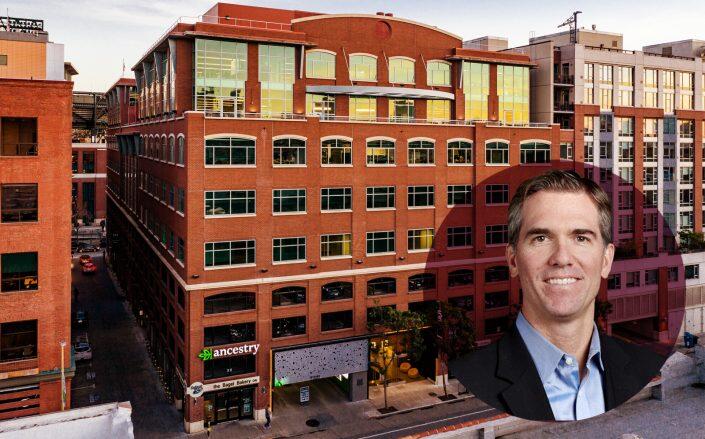
Jason Morehouse, partner at Ellis Partners, and 153 Townsend St. (LinkedIn via Morehouse, CBRE via CoStar)
Real estate investor and developer Ellis Partners has acquired a nine-story Class A office building in San Francisco, reinforcing the city’s attractiveness as a core market for office investors even as demand for that space remains below normal.
San Francisco-based Ellis is the new owner of a 179,000-square-foot building at 153 Townsend St., according to a statement Wednesday from CBRE, which represented the company in the deal and arranged a loan to finance it. The sale was conducted off-market, Kyle Kovac, an executive vice president at CBRE, said on Wednesday.
CBRE’s San Francisco Investment Sales team of Mike Taquino, Kovac and Giancarlo Sangiacomo represented Ellis in the sale, while the commercial brokerage firm’s local debt and structured finance team, led by Mike Walker and Brad Zampa, arranged the fixed-rate loan, the release said. Kovac and the other brokers declined to disclose the price or any other details beyond the release, including the loan’s interest rate. The seller was American Realty Advisors, which bought the property in 2012 for about $93.8 million, according to data from Reonomy, a commercial real estate analytics firm, and First Republic Title records.
American Realty declined to comment, and Ellis didn’t respond to requests for comment.
The building is in the city’s South of Market neighborhood, home to established tech companies and startups such as Salesforce, Slack and Okta. Built in 2002, it’s across the street from Oracle Park, where the San Francisco Giants play, and within two blocks of a Caltrain terminal and a subway stop, according to CBRE’s release.
The property is fully leased and mostly occupied by Ancestry.com, which is reportedly renting 128,570 square feet across four floors through February 2030. The company put its entire block of space on the market for sublease earlier this year, as it planned to transition to a hybrid work model, although a spokesperson said in June that it intends to maintain an office presence in San Francisco, the San Francisco Business Times reported at the time.
Ellis’ acquisition marks its first through EPNY Ventures I LLC, an investment vehicle and a joint venture between Ellis and the New York State Common Retirement Fund, which provided it with a $200 million equity commitment. The vehicle, which closed in September 2019, focuses on acquiring and managing core office, industrial and retail properties in the San Francisco Bay Area.
“We are thrilled to be adding 153 Townsend to our core portfolio and look forward to identifying complementary investments to fill out the balance of our venture,” Jason Morehouse, partner and director of acquisitions at Ellis, said in CBRE’s release.
This was not an easy thing to explain. I was standing in the middle of the intersection of Mound and Calhoun streets because I had just experienced a sudden realization that I couldn’t believe: This otherwise unremarkable view of petite 1920s bungalows that I walked past every day was reproduced in exacting detail in a painting by the master photorealist painter Robert Bechtle, down to the sewer-repair scars in the asphalt.
Six Houses on Mound Street 2021 and Bechtle’s “Six Houses on Mound Street, 2006.” The artist frequently painted this block on Mound Street at different times from different angles featuring different cars. The house he grew up in is in the middle of the block.
(Left) Andy Murdock; (Right) Courtesy of the Robert Bechtle and Whitney Chadwick Trust and Gladstone Gallery, New York and Brussels
I showed her an image of the painting on my phone and how it matched the houses across the street. She shrugged in exactly the way a 7-year-old should and ran off to Krusi Park in search of something more interesting. I, on the other hand, was awestruck. Few places in Alameda, an island city of roughly 78,000 people across the Bay from San Francisco, end up in travel guidebooks — or even on the radar of Bay Area locals. And this quiet four-way stop is definitely not one of those places. How did it end up in a Bechtle painting?
Alameda is nearly flat, ideal for long walks. At times on strolls around the island I would see an old American-made car parked in front of a little bungalow and think, “Wow, that looks almost like a Robert Bechtle painting.” I never connected the dots.
Now all I wanted to do was connect the dots, each and every one of them. If there was one Bechtle painting in Alameda, there were probably more.
—
If you’ve spent time in San Francisco’s Museum of Modern Art, you’ve likely seen one of Bechtle’s most famous works: a painting of a green and gold early ’70s Ford Gran Torino station wagon, complete with faux wood-grain siding. It’s so perfectly rendered that you have to walk up close and stare for a while to see that it’s an oil painting not a photograph. What I had failed to notice was its title, “Alameda Gran Torino.”
Alameda Ford Fusion Hybrid 2021. A Ford is parked in front of the same house, but it’s a Fusion Hybrid not a Gran Torino as in Bechtle’s 1974 painting.
(Left) Andy Murdock; (Right) Courtesy of SFMOMA
It’s a quintessential Bechtle painting: precisely realistic to such a degree that it forces you to boggle at his technical mastery while focusing on a subject so everyday, so blah, that it also makes you wonder why it warranted a painting in the first place. Gran Torino station wagons weren’t built to be beautiful. They were bulky, comfy and practical — unless you needed to fit in a compact parking space. It was your friend’s parents’ car with a broken 8-track player and Cheez-It crumbs in the springy back seat.
In Bechtle’s hands, though, this close-up of a bulbous American car in an unremarkable driveway makes people stop in their tracks. Mel Waldorf, a software engineer and lead guitarist for the Jewish surf-rock band Meshugga Beach Party, and Jessica Lindsey, a Bay Area antiques dealer, were on their second date together when this happened to them.
“At the time, I was new to the Bay Area and had no idea where Alameda was, but I’m a big fan of old station wagons. I’ve owned several over the years. So I knew what a Gran Torino was. Jessica on the other hand, knew Alameda, but didn’t know about Gran Torinos,” Waldorf told me.
“House on Washington Street Alameda, 2015,” but again Bechtle got the street name wrong. The bungalow on the corner of Fillmore and Mound has been going through an emo phase in recent years, but is otherwise the same house Bechtle painted in 2015 (not on Washington Street as his title implies).
(Left) Andy Murdock; (Right) Courtesy of the Robert Bechtle and Whitney Chadwick Trust and Gladstone Gallery, New York and Brussels
The date, it’s safe to say, went well. Of all the art they saw that night, “Alameda Gran Torino” was their favorite. Years later, the couple were house hunting around the Bay Area when they stumbled upon a cute duet townhouse on the east end of Alameda, which they wound up buying.
“When we moved in, the previous owner had left a postcard of the painting from the SFMOMA,” said Waldorf. They remembered it well, but there was a detail in the painting that suddenly had new meaning to them: Bechtle had included the house number in the painting. It was the same as their new home.
They ran outside and held the postcard in front of the house. The trim matched. It was the same tree, the same garage door, the same pattern in the concrete of the driveway.
“No question, it was the same house! We were living in the Bechtle painting!” Waldorf said.
—
Like me, they hadn’t really considered the precise locations of Bechtle’s paintings. The world he paints doesn’t feel like a specific place; it’s a land of shadeless streets, cookie-cutter developments and backyard barbecues on summer-crisped lawns. They’re vaguely familiar, like the photos from a family vacation that never quite made it into an album. As a Californian, from a place where newness is the norm, the scenes immediately look recognizable. But they could be California anywhere — and in my mind they were always somewhere else, somewhere distant, somewhere more suburban and, well, soulless.
That was precisely what Bechtle was going for. There was a simple explanation for why he chose to paint a seemingly random corner in Alameda: One of the houses in the painting is the house he grew up in, a small 1928 Mediterranean-style bungalow with terracotta roof tiles and a red-painted front walk and driveway that was the fashion of the day (and still persists in Alameda). He was not a fan. Growing up in the ’30s and ’40s, the development was still new, the trees planted in Alameda’s thin, sandy soil were young and scrawny. Everything was just too dull and uniform.
“When I was in high school, I used to hate the look of the house and those little bungalows. I couldn’t stand it. It all seemed so chockablock next to each other, and repetitious, and kind of smug,” Bechtle said in a 2012 interview with the Walker Art Center in Minneapolis.
“Clay Street, Alameda, 2013″ is a Bechtle watercolor. But Bechtle got the street name wrong. This row of Mediterranean bungalows is actually along Court Street in Alameda’s East End. Bechtle called this Clay Street, which is just a few blocks away.
(Left) Andy Murdock; (Right) Courtesy of the Robert Bechtle and Whitney Chadwick Trust and Gladstone Gallery, New York and Brussels
Neighborhoods aren’t born with character, it emerges over the passage of time, as does our appreciation of them. The two-bedroom, one-bath bungalows of the East End were built as affordable working-class homes. Just 10 years ago, a realtor described them to me as “starter homes” even though I couldn’t start to afford one. In today’s market, a small East End bungalow commonly sells for more than $1 million, sight unseen. Alameda takes pride in its ornate Victorians, but the humble Mediterranean bungalows have quietly become classics of California architecture to the point that their Spanish-inspired aesthetic is often copied in today’s developments that also feel too dull and uniform.
Bechtle was as surprised as anyone when he came back to Alameda after finishing his Army service based in Germany and suddenly found a new appreciation for the place from an artistic standpoint. As a young aspiring artist, he was trying to differentiate himself from a Bay Area art scene then dominated by figurative artists like Richard Diebenkorn and Wayne Thiebaud. Studying at the California College of Arts and Crafts in Oakland, Bechtle purposely avoided taking classes from Diebenkorn to avoid being overly influenced by him. At the time, embracing photorealism was a way to rebel against the mainstream, and Alameda’s everywhere-ness looked like open territory for creative exploration.
“It was a great revelation to all of sudden 10 years later decide that maybe there’s a reason to paint this stuff,” Bechtle said. “One of the reasons being that nobody else was doing it, which was important in that I wasn’t looking over my shoulder to see how or remember how some of the artists had painted it. Then I realized that I really was connected to all of that stuff. As much as I may hate it, on a certain level, I had great affection for it in other ways.”
—
The more I looked through his paintings online, the more they looked like places I had been. Some, like Alameda Gran Torino, had addresses on the houses, which made them easier to track down. A few had titles that told me where to look like “Houses on Clay Street” or “Foster’s Freeze Alameda” (now Neptune’s). In others, the clues were more subtle: specific architectural features, distinctive trees.
I found myself inside some later Bechtle paintings on Sterling Avenue, a one-block street of nearly identical, impeccably preserved California craftsman bungalows and globe streetlights, a street that walks the line between charmingly historic and almost eerie in its Pleasantville uniformity. I walked into other Bechtle paintings on Burbank Street, the palm-lined street near the beach with trees so tall that they’re visible from all over the East Bay.
Covered Car – Alameda 2021 and Robert Bechtle’s “Covered Car – Alameda, 2009.” The covered car has gone away, but the house on Encinal Avenue is unmistakable.
(Left) Andy Murdock; (Right) Courtesy of the Robert Bechtle and Whitney Chadwick Trust and Gladstone Gallery, New York and Brussels
Over time, I tracked down the locations of more than 40 Bechtle paintings (you can explore them all on a map here). Correction: they weren’t all paintings. Some were the photorealistic oil paintings he’s best known for, others were gauzy watercolors, moody charcoal drawings, hard-ground etchings and ink sketches. The Bay Area figurative style he so carefully avoided early on sneaks into his work when he departs from realism.
I admit, the appeal of my Alameda Bechtle hunt isn’t immediately obvious. What did I expect to learn from standing in these spots? After all, a photorealistic painting is by definition an exact replica of a place. As it happens, one thing you learn is that there is more art in photorealism than initially meets the eye: choices about what gets left in and what gets left out, colors, textures, mood. In a painting of his brother and his 1960 T-Bird, Bechtle swapped a house on Calhoun Street in the background for an apartment building with a rock garden. Both look real, but at least one is a lie.
It probably passes unnoticed that the houses Bechtle painted over the years — often backdrops to cars — looked quite similar for one simple reason: They’re often the same house. He painted the little Mediterranean bungalow on Mound Street that he grew up in and where his mom lived for decades after multiple times, straight on and from various angles. He painted views looking down the street from the front of the house, or the spot around the corner where his brother parked his T-Bird. As much as Bechtle tried to escape Alameda, he found himself forever pulled back into a narrow orbit around his family home.
“Alameda’s a funny place, if you’ve ever been there, since it’s an island, literally an island,” Bechtle said in an oral history interview with the Smithsonian. “It’s connected by bridges and a tunnel, but it really has an insular personality even though it takes just five minutes to walk across a bridge to Oakland. There’s something about the islandness which to this day is part of its character.”
Sidewalk view near where Bechtle painted “Burbank Street Alameda” in 2015, a street whose tall palms can be seen for miles around.
(Left) Andy Murdock; (Right) Courtesy of the Robert Bechtle and Whitney Chadwick Trust and Gladstone Gallery, New York and Brussels
He said this in the late 1970s, but it still holds true today. This islandness also lends to a general feeling of a place trapped in time. Alameda is known for its well-preserved Victorian houses, but it’s equally good at preserving long-standing exclusionary housing policies and has a history of police violence. This tension courses through Bechtle’s art, and the fact that I could track down the precise locations of more than 40 of his paintings shows just how slowly things change in Alameda. An old truck from one Bechtle painting on Central Avenue still sits in the same driveway. Not everything remains precisely the same: Bechtle’s studio in the early 1960s, a waterfront cottage on Central Avenue in the West End, was torn down in a wave of development in the late 1960s, and his water view captured in “Nancy Sitting” (1964) was filled in to build condos.
There are some Bechtle paintings where the location still remains a mystery to me. He didn’t always note where they were from, at least in the titles, and even when he did he was often off by a block or two. I thought I might at some point see whether I could speak with him to ask him to tell me more about the places he painted, but I missed my chance: Just as I started to get really interested, Bechtle passed away at the age of 88.
To be honest, asking him about the precise locations of his paintings would have been like asking him about the cars he so frequently painted: missing the point entirely. He painted cars, but he really wasn’t much of a car guy. He thought people often got too hung up on the objects in his paintings — to him they were merely a way in, the language he used to talk about the world he lived in. So many of his paintings look like Alameda, but they could be from other places he lived and painted — Berkeley, Oakland, Albany, San Francisco — or moments captured from road trips to Santa Barbara or Palm Springs. That was the point: Each one depicted somewhere very specific, but they could be just about anywhere.
SAN FRANCISCO (BCN) — Technology companies and workers aren’t leaving the Bay Area, but they are moving within it, according to data presented Wednesday in a San Francisco Board of Supervisors committee hearing.
In a meeting of the Budget Finance committee, the city’s chief economist Ted Egan explained that most job fluctuation within the city is businesses starting, growing or shutting down — less than 20 businesses moved in or out of the city, he said.
However, job listings show that tech companies are increasingly relying on remote workers. Job listings show that hiring is rebounding toward pre-pandemic levels, but about 17 percent of tech jobs listed in the San Francisco location are now remote, compared to 2 to 3 percent prior to the pandemic, Egan said.
There’s also more unused office space available to be subleased now than at any other point in the last 20 years. Since the start of the pandemic, space available for subleasing has increased in San Francisco by 183 percent, Egan said.
Housing data also supports the conclusion that workers are relocating out of San Francisco to other parts of the Bay Area, according to Egan. Housing prices on the online real estate tool Zillow show that prices for single-family homes in San Francisco have dropped despite housing prices rising nationally. Housing price growth has also been low in other areas of highly concentrated tech jobs such as Palo Alto and San Jose, Egan added.
Meanwhile, housing price growth has been high in other Bay Area regions such as west Marin County, eastern Contra Costa County and Napa — areas that could make more sense to live in if you don’t have to commute into the city as often or at all.
“This isn’t people fleeing the Bay Area, running away to Miami or Texas,” Egan said. “But it does point to a reallocation of people and tech talent within the Bay Area and perhaps broadly within Northern California.”
As a result of remote working and reallocation, payroll paid within the city has drastically dropped. San Francisco bases how much of a business’s gross receipts are taxable to the city based in part the proportion of their payroll paid within the city, Egan said, and the city could lose tax revenue based on decreasing payroll. Any estimates are currently “highly uncertain,” he said, but could have a major impact on the city’s economy.
With demand for tech workers still high and survey data showing that many workers prefer flexible work from home policies, Egan said this trend could continue at least in the medium term. Its impact could affect not only city tax revenue and housing demand, but also restaurants, retailers and hotels, which previously relied on office workers as a large part of their clientele.
Kate Sofis, director of the city’s Office of Economic and Workforce Development, added that the city has several initiatives in place and in the works to strengthen ties with tech companies. Those initiatives include training programs for city residents such as TechSF and efforts to remove barriers for new startups without resorting to tax incentives.
Supervisor Matt Haney also pointed out the importance of strengthening local education systems such as San Francisco Unified School District and San Francisco State University to continue to provide skilled workers for companies to continue to draw from.
“That’s a win-win for the companies and it’s a win-win for our residents, particularly those who are often shut out of these industries,” Haney said.
FREMONT — A hotel in Fremont has been bought by a big investor that also has grabbed a hotel in San Francisco, fresh evidence that Bay Area lodgings still command buying interest despite coronavirus-spawned uncertainties.
Hilton Garden Inn Fremont Milpitas has been bought for $38.9 million by an affiliate of AWH Partners, according to documents filed on Sept. 10 with the Alameda County Recorder’s Office.
Separately, on Sept. 9, an alliance of AWH Partners and The Roxborough Group paid $87.5 million for Villa Florence Hotel, a 189-room lodging in San Francisco.
In the Fremont hotel deal, the seller was a venture headed by Vinobhai Patel and Neil Patel, a group that had developed the hotel. The hotel’s construction was completed earlier this year.
The purchase of Hilton Garden Inn Fremont Milpitas suggests that property buyers envision an upside in key hotel sites once the economic woes linked to the deadly bug have begun to recede.
“Buyers that are purchasing these assets today are really looking at the long-term picture,” said Alan Reay, president of Atlas Hospitality Group, which tracks the California Lodging Market. “The buyer understands that with a brand-new hotel like this, they don’t have to put a lot of money back into the property.”
New York City-based AWH Partners, acting through its affiliate FO Fremont Property, bought the hotel in an all-cash deal, the county records show.
The hotel totals 145 rooms, according to a representative of the lodging, which is located at 45976 Warm Springs Blvd. in Fremont.
“Amenities include a fitness center, business center, and an indoor pool,” AWH stated in a post on its website that described the Hilton Garden Inn Fremont. “An on-site restaurant and bar and a 24-hour grab-n-go market” are also part of the amenities, the company said on its site.
The buyers were likely enticed by the Hilton Garden Inn Fremont’s category and typical market, in Reay’s view.
“The product type of this hotel is the kind of product that is coming back faster after COVID than the major full-service hotels,” Reay said. “This hotel typically has a much better profit margin than the really big hotels. It’s a very good model and is very successful.”
Plus, the hotel’s location in one of Silicon Valley’s cities was also likely a big draw for the buyer. The hotel is located in the “Fremont Innovation District,” according to a post on the AWH Partners website.
“Silicon Valley is probably in the top three or five of the commercial business travel centers,” Reay said. “It’s supply and demand. There’s a lot of buyer interest out there right now in hotels.”
To get a sense of Bay Area buyers’ voracious appetites, look up to the “treehouse in the sky.”
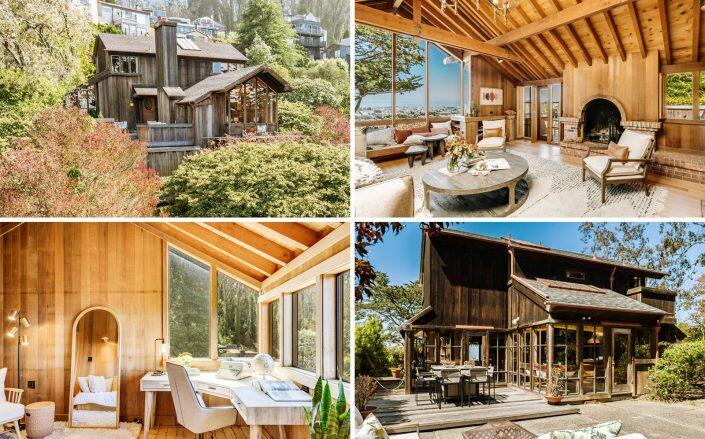
That’s what Compass’ Michael Bellings dubbed the three-bedroom, 1,920-square-foot Cole Valley home loaded with exposed wood beams that he listed for just under $3.5 million.
Less than two weeks later, he had gotten 15 offers, half of them all-cash, and a handful for about $1 million over asking price. In the end, the frenzy pushed up the closing sale price to $5.6 million for the Belgrave Avenue property with sweeping views of the city skyline — 60 percent above the original listing.
“We couldn’t have guessed it would go that high in our wildest dreams,” said Bellings, who co-listed the property with his brother, Aaron; the two lead Bellings Brothers Real Estate Team.
But perhaps the strong demand shouldn’t have come as a surprise given the current market.
The San Francisco metro area led the nation in the number of homes that sold for 30 percent or more above asking price, with 7.4 percent, according to a Zillow second-quarter report. That’s nearly double the first quarter’s 3.8 percent, and more than five times the national average of 1.4 percent.
Overall home prices are rising as well. A recent report found that buyers in San Francisco need an annual income of $350,000 to afford a single-family property.
In the Bay Area and across markets, “relentless demand for houses and supply that failed to keep up drove competition for many houses into new territory, especially in hot markets,” according to Zillow.
For the nearly 50-year-old Cole Valley home, the sale also set a record for the neighborhood at $2,395 a foot. The view and the location itself helped, Bellings said, along with elements like a brick fireplace, original handcrafted tiles in the kitchen, varying wood finishes and sunken living room; the home was designed for a doctor and his wife, who were its only owners.
The winning offer was all-cash and the deal closed within 7 days. Bellings wouldn’t disclose the buyers, but said they already live in the neighborhood and bought the home for “extended family.”
The listing also included plans for a 10,000-square-foot mansion, signalling a potential teardown for a spec developer. Bellings said he felt compelled to have those plans drawn up for that “modern monstrosity” given the $15 million to $20 million new builds rising in the area, but said the owners would leave the existing home intact.
And a few developers did put in bids, but “owner-users were emotionally driven to offer more,” he said.
Bellings said he also considered some minor improvements before listing the property, but opted against it.
“If I had done your typical whitewall, Noe Valley renovation it wouldn’t have sold at this level,” he said. “It goes to show that charm is still in.”